Four-Year Online PharmD Cost Calculator Guide

Co-Founder and Chief Data Scientist
An online Doctor of Pharmacy (Pharm.D.) program can look affordable until campus visits, clinical rotations, and time away from work enter the budget. If you are comparing four-year programs, advertised tuition is only a starting point.
This guide gives you a cost-calculator worksheet, explains which expenses and financing assumptions to include, and shows how to check whether a program can support your intended path to pharmacist licensure. Use it to compare schools on the same basis before paying an enrollment deposit.
Key Things You Should Know
- A useful four-year estimate adds tuition, required fees, in-person training costs, and financing costs by academic year; it does not treat a school's tuition figure as the total price.
- Online instruction does not eliminate in-person labs or introductory and advanced pharmacy practice experiences. Placement travel and reduced work hours can materially change the comparison.
- Check borrowing eligibility under rules effective July 1, 2026, and verify the program's Accreditation Council for Pharmacy Education (ACPE) status and your state's licensure requirements before relying on a calculator result.
What is the cost of a four-year online PharmD program?
There is no dependable single price for a four-year online Pharm.D. Tuition may be charged by credit, term, or academic year, while required fees and in-person costs differ by school and student location. Your decision-useful figure is the estimated total cost to complete the professional program, calculated from each school's current charges and your likely schedule - not its advertised tuition alone.
Compare prices for the same academic year, residency classification, credit load, and four-year period. Ask whether published tuition includes summer terms and whether rates can rise before graduation. An online Pharm.D. cost comparison can help identify schools to investigate, but use each school's current tuition schedule for the final calculation.
How does an online PharmD cost calculator estimate total program expenses?
A practical calculator is an academic-year ledger, not a single tuition multiplier. Enter school charges and personal costs separately for each of the four years, then repeat the worksheet for every school. The fields below keep unlike expenses from disappearing into a single estimate.
| Cost field | Year 1 | Year 2 | Year 3 | Year 4 |
| Tuition, including required summer terms | _____ | _____ | _____ | _____ |
| Mandatory school and technology fees | _____ | _____ | _____ | _____ |
| Books, resources, equipment, and supplies | _____ | _____ | _____ | _____ |
| Campus visits and required travel | _____ | _____ | _____ | _____ |
| Clinical-placement travel or temporary housing | _____ | _____ | _____ | _____ |
| Screening, health, registration, and exam expenses | _____ | _____ | _____ | _____ |
| Grants and scholarships, entered separately | _____ | _____ | _____ | _____ |
Add each year's expenses, then subtract only grants and scholarships you are eligible to receive. Total the four annual results. Track loans separately: borrowing pays a bill but does not reduce the cost, and interest and loan fees can increase what you ultimately repay. Keep ordinary living expenses and any forgone earnings in separate planning lines so you can assess affordability without mistaking them for school charges.
A generic online doctoral program duration comparison is not a substitute for the Pharm.D. course sequence: the timing of rotations and required terms determines when costs occur.
Are online PharmD programs accredited and accepted for pharmacist licensure?
An online delivery format does not determine accreditation or licensure eligibility. ACPE accredits professional pharmacy education programs; institutional accreditation concerns the institution, while distance-education state authorization concerns whether a school may enroll a student in a particular state. These are separate checks. Confirm the specific Pharm.D. program's current ACPE status in ACPE's official records, rather than relying on a general institutional claim.
A Pharm.D. graduate must still satisfy the licensing board in the state where they intend to practice, including applicable supervised experience and examinations. The North American Pharmacist Licensure Examination (NAPLEX) assesses pharmacy practice knowledge; a jurisdiction may also require its applicable law examination, whether the MPJE, UMPJE, or another process. Graduation or an exam pass alone does not issue a license. Before paying a deposit, ask the school and state board about licensure eligibility, distance enrollment, and approval of proposed clinical sites. Use a list of best online Doctor of Pharmacy programs to generate candidates, not to replace those checks.
The largest omission is often a cost that occurs away from the online classroom. Request an itemized school budget and mark which charges are mandatory, which vary by location, and which arise only after graduation. Include these categories before comparing totals:
- Before entry: any remaining prerequisite courses and labs, applications, transcripts, and required admission travel.
- During coursework: tuition, mandatory fees, books or clinical-reference subscriptions, computer and internet requirements, lab supplies, and required campus immersions.
- During experiential training: background checks, immunizations, intern registration where required, transportation, parking, and possible temporary housing near rotation sites.
- At graduation and licensure: applicable examination, application, and initial license fees; these may fall outside a school's published attendance budget.
Ask whether previous courses satisfy prerequisites before adding their cost or assuming they will transfer. The receiving school decides how credit applies; pharmacy transfer credit requirements are a useful prompt for that conversation, not evidence that professional Pharm.D. courses will transfer.
Prerequisites are undergraduate pre-professional courses completed before entry; they are not the four-year professional Pharm.D. curriculum. Schools commonly evaluate science and general education coursework, but exact subjects, labs, grades, course-age rules, and any bachelor's-degree requirement vary. Do not add an entire bachelor's degree to your estimate unless your target program actually requires one.
Have each school review your transcripts and identify remaining courses, accepted substitutions, and whether unfinished prerequisites may be completed before matriculation. Then add only the confirmed gaps to your calculator. Check the current school admissions page and, where that school uses it, its PharmCAS directory entry for application instructions. The PCAT was retired in January 2024 and should not be budgeted as a routine current entrance exam. A pharmacy school application readiness guide can help organize questions, but a school must confirm your eligibility.
Both pathways must prepare students for pharmacist practice through professional coursework and supervised experiences. Online or hybrid programs may deliver lectures and discussions remotely, but skills assessment, labs, and clinical work can require attendance in person. "Online" does not establish that classes are asynchronous, that campus trips are optional, or that students can maintain full-time work throughout the program.
For the cost comparison, obtain each program's term-by-term calendar: live class times, required campus dates, laboratory locations, assessment schedules, and clinical blocks. A science background may satisfy some entry prerequisites without shortening the professional curriculum; online Pharm.D. options for science graduates can help frame that distinction.
For a four-year pathway, budget for four academic years after any outstanding prerequisites. Confirm whether the calendar includes summers and when advanced rotations begin. An online format does not necessarily permit a lighter pace or a faster finish: sequenced courses, required attendance, and placement availability can limit scheduling flexibility.
If speed would reduce your living costs or time away from work, compare the published calendars and eligibility requirements of shortened Doctor of Pharmacy pathways. Do not assume a shorter advertised timeline will save money until you compare total tuition, required travel, and the workload you can realistically manage.
Pharm.D. students complete supervised introductory pharmacy practice experiences (IPPEs) and more advanced pharmacy practice experiences (APPEs). These occur in practice settings rather than simply through online lessons. Schools set and approve placements under their program policies; location, scheduling, preceptor availability, and state intern-registration rules can affect where a student may train.
Before entering a travel estimate, ask the school who secures sites, whether nearby placements are available but not guaranteed, when full-time rotation blocks occur, and what happens if a placement changes. Budget for site-specific screening, health requirements, commuting, and possible housing. Do not assume your current job can substitute for a rotation. Articles on how to finish an online pharmacy degree sooner may discuss other pharmacy credentials; they do not eliminate professional Pharm.D. clinical requirements.
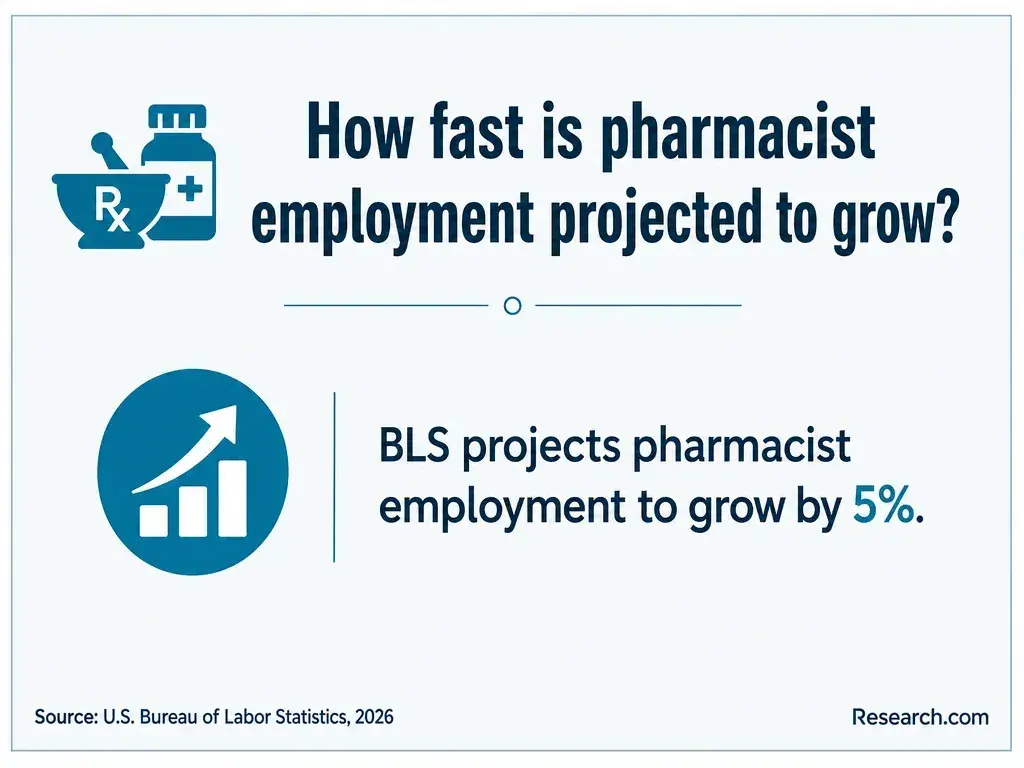
Once licensed, graduates may pursue pharmacist roles in community, hospital, ambulatory, and other practice settings, subject to employer and state requirements. The Bureau of Labor Statistics reports median annual pay of $140,910 in May 2025 for pharmacists and projects 5% growth, 2025-2035, with about 12,500 openings per year. That occupational median is useful context for a borrowing decision, not a forecast of your first salary, location, or ability to secure a particular role.
A residency offers structured postgraduate practice training, while a fellowship typically emphasizes a different specialized training path; neither is automatically required for every pharmacist job. Board certification is also distinct from state licensure. If your goal is a pharmacy-adjacent role rather than licensed pharmacist practice, compare the affordable route through pharmacy education with the full Pharm.D. investment - but do not treat a technician or pharmaceutical-sciences credential as a substitute for pharmacist licensure.
How can students compare online PharmD programs and choose a reputable school?
Choose among schools using a verified total-cost estimate and evidence that you can complete the program where you live. A lower tuition figure loses its advantage if it requires unaffordable travel, leaves clinical placement uncertain, or cannot support your intended licensure path. Before committing, complete these checks for each finalist:
- Confirm current ACPE professional-program status, institutional accreditation, state enrollment authorization, and your intended licensing board's requirements.
- Request the current tuition and fee schedule, full academic calendar, required campus dates, and written clinical-placement policies.
- Obtain a school-specific prerequisite review and calculate each year's expenses, grants, borrowing need, and likely changes in work income.
- Review published NAPLEX outcomes with their reporting year and cohort context, then ask how the school supports students who need placement or academic assistance.
- Confirm financial aid eligibility with the aid office under rules applicable to your start date; federal borrowing rules changed for many new graduate and professional borrowers beginning July 1, 2026.
Finally, ask for written answers to unresolved admission questions. Lists of pharmacy programs with flexible entry requirements can identify possibilities, but a lower entry threshold neither guarantees admission nor resolves questions about cost, completion, or licensure.
Other Things You Should Know About PharmD
Show interest and loan fees in a separate financing estimate. They affect repayment but vary with how much you borrow, when funds are disbursed, and the loan terms that apply.
No. It is a useful aid-budget starting point, but its living and travel allowances may differ from your actual housing, campus-trip, and rotation costs.
Keep an unawarded scholarship out of your base estimate. You can run a second scenario showing how your cost changes if you receive it and meet its renewal conditions.
Label those years as estimates rather than presenting the total as a quoted program price. Ask whether the school guarantees a rate or publishes a policy governing future increases, and update the worksheet when new rates appear.
- An Advanced Pharmacy Practice Experience in a University's Office of Experiential Education - PMC https://pmc.ncbi.nlm.nih.gov/articles/PMC10159452/
- Cost of Attendance (Budget) | 2025-2026 Federal Student Aid Handbook https://fsapartners.ed.gov/knowledge-center/fsa-handbook/2025-2026/vol3/ch2-cost-attendance-budget
- Types of Financial Aid: Grants, Work-Study, and Loans | studentaid.gov https://studentaid.gov/understand-aid/types
- Earn an Online Pharm.D. Degree at St. John Fisher University https://onlinepharmd.sjf.edu/
- Doctor of Pharmacy | St. John's University https://www.stjohns.edu/academics/programs/doctor-pharmacy
- Distance Doctor of Pharmacy | University of Findlay https://pharmdonline.findlay.edu/programs/online-pharm-d
- Experiential Education | Washington State University https://pharmacy.wsu.edu/pharmd/experiential-services/
- Doctor of Pharmacy - On Campus & Online Hybrid | Extended & Distance Education https://www.su.edu/admissions/graduate-students/pharmacy-application-information/doctor-of-pharmacy/
- Tuition and Financial Aid - UW School of Pharmacy https://sop.washington.edu/pharmd/admissions/tuition-and-financial-aid/
- Experiential Education | University of Saint Joseph CT https://www.usj.edu/academics/sppas/pharmacy/experiential-education/