PharmD Transfer Students: Planning the Remaining Curriculum

Co-Founder and Chief Data Scientist
A Pharm.D. transfer offer matters only if it leaves you with a workable path to graduation. A school might accept credits yet require you to repeat a course sequence, delay clinical rotations, or spend another year in the program.
This guide is for students who have started a professional Doctor of Pharmacy curriculum and need to decide whether transferring will save time, money, or both. You'll learn what to request from receiving schools, how to map the remaining curriculum, and which costs and licensing considerations to check before accepting an offer.
Key Things You Should Know
- The receiving Pharm.D. program decides which professional courses count and where you enter its sequence; accepted credits do not necessarily shorten your time to graduation.
- Compare a written course-by-course evaluation and graduation plan, including introductory and advanced pharmacy practice experiences, before paying a deposit or withdrawing from your current school.
- Graduation is not pharmacist licensure. The pharmacist occupation's median annual pay was $140,910 in May 2025, but that figure does not predict an individual transfer student's earnings.
How does PharmD transfer admission work, and what is advanced standing?
A professional Pharm.D. transfer means applying to continue a partly completed pharmacy curriculum at another institution. It differs from entering pharmacy school with undergraduate pre-pharmacy prerequisites. Advanced standing means the receiving school places an admitted student beyond its starting point based on work it accepts; it does not mean every completed course will count.
Schools may consider transfers only when a seat is available in the appropriate cohort. An admissions offer, a credit evaluation, and approval to enter a particular professional year can be separate decisions. Ask when each becomes final and whether the offer depends on finishing current courses in good standing. When reviewing pharmacy school credit transfer options, prioritize published policies and a written individual evaluation over a general statement that transfers are welcome.
Which PharmD credits transfer toward the remaining curriculum?
Receiving schools commonly examine professional coursework for content, credit value, laboratory or skills components, grades, and how recently it was completed. A therapeutics course with the same title may cover different disease states or be taught at a different point in the sequence. The school may accept it as elective credit without allowing it to replace a required course.
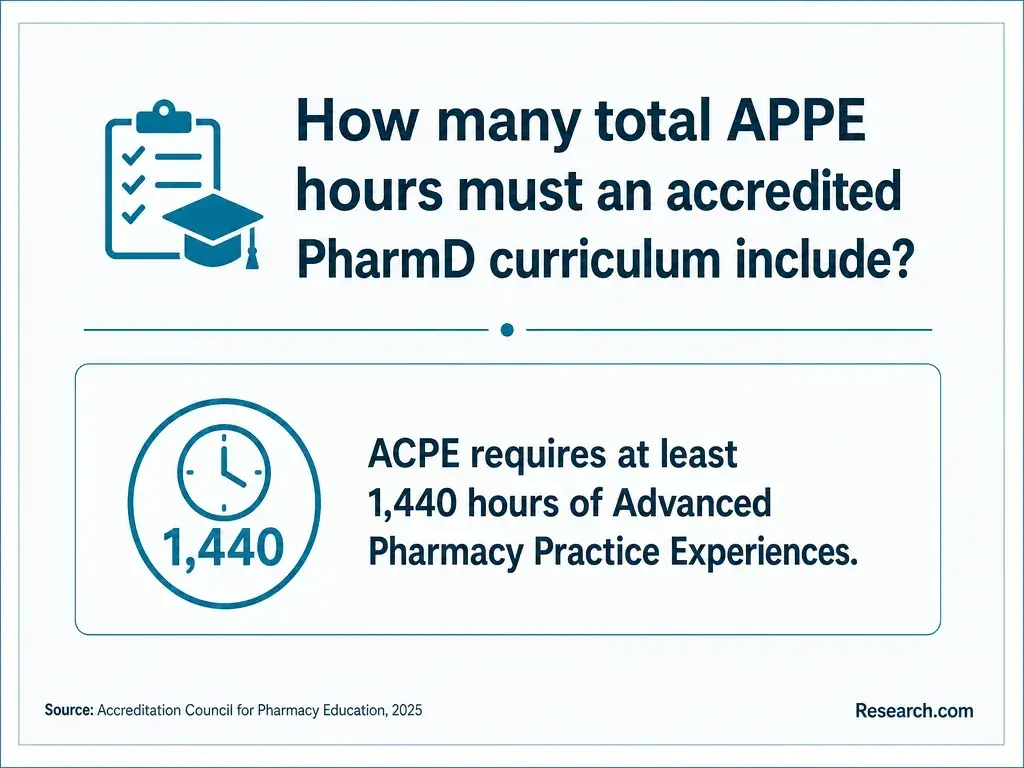
Keep three categories separate: undergraduate prerequisites used to qualify for admission; professional Pharm.D. courses that might replace degree requirements; and experiential education. Introductory pharmacy practice experiences (IPPEs) and advanced pharmacy practice experiences (APPEs) involve supervised practice and may require separate review of hours, settings, objectives, and evaluations. Prior employment should not be assumed to replace a rotation. If most of your completed work is pre-professional, guidance on pharmacy education after a pre-pharmacy track is more relevant than an advanced-standing transfer policy.
How do you compare PharmD programs for transfer acceptance and accreditation?
Start with eligibility: confirm the receiving program's current Accreditation Council for Pharmacy Education (ACPE) professional-program status and its policy on transfers from your institution. Institutional accreditation is a different designation; neither it nor a school's permission to enroll online students substitutes for ACPE professional-program accreditation. Ask how your intended licensing jurisdiction treats the program and any planned out-of-state rotations.
Then compare remaining requirements, not just credits accepted: your entry cohort, required course sequence, rotation availability, expected graduation term, total remaining cost, and whether you can meet attendance requirements. A program's published graduation or NAPLEX results may provide context, but they do not establish an individual transfer student's outcome. Likewise, pharmacy degree programs with accelerated schedules should be checked for their actual credential and entry requirements; a short advertised timeline is not a promise of Pharm.D. advanced standing.
Requirements vary by school, but a transcript alone rarely shows enough detail to establish professional-course equivalency. Request the receiving school's transfer checklist early, especially if it reviews applications only when cohort seats open. Its admissions and academic offices may require different materials.
Prepare a review packet that lets evaluators compare completed work with their curriculum:
- Official transcripts and, if requested, a record of courses currently in progress.
- Catalog descriptions and full syllabi showing topics, credits, contact hours, laboratories, and assessments.
- IPPE or APPE records, including sites, dates, hours, learning objectives, and preceptor evaluations, if you seek experiential credit.
- Any required letter of good standing, explanation of a withdrawal or interruption, and records of completed compliance training.
Ask which documents must arrive directly from your current institution and whether an initial assessment is provisional. If a missing prerequisite or incomplete record affects eligibility, check the receiving school's actual policy rather than assuming that pharmacy school requirements and exceptions apply to professional-course transfers.
Placement depends on prerequisite chains as well as credits. A student may have enough accepted coursework to enter an upper-level cohort but still need a course offered only once a year. Skills assessments, IPPE completion, or APPE readiness rules can also determine when rotations begin.
The following comparison shows why an accepted-credit total is not enough to judge a transfer offer:
| Evaluation result | Possible effect on the remaining curriculum |
| Required courses accepted in sequence | The student may join the next available cohort if other progression requirements are met. |
| Credits accepted only as electives | Required courses may still need to be repeated, extending enrollment. |
| Coursework accepted but experiential work not approved | Additional supervised experiences may shift APPE timing and graduation. |
Before accepting a place, turn the evaluation into a term-by-term plan:
- Mark each remaining required course, its prerequisite, and the term it is offered.
- Place outstanding IPPEs, APPEs, skills assessments, and compliance deadlines on the same timeline.
- Ask the program to confirm your earliest feasible graduation term in writing, including what could change it.
Compare that plan with staying at your current school. A new program's option to complete a Pharm.D. on an accelerated schedule helps only if your approved placement actually permits the faster sequence.
They can if their admissions and transfer policies permit it, but an online label does not settle placement or scheduling. Confirm whether classes meet live, when hands-on labs or campus immersions occur, how exams are administered, and whether you must join a fixed cohort. IPPEs and APPEs require supervised practice at approved sites; do not assume they can be completed remotely or at your current workplace.
Ask who finds and approves rotation sites, whether placements near your home are possible, and what travel or time away from work may be required. Verify the program's authorization to enroll a student in your state separately from ACPE accreditation and from any state rules governing clinical placement or intern registration. Compare these details when considering online pharmacy school programs; delivery format alone does not indicate that a transfer will be practical.
There is no dependable transfer-wide completion time or price. The decision-relevant figures are the receiving school's confirmed graduation term and its estimate for your remaining enrollment. A repeated course, a missed annual sequence, or a later APPE start can outweigh an attractive per-credit tuition rate.
Request a term-by-term cost estimate covering tuition and mandatory fees, plus likely expenses for materials, immunizations and background checks, equipment, campus visits, rotation travel or housing, and licensing applications and exams. Compare that amount with the cost of finishing where you are, including earnings you might forgo if transferring delays graduation. Lists of cost-conscious online Pharm.D. choices are a starting point, not a substitute for an individual transfer budget.
Financial aid can also change after a transfer. Have each school's aid office explain your student classification, remaining eligibility, and aid package under the rules for your enrollment period. Federal borrowing rules changed for many new graduate and professional borrowers beginning July 1, 2026; do not build a plan around an assumed Grad PLUS loan or an old borrowing limit.
Expect both admission screening and a separate academic-placement review. A school may examine professional-school grades, good standing, reasons for transferring, interviews, recommendations, and completion of its prerequisite courses. Minimum grades or GPA thresholds, course-age rules, deadlines, and whether in-progress work is allowed are school-specific. Meeting a stated minimum does not guarantee admission or a particular entry year.
Check whether the school uses PharmCAS for transfer applications or requires a direct application, and ask about supplemental materials and deposits. The Pharmacy College Admission Test (PCAT) was retired in January 2024; it should not be treated as a current exam to schedule. General discussions of how competitive is pharmacy school admission cannot predict transfer admission, which may also depend on an opening in the right cohort.
A Pharm.D. is an educational credential, not a pharmacist license. After graduation, an applicant must meet the requirements of the state or other jurisdiction where they seek licensure. These generally include the North American Pharmacist Licensure Examination (NAPLEX), along with that jurisdiction's application, experience, background, and any applicable law-exam requirements. Jurisprudence testing varies; do not assume every jurisdiction uses the MPJE, particularly as some began transitioning to the UMPJE in 2026.
Check the relevant board of pharmacy and the National Association of Boards of Pharmacy for the rules and procedures that apply when you graduate. If your transfer involves rotations across state lines, ask about intern registration before placements begin. A different, shorter doctorate - including fast online doctoral study - does not replace the qualifying pharmacy education and jurisdictional steps required for the usual U.S.-educated pharmacist pathway.
What careers, salaries, and job outlook follow PharmD completion?
Licensed pharmacists work in settings including community pharmacies, hospitals, ambulatory care, and specialty pharmacy. The Bureau of Labor Statistics projects 5% pharmacist employment growth from 2025 to 2035, with about 12,500 openings per year. That occupation-wide outlook does not predict openings in a particular location or specialty, so consider whether a transfer's added time or debt supports the work you want to pursue.
Some graduates seek postgraduate year one (PGY1) residency training and, for further specialization, postgraduate year two (PGY2) training; fellowships serve different, often industry-focused goals. Employers' preferences vary, and neither postgraduate training nor optional specialty board certification replaces state licensure. If your goal is a pharmacy technician or another nonlicensed pharmacy-adjacent role, an affordable route through pharmacy education may warrant comparison before you pay to finish a Pharm.D.
Other Things You Should Know About PharmD
Find out when the receiving school needs a good-standing letter or other records, then plan the conversation accordingly. Keep attending courses and meeting progression requirements while an application is pending; an inquiry is not a transfer approval.
Policies differ, and some schools require applicants to be in good standing. Disclose the dismissal accurately and ask whether you are eligible to apply before spending money on transcripts or application fees.
The receiving school controls how transfer grades appear in its records and how it calculates academic standing or honors. Ask its registrar for the written policy if those outcomes matter to you.
Possibly. Ask your current school about leave eligibility, return deadlines, and the effect on course sequencing and financial aid. A leave may preserve an option to return while you seek a firm transfer evaluation, but its terms are institution-specific.
- Pharmacist Licensure Snapshot | Department of State https://www.pa.gov/agencies/dos/department-and-offices/bpoa/boards-commissions/pharmacy/pharmacist-licensure-snapshot
- NYS Pharmacy: License Requirements - Office of the Professions https://www.op.nysed.gov/professions/pharmacist/license-requirements
- Transfer or Advanced Standing Policy | usc.edu https://mann.usc.edu/program/doctor-of-pharmacy-pharmd/admissions/transfer-or-advanced-standing-policy/
- Transfer Pharm.D. Applicants - Pharmacy Advising Center https://advising.pharmacy.uconn.edu/faq/transfer-pharmd-applicants/
- Frequently Asked Questions (FAQ) - College of Pharmacy https://www.pharmacy.umn.edu/doctor-pharmacy/admissions/frequently-asked-questions-faq
- FAQ | OSU College of Pharmacy - Oregon State University https://pharmacy.oregonstate.edu/programs-admissions/pharm-d/faq
- Prospective Students | Ernest Mario School of Pharmacy https://pharmacy.rutgers.edu/info-for/prospective-students/
- FAQs | Long Island University https://liu.edu/pharmacy/Admissions/PharmD/FAQs