St. John Fisher Online PharmD Versus Campus PharmD

Co-Founder and Chief Data Scientist
Choosing between St. John Fisher University's online and campus Doctor of Pharmacy (Pharm.D.) pathways is not simply a choice between studying at home and studying in Rochester. Both require substantial time for hands-on learning and supervised patient care, but they place different demands on your schedule, travel, and support system.
This guide compares the requirements that matter most to prospective students - including clinical placements, admissions, cost, and the route to pharmacist licensure - so you can identify which pathway is workable before committing.
Key Things You Should Know
- St. John Fisher's online Pharm.D. combines distance coursework with required in-person training; it is not a fully remote or self-paced route.
- Both pathways lead to a professional Pharm.D., but neither degree alone grants a pharmacist license. Confirm the applicable ACPE accreditation record and your intended state's licensing rules.
- Compare the full cost of attendance - not tuition alone - and get written answers about required Rochester visits, rotation locations, and time away from work before choosing.
What is the difference between St. John Fisher's online and campus PharmD programs?
The central difference is where and how students complete the academic portion of the Wegmans School of Pharmacy's professional Pharm.D. Online students complete substantial coursework at a distance but must also attend required in-person activities and clinical experiences. Campus students take their scheduled coursework primarily in Rochester and also complete clinical experiences. Neither option eliminates the need to be available for supervised practice.
This comparison separates the day-to-day differences from requirements both groups must plan around. Exact meeting times, campus visits, and placement arrangements should be confirmed for your entering cohort.
| Decision factor | Online pathway | Campus pathway |
| Academic setting | Distance coursework with scheduled participation and required in-person components | Primarily in-person instruction on the Rochester campus |
| Hands-on learning | Requires travel for specified in-person activities and supervised practice | Campus-based activities plus supervised practice at assigned or approved sites |
| Location planning | Requires checking eligibility to enroll from your state and the feasibility of clinical placements | Requires planning for regular campus attendance and potentially distant rotations |
| Likely advantage | Less routine travel to Rochester for a student who lives elsewhere | More routine face-to-face access to campus instruction and peers |
| Key constraint | Online classes do not make labs or rotations remote | Campus attendance limits where a student can live during coursework |
A student comparing online pharmacy education options should judge flexibility by the required live sessions, campus visits, and rotation calendar - not by the word "online" alone.
Is St. John Fisher's online PharmD program ACPE accredited?
St. John Fisher's Wegmans School of Pharmacy offers an Accreditation Council for Pharmacy Education (ACPE)-accredited professional Pharm.D. program. ACPE accredits the professional pharmacy program; it does not certify individual pharmacists. Before enrolling, check ACPE's current program record and ask the school to confirm explicitly that your proposed online pathway is included under that accreditation.
Accreditation answers a different question from state authorization. Authorization concerns whether the university may enroll you in distance education from your location; it does not necessarily establish that a clinical placement is available there or that you will meet that state's pharmacist licensing rules. Students pursuing pharmacy education after a pre-pharmacy track should check accreditation for the professional Pharm.D., not mistake accreditation of earlier undergraduate coursework for it.
Does St. John Fisher's online PharmD lead to pharmacist licensure?
An ACPE-accredited Pharm.D. is an important educational step toward U.S. pharmacist licensure, whether its academic instruction is online or on campus. Graduation does not itself issue a license. Applicants must satisfy their intended jurisdiction's requirements, which generally include board eligibility review and the North American Pharmacist Licensure Examination (NAPLEX), along with any applicable law examination and other state-specific conditions.
Do not assume every state uses the Multistate Pharmacy Jurisprudence Examination (MPJE): jurisdictions set their own law-exam rules, and some have moved to the Uniform MPJE (UMPJE). Intern registration, experiential-hour recognition, background checks, and application procedures can also vary. Ask your intended board of pharmacy about eligibility before you commit to a pathway or an out-of-state rotation.
If you are considering pharmacy degree options with shorter study periods, check the credential carefully. A pharmacy technician or pharmacy-adjacent qualification does not replace the professional Pharm.D. education required for the U.S.-educated pharmacist pathway.
Both pathways pursue professional pharmacist preparation rather than merely repeating undergraduate pre-pharmacy courses. That preparation brings together pharmaceutical and biomedical science, the use and monitoring of medicines, patient communication, clinical decision-making, and supervised pharmacy practice. Coursework develops the knowledge used to assess medication-related problems; labs, skills activities, and clinical experiences provide opportunities to apply it under appropriate supervision.
Prerequisites and the professional curriculum are separate. Chemistry or biology credits may help satisfy admission requirements, but they do not automatically replace a Pharm.D. course. Likewise, a flexible admissions route does not remove professional practice requirements. When reviewing pharmacy programs with flexible entry requirements, ask which prerequisites may remain in progress and which must be completed before matriculation.
Request the current curriculum map for each Fisher pathway. Check the order of courses, live class commitments, assessments, hands-on sessions, and the point when rotations make a regular work schedule difficult; course titles alone will not reveal those constraints.
Students in either pathway must complete supervised, in-person experiential education. Introductory pharmacy practice experiences (IPPEs) introduce practice during the professional program; advanced pharmacy practice experiences (APPEs) provide more extensive rotations later in training. An online lecture cannot substitute for an in-person rotation merely because a student already works in a pharmacy.
The practical difference may be where a feasible, school-approved site can be arranged - not a different standard of patient-care training. Do not assume online students are guaranteed a placement near home or campus students will have every rotation near Rochester. Site availability, preceptor approval, scheduling, and jurisdictional rules can affect either group.
Before accepting an offer, ask the experiential education office who identifies and approves sites, whether placements are possible in your intended state, and which travel, intern registration, immunization, or background-check obligations fall to you. The school should separately evaluate prior academic work: guidance on how to evaluate credits for pharmacy prerequisites is not evidence that prior employment or credits will waive an IPPE or APPE.
Applicants should expect an evaluation of required pre-professional coursework, transcripts, and the current application materials for their chosen pathway. Do not assume a completed bachelor's degree is universally required for Pharm.D. admission, or that completing the minimum prerequisites guarantees acceptance. The Pharmacy College Admission Test (PCAT) was retired in 2024 and should not be treated as a current exam to schedule.
Use Fisher's current admissions instructions and PharmCAS listing, where applicable, to confirm the application route, prerequisite courses and labs, minimum grades, interview requirements, deadlines, and whether courses can be unfinished when you apply. For transfer, repeated, community-college, or online-lab coursework, request an individual evaluation; the receiving school decides how credit applies.
Comparisons of pharmacy degree entry options can help generate a shortlist, but Fisher's current rules - not another school's thresholds - determine whether you are eligible for its online or campus pathway.
Plan around Fisher's published sequence for your entering cohort rather than treating "online" as an accelerated or self-paced promise. The time you need includes scheduled professional coursework, in-person activities, and clinical rotations; prerequisite coursework needed before entry adds time for applicants who have not completed it. Rotations can also make the final stage much less compatible with full-time employment than earlier coursework.
If finishing sooner is your priority, compare Fisher's actual cohort calendar with verified fast-track Doctor of Pharmacy programs. Confirm what the advertised timeline includes: prerequisites, breaks, immersions, and APPEs can change your personal completion date.
Fisher's current tuition and mandatory-fee schedule is the starting point, not a defensible total-program price by itself. Ask for a written cost-of-attendance estimate for each pathway in the same academic year, using your expected enrollment load. Compare required fees as well as tuition, then account for books and clinical resources, technology, supplies, campus-visit travel, rotation travel or temporary housing, and costs associated with placement and eventual licensure.
For the online option, reduced routine commuting may be offset by trips to Rochester or a distant clinical site. For the campus option, living and commuting costs near Rochester may be more consequential. Neither pathway is automatically cheaper for every student. A pharmacy doctorate financial planning comparison is most useful when it includes those personal costs and any income you expect to forgo during rotations.
Also request an aid-year-specific explanation from Fisher's financial aid office. Federal borrowing rules changed for many new graduate and professional students beginning July 1, 2026; do not build a budget around an older Grad PLUS assumption or someone else's borrowing limit. Ask how your enrollment classification and any applicable transition rules affect your own aid offer.
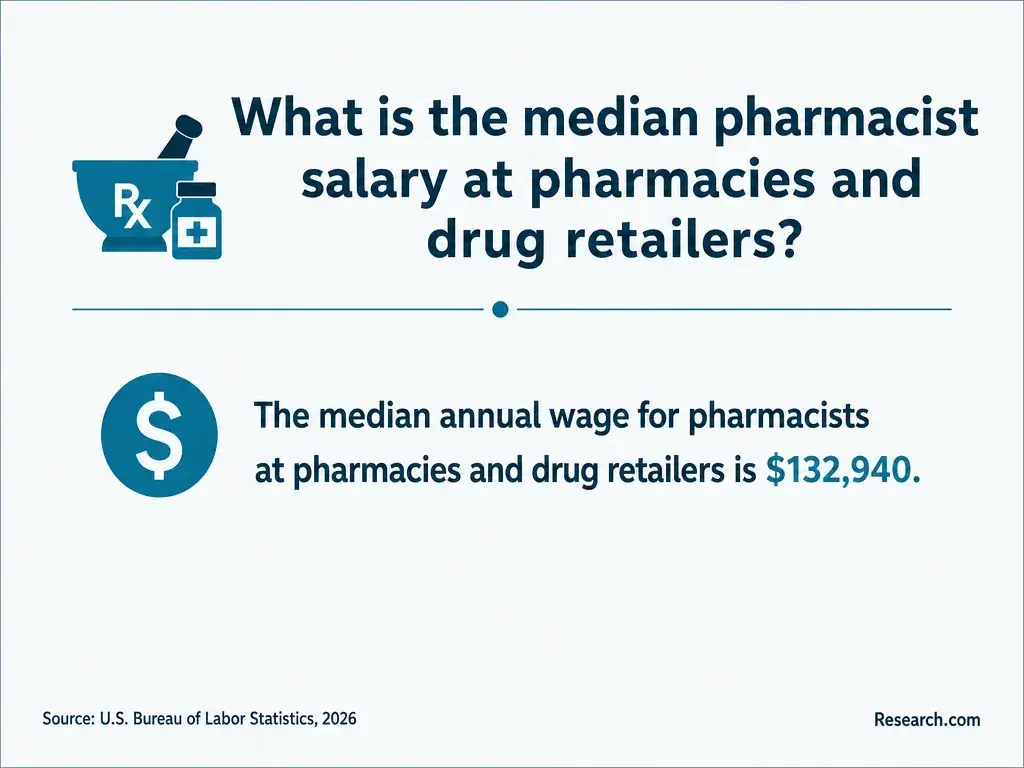
After meeting licensure requirements, Pharm.D. graduates may pursue pharmacist roles in community, hospital, ambulatory care, or other practice settings, subject to employer qualifications and available positions. The U.S. Bureau of Labor Statistics reports $140,910 in median annual pay for pharmacists in May 2025 and projects 5% employment growth from 2025-2035. Those occupation-wide figures are context for a career decision, not a salary or job-placement prediction for Fisher graduates or for either delivery pathway.
Some roles may favor postgraduate training. A residency is supervised postgraduate practice; a fellowship generally emphasizes a different, often research- or industry-focused training path. Board certification is a separate specialty credential, not a pharmacist license. None is universally required for pharmacist employment.
Use career goals when weighing cost: budget-friendly pharmacy education options are worth comparing, but a shorter pharmacy-related credential may prepare you for a different occupation rather than licensed pharmacist work. Likewise, paying more for one Fisher pathway does not establish a better career outcome.
How should students choose between online and campus PharmD study?
Favor online study if you can reliably attend its scheduled classes and in-person requirements, are eligible to enroll from your location, and have a realistic plan for clinical placements. Favor campus study if regular face-to-face instruction is important to you and living near Rochester is practical. A need to keep unrestricted full-time work hours favors neither option without a close look at the rotation calendar.
Resolve the following questions with Fisher before paying a deposit. They turn a broad preference into a workable enrollment decision:
- Request each pathway's current cohort calendar, including live sessions, required campus visits, hands-on activities, and rotation blocks.
- Ask the experiential education office whether approved IPPE and APPE sites are feasible where you expect to live, and what happens if a nearby site is unavailable.
- Confirm ACPE coverage, distance-education authorization, and the licensing requirements of the state where you intend to practice.
- Obtain comparable tuition-and-fee estimates and personalized aid information; add your likely travel, housing, and lost-work costs.
- Have admissions evaluate your prerequisites in writing and clarify any remaining conditions of enrollment.
Be cautious of a comparison based only on advertised flexibility or a projected finish date. Broader guides to online doctorate time to completion cannot establish Fisher's required schedule; its current calendar and your placement plan can.
Other Things You Should Know About PharmD
Ask Fisher what appears on its current diploma and transcript. Do not infer diploma wording from how courses are delivered.
Some students may work during coursework, but scheduled classes, in-person activities, and rotations can limit availability. Build a term-by-term work plan rather than assuming the same hours will remain possible throughout.
No. Technician experience can be useful preparation, but it does not replace the required professional education and jurisdiction-specific pharmacist licensing process.
Use published results as one point of context, checking the reporting year and group size. A school-wide result may not describe each delivery pathway separately, and no pass rate predicts an individual student's outcome.
- Cost of Attendance (Budget) | 2025-2026 Federal Student Aid Handbook https://fsapartners.ed.gov/knowledge-center/fsa-handbook/2025-2026/vol3/ch2-cost-attendance-budget
- Pharmacy Admissions | Albany College of Pharmacy and Health Sciences https://www.acphs.edu/admissions-aid/pharmacy-admissions/
- PharmD Student Voices: A Clinical Training Explainer | Doctor of Pharmacy https://pharmacy.wisc.edu/2025/08/13/pharmd-student-voices-a-clinical-training-explainer/
- PharmD FAQs - UNC Eshelman School of Pharmacy https://pharmacy.unc.edu/education/pharmd/pharmd-admissions-faqs/
- Experiential Education | Washington State University https://pharmacy.wsu.edu/pharmd/experiential-services/
- Earn an Online Pharm.D. Degree at St. John Fisher University https://onlinepharmd.sjf.edu/
- What's the Difference Between Asynchronous and Synchronous Learning? | Ohio State Online https://online.osu.edu/content-hub/blogs/whats-the-difference-between-asynchronous-and-synchronous-learning/
- IPPE & APPE | UTHSC https://www.uthsc.edu/pharmacy/current-students/oel/ippe-appe.php
- Pharmaceutical Studies 2+4 | Pharm.D. Application | St. John Fisher University https://www.sjf.edu/major-minors/pharmacy-studies-2-4-pharmd/pharmd-application/