How to choose between a pharmacy degree and a healthcare certificate

Co-Founder and Chief Data Scientist
A healthcare certificate may help you enter patient care or pharmacy support work sooner, while becoming a pharmacist requires a much longer professional education and a state license. Choosing the wrong route can mean paying for training that does not qualify you for the job you want. This guide compares the careers each credential can support, the time and costs involved, and the requirements to check before enrolling. Use it to decide whether you need the Doctor of Pharmacy (Pharm.D.) pathway or whether a shorter credential better matches your goal.
Key Things You Should Know
- Choose a Pharm.D. if your goal is pharmacist licensure. A healthcare certificate, including a pharmacy technician certificate, does not replace the professional degree or state licensing requirements.
- Choose a certificate if you want a specific support role sooner. Pharmacy technicians had median annual pay of $45,750 in May 2025, according to the Bureau of Labor Statistics; verify your state's entry requirements before choosing a program.
- Compare the entire path, not just tuition. Pharm.D. applicants may need prerequisite coursework before the professional program, followed by clinical training and licensure steps. Pharmacists had median annual pay of $140,910 in May 2025, but that figure does not guarantee an individual return on the investment.
What Is the Difference Between a Pharmacy Degree and a Healthcare Certificate?
A Pharm.D. is the professional degree used in the U.S. pharmacist-licensure pathway. A healthcare certificate is a narrower credential designed to teach skills for a particular job or to document additional training. Neither credential alone authorizes someone to practice as a pharmacist.
The distinction is the job each route can qualify you to pursue. This comparison separates the two routes before you evaluate individual schools.
| Decision factor | Pharm.D. pathway | Healthcare certificate pathway |
| Primary goal | Qualify to seek pharmacist licensure after meeting state requirements | Prepare for a defined support or allied-health role |
| Entry requirements | School-specific undergraduate prerequisites; a bachelor's degree is not universally required | Often a high school diploma or equivalent, though requirements vary |
| Training | Advanced medication science, patient care, and supervised pharmacy practice | Occupation-specific classroom, laboratory, or clinical skills |
| Main limitation | Degree completion does not itself confer a license | Does not substitute for a Pharm.D. or grant pharmacist authority |
If you already have science coursework, compare your transcript with individual schools' prerequisites rather than assuming you must start over. Guidance on the transition from pre-pharmacy to a Pharm.D. can help you frame that comparison.
Which Healthcare Careers Can You Enter With a Certificate?
Certificates can prepare you for pharmacy technician, medical assistant, phlebotomy technician, or nursing assistant roles, depending on the program and your state's rules. These jobs differ substantially: a pharmacy technician supports medication dispensing under applicable supervision, while a phlebotomy technician primarily collects blood samples. A certificate's name is not proof that it meets every hiring or credentialing requirement.
If you want to work around medications without becoming a pharmacist, pharmacy technician training is the closest match. It can provide firsthand exposure to pharmacy operations, but technician duties and legal authority remain distinct from a pharmacist's. If your longer-term aim is pharmacy school, do not enroll in a certificate expecting it to replace missing science prerequisites; instead, check pharmacy programs for applicants still completing requirements and confirm each school's actual matriculation rules.
What Degree Do You Need to Become a Pharmacist?
For the standard U.S.-educated route, you need a Doctor of Pharmacy degree from a program that meets the applicable educational requirements for licensure. Undergraduate pre-pharmacy classes prepare you to apply; they are not the professional Pharm.D. curriculum. A degree in pharmaceutical sciences, pharmacology, or pharmacy technology is not a substitute.
Admissions requirements differ by school. Some accept applicants after specified prerequisite credits without a completed bachelor's degree; others have different degree or coursework expectations. Check the current program's course and laboratory requirements, minimum grades, deadlines, and application process. The Pharmacy College Admission Test (PCAT) was retired in 2024, so it is not a current test to plan around. A review of pharmacy program applicant requirements can help you build questions for admissions staff, but the school's current rules control.
After graduating, applicants must satisfy their licensing jurisdiction's requirements, which generally include the North American Pharmacist Licensure Examination (NAPLEX) and may include a jurisprudence exam and other conditions. Internationally educated pharmacists follow a different eligibility process.
A healthcare certificate may take months or longer, depending on its coursework and required clinical hours. The Pharm.D. route usually involves prerequisite undergraduate study followed by a multi-year professional program. Your starting credits and the school's calendar matter more than a single advertised completion time.
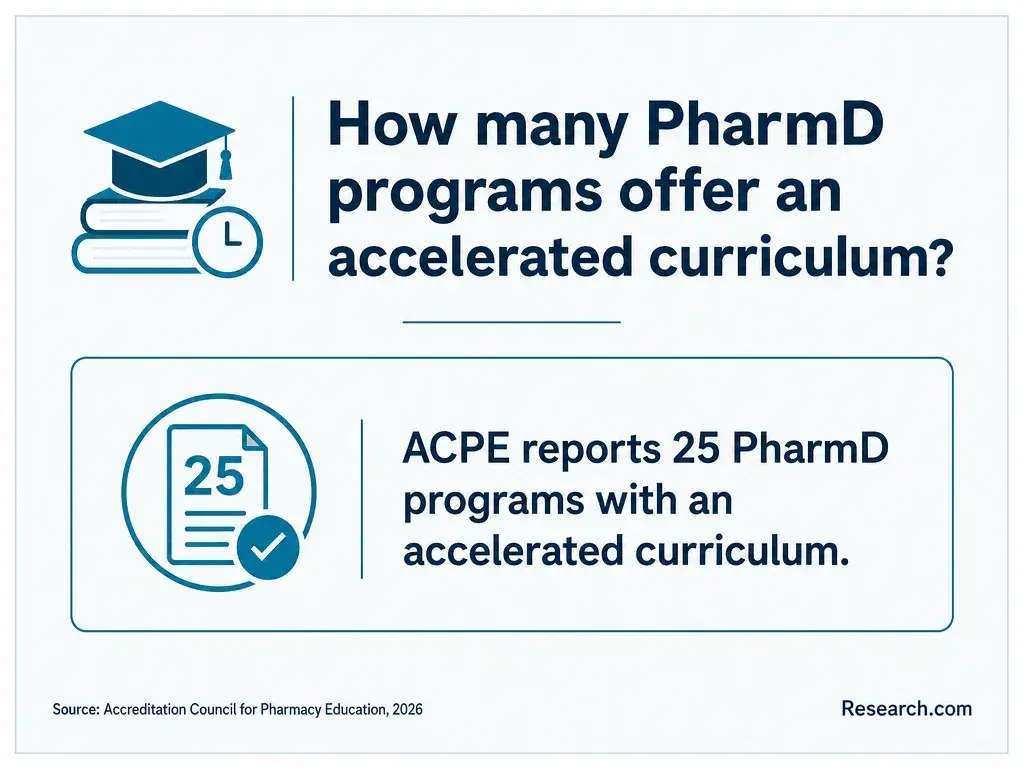
Accelerated Pharm.D. programs may shorten the academic calendar, but they do not eliminate required professional training or subsequent licensing steps. Compare the pharmacy doctorate program length from your own starting point: include prerequisites you still need, full-time attendance expectations, introductory and advanced practice experiences, and any time you may need before licensure. If you must keep working, ask for the actual weekly schedule and clinical-placement calendar rather than relying on the label "flexible."
Certificates often require a smaller initial investment because they are shorter, but price alone cannot establish value. A low-cost certificate is a poor bargain if it does not meet your state's or a prospective employer's requirements. Pharm.D. costs can include prerequisite courses as well as years of professional tuition and living expenses.
Request a written, year-by-year estimate from each program. The categories below help expose costs that an advertised tuition figure may omit.
| Cost category | Pharm.D. questions | Certificate questions |
| Instruction | Which prerequisite, tuition, and mandatory-fee charges apply to me? | Are books, supplies, and examinations included? |
| Hands-on training | Will rotations or campus visits require travel, housing, or time away from paid work? | Are clinical placements included, and who arranges them? |
| Entry into work | What will applications, licensing exams, and required checks cost? | Are state registration or third-party certification costs separate? |
For comparisons of online pharmacy degree affordability, add required in-person costs before judging the price. Also ask financial aid staff which rules apply to your enrollment and borrower status: federal borrowing rules changed for many new graduate and professional borrowers beginning July 1, 2026. Do not assume an older loan-limit description or unrestricted Grad PLUS access applies to you.
Pharm.D. students build on prerequisite science with pharmacology, therapeutics, calculations, medication safety, patient communication, and supervised practice. Introductory pharmacy practice experiences (IPPEs) and advanced pharmacy practice experiences (APPEs) connect classroom learning with work in practice settings. Schools determine their curricula and placement arrangements within applicable accreditation requirements.
A certificate concentrates on the tasks of its target occupation. Pharmacy technician coursework might cover prescription processing, calculations, inventory, and safety procedures; a phlebotomy program instead emphasizes specimen collection and handling. Compare course descriptions with the work you want to do, and ask whether a placement is required.
Prior study does not automatically shorten a Pharm.D. The receiving school decides whether previous courses satisfy prerequisites or qualify for credit within its professional curriculum. If you already have college credit, explore transfer-friendly pharmacy education options, then obtain a school-specific evaluation before budgeting for fewer semesters.
Online instruction can be legitimate, but delivery format does not establish program quality or eligibility for a credential. An online or hybrid Pharm.D. still has hands-on training and in-person practice experiences. Required campus sessions, scheduled classes, assessments, and rotations may make it incompatible with a full-time job even when much of the coursework is online.
When reviewing pharmacy doctorate programs with distance learning, ask where and when in-person work occurs, who approves clinical sites, and whether your state permits enrollment and the proposed placements. For an online healthcare certificate, likewise confirm how required labs or clinical hours are completed and whether the program meets requirements where you intend to work. "Online" should never be read as "fully remote" or "self-paced."
For a U.S. Pharm.D., check the Accreditation Council for Pharmacy Education (ACPE) professional-program listing and its current status. Separately check the university's institutional accreditation. These are different reviews; neither is the same as state authorization to enroll a distance-learning student or approval of a clinical placement.
For a certificate, the relevant check depends on the occupation and state. Confirm that the institution is appropriately accredited and that the specific program meets any education standard required for state registration, licensure, or a certification exam. A general list of shorter online doctorate pathways cannot establish Pharm.D. accreditation or pharmacist-licensure eligibility. Before paying a deposit, verify the specific program and credential with its accreditor and the authority governing your intended occupation.
Requirements follow the occupation and jurisdiction, not simply the credential awarded by a school. Pharmacist applicants must satisfy their state board's education, examination, and other licensing rules. The NAPLEX is a licensing examination, not a license. Jurisprudence requirements vary: a jurisdiction may use the Multistate Pharmacy Jurisprudence Examination (MPJE), the Uniform Multistate Pharmacy Jurisprudence Examination (UMPJE), another assessment, or different procedures.
Pharmacy technicians may need state registration or licensure, and some employers or states require or value national certification. Requirements for other certificate-based roles also vary by occupation and location. Before enrolling, identify the job title you want and check the responsible state agency and, if applicable, the certification body's eligibility rules. Even pharmacy degree programs with accelerated schedules cannot waive a licensing board's requirements; confirm what credential a program actually awards.
Which Path Offers Better Salary and Job Outlook?
Pharmacist roles generally offer higher pay but require a substantially larger investment of time and money. The Bureau of Labor Statistics reports median annual pay of $140,910 in May 2025 for pharmacists, with 5% projected employment growth from 2025-2035 and about 12,500 openings per year. That median describes workers in the occupation, not a new graduate's expected offer or a guaranteed return.
For pharmacy technicians, the Bureau of Labor Statistics reports median annual pay of $45,750 in May 2025, with 6% projected growth from 2025-2035 and about 44,700 openings per year. Technician work is a separate occupation that does not ordinarily require a Pharm.D. The figures do not account for your local wages, debt, years out of full-time work, or preferred duties.
Choose the Pharm.D. route if you specifically want to practice as a pharmacist and can make a realistic plan for prerequisites, professional education, clinical placements, and licensure. Choose a certificate if a defined support role meets your goal and you want to limit time and upfront expense. To compare cost-effective pharmacy degree options with certificates, use the same test for each: total cost to become eligible for the intended job, realistic time away from earnings, and requirements in the state where you plan to work.
Other Things You Should Know About PharmD
It may help you explain your interest in pharmacy and demonstrate relevant work skills, but admissions committees set their own criteria. Experience does not replace required courses or guarantee admission.
Not for every pharmacist job. A residency is postgraduate training that may be expected or preferred for some clinical roles. A fellowship is a different training route, and specialty board certification is a separate credential; none substitutes for state licensure.
Often, if a workplace permits it. Ask local pharmacies or healthcare facilities about observation opportunities, privacy rules, and age or onboarding requirements. Shadowing can help you distinguish pharmacist responsibilities from technician duties before committing to a program.
Do not assume you need to start a U.S. Pharm.D. from the beginning - or that your existing degree permits U.S. practice. Check the National Association of Boards of Pharmacy's foreign graduate certification pathway and the board rules in the state where you want to become licensed.
- NYS Pharmacy: License Requirements - Office of the Professions https://www.op.nysed.gov/professions/pharmacist/license-requirements
- FAQ | OSU College of Pharmacy - Oregon State University https://pharmacy.oregonstate.edu/programs-admissions/pharm-d/faq
- Pharmacist - Explore Healthcare Careers | Mayo Clinic College of Medicine and Science https://college.mayo.edu/academics/explore-health-care-careers/careers-a-z/pharmacist/
- 10 Top Healthcare Certifications That Pay Well | pennfoster.edu https://www.pennfoster.edu/blog/10-medical-certifications-that-pay-well
- How to Become a Pharmacist | School of Pharmacy https://pharmacy.llu.edu/about-us/school-news/how-become-pharmacist
- Pathways to Becoming a Certified Pharmacy Technician | ProTrain College https://protrain.edu/what-are-the-pathways-to-becoming-a-certified-pharmacy-technician/
- 14 Entry-Level Healthcare Certifications | San Juan College https://www.sanjuancollege.edu/blog/entry-level-healthcare-certifications/
- What is the Fastest Way to Become a Pharmacist? | University of Findlay https://pharmdonline.findlay.edu/blog/fastest-way-become-pharmacist
- How Much Do Pharmacists Make? Salary, Pay and Career Outlook | PCOM https://www.pcom.edu/pharmacy/news/how-much-do-pharmacists-make.html
- Licensed vs. Certified Pharmacy Tech: What's the Difference? | Concorde Career College https://www.concorde.edu/blog/licensed-vs-certified-pharmacy-tech