
PharmD Cost per Credit for Students With Transfer Credits

Co-Founder and Chief Data Scientist
A pharmacy school may accept your previous coursework without reducing the tuition you pay for its Doctor of Pharmacy (Pharm.D.) curriculum. That distinction matters if you are transferring from another college, completing pre-pharmacy courses, or hoping to change Pharm.D. programs.
This guide explains how schools apply credits, how per-credit and flat-rate tuition differ, and which costs can remain even after credits transfer. You will leave with a way to compare written credit evaluations and cost estimates rather than choosing a program based on its advertised rate alone.
Key Things You Should Know
- Accepted prerequisite credits may satisfy admission requirements but usually do not replace professional Pharm.D. courses or lower the price of that curriculum.
- There is no national Pharm.D. cost per credit for transfer students: compare the receiving school's billing method, credited professional courses, required remaining terms, and fees.
- Federal borrowing rules changed for many new graduate and professional students beginning July 1, 2026; confirm your own aid eligibility before relying on loans to cover the remaining cost.
What Is the PharmD Cost Per Credit for Transfer Students?
There is no standard transfer-student price per Pharm.D. credit. Each school sets its tuition and decides whether to bill by professional credit, semester, or a fixed cohort schedule. A quoted per-credit rate may cover tuition only, while mandatory fees and living costs sit outside it. A flat-rate school may charge the same tuition for a term even if it accepts a course you previously completed.
Start by asking what the school means by "transfer credit." Prerequisite credit is undergraduate coursework accepted to meet admission requirements. Professional transfer credit replaces a requirement within the Pharm.D. curriculum. Only the second kind has a plausible direct effect on professional tuition, and even then the billing policy and course sequence determine whether the bill falls.
For a valid comparison, request an itemized estimate based on the courses and terms you would actually have left. A list of options emphasizing pharmacy education with shorter completion time can help frame the search, but neither a short timeline nor a low advertised rate establishes your personal total cost.
How Do Transfer Credits Reduce the Total Cost of a PharmD?
Credits save money only when the receiving school applies them to a requirement you otherwise would pay to complete, or when they eliminate a billed term. Accepted prerequisites can still be valuable: they may keep you from repeating undergraduate courses, but their savings occur before entry to the professional program.
The table separates common credit outcomes from their likely billing effects. It can help you interpret an evaluation that says credits were "accepted" without specifying what they replace.
| Credit outcome | Effect on the Pharm.D. bill |
| Prerequisite requirement satisfied | Usually avoids repeating pre-professional study; does not necessarily reduce professional tuition. |
| Professional course replaced under per-credit billing | May reduce billed credits if the school does not impose a minimum charge or substitute another requirement. |
| Professional course replaced under flat-term billing | May produce no tuition reduction unless the remaining schedule loses a billed term. |
| Credit accepted as an elective only | May not shorten a sequenced curriculum or reduce its total charge. |
Compare the full cost of attendance, not just tuition. Mandatory fees, books and clinical references, equipment, background checks, immunizations, introductory and advanced pharmacy practice experience travel, and possible rotation housing can remain. If transferring delays graduation because required courses are offered in sequence, additional living expenses and time away from work may outweigh a tuition reduction.
Before paying a deposit, get the decisions that drive savings in writing:
- Ask for a course-by-course evaluation showing which credits satisfy prerequisites and which replace professional requirements.
- Request the remaining term-by-term course plan and an itemized tuition-and-fee estimate for that plan.
- Ask whether accepted credits change your billed terms, scholarship eligibility, or financial aid classification.
Federal student aid depends on your eligibility, the school's classification of your program, and rules applicable to your borrowing period. Because federal rules changed for many new graduate and professional borrowers beginning July 1, 2026, confirm current loan options with the financial aid office rather than assuming earlier Grad PLUS availability or borrowing limits still apply. For broader examples of applying prior college credits to pharmacy programs, still rely on the receiving school's written decision for your own courses.
Which PharmD Programs Accept the Most Transfer Credits?
No dependable nationwide ranking identifies the Pharm.D. program that will accept the most of your credits. A school may accept extensive undergraduate prerequisite work while granting little or no credit toward its professional curriculum. Another may consider a student transferring from a different Pharm.D. program but require detailed syllabus review and placement in a particular cohort.
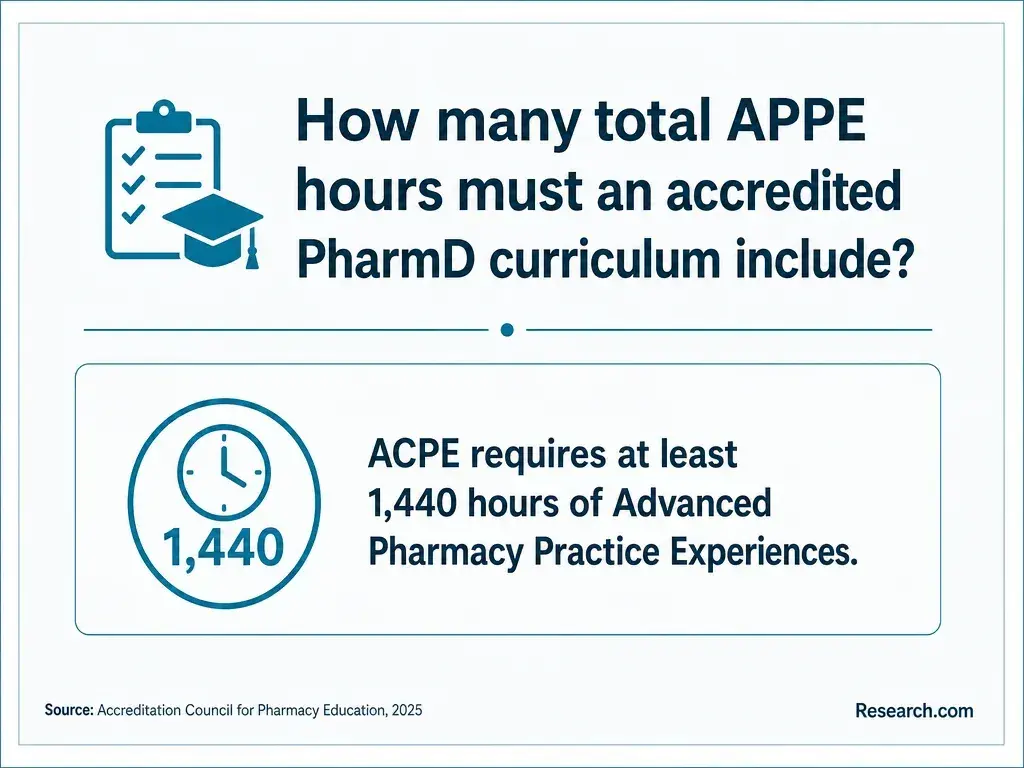
Compare schools on the credits that actually advance graduation: the maximum professional credit they will apply, required courses that cannot be waived, residency-in-program rules, and the first term you could enter. Also ask whether previously completed experiential work can count; never assume a rotation or job will substitute for a required pharmacy practice experience. Published lists of shortened Doctor of Pharmacy pathways describe a different possibility: an accelerated curriculum is not necessarily a generous transfer policy.
A program that accepts fewer credits could cost less if its remaining tuition and living expenses are lower. Conversely, a generous evaluation may have limited value if course sequencing keeps you enrolled for the same number of terms.
Check the Accreditation Council for Pharmacy Education (ACPE) status of the professional Pharm.D. program in ACPE's current program records. Confirm that its status supports the licensure route you intend to pursue, and ask the program about any status or campus-specific questions. Institutional accreditation is a separate matter; neither it nor a favorable transfer policy substitutes for checking professional-program accreditation.
For online or hybrid options, verify state authorization to enroll you separately from ACPE status. Authorization to study from your state does not automatically establish that you can complete clinical placements there or qualify for that state's pharmacist license. An online pharmacy program comparison can identify candidates to investigate, but confirm each candidate's current accreditation, authorization, and placement rules directly before enrolling.
Schools commonly evaluate prior biology, chemistry, mathematics, and general education courses against their admission prerequisites. Acceptance depends on the receiving school's requirements for course content, laboratories, grades, and how recently coursework was completed. A completed bachelor's degree is not a universal prerequisite for Pharm.D. admission.
Transferring a professional Pharm.D. course is a different process. The school may compare syllabi, learning outcomes, credit hours, assessments, and the sequence in which patient-care skills are taught. It may decline a seemingly similar course if that course does not match its curriculum. Prior work in pharmaceutical sciences, pharmacy technology, or employment in a pharmacy is not automatically equivalent to professional Pharm.D. coursework.
If your credits come from a biology, chemistry, or pre-pharmacy track, explore pharmacy education after a pre-pharmacy track with the prerequisite distinction in mind. Send official transcripts and any requested syllabi to the receiving school; a former school's accreditation alone does not compel acceptance.
The answer depends less on the number of credits accepted than on where they fit in the required sequence. Prerequisite credits can make you ready to enter a Pharm.D. program sooner without shortening its professional phase. Professional transfer credits might remove coursework, but required laboratories, introductory pharmacy practice experiences (IPPEs), and advanced pharmacy practice experiences (APPEs) can still determine the earliest graduation date.
Ask for a term-by-term graduation plan that identifies the first available entry point and any courses offered only at particular times. If the school cannot show that accepted credits remove a term, do not budget for an earlier graduation. General lists of doctoral programs with accelerated timelines may include degrees with no comparable Pharm.D. clinical requirements; their completion times are not a substitute for your pharmacy school's plan.
Admission and transfer-credit approval are separate decisions. Each school sets its own prerequisite courses and labs, grade and GPA rules, transcript requirements, interviews, deadlines, and policies for applicants with prior professional pharmacy study. Some use the Pharmacy College Application Service (PharmCAS); others have different application procedures or additional requirements. The Pharmacy College Admission Test (PCAT) was retired in January 2024 and should not be treated as a current exam to schedule.
Check whether remaining prerequisites can be in progress when you apply and when they must be completed. If that describes your situation, guidance on how to apply to pharmacy school while finishing prerequisites can help you formulate questions, but the target school's current admission conditions control. Meeting a minimum threshold does not guarantee admission or professional transfer credit.
Some Pharm.D. programs offer online or hybrid instruction, but transfer eligibility depends on each program's policy. Online coursework does not mean a fully remote degree: scheduled classes, hands-on labs, campus visits, and in-person IPPEs and APPEs may be required. The school may coordinate or approve rotation sites while still requiring you to meet site availability, travel, health, background-check, and state intern-registration conditions.
Compare an online option's total tuition and fees with the cost of required travel, temporary housing, and reduced work hours. A low-cost online pharmacy doctorate is worth investigating only after you confirm that it is the Pharm.D. pathway you need, that you can enroll from your state, and that its in-person requirements are workable for you.
Completing a Pharm.D. does not itself authorize you to practice as a pharmacist. For a U.S.-educated graduate, the licensing jurisdiction determines eligibility, including degree and experiential requirements, application and background-check rules, the North American Pharmacist Licensure Examination (NAPLEX), and any applicable law examination. Do not assume every jurisdiction uses the Multistate Pharmacy Jurisprudence Examination (MPJE): some use the Uniform Multistate Pharmacy Jurisprudence Examination (UMPJE) or different requirements. Confirm the current route with the state board of pharmacy before selecting a program or rotation location.
Be especially careful with articles about how quickly can an online pharmacy degree be completed: "pharmacy degree" can refer to credentials other than a licensure-qualifying Pharm.D. Passing an exam, completing a residency, or earning a certificate also does not by itself issue a pharmacist license.
What Pharmacist Careers and Salaries Follow a PharmD?
Licensed pharmacists work in settings such as community pharmacies, hospitals, ambulatory care, and other medication-focused services. The U.S. Bureau of Labor Statistics reports median annual pay for pharmacists of $140,910 in May 2025 and projects 5% growth, 2025-2035, with about 12,500 openings per year. Those occupation-wide figures do not predict an individual graduate's pay or make a particular tuition bill worthwhile.
Some positions may favor postgraduate residency training or a fellowship, while others do not require either. Specialty board certification is a separate credential, not a pharmacist license. If your goal is a pharmacy-adjacent job rather than pharmacist practice, compare its actual education requirements before committing to Pharm.D. debt; pharmacy technician work, for example, is a separate occupation that does not ordinarily require the degree. If pharmacist practice is your goal, review pharmacy school application eligibility alongside your written transfer evaluation, remaining cost, and likely time to licensure.
Other Things You Should Know About PharmD
Policies vary by school and subject. Ask whether the program accepts the credit shown on your college transcript and whether it still requires a college-level course or laboratory in that subject.
The receiving school determines how transfer courses appear in its academic record. An application service or admissions office may also calculate an application GPA using coursework from multiple institutions. Ask which GPA is used for admission and which applies after enrollment.
A transfer does not automatically determine residency eligibility. Keep documentation of completed coursework and rotations, and check individual residency application requirements; your record and experiences will matter more than a general assumption about transfer status.
Possibly, if your employer's benefit covers the program and you meet its conditions. Check annual coverage, eligible courses, work-schedule requirements, and any repayment obligation if you leave the job.
- Pharmacy Tuition Rates & Fees | University of Cincinnati | James L. Winkle College of Pharmacy https://www.pharmacy.uc.edu/admissions/tuition-fees.html
- Transfer or Advanced Standing Policy | usc.edu https://mann.usc.edu/program/doctor-of-pharmacy-pharmd/admissions/transfer-or-advanced-standing-policy/
- FAQ | OSU College of Pharmacy - Oregon State University https://pharmacy.oregonstate.edu/programs-admissions/pharm-d/faq
- 2025-2026 Tuition and Fees - Student Account Services | University of Kentucky https://studentaccount.uky.edu/tuition-and-fees/past-tuition-and-fees/2025-2026-tuition-and-fees
- Pharm.D. Tuition & Fees | University of Health Sciences and Pharmacy in St. Louis https://www.uhsp.edu/admissions/pharmd-tuition-fees/
- Pharmacy Tuition and Fees - KU Financial Aid https://financialaid.ku.edu/calculate-costs/tuition-and-fees/pharmacy
- Cost of Attendance " Pharm.D. Admissions " | ufl.edu https://admissions.pharmacy.ufl.edu/financial-aid/anticipated-expenses/
- Tuition and Financial Aid FAQs - Fisher Pharm.D. Online | SJF-PHA https://onlinepharmd.sjf.edu/admissions/tuition-and-financial-aid/faqs/
- Medical Laboratory Science - BS https://www.farmingdale.edu/curriculum/bs-mls.shtml
- Transfer Pharm.D. Applicants - Pharmacy Advising Center https://advising.pharmacy.uconn.edu/faq/transfer-pharmd-applicants/


