Calculus Prerequisites for PharmD Programs

Co-Founder and Chief Data Scientist
Choosing the wrong math course can delay a Doctor of Pharmacy (Pharm.D.) application or leave you paying for a class you did not need. Calculus requirements vary by school, and a course labeled "calculus" may not satisfy the program you want to enter. This guide helps prospective U.S. pharmacy students decide whether to take calculus, which version to choose, and how to get a school's answer before enrolling. It also explains how to time the course and evaluate an online option.
Key Things You Should Know
- There is no universal Pharm.D. calculus prerequisite: some programs require it, while others use different math requirements.
- If calculus is required, the course title alone is not enough; confirm whether the school accepts your specific course and credits.
- Complete an accepted course by each school's stated deadline, which may be later than the application deadline but before enrollment.
What calculus prerequisites do PharmD programs typically require?
A Pharm.D. prerequisite is undergraduate coursework completed before entering the professional pharmacy program. Schools that specify calculus commonly look for an introductory, college-level course, but they set their own rules for course content, credit hours and acceptable substitutions. Calculus taken within the professional Pharm.D. curriculum, if a school offers it there, is not a substitute for an admission prerequisite.
Read the current admissions page for each school on your list rather than treating a general list of pharmacy program applicant requirements as the final word. Check the exact course description, minimum grade, treatment of repeated courses and deadline for completion. Also check whether the school requires a bachelor's degree or accepts applicants after specified undergraduate prerequisites; neither rule is universal.
Do all PharmD programs require calculus for admission?
No. A school may require calculus, allow a choice among math courses, specify statistics instead, or set a broader quantitative coursework requirement. A course being useful in pharmacy does not make it an admissions requirement. Likewise, a school's decision not to require calculus does not mean its professional curriculum avoids quantitative work.
If calculus would add a term to your schedule, compare schools' published requirements before registering. Some pharmacy application eligibility pathways permit applications with courses in progress, but admission may remain conditional on finishing them. Do not assume that permission to apply without a completed course means permission to enroll without it.
Which calculus course is best for PharmD prerequisites?
If your target schools accept it, a standard Calculus I course is often the most portable choice across applications. "Most portable" is guidance, not a guarantee: the receiving pharmacy school decides whether a particular course meets its rule. Ask for a written evaluation before taking a differently titled or specialized course solely for admission.
The comparison below shows why the course description matters more than the word "calculus" on a transcript.
| Course type | Admissions consideration |
| Standard Calculus I | May align with a requirement for introductory calculus; confirm credits and any stated exclusions. |
| Applied or business calculus | May cover different topics or depth; obtain school-specific approval. |
| Precalculus | Prepares students for calculus but does not ordinarily replace a requirement explicitly calling for calculus. |
Students comparing Pharm.D. programs for biology majors should not assume that a science-heavy transcript automatically covers math. Match each completed course to each school's prerequisite list.
Statistics can satisfy a requirement when the school expressly accepts statistics, but it does not automatically replace a calculus requirement. Business calculus may qualify if the school accepts applied calculus or approves your course after reviewing its content. A school can also require both calculus and statistics, so confirm whether the subjects are alternatives or separate requirements.
Transfer approval is distinct from a course appearing on your transcript. The receiving school determines how prior credit applies, including credit earned elsewhere. Guidance on pharmacy school transfer admission can help frame your questions, but request a decision on the specific math course from each admissions office. Send its catalog description or syllabus if asked.
Start with the school's admissions requirements for the application cycle you intend to enter. Cross-check its PharmCAS directory entry if the school uses PharmCAS, then ask admissions to resolve any discrepancy. PharmCAS is a centralized application service, not a source of nationwide course-equivalency rules.
Use this sequence to avoid paying for a course that will not count:
- Confirm the professional Pharm.D. program's current status in the Accreditation Council for Pharmacy Education (ACPE) program records.
- Find the school's current math prerequisite, including credits, grades, substitutions and completion deadline.
- Send admissions your proposed course's institution, number, credits, catalog description and, if necessary, syllabus.
- Keep the school's written answer and confirm whether your application record needs an update after the final grade posts.
ACPE accredits professional pharmacy programs; it does not approve your individual prerequisite course. If you compare online Doctor of Pharmacy programs, check state authorization separately from ACPE accreditation and from acceptance of an online undergraduate calculus course.
Complete calculus before applying if you need its grade to show academic readiness or if a target school requires all prerequisites at application. Otherwise, a school may allow it to be in progress when you apply and require a final passing grade before matriculation, meaning the start of the professional program. Check the school's actual deadline rather than assuming that the application deadline is also the coursework deadline.
Work backward from enrollment and leave room for registration, course sequencing and transcript delivery. This matters even when considering shortened Doctor of Pharmacy pathways: an accelerated professional curriculum does not necessarily shorten the time needed to finish admission prerequisites. If a calculus retake is possible, ask how that school evaluates both attempts before choosing an application cycle.
Pharm.D. applicants commonly encounter prerequisites in biology and chemistry, often with laboratory components, and may also need anatomy, physiology or microbiology. The exact subjects, course sequences, lab formats, credits and minimum grades vary by school. Check these alongside calculus: a math course that fits your schedule may conflict with a required science sequence or lab.
Budget for the full prerequisite plan, not just calculus tuition. Lab courses can carry additional fees, and an extra term can delay entry into the professional program. An online pharmacy degree cost comparison is most useful when you also account for prerequisite coursework and confirm that the degrees being compared lead to the same career goal. A pharmacy technician credential, for example, is not a substitute for a Pharm.D. when the goal is pharmacist licensure.
Possibly. Whether an online calculus course counts depends on the admitting school's policy and its evaluation of the course and institution. Confirm that the course awards transcripted college credit, has acceptable content and meets any rules about delivery or grading. Do not assume that an online Pharm.D. program automatically accepts every online prerequisite.
Ask whether the course has scheduled class meetings or proctored exams before deciding it fits your work schedule. Online prerequisite flexibility is also different from online doctoral program duration: professional pharmacy education can include required in-person activities and clinical rotations even when some instruction is online.
A required minimum grade determines whether calculus can satisfy a prerequisite; it does not guarantee admission. Admissions committees may also consider overall and science academic performance, course trends and other application components under their own policies. If your grade falls below a school's minimum, ask whether a retake is permitted and how repeated grades are evaluated.
Retaking calculus has a cost in tuition and time, so target the problem it solves. A retake may be necessary for eligibility or useful evidence of improved preparation; it may be less valuable if your existing grade meets every target school's rule and another missing prerequisite is the real obstacle. When evaluating an affordable route to a Pharm.D., include the cost of any required retakes rather than comparing professional-program tuition alone.
What careers and licensing steps follow a PharmD degree?
Calculus is an admissions decision, not a pharmacist license requirement by itself. After completing an ACPE-accredited Pharm.D. program, U.S.-educated graduates must meet the requirements of the state or jurisdiction where they seek licensure. These generally include the North American Pharmacist Licensure Examination (NAPLEX), along with any applicable jurisprudence examination and other board requirements. The law examination varies by jurisdiction; do not assume every board uses the MPJE. Passing an exam alone does not issue a license.
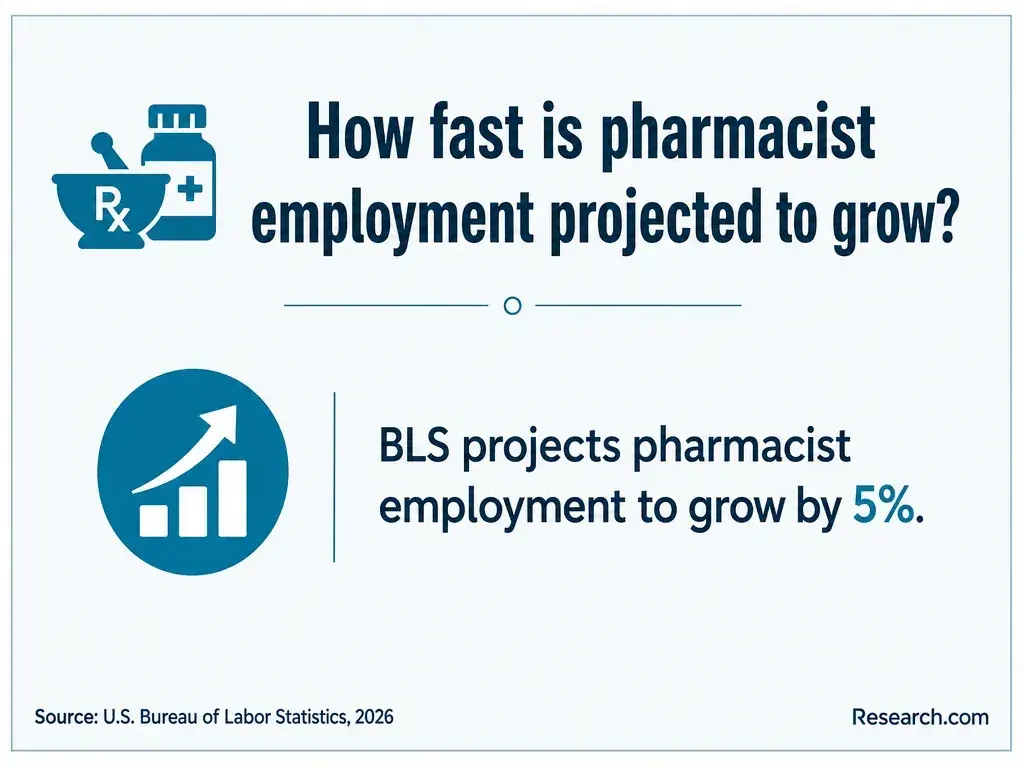
Licensed pharmacists work in settings such as community pharmacies, hospitals and ambulatory care. The Bureau of Labor Statistics reports median annual pay of $140,910 in May 2025 for pharmacists and projects 5% job growth for 2025-2035. These occupation-wide figures are context for a long educational commitment, not a predicted outcome for an individual graduate. Residency or fellowship training may support particular career goals but is not universally required for pharmacist licensure.
If your goal is a pharmacy-adjacent job rather than licensed pharmacist practice, consider whether pharmacy degree options with shorter study periods serve it better. Pharmacy technician work is a separate occupation and does not ordinarily require a Pharm.D.; it also does not confer pharmacist authority.
Other Things You Should Know About PharmD
Only if the pharmacy school accepts that score and awards or recognizes the required credit. Ask how it must appear on an official transcript.
Policies differ. Ask whether the school accepts a passing mark for prerequisites, especially if it normally specifies a minimum letter grade.
Some schools set coursework-age rules, while others may not. Check the policy for the cycle you plan to enter before repeating an older course.
The admitting school may require an approved credential evaluation and additional documentation. An evaluation describes the coursework; the pharmacy school still decides whether it fulfills its prerequisite.
- Are Prerequisite Courses Barriers to Pharmacy Admission or the Keys to Student Success? - PMC https://pmc.ncbi.nlm.nih.gov/articles/PMC10159397/
- Admission Requirements | ufl.edu https://admissions.pharmacy.ufl.edu/steps-to-apply/application-requirements/
- Verifying Your Prerequisite Course Work | ucsf.edu https://pharmd.ucsf.edu/admissions/reqs/academic/verify
- PharmD FAQs - UNC Eshelman School of Pharmacy https://pharmacy.unc.edu/education/pharmd/pharmd-admissions-faqs/
- Admissions: USC Mann PharmD Program https://mann.usc.edu/program/doctor-of-pharmacy-pharmd/admissions/
- Prerequisite Coursework | College of Pharmacy | NEOMED https://www.neomed.edu/pharmacy/admissions/paths/prerequisites/
- Pre-Pharmacy - The A Center - The University of Arizona https://theacenter.arizona.edu/pre-health/pre-pharmacy
- AP/IB Credit - UW School of Pharmacy https://sop.washington.edu/pharmd/admissions/prerequisite-info/apib-credit/
- PharmD Prerequisites - Doctor of Pharmacy https://pharmacy.wisc.edu/pharmd/prerequisites/
- Prerequisite Coursework | School of Pharmacy https://www.pharmacy.pitt.edu/academics/doctor-pharmacy/apply-pharmd-program/prerequisite-coursework