
PharmD versus medical school: timeline and cost

Co-Founder and Chief Data Scientist
Choosing between pharmacy school and medical school means choosing different work - not just different tuition bills. A Doctor of Pharmacy (Pharm.D.) can lead to pharmacist licensure sooner, while becoming a physician requires medical school followed by residency. For prospective applicants, the difference affects when they can practice, how much they may need to borrow, and what they will do with patients each day. This guide compares the timelines and costs, then shows which admissions, licensing, and career questions to resolve before committing to either path.
Key Things You Should Know
- A typical Pharm.D. route takes about two to four years of prerequisite study plus four years of professional school; a physician route commonly takes four years of undergraduate study, four years of medical school, and at least three years of residency.
- Neither degree alone authorizes practice. Pharmacists need state licensure; physicians must complete applicable examinations and state licensing requirements, with residency central to independent practice.
- Cost comparisons must include prerequisites, living expenses, borrowing, and delayed earnings - not tuition alone. Pharmacists' median annual pay was $140,910 in May 2025, according to the Bureau of Labor Statistics (BLS).
How Do PharmD and Medical School Pathways Compare?
The key distinction is professional scope. Pharmacists specialize in medication use and safety; physicians diagnose and treat medical conditions. Both counsel patients and work on healthcare teams, but their training and legal authority are not interchangeable.
This comparison shows the usual sequence and the practical decision behind each route. Individual schools and states may impose additional requirements.
| Decision point | Pharm.D. to pharmacist | Medical degree to physician |
| Entry | Complete a school's undergraduate prerequisites; a bachelor's degree is not universally required. | Typically complete a bachelor's degree and required premedical coursework. |
| Professional degree | Pharm.D., commonly four years after prerequisites. | Doctor of Medicine (MD) or Doctor of Osteopathic Medicine (DO), generally four years. |
| After graduation | Meet state pharmacist licensing requirements; residency is optional for many jobs. | Enter specialty residency; meet examination and state licensing requirements. |
| Best fit | Interest in medications, patient counseling, and optimizing drug therapy. | Interest in diagnosis, treatment decisions, and physician responsibility for patient care. |
These are distinct professional doctorates, so general lists of doctoral degree timeline options should not be used to infer a shorter route to either license. Choose based first on the work you want to do, then compare the time and cost of reaching it.
How Long Does It Take to Become a Pharmacist or Physician?
Pharmacy applicants commonly spend two to four years completing undergraduate prerequisites before a four-year Pharm.D. program. Some schools offer accelerated professional curricula, but a shorter calendar still includes required coursework and supervised clinical experiences. A bachelor's degree may extend the pre-pharmacy stage, depending on the applicant and school.
Future physicians typically spend four years on a bachelor's degree and four years in medical school. Residency follows and lasts at least three years, with length varying by specialty; some physicians pursue fellowship training afterward. A pharmacy graduate can pursue a postgraduate year one (PGY1) residency and, for some specialties, a postgraduate year two (PGY2), but these are not universal conditions of pharmacist licensure.
When evaluating fast-track Doctor of Pharmacy programs, compare the date you could actually become license-eligible, not just the advertised graduation date. Confirm prerequisites, rotation scheduling, and the workload before counting on an earlier start to full-time employment.
How Much Does a PharmD or Medical Degree Cost?
There is no reliable single price for either route: public or private tuition, residency status, prerequisite work, and living costs can change the total substantially. Medical school generally involves four years of professional tuition before residency earnings begin; a Pharm.D. applicant may face fewer pre-professional years but still incur substantial professional-school costs. Compare each school's published cost of attendance for the same academic year, not one school's annual tuition against another's total-program estimate.
A full budget should capture the costs below because they can change which offer is less expensive in practice.
| Cost category | What to check for either pathway |
| Before admission | Remaining prerequisites, application and interview expenses, and any required undergraduate degree. |
| During school | Tuition, mandatory fees, supplies, insurance, living expenses, and interest on borrowed funds. |
| Clinical training | Transportation or temporary housing for pharmacy rotations or medical clerkships. |
| After graduation | Licensing exams and applications; residency relocation and the difference between trainee pay and later earnings. |
Federal borrowing rules changed for many new graduate and professional borrowers beginning July 1, 2026. Do not assume an older Grad PLUS arrangement or loan limit applies to your start date. Ask each financial aid office for an aid-year-specific borrowing estimate and confirm current eligibility with Federal Student Aid. To reduce the cost of pharmacy school, compare net cost, available aid, required travel, and licensure eligibility - not advertised tuition alone.
Pharm.D. schools set their own prerequisite courses, laboratory rules, minimum grades, and policies on a completed bachelor's degree. Many use the Pharmacy College Application Service (PharmCAS), but applicants must check each school's current directory entry and admissions page for its application route, supplemental requirements, interview, and deadlines. The Pharmacy College Admission Test (PCAT) was retired in January 2024; it is not a current exam to schedule.
MD and DO applicants generally need a bachelor's degree, specified science coursework, the Medical College Admission Test (MCAT), and evidence of preparation for clinical work. Requirements vary by school; meeting a stated minimum does not assure admission on either route.
Before spending money on extra classes, compare your transcript against each target school's pharmacy school prerequisite expectations. Ask how the school treats community-college courses, online labs, older coursework, and classes still in progress. The receiving school - not the institution where you earned a credit - decides whether it satisfies a prerequisite.
Undergraduate pre-pharmacy courses build a science foundation; they are not the professional Pharm.D. curriculum. Pharmacy students study pharmacology, therapeutics, medication safety, calculations, law, and patient communication. They also complete introductory pharmacy practice experiences (IPPEs) and more intensive advanced pharmacy practice experiences (APPEs) in supervised settings.
Medical students study biomedical science and clinical examination, then move into supervised clerkships across medical disciplines. Their education prepares them for physician residency and, ultimately, diagnosis and treatment within their licensed scope. Pharmacy training goes deeper on medication selection, monitoring, and safe use, while medical training covers a broader range of diagnostic and treatment responsibilities.
If you plan to transition from pre-pharmacy to a Pharm.D., check which courses count as prerequisites and which, if any, could count toward professional credits. Prior science study does not automatically shorten the Pharm.D., and a Pharm.D. does not replace medical school.
An online or hybrid delivery format does not, by itself, determine accreditation or license eligibility. Check the Accreditation Council for Pharmacy Education (ACPE) record for the specific professional Pharm.D. program. Institutional accreditation, authorization to enroll students in your state, approval of clinical placements, and eligibility under your intended state pharmacy board's rules are separate questions.
Online coursework also does not eliminate in-person labs or supervised IPPE and APPE rotations. Programs may require scheduled live classes, campus visits, and travel to approved sites. Compare online Pharm.D. schools to compare by their documented attendance requirements, placement support, and full costs rather than assuming "online" means self-paced or fully remote.
Before enrolling, get written answers about where rotations can occur, who approves the sites, whether you need intern registration, and whether the program meets educational requirements in the state where you intend to seek licensure.
For U.S.-educated pharmacists, graduating from an ACPE-accredited Pharm.D. program is an educational step, not a license. Applicants generally must meet their state board's experience and other requirements, pass the North American Pharmacist Licensure Examination (NAPLEX), and satisfy applicable law-exam requirements. Do not assume your jurisdiction requires the Multistate Pharmacy Jurisprudence Examination (MPJE): requirements vary, and some jurisdictions began transitioning to the Uniform MPJE (UMPJE) in 2026. The state board decides when a license is issued.
Physician licensing likewise depends on the state. MD and DO graduates complete the applicable national examination sequence and postgraduate training required for licensure; independently practicing in a specialty generally involves completing residency. Graduation or an exam pass alone does not confer a license in either profession.
If you might change pharmacy schools, investigate pharmacy school credit transfer options before assuming earlier coursework will keep your licensing timeline intact. The receiving program determines how credits apply, and you must still complete the education and experience your licensing board requires.
Licensed pharmacists may work in community pharmacies, hospitals, ambulatory care, specialty pharmacy, or other medication-focused settings. Some hospital and specialized roles favor or require residency training. Fellowships commonly emphasize research or industry work; specialty board certification is a separate credential, not a substitute for state licensure.
Physicians practice in a specialty after medical school and residency, with responsibilities shaped by training and state law. If diagnosing illness and directing medical treatment is your primary goal, pharmacy school is not a shortcut to that work. If medication expertise and patient counseling appeal more, medical school may add years of training for a different role than you want.
For someone interested in pharmacy but not pharmacist duties, shorter online pharmacy education options may be worth exploring. Pharmacy technicians, however, have a separate role and do not ordinarily need a Pharm.D.; technician education does not itself qualify someone for pharmacist licensure.
The BLS reports that pharmacists' median annual pay was $140,910 in May 2025. That is an occupation-wide midpoint, not a starting salary or a return guaranteed by a Pharm.D. Physician pay varies substantially by specialty, setting, and stage of training, so a single physician figure would obscure the comparison a prospective student needs to make.
Compare likely when you will earn, not just what established professionals earn. Pharmacists who become licensed without residency may enter full-time practice sooner; physicians typically receive residency pay before reaching later-career physician earnings. Borrowing, interest, taxes, and location also affect the financial result.
Do not confuse either occupation's earnings with a quicker entry route. Before selecting among fast online pharmacy program choices, identify the occupation the credential prepares you for; a short pharmacy-related program is not a Pharm.D. or medical degree.
What Is the Job Outlook for Pharmacists and Physicians?
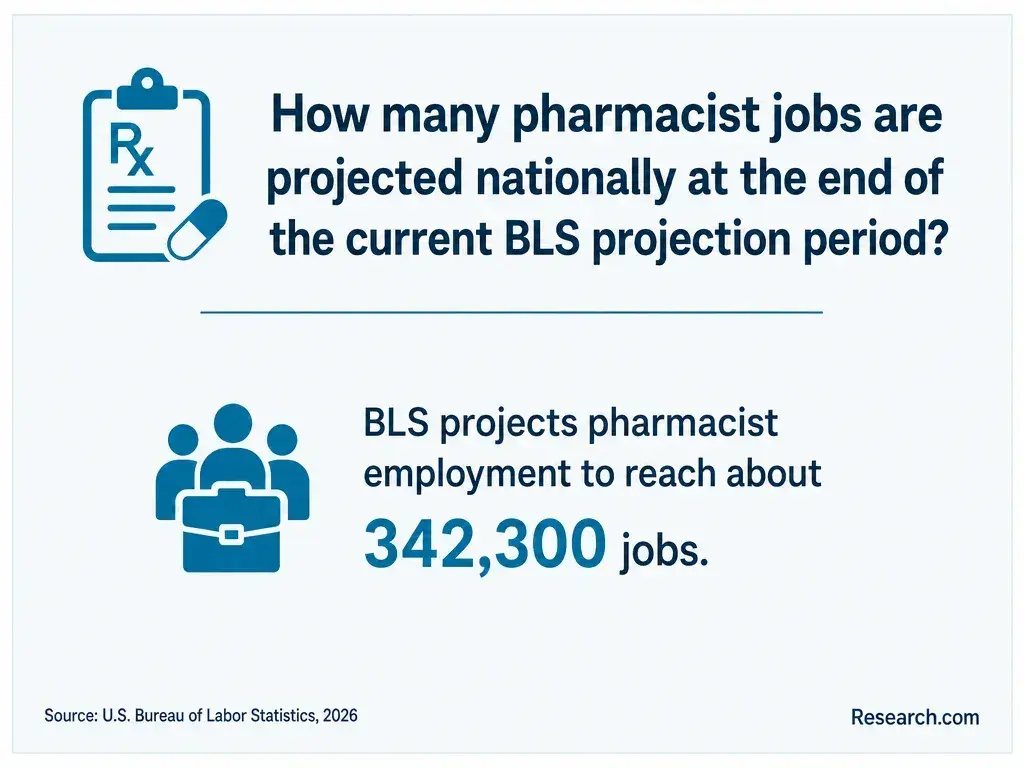
The BLS projects pharmacist employment to grow 5% from 2025 to 2035, with about 12,500 openings per year. That suggests continuing opportunities, but national projections cannot predict openings in your preferred city or practice setting. Physician opportunities likewise depend on specialty, location, and completion of the required training.
Use a short decision check before applying: identify whether you want medication-focused practice or physician diagnosis and treatment; map the years until licensure in your intended state; and request comparable, aid-year-specific total-cost estimates from schools. Shadowing both roles can test whether the daily work matches your expectations.
A strong job outlook is not a reason to rush into a program whose entry conditions you cannot meet. If your prerequisites are unfinished, review pharmacy programs for applicants still completing requirements, then confirm directly which courses may remain in progress and when they must be finished. The better choice is the path whose licensed work you want and whose full training cost and timeline you can realistically carry.
Other Things You Should Know About PharmD
Yes, if they meet the medical school's admissions requirements. A Pharm.D. does not generally replace medical school or its required clinical training; ask each school how it evaluates your prior coursework.
A Pharm.D. is a doctoral degree, but professional introductions must not mislead patients into thinking a pharmacist is a physician. Workplace policies and state rules may govern how the title is used.
Some can, but required classes, assessments, and clinical schedules may make regular employment difficult. Ask about attendance and rotation expectations before building wages into your financing plan.
Schools set their own policies for observation and experience. Shadowing can help you compare the jobs even when it is not required; confirm documentation rules with each admissions office.
- Cost of Attendance (Budget) | 2025-2026 Federal Student Aid Handbook https://fsapartners.ed.gov/knowledge-center/fsa-handbook/2025-2026/vol3/ch2-cost-attendance-budget
- What Financial Aid Offers Don't Tell You About the Cost of College | U.S. GAO https://www.gao.gov/blog/what-financial-aid-offers-dont-tell-you-about-cost-college
- Pharmacist (PharmD) - Genetics Undergraduate Program https://undergrad.genetics.iastate.edu/career-planning/pharmacist-pharmd
- Admissions Frequently Asked Questions and Tips | ucsf.edu https://pharmd.ucsf.edu/admissions/faq-tips
- PharmD Prerequisites - Doctor of Pharmacy https://pharmacy.wisc.edu/pharmd/prerequisites/
- Pharmacy vs. Medical School: Differences, Pros/Cons, & Which One is Right for You (2026) | Auburn University https://career.auburn.edu/blog/2026/08/21/pharmacy-vs-medical-school-differences-pros-cons-which-one-is-right-for-you-2026/
- PharmD Program at the College of Pharmacy | UNT Health Fort Worth https://www.unthealth.edu/college-of-pharmacy/faqs/pharmd-program.html
- USMLE (United States Medical Licensing Examination) | harvard.edu https://medstudenthandbook.hms.harvard.edu/206-licensure-usmle-united-states-medical-licensing-examination
- Pharm.D. Program Structures | AACP https://www.aacp.org/resource/pharmd-program-structures
- Dual Degree Programs | PharmCAS https://www.pharmcas.org/school-directory/explore-and-compare/dual-degree-programs


