
How to evaluate pharmacy school student support outcomes

Co-Founder and Chief Data Scientist
A pharmacy school may advertise extensive student support, but the useful question is whether students can access that support when coursework, clinical rotations, finances, or licensure preparation become difficult. For prospective Doctor of Pharmacy (Pharm.D.) students, that distinction can affect both educational cost and the path to practice. This guide shows you how to compare support services with graduation, exam, and career outcomes - and how to identify missing information before you commit to a program.
Key Things You Should Know
- Compare outcomes for the same entering cohort: on-time graduation alone can hide delayed completion, withdrawals, and dismissals.
- Use published National Association of Boards of Pharmacy (NABP) first-time NAPLEX results alongside a school's graduation data; neither measure proves that support services caused the outcome.
- Verify Accreditation Council for Pharmacy Education (ACPE) program status, the full cost of attendance, and access to advising, clinical placement, and wellness support before paying a deposit.
How should you define student support outcomes in pharmacy school?
Student support outcomes are observable results that help you judge whether a school's services help students progress through the professional Pharm.D. curriculum. Useful measures include continued enrollment, timely graduation, successful completion of required clinical experiences, first-time licensure-exam performance, and access to postgraduate or employment opportunities. Satisfaction surveys add context, but a favorable survey is not a substitute for progression data.
Ask for results tied to an entering class, including students who withdrew, repeated a year, or graduated late. Then ask whether the school reports results separately for students in different pathways or delivery formats. A school with strong overall results may still have gaps affecting the pathway you plan to enter.
Pre-pharmacy coursework is not the professional Pharm.D. curriculum, so confirm when each school starts counting its cohort. If you are preparing to transition from pre-pharmacy to a Pharm.D., this distinction prevents you from comparing undergraduate retention with professional-program graduation.
Which pharmacy school support services most influence student success?
Prioritize services that address predictable barriers in a Pharm.D. program: demanding science and patient-care coursework, supervised experiential education, financial pressure, and the transition to licensure. A service matters most when students know how to reach it, can use it early, and receive follow-up before a setback becomes a withdrawal.
Look for evidence that academic advisers monitor progression, tutoring covers required professional courses, experiential staff coordinate placements, and financial aid counselors understand professional-student costs. Ask current students whether appointment availability matches the school's description. For pharmacy programs for career changers, also check whether support addresses gaps in prerequisite knowledge without assuming every applicant has the same academic background.
Be wary of a long service directory with no published hours, eligibility rules, staffing contacts, or process for getting help during rotations. Availability matters more than the number of services listed.
How can you compare pharmacy school graduation and licensure outcomes?
Start with each school's most recent published outcomes, then check definitions and reporting years before comparing figures. NABP publishes school-level NAPLEX performance; the North American Pharmacist Licensure Examination (NAPLEX) tests pharmacy practice knowledge but is only part of the state licensure process. Jurisdictions set additional requirements, which may include a jurisprudence examination.
The following comparison separates measures that are often presented together even though they answer different questions.
| Measure | What it can show | Important limitation |
| Entering-cohort graduation | Whether students complete the professional program | Definitions of on-time completion and treatment of transfers may differ |
| Withdrawals, dismissals, and delayed graduation | Whether completion rates conceal substantial setbacks | Small cohorts can fluctuate considerably |
| First-time NAPLEX pass rate | How first-time test takers performed in a stated year | Test takers are not necessarily the full entering class |
| Residency or employment outcomes | Where responding graduates went next | Response rates and outcome definitions may differ |
Ask for the number of students behind each rate, not just the percentage. An accelerated Pharm.D. programs comparison especially requires consistent cohort definitions: a shorter planned curriculum should not be mistaken for stronger student support merely because its graduation timeline differs.
ACPE accreditation indicates that a professional pharmacy program has been evaluated against standards that include student-related policies, resources, assessment, and progression. Check the program's current status in ACPE's official directory, and read any public status information rather than relying on a school's general claim that it is "accredited." Accreditation supports a baseline judgment; it does not establish that every student receives timely tutoring or that graduates will pass licensing exams.
ACPE professional-program accreditation differs from an institution's accreditation and from authorization to enroll distance-learning students in your state. It also does not grant an individual a pharmacist license. If you encounter shorter online doctorate pathways, verify the credential carefully: a doctorate in another field is not a substitute for a Pharm.D. that meets the applicable pharmacist-licensure education requirements.
Compare the support students can use during scheduled classes, required in-person activities, and clinical rotations - not simply whether the school labels its teaching online or on campus. Online instruction may involve live sessions; it does not mean that hands-on labs, introductory pharmacy practice experiences (IPPEs), or advanced pharmacy practice experiences (APPEs) are remote or self-paced.
For online pharmacy school programs, ask who approves sites and preceptors, whether placements near home are possible, and how advisers or tutors meet with students during rotations. Confirm campus visits, travel costs, technology support, state authorization, and whether your intended licensing jurisdiction accepts the educational pathway. Campus students should ask comparable questions about placement travel and support away from campus; proximity to classrooms does not guarantee a nearby rotation.
Ask how the school identifies students who are struggling before a failed course or rotation. Effective policies should explain who contacts the student, how quickly an appointment is available, what tutoring covers, and how a student returns to good standing after remediation. Request the current student handbook so you can distinguish an available option from a required, potentially costly course repeat.
Advising should also account for an individual student's entry route. Review pharmacy degree transfer credit policies alongside the school's written evaluation of your own coursework: the receiving school decides whether prior credits meet prerequisites or apply to the professional curriculum. Ask whether a changed course sequence could delay graduation or financial aid eligibility.
Look for accessible counseling referrals, a clear process for disability accommodations, and a way to seek help during off-campus rotations. Ask who coordinates accommodations for labs, assessments, and experiential sites, and how requests are handled without unnecessarily disclosing private health information to instructors or preceptors. An accommodation process should be understandable before a student faces an urgent deadline.
Scheduling flexibility can matter particularly to caregivers, working students, and students managing health conditions. When considering pharmacy programs for nontraditional applicants, distinguish supportive admissions messaging from workable attendance, leave, and return-to-study policies. Ask whether a leave changes course sequencing or delays the next available rotation; no school can promise that every clinical schedule will be flexible.
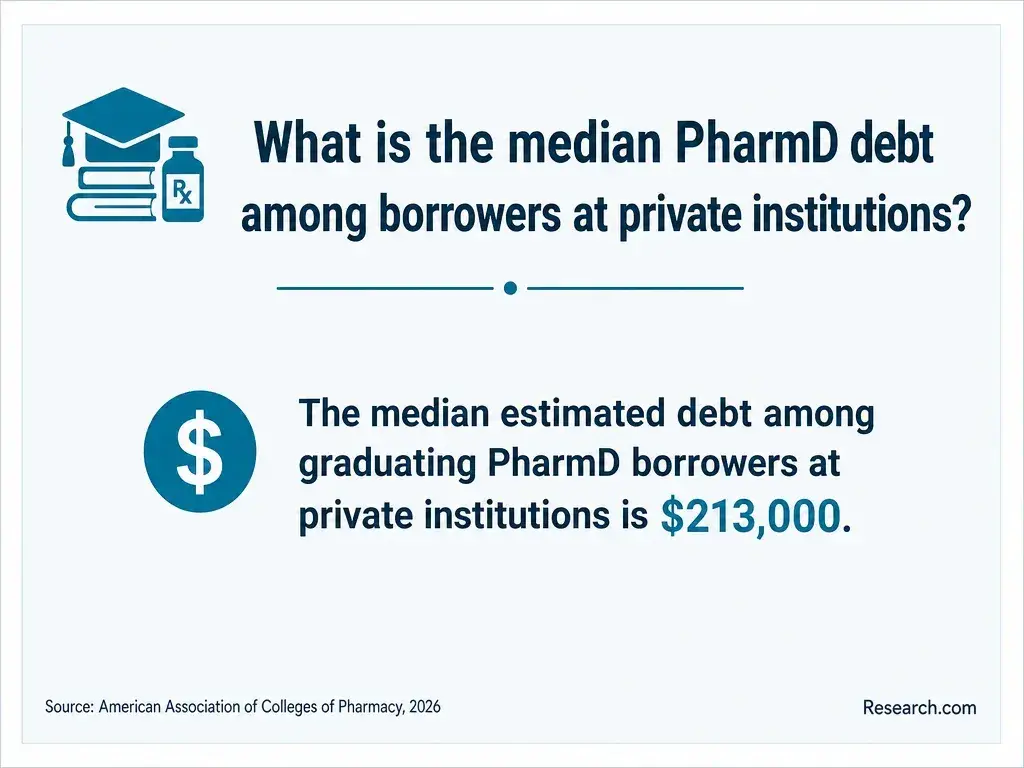
Compare each school's current cost-of-attendance estimate, not advertised tuition alone. Include mandatory fees, equipment and software, background checks, immunizations, transportation or housing for rotations, campus visits, and licensure-related expenses. If costs vary by placement, ask for a realistic range rather than assuming you will receive the least expensive site.
Financial aid staff should explain how your enrollment status and program classification affect eligibility, as well as the borrowing rules for your entry year. Federal borrowing rules changed for many new graduate and professional students beginning July 1, 2026; do not assume older Grad PLUS arrangements or loan limits apply to you. Compare written aid offers and ask which expenses must be paid before aid is disbursed.
Lists of budget-friendly pharmacy degree programs can help identify schools to investigate, but a lower tuition figure is not proof of lower total cost or adequate support. Price additional terms, required travel, and any lost work time before deciding.
Career outcomes are useful when they identify what graduates actually did and how the school collected the information. Ask whether employment figures cover all graduates or only survey respondents, and whether career services help with interviews, licensure planning, and practice-setting exploration. The Bureau of Labor Statistics reports median annual pay of $140,910 in May 2025 for pharmacists and projects 5% growth, 2025-2035, with about 12,500 openings per year. Those national figures describe the occupation, not a particular school's graduates or a promised return on tuition.
A postgraduate year one (PGY1) residency provides broad practice training; a postgraduate year two (PGY2) residency develops more specialized practice. Fellowships often have a different, program-specific focus. These routes, direct employment, and optional specialty board certification serve different goals; none replaces state pharmacist licensure. If a school advertises residency placements, request the number of applicants as well as the number who obtained positions.
Descriptions of pharmacy degree programs with accelerated schedules require a credential check. A short pharmacy-related program may prepare someone for a different role; it should not be counted as a pharmacist career outcome unless it is the relevant Pharm.D. pathway followed by applicable licensure requirements.
Which questions should you ask before choosing a pharmacy school?
Take the same questions to every school and request written answers or links to current policies. That makes missing data and meaningful differences easier to spot than a general conversation about "student success."
- What happened to the most recent entering Pharm.D. cohort, including delayed graduates, withdrawals, and dismissals?
- What were the school's latest published first-time NAPLEX results, and how many graduates took the exam?
- How soon can a student obtain tutoring or advising after a difficult assessment or rotation evaluation?
- Who coordinates IPPE and APPE placements, and what travel, intern-registration, or other student obligations may apply?
- What is my estimated total cost, which aid rules apply to my entry year, and what would an extra term cost?
- Can I review current accreditation status, the student handbook, accommodation procedures, and graduate-outcome definitions before depositing?
Choose the school that can substantiate outcomes and show that its support is usable under your likely schedule and budget. An affordable route through pharmacy education is only a sound choice if the credential fits your goal and its complete cost, clinical obligations, and licensure pathway hold up to scrutiny.
Other Things You Should Know About PharmD
Ask admissions to connect you with students in your intended pathway, including someone who has completed rotations. Their experiences can reveal practical issues, but treat individual accounts as context rather than representative outcome data.
Generally, a student's education records are protected under the Family Educational Rights and Privacy Act (FERPA). Ask the school what consent is needed before it shares records with a family member.
Not necessarily. Undergraduate and professional students may use different advisers, tutors, or eligibility rules. Ask specifically about services available after you enter the Pharm.D. curriculum.
Start with the school's published grievance or appeal process and keep copies of relevant communications. The student handbook should identify the appropriate office and deadlines; accreditation-related complaints have a separate ACPE process.
- Reenvisioning Assessment for the Academy and the... - PMC https://pmc.ncbi.nlm.nih.gov/articles/PMC3776895/
- Current PharmD Student Resources | CU School of Pharmacy https://pharmacy.cuanschutz.edu/current-students/on-campus-pharmd-students/pharmd-resources
- NAPLEX Preparatory Perceptions from Recent Graduates at One College of Pharmacy - ScienceDirect https://doi.org/10.1016/j.ajpe.2024.100642
- Student Support Services | University of Health Sciences and Pharmacy in St. Louis https://www.uhsp.edu/campus-experience/student-support-services/
- School of Pharmacy Educational Assessment | dyu.edu https://www.dyu.edu/academics/schools-and-departments/school-pharmacy/school-pharmacy-educational-assessment
- Retention and Student Success - Best Practices and Successful Initiatives - University of Maine System https://www.maine.edu/student-success/retention-and-student-success-best-practices-and-successful-initiatives/
- Measuring Student Success Beyond Completion - AGB https://agb.org/trusteeship-article/measuring-student-success-beyond-completion/


