Online PharmD Learning Platform Checklist

Co-Founder and Chief Data Scientist
An online Doctor of Pharmacy (Pharm.D.) program may let you study from home, but its labs, assessments, and clinical rotations can still require substantial time in person. For prospective pharmacy students, the decision is less about finding an online classroom than confirming that the entire pathway fits their location, schedule, budget, and licensing goals.
This guide explains what to check in a program's learning platform and beyond it, then gives you a comparison checklist to use before applying or paying a deposit.
Key Things You Should Know
- Confirm the specific Pharm.D. program's Accreditation Council for Pharmacy Education (ACPE) status, your state's distance-education eligibility, and your intended licensing board's rules separately.
- Get written details on live classes, campus visits, introductory and advanced clinical rotations, placement support, and time away from work; "online" does not mean fully remote or self-paced.
- Compare total attendance costs and licensure outcomes, not tuition alone. The U.S. pharmacist median annual pay was $140,910 in May 2025, but that figure cannot predict an individual graduate's earnings or debt repayment.
What is an online PharmD learning platform?
An online Pharm.D. learning platform is the set of digital systems a professional pharmacy program uses for lectures, discussions, assignments, assessments, and student support. It may include a learning management system, live video classes, virtual patient cases, drug-information resources, and exam proctoring. Platform access is not the same as hands-on training: a virtual case can support clinical reasoning, but it does not replace required supervised patient-care experiences.
Start online Pharm.D. program selection by checking the program's published delivery requirements, then ask for a demonstration of the systems students actually use. Distinguish tools mentioned in promotional material from tools students receive access to and use in assessed coursework.
How do online PharmD programs meet accreditation requirements?
ACPE accredits professional pharmacy education programs, including programs that deliver some instruction online. The program must meet applicable educational standards across its curriculum, assessment, faculty support, and experiential education; online delivery does not waive those expectations. Check the specific professional program and its current status in ACPE's official directory before relying on a school's description.
Three checks answer different questions. ACPE status concerns the professional Pharm.D. program. Institutional accreditation concerns the university or college. State authorization concerns whether a school may enroll a distance learner in your location; clinical placement can raise additional state or site requirements. None of these checks, alone, establishes eligibility for a pharmacist license in every state. Even when comparing affordable pharmacy doctoral education, do not trade away verification of the professional program's status.
Can online PharmD graduates become licensed pharmacists?
Yes, graduates of an appropriately accredited online or hybrid Pharm.D. pathway can pursue U.S. pharmacist licensure, subject to the requirements of the jurisdiction where they apply. Degree completion is not a license. State boards determine eligibility, which generally involves an accepted pharmacy education, required practical experience, the North American Pharmacist Licensure Examination (NAPLEX), and any applicable law examination or other state requirements.
Do not assume every jurisdiction uses the Multistate Pharmacy Jurisprudence Examination (MPJE): examination rules vary, and some jurisdictions began transitioning to the Uniform Multistate Pharmacy Jurisprudence Examination (UMPJE) in 2026. Before enrolling, ask the school how its pathway supports licensure in your intended state, then confirm the answer with that state's pharmacy board. General doctoral degree timeline options are not substitutes for a professional Pharm.D. that satisfies pharmacist licensing requirements.
The professional Pharm.D. curriculum typically integrates pharmaceutical sciences, pharmacotherapy, calculations, medication safety, patient assessment, communication, and supervised practice. Students learn to evaluate medication regimens and explain recommendations; prerequisite biology or chemistry courses are preparation for, not replacements for, this professional curriculum.
Ask for the current course sequence and identify how students practice and are assessed on counseling, clinical decision-making, dispensing workflows, and any required compounding or physical-assessment skills. A platform may teach concepts through simulations while the school schedules hands-on work separately. Students hoping to build on prior biology or chemistry coursework should ask which credits satisfy admission prerequisites and whether any credits can enter the professional curriculum; those are different decisions.
Online and campus pathways lead toward the same professional degree, but their weekly logistics may differ substantially. The most useful comparison is a sample term schedule - not the label "online."
This table separates common delivery differences from the questions that still require a program-specific answer.
| Factor | Online or hybrid pathway | Campus pathway |
| Class attendance | May combine recorded work with required live sessions | Usually centers on scheduled in-person classes |
| Hands-on training | May require campus visits or other designated in-person sessions | Often integrated into the campus schedule |
| Clinical rotations | In-person placements remain necessary; location and travel depend on the program | In-person placements remain necessary; location and travel depend on the program |
| Best scheduling test | Check live meetings, visits, rotation blocks, and time zones | Check commuting, campus hours, and rotation blocks |
Online delivery may reduce routine commuting without preserving a full-time work schedule during rotations. Likewise, how accelerated Pharm.D. programs work is a separate question from where classes meet: a shorter calendar can mean less room for paid work or schedule changes.
Requirements are school-specific. Programs may specify undergraduate prerequisite courses and labs, minimum grades, a GPA threshold, recommendations, interviews, and application materials. A completed bachelor's degree is not universally required. A published minimum is an eligibility threshold, not an admission guarantee.
Use the current school admissions page and, if that school participates, its PharmCAS directory entry to check deadlines and submission rules. Ask admissions staff how they evaluate online labs, community-college work, repeated courses, older credits, and courses still in progress. The Pharmacy College Admission Test (PCAT) was retired in January 2024; do not plan around taking it. A guide to pharmacy program applicant requirements can help frame your questions, but the school's current rules control your application.
Completion time depends on prerequisite work, the program's professional course sequence, and any approved prior credit. An online format does not automatically shorten the professional curriculum. Request a term-by-term plan that includes campus attendance and rotation blocks; compare the date you could actually start professional courses, not just the advertised program length.
For cost, request a written estimate covering tuition, mandatory fees, technology, materials, travel and lodging for in-person sessions, rotation-related expenses, and licensing steps. The cheapest advertised tuition may not mean the lowest cost of attendance, particularly if placements require travel or prevent paid work. Comparisons of pharmacy education with shorter completion time should be checked for the exact credential: a shorter pharmacy-related degree may not be a licensure-qualifying Pharm.D.
Ask the financial aid office to explain your classification and borrowing options for your entry date. Federal loan rules changed for many new graduate and professional borrowers beginning July 1, 2026; older descriptions of Grad PLUS access or borrowing limits may not apply to you.
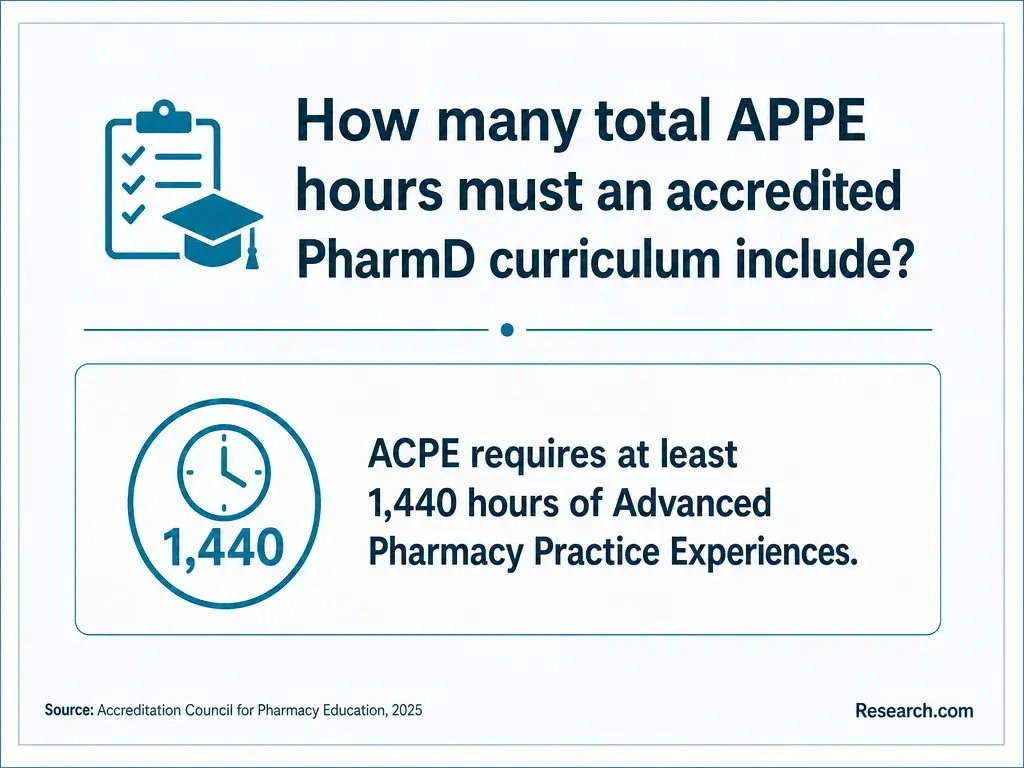
Pharm.D. students complete introductory pharmacy practice experiences (IPPEs) and advanced pharmacy practice experiences (APPEs). IPPEs introduce supervised practice; APPEs provide more extensive practice in settings such as community pharmacies, hospitals, and patient-care services. These are in-person professional requirements, not activities a learning platform can make fully remote.
Before committing, ask who secures and approves sites and preceptors, whether placements are available near your home, and when locations become final. Confirm requirements for intern registration, background checks, immunizations, transportation, and any limits on using your current workplace. Do not assume previous pharmacy work counts toward rotations or that professional coursework transfers: pharmacy school credit transfer options are determined by the receiving school, while experiential substitutions require its separate approval.
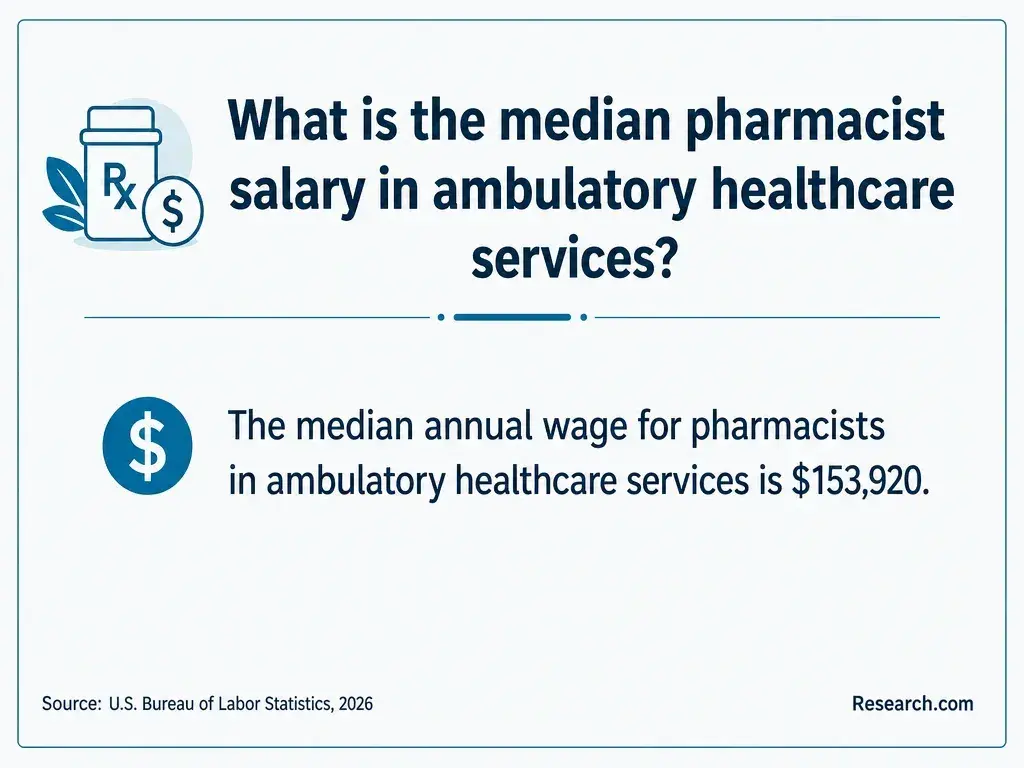
Licensed pharmacists work in community, hospital, ambulatory, specialty, and other practice settings; responsibilities and hiring expectations vary. The Bureau of Labor Statistics reports a pharmacist median annual pay of $140,910 in May 2025 and projects 5% employment growth from 2025 to 2035, with about 12,500 openings per year. These occupation-wide figures do not predict a particular online program graduate's job, starting salary, or return on tuition.
Some positions favor postgraduate residency training; fellowships often serve different career goals, such as industry-focused work. Neither is universally required for pharmacist employment, and optional specialty board certification is separate from state licensure. If your goal is a pharmacy technician or another pharmacy-adjacent role rather than licensed pharmacist practice, investigate pharmacy programs with shorter completion times before taking on a Pharm.D. commitment.
How can you choose a reputable online PharmD program?
Compare only programs that can plausibly serve your intended licensing state and schedule. Use the fields below for written answers from each school; a blank or unclear answer is a reason to follow up before paying a deposit.
This scorecard keeps the most consequential program facts side by side. Enter the source or contact who confirmed each answer alongside your notes.
| Comparison field | Program A | Program B |
| ACPE professional-program status; date checked | ________ | ________ |
| Enrollment authorization in my state | ________ | ________ |
| Licensing-state guidance confirmed with board | ________ | ________ |
| Live classes, time zone, and campus visits | ________ | ________ |
| IPPE/APPE site support and travel expectations | ________ | ________ |
| Prerequisites and earliest feasible start | ________ | ________ |
| Estimated total attendance cost and aid terms | ________ | ________ |
| Published NAPLEX outcomes and reporting period | ________ | ________ |
Once the fields are filled, use this final check to turn the comparison into a decision:
- Verify ACPE status independently and confirm state authorization, clinical-placement feasibility, and licensing requirements with the appropriate offices and board.
- Compare actual term schedules and written cost estimates, including likely travel and lost work time.
- Ask how the school supports students who need placement changes, technology help, academic support, or licensure preparation; review published NAPLEX results with their reporting period and cohort context.
- Request written evaluations of outstanding prerequisites or prior credit before treating an expected start date as firm.
Be cautious if a school cannot explain required in-person work, implies that accreditation alone guarantees licensure, or promises nearby rotations without describing its placement process. Applicants to pharmacy programs for students with varied academic backgrounds should be especially careful to distinguish conditional admission from permission to begin professional coursework.
Other Things You Should Know About PharmD
Not necessarily. Ask the school for its current device, internet, webcam, and software requirements before purchasing anything. Confirm which clinical references or applications are supplied through student access.
Possibly, but required live sessions and timed assessments may follow the school's local schedule. Check the published attendance policy rather than assuming recorded classes are available for every activity.
Potentially. Tell the school promptly because state rules and placement arrangements may differ. Check the new state board's requirements yourself before relying on a previously planned pathway.
Ask what a typical week actually looks like, how much notice students receive for in-person commitments, and how quickly the school resolves technology or placement problems. Their experience is useful context, but confirm requirements against current school policies.
- Program Integrity Questions and Answers | ed.gov http://www.ed.gov/laws-and-policy/higher-education-laws-and-policy/program-integrity-information-questions-and-1
- DAPIP | Homepage - Office of Postsecondary Education (OPE) https://ope.ed.gov/dapip/
- Rule 3358:5-7-14 | Student location policy. https://codes.ohio.gov/ohio-administrative-code/rule-3358:5-7-14
- Cost of Attendance (Budget) | 2025-2026 Federal Student Aid Handbook https://fsapartners.ed.gov/knowledge-center/fsa-handbook/2025-2026/vol3/ch2-cost-attendance-budget
- Distance Doctor of Pharmacy | University of Findlay https://pharmdonline.findlay.edu/programs/online-pharm-d
- Experiential Education | Washington State University https://pharmacy.wsu.edu/pharmd/experiential-services/
- Earn an Online Pharm.D. Degree at St. John Fisher University https://onlinepharmd.sjf.edu/
- PharmD Remote Pathway | CU School of Pharmacy https://pharmacy.cuanschutz.edu/degreesandprograms/pharmd/remote-pharmd
- Ready or Not, Here It Comes! New Regulations When Offering Programs Leading to a License Effective July 1! | WCET https://wcet.wiche.edu/frontiers/2024/05/16/ready-or-not-here-it-comes-new-regulations-when-offering-programs-leading-to-a-license-effective-july-1/
- Experiential Education Site Selection Policy | ucsf.edu https://pharmd.ucsf.edu/policies/site-selection