Social Science Prerequisites for PharmD Programs

Co-Founder and Chief Data Scientist
A psychology or sociology course can look like a straightforward Pharm.D. prerequisite - until one pharmacy school accepts it and another asks for something different. This guide is for prospective Doctor of Pharmacy (Pharm.D.) applicants choosing courses or checking credits they have already earned. It explains common social science requirements, how schools evaluate credits and online classes, and what else to verify before applying.
The goal is to help you avoid paying for an unnecessary course or discovering a missing prerequisite too late.
Key Things You Should Know
- Psychology and sociology are common ways to meet a social science prerequisite, but the receiving pharmacy school decides which courses count.
- Check both subject and credit requirements: one 3-credit course cannot, by itself, satisfy a 6-credit requirement.
- Get written confirmation of course equivalencies and online-course acceptance before enrolling; prerequisite credit is separate from the professional Pharm.D. curriculum.
What social science courses are required for PharmD program admission?
There is no single social science course required for admission to every U.S. Pharm.D. program. Schools may specify introductory psychology or sociology, allow a broader social and behavioral science elective, include these subjects within a general education requirement, or set no separate social science category.
Read the target school's current prerequisite list alongside its pharmacy program application requirements. Look for the exact subject, minimum credits, accepted course level, minimum grade, and deadline for finishing coursework. A recommended class is not the same as a required one. These are pre-professional courses completed before entry, not credits automatically awarded toward the professional Pharm.D. curriculum.
Which psychology and sociology classes satisfy PharmD prerequisites?
Introductory psychology and introductory sociology are sensible courses to check first because their broad content may match a school's stated requirement. A specialized class - such as abnormal psychology, social psychology, or medical sociology - may count when a school accepts upper-level or subject-specific electives, but its title alone does not establish equivalency. Courses in anthropology, economics, or political science may qualify for a broad social science category at some schools and not others.
For applicants coming from another field, existing psychology or sociology credits may reduce additional coursework. That can make pharmacy programs for career changers worth exploring, provided the school allows outstanding prerequisites to be completed by its stated deadline. Compare the course description and syllabus with the school's wording rather than assuming every course carrying a social science label will count.
Do PharmD prerequisites vary by pharmacy school?
Yes. Each school sets its own admissions prerequisites and decides how prior coursework applies. The current school admissions page and, where applicable, its PharmCAS directory entry should guide your planning; neither another school's acceptance nor a general course-category label guarantees approval.
The table shows policy differences that can change which course you should take. It describes possibilities to check, not rules shared by all programs.
| Policy to compare | Possible differences | Why it matters |
| Accepted subjects | Named psychology or sociology course versus a broader elective | A specialized course may fit one school but not another. |
| Credit and grade rules | Different credit minimums or required grades | An accepted subject may still leave a shortfall. |
| Completion timing | Required before applying versus before matriculation | Your remaining course schedule may affect eligibility. |
| Prior-course policies | Different treatment of online, transfer, or older credits | Previously earned coursework may need individual review. |
When you compare pharmacy doctorate options, keep a separate prerequisite checklist for each school. Do not use one program's decision as a nationwide rule.
Often they can, but acceptance is school-specific. Ask whether the course must be taken for college credit at an eligible institution, whether a graded transcript is required, and whether the program distinguishes online courses from online laboratory courses. A social science lecture has different considerations from a science prerequisite with a lab; approval of one does not imply approval of the other.
Before choosing a course for its convenience or price, confirm that the receiving school accepts its format and credits. If you are also comparing online pharmacy school cost options, treat the prerequisite course and the professional program as separate decisions. An online Pharm.D. pathway may still require in-person labs, campus visits, and clinical rotations.
Request a course-by-course answer from each target program before registering for a replacement class. This sequence creates a record you can use when planning applications.
- Copy the current prerequisite wording, credit minimum, grade rule, and completion deadline from the school's admissions materials.
- Collect the course title, institution, credit system, catalog description, syllabus, and transcript or planned-course details.
- Ask admissions which specific requirement the course fulfills and whether its format, grade, and credits are acceptable.
- Save the dated written response and recheck the requirement if you apply in a later admissions cycle.
A transcript evaluation or a general transfer-credit award is not necessarily approval of a particular prerequisite. Use pharmacy prerequisite credit evaluation as a planning topic, but rely on the receiving school's decision for your application. Be especially careful with quarter credits, repeated courses, and classes whose titles do not reveal their content.
The timeline has two distinct parts: completing any missing pre-professional prerequisites and then completing the professional Pharm.D. program. The latter commonly takes four academic years, although program designs and entry pathways vary. A social science course taken before admission generally fulfills an entry requirement; it does not shorten the professional curriculum unless a school explicitly provides an applicable pathway.
When comparing timelines, include time needed for prerequisite sequencing, application cycles, and required in-person training. Lists of shortest online doctoral programs may include degrees that do not qualify graduates for the U.S. pharmacist licensing pathway. The relevant comparison is between Pharm.D. programs whose requirements and accreditation fit your goal - not doctoral degrees with similar-sounding titles.
Check the professional Pharm.D. program's current status with the Accreditation Council for Pharmacy Education (ACPE). ACPE program accreditation is distinct from an institution's accreditation and, for an online pathway, from authorization to enroll students in a particular state. Verify those matters separately, along with any restrictions affecting clinical placements.
Earning a Pharm.D. does not itself grant a pharmacist license. Graduates must meet the licensing board's applicable requirements, which can include supervised experience, the North American Pharmacist Licensure Examination (NAPLEX), and a jurisdiction-specific law assessment. Do not assume every jurisdiction uses the Multistate Pharmacy Jurisprudence Examination (MPJE); requirements and use of the Uniform Multistate Pharmacy Jurisprudence Examination (UMPJE) vary. If considering Pharm.D. completion pathways, confirm the particular professional program's ACPE status and ask the board where you intend to practice about licensure eligibility.
What careers and salaries can PharmD graduates expect?
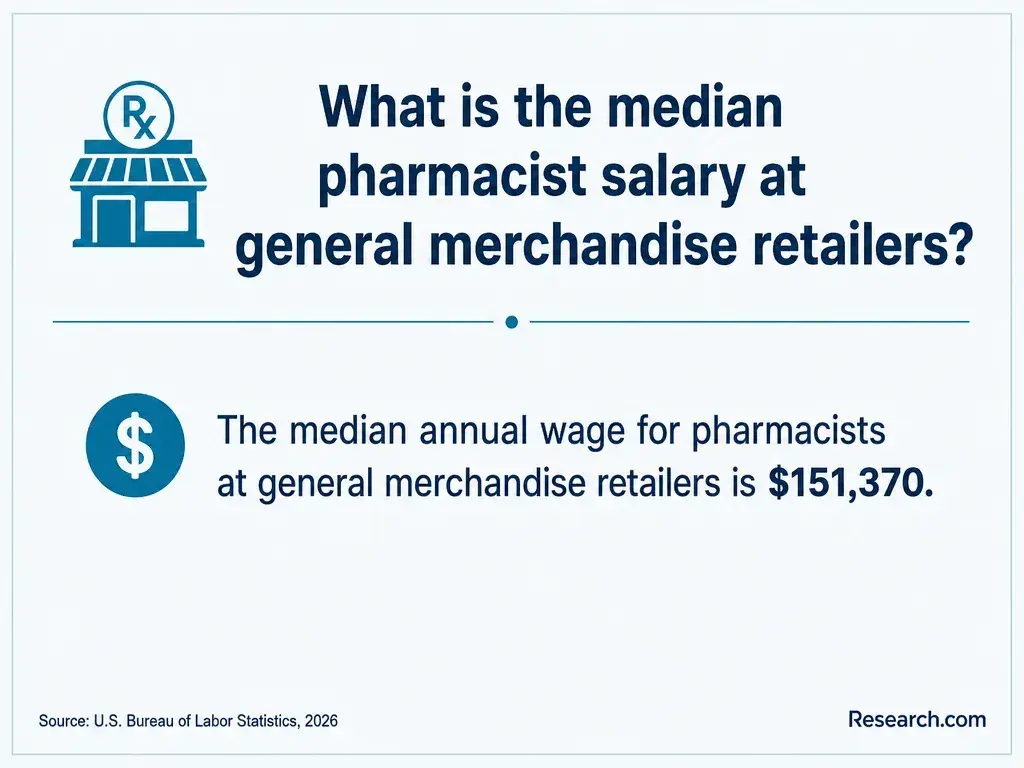
A licensed pharmacist may work in community, hospital, ambulatory care, or other medication-related settings; duties and additional training expectations vary by role. The Bureau of Labor Statistics reports median annual pay for pharmacists of $140,910 in May 2025 and projects 5% job growth, 2025-2035. Those occupation-wide figures are context, not a salary or job offer for an individual graduate.
Some positions favor postgraduate residency or fellowship training, while many pharmacist roles do not require it. Specialty board certification is a separate credential, not a substitute for state licensure. If your goal is a pharmacy support role rather than licensed pharmacist practice, short-duration pharmacy programs may be more relevant; a pharmacy technician pathway does not ordinarily require a Pharm.D. Choose prerequisite courses with the credential and role you actually intend to pursue in mind.
Other Things You Should Know About PharmD
Usually, experience is evaluated separately from required academic coursework. Ask the school whether it offers a formal way to satisfy the specific requirement through prior learning; do not assume pharmacy work or volunteering waives it.
Only if the receiving program permits pass/fail grades for that prerequisite. Check its grading policy before changing a course's grading option.
Policies vary. Ask whether the school accepts the exam credit, what transcript notation it needs, and whether the awarded credits fulfill the specific prerequisite rather than only general elective credit.
The pharmacy school may require a designated foreign-credential evaluation and additional course documentation. Confirm its process directly; an evaluator's credit recommendation does not, by itself, establish that the course meets a Pharm.D. prerequisite.
- Evaluation of Foreign Degrees - United States Department of State https://www.state.gov/global-community-liaison-office/family-member-employment/family-member-employment-in-the-d-c-area/evaluation-of-foreign-degrees
- Prerequisite Coursework | School of Pharmacy https://www.pharmacy.pitt.edu/academics/doctor-pharmacy/apply-pharmd-program/prerequisite-coursework
- PharmD Program Prerequisites - Temple School of Pharmacy https://pharmacy.temple.edu/pharmdprereqs
- PharmD Application Process and Requirements | umich.edu https://pharmacy.umich.edu/pharmacy-programs/pharmd-program/application-process-requirements/
- FAQ | OSU College of Pharmacy - Oregon State University https://pharmacy.oregonstate.edu/programs-admissions/pharm-d/faq
- PharmD Prerequisites - Doctor of Pharmacy https://pharmacy.wisc.edu/pharmd/prerequisites/
- Academic Prerequisites - Admissions | ucsf.edu https://pharmd.ucsf.edu/admissions/reqs/academic