How to Ask for Help When Struggling in a PharmD Course

Co-Founder and Chief Data Scientist
A difficult exam or a growing backlog in a Doctor of Pharmacy (Pharm.D.) course can make it hard to know whether to study differently, ask for help, or reconsider your schedule. Acting early matters because courses build on one another, and a missed progression requirement can delay clinical training.
This guide is for Pharm.D. students who need a practical next step. It explains whom to contact, how to describe the problem, which support to try first, and when a course withdrawal deserves serious consideration.
Key Things You Should Know
- Ask for help after the first clear warning sign - not only after a failing grade. Bring the syllabus, your assessment results, and a specific example of where your reasoning breaks down.
- Choose support that matches the problem: a professor for course expectations, tutoring for repeated skill gaps, an academic adviser for progression rules, or health and counseling services when well-being is interfering with study.
- Before withdrawing, confirm the course's deadline, prerequisite sequence, financial-aid implications, and effect on clinical rotations with the offices responsible for those decisions.
How can students ask for help when struggling in a PharmD course?
Start with a specific request and the person best able to answer it. A course instructor can clarify an exam error; a tutor can help you practice the underlying skill; an academic adviser can explain what a grade means for your program sequence. You do not need to know the solution before making contact.
Use this short sequence to turn a vague concern into a useful conversation:
- Identify the warning sign: a low quiz score, missed assignment, difficulty applying concepts, or repeated trouble completing cases on time.
- Check the syllabus and your work for one or two examples of what you do not understand.
- Contact the instructor promptly and request a meeting or office-hours visit; ask the adviser separately if progression may be at risk.
- Leave each conversation with a practice plan, a way to check improvement, and a date to reassess.
If you entered pharmacy school with a biology or chemistry background, say whether the difficulty is applying familiar science to patient cases rather than recalling the science itself. Students still exploring online pharmacy programs for science-background students can use that distinction when asking what academic support a program provides.
Which PharmD courses are most challenging for pharmacy students?
There is no universal "hardest" Pharm.D. course. Challenges depend on a student's preparation, teaching format, and assessment style. The professional Pharm.D. curriculum also differs from undergraduate pre-pharmacy prerequisites: it asks students to apply foundational science to medication decisions and patient care.
The comparison below shows why common course difficulties call for different kinds of practice, rather than simply more reading.
| Course area | What students may find difficult |
| Pharmacology and medicinal chemistry | Connecting drug mechanisms and chemical properties to therapeutic effects. |
| Pharmacokinetics and calculations | Choosing an appropriate method, checking units, and interpreting the result. |
| Therapeutics and patient cases | Combining disease knowledge, patient factors, evidence, and monitoring plans. |
| Skills labs and experiential preparation | Demonstrating communication and technical skills accurately under assessment conditions. |
If the gap began before matriculation, review the relevant foundation without assuming you must repeat a prerequisite. Pharmacy school admission requirements vary by institution, while the immediate question for an enrolled student is which professional-course skill needs attention now.
What academic support services help PharmD students improve?
The most useful service is the one that addresses the cause of the difficulty. Course tutoring may help with calculations or therapeutics; an academic skills center can address study planning; a drug-information librarian can teach efficient evidence searching. A skills-lab instructor or experiential education office may be better suited to concerns about counseling demonstrations or rotation readiness.
Ask what support your school actually offers, when it is available, and whether it covers the assessment you are preparing for. If you are comparing best online Doctor of Pharmacy programs, check access to live instructor help, tutoring, skills practice, and in-person requirements rather than assuming online delivery means the same support at every school.
Keep the first message brief and specific. For example: "I missed the renal-dose adjustment questions on the last quiz. I reviewed my work and think I am choosing the wrong patient information before calculating. Could we meet during office hours to go through one example and discuss how I should practice?" This gives the professor something concrete to address without asking them to reteach the whole unit by email.
During the meeting, explain how you arrived at an answer, listen for the point where your reasoning diverged, and confirm what you should attempt independently next. If a professor identifies a deeper prerequisite gap or a risk of failing, involve your academic adviser too. Before considering a move to another school, ask the receiving program about pharmacy school credit transfer options; acceptance of previous coursework is not automatic.
Seek tutoring when the same error appears across assignments, you cannot explain a solution without looking at notes, or your current study method is not improving performance. Seek peer mentoring when you understand the material but need help organizing a heavy course load or adjusting to a program's pace. Do not wait for a course to become mathematically impossible to pass.
Bring attempted problems or cases to each session. Ask the tutor to watch your reasoning, then complete a similar problem on your own; a reassuring explanation is less useful than evidence that you can reproduce the skill. If setbacks have already affected your schedule, discuss the school's repeat and progression policies before assuming that Pharm.D. completion pathways will recover lost time.
Academic support works poorly when exhaustion, illness, caregiving demands, or financial strain are the main barrier. Tell an adviser enough to identify the appropriate support, and contact student health, counseling, accessibility services, or an employee-assistance resource if your school provides one. If you feel unsafe or are in immediate danger, seek urgent local help rather than waiting for an academic appointment.
Financial pressure can also make an already difficult term harder. Meet with the financial-aid office before changing enrollment or taking on more work, because aid eligibility and borrowing rules depend on your circumstances and the applicable aid year. If cost is driving a longer-term program decision, compare the full educational cost of lower-cost online Pharm.D. pathways, including any required travel and clinical placements - not tuition alone.
Match practice to the assessment. Rereading can refresh facts, but it does not show whether you can calculate a dose, select relevant patient information, or defend a treatment recommendation. Ask your instructor which reasoning steps the course expects before changing your approach.
These strategies produce work you can review with a professor or tutor:
- Retrieve key concepts from memory before checking notes, then revisit missed concepts over several study sessions.
- Work new calculations and patient cases without a completed example beside you; check units, assumptions, and clinical reasoning afterward.
- Keep an error log that separates knowledge gaps, misread questions, calculation mistakes, and time-management problems.
- Practice counseling or skills assessments aloud using the course's published criteria and permitted materials.
Do not confuse a shorter credential with a faster route through the professional curriculum. Listings of fastest online pharmacy degree programs may include credentials with different purposes; they do not establish that a Pharm.D. student can skip required professional coursework or experiential education.
Book help around a decision or a demonstration of skill, not just before an exam. Bring your attempted work to office hours, ask the instructor to identify the first incorrect step, and try a fresh example before leaving. If the issue spans courses, ask an adviser to help you prioritize deadlines and identify which course is a prerequisite for later work.
Check the student handbook for tutoring access, remediation rules, examination review procedures, and the appropriate contact for experiential concerns. A timetable that looks flexible can still have fixed skills assessments and rotations. General comparisons of online doctorate time to completion are no substitute for your Pharm.D. program's actual course sequence and policies.
Consider withdrawal when a realistic review of remaining assessments shows that passing is unlikely, or when continuing would substantially worsen a serious health or personal problem. First, check whether your program permits withdrawal from that course and what alternative - such as remediation, a repeat, or a leave - may be available. A transcript withdrawal, course failure, and approved leave can have different consequences.
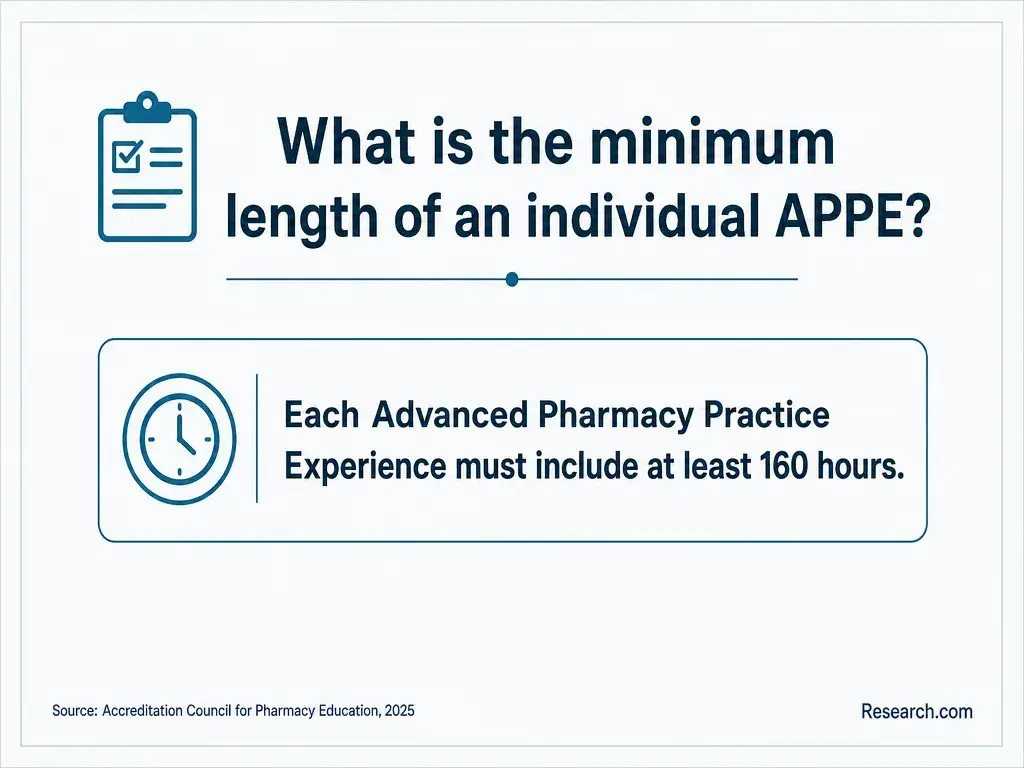
Before the deadline, ask the registrar about transcript treatment, the academic adviser about course sequencing and progression, and financial aid about enrollment status and possible aid or loan effects. Ask the experiential education office if the course gates introductory pharmacy practice experiences (IPPEs) or advanced pharmacy practice experiences (APPEs). If you later compare pharmacy programs that may offer strong value, include the cost of repeated coursework and any delayed progression; a shorter advertised timeline may not apply to transfer students.
How can struggling students protect PharmD progression and licensure eligibility?
Get your program's progression requirements in writing: minimum course grades, remediation opportunities, repeat limits, professional-behavior standards, and conditions for entering IPPEs and APPEs. Ask which office confirms that requirements have been met. If a problem arises during a rotation, follow the school's reporting process promptly, especially when patient safety is involved.
Graduating from a Pharm.D. program is distinct from obtaining a pharmacist license. The Accreditation Council for Pharmacy Education (ACPE) accredits professional pharmacy programs, while state boards set licensure requirements; the North American Pharmacist Licensure Examination (NAPLEX) is part of the licensing process, not a license by itself. Jurisprudence examinations and intern-registration requirements vary by jurisdiction. If you must reapply or change pathways, investigate pharmacy degree options without every prerequisite completed, but confirm any new school's current admission, credit-evaluation, and ACPE status directly before committing.
Other Things You Should Know About PharmD
Asking for help is not, by itself, a residency disqualification. Programs evaluate applicants under their own criteria. Focus on addressing the difficulty and accurately describing what you learned if an application later asks about an academic setback.
Yes. Contact the school's accessibility office to discuss eligibility and its process. Accommodations are generally arranged through that office rather than negotiated informally with each professor; whether they apply to a past assessment depends on school policy.
Follow the site's immediate safety procedures and promptly notify your preceptor and the school's experiential education office as directed by program policy. Do not wait for a routine course review to raise an urgent concern.
Ask how information from the meeting will be handled. Faculty may need to share relevant academic or safety concerns with authorized school personnel under institutional policy; student education records also have legal protections.
- The Civil Rights of Students With Hidden Disabilities and Section 504 | U.S. Department of Education http://www.ed.gov/laws-and-policy/individuals-disabilities/section-504/civil-rights-of-students-hidden-disabilities-and-section-504
- ADA Requirements: Testing Accommodations https://www.ada.gov/resources/testing-accommodations/
- College Students: Mental Health Problems and Treatment Considerations - PMC https://pmc.ncbi.nlm.nih.gov/articles/PMC4527955/
- Frequently Asked Questions | Protecting Student Privacy https://studentprivacy.ed.gov/frequently-asked-questions
- Academic Advising and Peer Mentoring | FAO UNC Eshelman School of Pharmacy https://faopharmacy.unc.edu/office-of-student-affairs/academic-advising/
- P4 Student Advice to P1 Students - School of Pharmacy https://pharmacy.ku.edu/pharmacy-school-advice
- Tutor Services | cnsu.edu https://pharmacy.cnsu.edu/dept/student-affairs/tutor-services.php
- Student mental health is in crisis. Campuses are rethinking their approach | apa.org https://www.apa.org/monitor/2022/10/mental-health-campus-care
- Advising & Academics " Pharm.D. Students " | ufl.edu https://students.pharmacy.ufl.edu/student-affairs/advising-academics/
- Online Student Services | CU School of Pharmacy https://pharmacy.cuanschutz.edu/current-students/distance-degree-and-programs/student-services