Online PharmD academic advising: what to ask

Co-Founder and Chief Data Scientist
An online Doctor of Pharmacy (Pharm.D.) program may let you complete some coursework from home, but its labs, clinical placements, costs, and path to licensure can look very different from what "online" suggests. If you are preparing for an advising appointment, the most useful questions are the ones that uncover commitments you cannot easily change after enrolling. This guide gives prospective students a question bank and comparison criteria to help determine whether a program is credible, manageable, and appropriate for the state where they intend to practice.
Key Things You Should Know
- Confirm the specific Pharm.D. program's ACPE status, your state's distance-education eligibility, and the pharmacy board's licensure rules separately; none substitutes for the others.
- Ask for a written schedule of live classes, campus visits, introductory and advanced clinical rotations, and placement responsibilities before assuming you can keep working full time.
- Compare total attendance costs and current aid eligibility, not tuition alone; federal borrowing rules changed for many new professional students beginning July 1, 2026.
What should you ask an advisor about an online PharmD program?
Ask for answers that apply to your entry term, location, prior coursework, and intended licensing state. Use the following questions during the appointment, then request links to the current catalog or a written follow-up for anything that could affect enrollment.
- What is the program's current ACPE status, and where can I verify it?
- Can I enroll from my state, complete placements there, and use this education toward licensure in my intended state?
- Which classes meet live, and when must I attend campus, labs, assessments, or rotations in person?
- Who finds and approves clinical sites, and what happens if a local placement is unavailable?
- Which of my prerequisites count, what remains unfinished, and when must each requirement be completed?
- What is my estimated total cost, including travel and rotations, and which aid rules apply to me?
- Where can I see recent, program-specific NAPLEX results and academic support policies?
If admission is your immediate hurdle, compare the school's published pharmacy school admission requirements with an advisor's evaluation of your record. An advising conversation is useful, but it is not an admission decision or a binding credit evaluation.
Is the online PharmD program accredited by ACPE?
Ask for the exact name of the professional Pharm.D. program and check its current listing with the Accreditation Council for Pharmacy Education (ACPE). ACPE accredits pharmacy education programs, not individual pharmacists. Confirm the listed status and ask whether the online or hybrid pathway is part of that program; do not rely solely on a university-wide accreditation statement or an advertisement.
Institutional accreditation addresses the university as a whole. State authorization concerns whether it may offer distance education to you where you live. Neither answers whether your intended pharmacy board will accept your education or whether a particular in-state clinical site can host you. Verify those questions independently with the school and relevant board.
A low advertised price is not a reason to skip this check. Apply the same ACPE and state-eligibility screening when exploring lower-cost online pharmacy degree programs; some pharmacy-related credentials are not professional Pharm.D. degrees.
How does an online PharmD prepare you for pharmacist licensure?
The professional curriculum and supervised practice prepare students for licensing requirements, but graduating does not issue a pharmacist license. Ask which state boards the school has evaluated for its pathway, what graduate eligibility information it provides, and how it supports exam preparation. Then confirm the requirements directly with the board where you plan to practice.
The North American Pharmacist Licensure Examination (NAPLEX) assesses pharmacy practice knowledge. Jurisprudence requirements differ by jurisdiction: some use the Multistate Pharmacy Jurisprudence Examination (MPJE), some have adopted the Uniform MPJE (UMPJE), and others have different requirements. Boards may also require an application, supervised experience or intern registration, fees, and background checks. Passing an exam alone does not confer a license.
A shorter academic calendar does not remove these licensing steps. If you are comparing pharmacy programs with shorter completion times, first confirm that the credential is an entry-to-practice Pharm.D. and ask how its graduates meet your board's requirements.
The meaningful distinction is where and when required learning happens, not whether one format avoids hands-on training. This comparison identifies commitments to verify for each program rather than assuming that every school uses the same schedule.
| Decision factor | Online or hybrid pathway | Campus-based pathway |
| Class meetings | May combine recorded work with required live sessions | Typically schedules most instruction on campus |
| Skills training | May require campus immersions or other approved in-person sessions | Usually occurs regularly on campus |
| Clinical experiences | Require approved, supervised placements in person | Require approved, supervised placements in person |
| Travel and scheduling | Potentially fewer routine commutes but possible concentrated travel | More predictable campus travel, with rotation travel still possible |
Ask for a term-by-term calendar, including mandatory live attendance and time away from work. If schedule flexibility is your main reason for considering a short doctoral degree completion option, check the credential carefully: a doctorate in another subject does not substitute for a professional Pharm.D. when your goal is pharmacist licensure.
A Pharm.D. is professional education beyond pre-pharmacy prerequisites. Its curriculum typically develops medication and disease knowledge, patient assessment, drug-information evaluation, communication, and medication-safety skills through coursework and supervised practice. Introductory pharmacy practice experiences (IPPEs) build early practice skills; advanced pharmacy practice experiences (APPEs) provide more intensive rotations later in the program.
Ask to see the current curriculum map: which skills require in-person labs, when IPPEs and APPEs begin, whether courses must be taken in sequence, and what happens after an unsuccessful course or rotation. Online cases and simulations may support learning but do not mean required supervised experiences can be completed remotely.
If you have prior coursework, ask for separate evaluations of prerequisite credit and possible professional-course credit. The receiving school decides whether either applies; guidance on transfer credits for pharmacy school cannot establish that a particular Pharm.D. course or rotation will be waived.
Requirements vary by school. Ask for the current prerequisite list, including labs, minimum grades, course-age rules, and the deadline for finishing courses still in progress. Also ask whether a bachelor's degree is required: some programs admit students after specified undergraduate prerequisites instead. A stated minimum makes you eligible for consideration, not guaranteed admission.
Confirm whether the school uses the Pharmacy College Application Service (PharmCAS), requires a supplemental application or interview, and has separate transcript, recommendation, deposit, or deadline rules. The Pharmacy College Admission Test (PCAT) was retired in January 2024; it is not a current test you can schedule to strengthen an application.
For pharmacy programs for applicants still completing requirements, pin down the distinction between applying with courses in progress and starting the professional curriculum before they are finished. Get an individual prerequisite evaluation rather than assuming a course title, online lab, or community-college credit will be accepted.
Ask the advisor for your expected start-to-graduation schedule, not just the program's advertised length. Prerequisites completed before admission, lockstep course sequences, campus sessions, and rotation availability can change your personal timeline. A faster calendar may also leave less room for paid work. If you hope to complete a Pharm.D. on an accelerated schedule, compare weekly obligations and clinical blocks as well as the graduation date.
Request a cost-of-attendance estimate for your residency status and entry term. It should distinguish tuition and mandatory fees from books and technology, campus travel, rotation housing or transportation, health requirements, background checks, and licensing-related expenses. Ask what can change each year and which expenses the estimate excludes.
Discuss aid with the financial aid office, not only an academic advisor. Federal loan rules changed for many new graduate and professional borrowers beginning July 1, 2026; eligibility and any transitional treatment depend on the student and applicable rules. Do not assume an older borrowing arrangement or enough loan access to cover every travel expense.
IPPEs and APPEs take place at approved practice sites under qualified supervision; "online" describes instructional delivery, not a promise of remote rotations. Ask the experiential education office whether it identifies sites, approves student-proposed sites, or both. Request its policy for placements near your address and its plan when a preferred site cannot be secured.
Before committing, establish when rotations occur, whether they require weekday availability or relocation, and which costs students bear. Ask about preceptor approval, intern registration where applicable, immunizations, background checks, and restrictions on using your current workplace. A job at a pharmacy does not automatically satisfy a rotation requirement.
Even a program marketed for speed must fit its required experiential education into the schedule. Treat any unusually short completion claim as a prompt to check the degree awarded, entry requirements, and actual rotation calendar - not as evidence that hands-on training has disappeared.
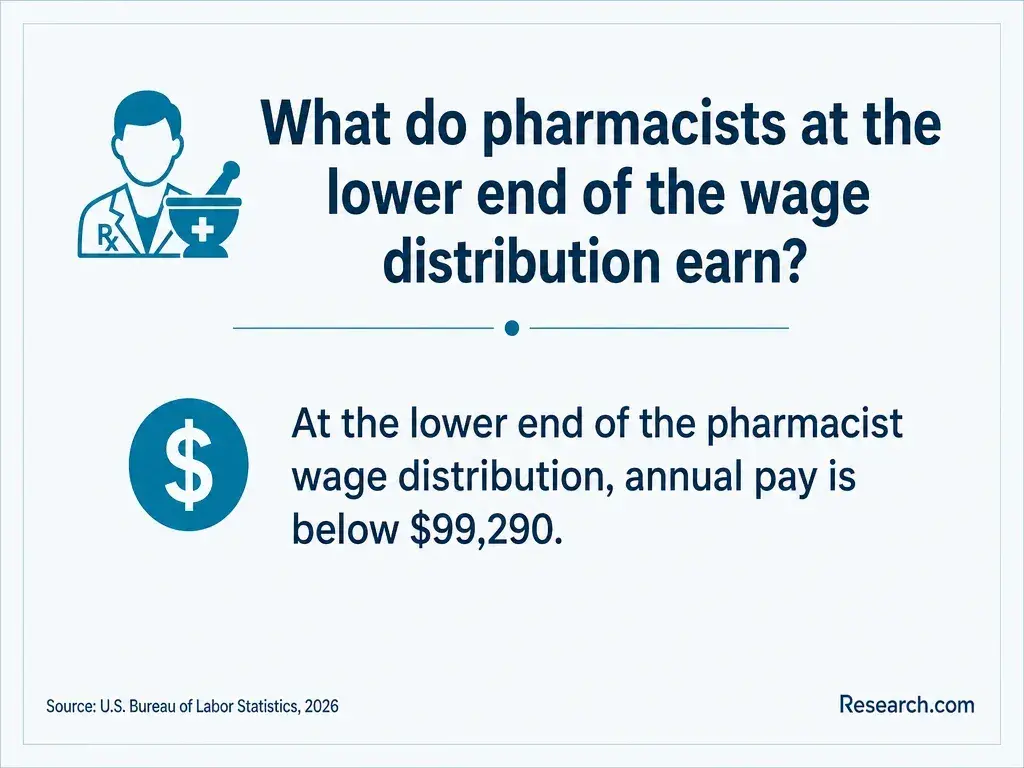
After meeting state licensing requirements, graduates may pursue pharmacist roles in community, hospital, ambulatory care, and other settings. The U.S. Bureau of Labor Statistics reports pharmacist median annual pay of $140,910 in May 2025. That occupation-wide median is not a starting-salary offer or a prediction for graduates of a particular online program.
Ask a program for clearly defined graduate outcomes, career advising services, and the dates and methods behind any placement claims. Some clinical positions favor postgraduate residency training; a residency, industry fellowship, or optional specialty board certification serves a different purpose from the state license. None is universally required for pharmacist employment.
If you already hold a science degree, examine pharmacy degree options for science majors against your intended job. Prior science study may cover some prerequisites, but it does not replace the professional curriculum or licensure. If your goal is a pharmacy technician role rather than pharmacist practice, a Pharm.D. is generally not the required route.
How can you compare online PharmD programs and choose a reputable school?
Start with programs you can verify, then compare written answers for the same entry term and intended licensing state. A list of online Pharm.D. schools to compare can help you build a shortlist, but check current status and policies with each school rather than treating a listing as an enrollment guarantee.
Use this sequence to turn advising conversations into a decision you can defend:
- Eliminate pathways whose credential, ACPE status, enrollment authorization, or known state-licensure eligibility does not match your goal.
- Request written evaluations of prerequisites and a term-by-term calendar showing live classes, campus visits, IPPEs, and APPEs.
- Compare total costs and aid eligibility alongside likely time away from work and possible rotation travel.
- Review program-specific NAPLEX outcomes with their reporting year and examine academic and experiential support policies.
- Ask the experiential office and your intended pharmacy board to resolve any unanswered placement or licensing questions before paying a deposit.
When price could decide between otherwise suitable programs, use pharmacy program tuition options as a starting point, then compare like-for-like costs. An unconfirmed local rotation, a required trip you cannot take, or credits that do not apply may outweigh a lower advertised tuition rate.
Other Things You Should Know About PharmD
Start with admissions for application rules and credit evaluation, academic advising for course sequencing, and experiential education for rotation logistics. Financial aid and the relevant pharmacy board are the better contacts for borrowing and licensure questions, respectively.
Bring unofficial transcripts for discussion, a list of courses in progress, your intended practice state, your work constraints, and questions about travel. The school may still require official records before making a final credit determination.
Usually not. Ask for the standard sequence and the policies governing course repeats, leaves, and delayed placements so you understand what could change the estimate.
Ask the responsible office to identify the policy effective for your entry term and clarify the discrepancy in writing before you rely on the answer.
- GAC - Chapter 480-2 LICENSURE AS A PHARMACIST https://rules.sos.ga.gov/gac/480-2
- Cost of Attendance (Budget) | 2025-2026 Federal Student Aid Handbook https://fsapartners.ed.gov/knowledge-center/fsa-handbook/2025-2026/vol3/ch2-cost-attendance-budget
- State Licensure Requirements for Students Seeking... - PMC https://pmc.ncbi.nlm.nih.gov/articles/PMC5135425/
- Earn an Online Pharm.D. Degree at St. John Fisher University https://onlinepharmd.sjf.edu/
- Licensure Disclosure - School of Pharmacy https://pharmacy.ku.edu/licensure-disclosure
- PharmD FAQs - UNC Eshelman School of Pharmacy https://pharmacy.unc.edu/education/pharmd/pharmd-admissions-faqs/
- Advanced Pharmacy Practice Experiences | Pharmacy & Health Sciences https://cphs.campbell.edu/academic-programs/pharmacy/doctor-of-pharmacy/experiential-education/rotations/advanced-pharmacy-practice-experiences/
- Experiential Education | Washington State University https://pharmacy.wsu.edu/pharmd/experiential-services/
- Transfer credit practices - UC Admissions https://admission.universityofcalifornia.edu/counselors/preparing-transfer-students/transfer-credit-practice.html
- How Do Transfer Credits Work When You Go Back to School? | Whitworth Online https://online.whitworth.edu/news-articles/how-do-transfer-credits-work-when-you-go-back-to-school/