Four-year PharmD versus Accelerated PharmD Pathways

Co-Founder and Chief Data Scientist
Choosing between a four-year and an accelerated Doctor of Pharmacy (Pharm.D.) program is not simply a choice between slower and faster. A compressed calendar can mean less time to earn a pharmacist's salary, but also shorter breaks, less room to repeat a course, and more demanding clinical schedules. This guide is for prospective U.S. pharmacy students comparing their options. It separates prerequisite study from professional training, explains costs and licensing steps, and shows which questions to ask before committing to either pathway.
Key Things You Should Know
- A four-year Pharm.D. typically spans four academic years; an accelerated pathway commonly compresses the professional curriculum into about three calendar years. Neither estimate includes any prerequisites you still need.
- A faster schedule does not remove required coursework, supervised clinical experiences, or state licensure steps. Check the program's current ACPE status and the rules of the state where you intend to practice.
- Compare the full cost of attendance and your ability to manage year-round study - not tuition alone. Earlier graduation may reduce living costs or bring employment closer, but it is not a guaranteed financial advantage.
What is the difference between four-year and accelerated PharmD pathways?
Both routes lead to a professional Pharm.D. when completed at a program authorized to award that degree. The principal difference is calendar design: an accelerated program generally schedules coursework and clinical training across more of the year, rather than eliminating essential preparation. "Accelerated" does not mean a shorter undergraduate prerequisite sequence unless the school separately offers one.
This comparison shows where the scheduling difference is most likely to affect your decision. Individual schools may organize terms and rotations differently.
| Decision factor | Four-year pathway | Accelerated pathway |
| Professional-program calendar | Usually four academic years | Often about three calendar years, with more continuous enrollment |
| Breaks and scheduling flexibility | Generally more time between academic years | Typically shorter breaks and a denser sequence |
| Degree and clinical expectations | Professional Pharm.D. coursework and supervised practice | Professional Pharm.D. coursework and supervised practice on a compressed calendar |
| Main trade-off | Longer time before graduation; potentially more breathing room | Earlier possible graduation; less flexibility if work, health, or coursework disrupts progress |
If you can sustain intensive, continuous study, it may make sense to complete a Pharm.D. on an accelerated schedule. If you need substantial term breaks or expect to work consistently, inspect the actual calendar before assuming the faster route is practical.
How long do traditional and accelerated PharmD programs take to complete?
A traditional Pharm.D. commonly takes four academic years after required pre-pharmacy coursework. An accelerated professional curriculum commonly takes about three calendar years because it uses summer terms or otherwise limits extended breaks. The time from your first college course to pharmacist licensure can be longer under either route.
Ask each school for a term-by-term calendar showing when classroom instruction, introductory experiences, and full-time advanced rotations begin. Also ask when a student who must repeat a course could next take it: an infrequently offered course can erase an accelerated program's apparent time advantage.
Be cautious when you compare online doctorate lengths. Completion times for other doctoral degrees, or for post-professional degrees intended for existing pharmacists, do not establish how quickly a new student can earn an entry-to-practice Pharm.D.
What are the admission requirements for accelerated PharmD programs?
Accelerated programs generally evaluate prerequisite undergraduate coursework, academic performance, application materials, and readiness for an intensive schedule. Requirements are school-specific: a bachelor's degree may be required by one program but not another, and policies for laboratory courses, grades, repeated classes, and coursework still in progress can differ. Prerequisites are not the professional Pharm.D. curriculum.
To assess pharmacy school application eligibility, compare your transcript with each school's current admissions page and its PharmCAS directory entry, if the school participates. Confirm how the school evaluates community-college, online, Advanced Placement, and international coursework; the receiving school decides whether credit meets its requirements. Check its application deadline, interview process, and any supplemental materials. The PCAT was retired in January 2024 and is not a current exam to schedule.
Meeting published minimums is not an admission guarantee. If several prerequisites remain, compare the date you could actually start each pathway - not just its advertised professional-program length.
The Accreditation Council for Pharmacy Education (ACPE) accredits U.S. professional Pharm.D. programs, not individual pharmacists. Before paying a deposit, look up the specific program in ACPE's current program records and read its status, including any conditions or pending actions. Do not substitute a university's institutional accreditation for verification of its professional Pharm.D. program.
Accreditation is a crucial part of the usual U.S.-educated route to pharmacist licensure, but graduation alone does not issue a license. State boards determine eligibility and additional requirements. If you are considering pharmacy education after undergraduate science coursework, verify that the credential is an entry-to-practice Pharm.D.; a degree in biology, pharmacology, or pharmaceutical sciences is not an interchangeable licensing credential.
For a distance-learning program, check three separate matters: ACPE professional-program status, the institution's authority to enroll you where you live, and whether required clinical placements can be approved where you plan to complete them. None automatically establishes the others.
Both pathways develop knowledge of drug action, therapeutics, calculations, medication safety, law, and patient communication. Coursework applies those subjects to decisions such as assessing a medication regimen and counseling a patient under appropriate supervision. An accelerated program may teach comparable material in shorter, more continuous terms; request its actual course sequence rather than assuming that every accelerated curriculum is organized the same way.
Experiential education includes introductory pharmacy practice experiences (IPPEs), which introduce supervised practice, and advanced pharmacy practice experiences (APPEs), which place students in more intensive supervised rotations. Settings can include community, hospital, ambulatory, and other practice sites. Ask who secures and approves placements, when rotations occur, and whether travel or temporary housing may be necessary. Students may also need intern registration, health documentation, background checks, and site-specific onboarding.
If you hope to apply prior college credits to pharmacy programs, obtain a written evaluation. Acceptance of prerequisite credit does not mean a school will waive professional Pharm.D. courses or clinical experiences.
Campus-based and hybrid pathways may be available, but delivery format and calendar length are separate decisions. Online coursework can still involve scheduled live classes, in-person laboratories or campus sessions, and supervised clinical rotations at approved sites. "Online" therefore does not mean fully remote, self-paced, or compatible with unrestricted full-time employment.
When reviewing Doctor of Pharmacy programs with online coursework, request a sample weekly schedule and a list of every required in-person visit. Ask whether the school coordinates rotations near your home, how sites are approved, and what happens if a local placement is unavailable. Confirm state authorization and placement rules for your location directly with the school.
A campus program may suit someone who wants routine access to on-site labs and classmates. A hybrid accelerated program may reduce routine commuting, but travel for immersions and rotations can outweigh that benefit for some students.
There is no dependable national price difference: tuition structures, residency classification, fees, aid, and required travel vary by school. An accelerated program may have fewer calendar years of living expenses but more months of continuous tuition and less opportunity for paid work. Compare each school's current published cost of attendance for your enrollment status, not just its advertised tuition.
The following cost categories show why two programs with similar tuition can require different budgets.
| Cost category | Why it can differ between pathways |
| Tuition and mandatory fees | Schools may charge by term, credit, or program year; summer enrollment can matter. |
| Living expenses and lost earnings | A shorter calendar may reduce time to graduation, while a denser schedule can constrain employment. |
| Clinical and campus travel | Rotations, temporary housing, and required in-person sessions depend on placement and format. |
| Other required expenses | Books, technology, checks, immunizations, and licensing-related expenses may not appear in tuition. |
A list of low-cost online pharmacy doctorate options is a starting point, not a substitute for confirming that each credential is the entry-to-practice Pharm.D. you need. Ask financial aid offices for a personalized estimate and current borrowing eligibility. Federal rules changed for many new graduate and professional borrowers beginning July 1, 2026; do not assume an older loan offer or unrestricted Grad PLUS access applies to you.
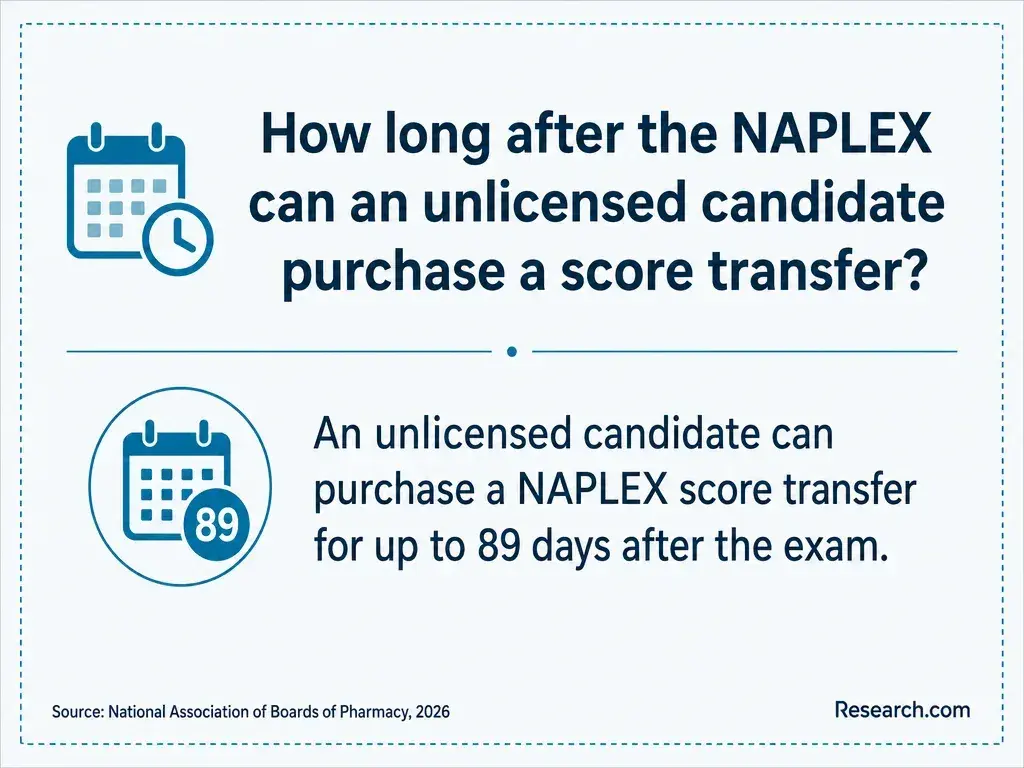
After meeting a state board's education and application requirements, a U.S.-educated candidate generally must pass the North American Pharmacist Licensure Examination (NAPLEX). The board may also require a jurisprudence exam, such as the Multistate Pharmacy Jurisprudence Examination (MPJE), the Uniform Multistate Pharmacy Jurisprudence Examination (UMPJE), or another state-specific assessment. Requirements, intern registration, background checks, and processing vary by jurisdiction; some jurisdictions began transitioning from MPJE to UMPJE in 2026.
Check the board where you intend to practice and current National Association of Boards of Pharmacy guidance before registering for exams. Passing the NAPLEX - or finishing a Pharm.D. - does not itself grant a pharmacist license. Claims that you can finish an online pharmacy degree sooner may concern a different credential or a pathway for already licensed professionals; they do not remove entry-to-practice licensing requirements.
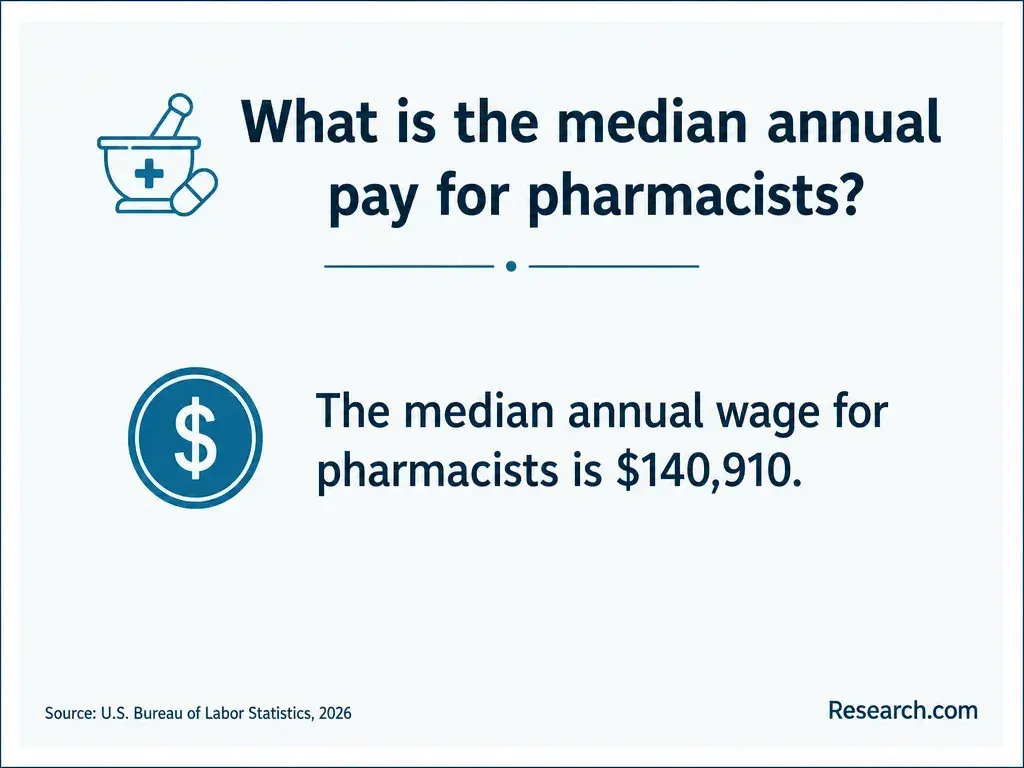
Once licensed, pharmacists work in settings including community pharmacies, hospitals, ambulatory care, and specialty pharmacy. Responsibilities and scope of practice vary by employer and state. The Bureau of Labor Statistics reports pharmacist median annual pay of $140,910 in May 2025 and projects 5% growth, 2025-2035, with about 12,500 openings per year. Those occupation-wide figures are not a starting-salary forecast or evidence that graduating sooner guarantees a job.
Some graduates enter practice directly. Others pursue postgraduate year-one or year-two residency training for roles where employers value concentrated clinical experience, or a fellowship for certain research or industry paths. Specialty board certification is a separate credential with its own eligibility rules; neither postgraduate training nor certification replaces state licensure, and neither is universally required.
For a return-on-investment comparison, place each school's complete cost estimate beside the time you expect to spend enrolled and any income you would forgo. An online pharmacy degree cost comparison is useful only if it distinguishes entry-to-practice Pharm.D. programs from other pharmacy credentials. Pharmacy technician roles, for example, are a separate occupation and do not ordinarily require a Pharm.D.
How should students choose a reputable PharmD program?
Start with eligibility and licensure, then test whether the calendar is feasible. A four-year route may be preferable if longer breaks, a less compressed course sequence, or more scheduling margin would help you succeed. An accelerated route may be preferable if you have completed the prerequisites, can commit to continuous study, and find that its full costs and placement arrangements support the earlier graduation date.
Use the following checks for each school you are seriously considering; written answers make programs easier to compare.
- Confirm the specific Pharm.D. program's current ACPE status and ask the relevant state board about licensure eligibility.
- Request a prerequisite review, a term-by-term curriculum, and the policy for repeating or remediating a course.
- Identify every required campus visit and clinical rotation period; ask who arranges placements and what travel you might face.
- Get a complete, student-specific cost and aid estimate, including summer terms and required non-tuition expenses.
- Review the school's published NAPLEX outcomes alongside its cohort sizes and reporting years; ask how it supports students preparing for licensure.
If your prerequisite record is incomplete, use pharmacy program admission planning to frame questions, but rely on each school's written matriculation conditions before making plans. A vague promise of nearby rotations, an unclear accreditation status, or a price that excludes mandatory attendance costs is a reason to pause - not a detail to sort out after paying a deposit.
Other Things You Should Know About PharmD
Possibly, but professional-course transfer is school-specific and may be limited by course sequencing or available cohort space. Ask the receiving program for a written review before withdrawing from your current school.
That depends on the school's progression policy and when the course is next offered. A repeat may delay rotations or graduation, so read the policy before enrolling.
Do not assume so. Internationally educated pharmacists may face a distinct board and foreign-graduate certification process. Ask the board in your intended state which route applies to your education.
Timing depends on board eligibility rules and exam policies. If you plan a gap, confirm application deadlines and requirements with the state board and allow time to prepare.
- Systematic Review of Predictors of Success for the North American Pharmacist Licensure Examination - PMC https://pmc.ncbi.nlm.nih.gov/articles/PMC8715967/
- Cost of Attendance (Budget) | 2025-2026 Federal Student Aid Handbook https://fsapartners.ed.gov/knowledge-center/fsa-handbook/2025-2026/vol3/ch2-cost-attendance-budget
- Doctor of Pharmacy, PharmD | Roosevelt University https://www.roosevelt.edu/colleges/science-health-pharmacy/pharmacy/programs/pharmd
- 5-Year Accelerated PharmD Pathway | MCPHS https://www.mcphs.edu/academics/programs/pharmacy-pharmd/5-year-accelerated-pharmd-pathway
- PharmD Curriculum | CU School of Pharmacy https://pharmacy.cuanschutz.edu/degreesandprograms/pharmd/curriculum
- Program: Pharmacy, PharmD | south.edu https://catalog.south.edu/preview_program.php
- How Long Is Pharmacy School? Timeline and Degree Requirements | PCOM https://www.pcom.edu/pharmacy/news/how-long-is-pharmacy-school.html
- Student Learning Outcomes MPJE | Southwestern Oklahoma State University https://swosu.edu/pharmacy/student-learning-outcomes/mpje.php
- Doctor of Pharmacy, PharmD Curriculum | umich.edu https://pharmacy.umich.edu/pharmacy-programs/pharmd-program/curriculum/
- Pharmacy | Pre-Health Advising https://prehealth.ucmerced.edu/health-careers/pharmacy