PharmD Transfer Credit Questions to Ask Admissions

Co-Founder and Chief Data Scientist
A pharmacy school may accept your previous coursework without letting it shorten your Doctor of Pharmacy (Pharm.D.) program. That distinction matters if you are changing schools, returning to study, or trying to avoid repeating classes.
This guide gives you specific questions to send admissions, explains how to interpret the answers, and shows you how to compare offers based on credits that actually satisfy graduation requirements - not just credits that appear on a transcript.
Key Things You Should Know
- Ask for a written evaluation separating accepted credit from credit that fulfills a specific Pharm.D. graduation requirement.
- Undergraduate prerequisites, professional Pharm.D. courses, and clinical experiences are evaluated differently; the receiving school decides what applies.
- Confirm the resulting start term, graduation date, and total remaining cost before accepting an offer. Fewer accepted credits do not always mean a longer program, and more accepted credits do not always shorten one.
What PharmD transfer credit policies should you ask admissions about?
Start by asking whether the school admits students into an advanced point in its professional Pharm.D. curriculum at all. Some schools may accept prior coursework only as admission prerequisites or elective credit. Admissions can usually identify the policy, but a faculty committee or registrar may make the final course-by-course decision.
Send these questions to each school and request answers tied to your own record:
- Do you accept transfers into the professional Pharm.D. curriculum, and which entry terms or class levels are available?
- Who makes the final decision, and can I receive a written evaluation before paying a nonrefundable deposit?
- Which accepted courses satisfy required courses, which count only as electives, and which do not count toward graduation?
- Will I need to repeat any course, laboratory, or clinical experience because of curriculum sequencing?
- Is admission or advanced placement conditional on a final grade, syllabus review, or available seat?
For broader pharmacy transfer planning, keep the school's written decision separate from any general description of transfer-friendly programs. A published policy is not an individual credit award.
How does ACPE accreditation affect PharmD transfer credit eligibility?
The Accreditation Council for Pharmacy Education (ACPE) accredits professional pharmacy education programs. Ask whether your previous Pharm.D. program's accreditation status and dates meet the receiving school's transfer policy, and check the current status of the program you hope to enter in ACPE's official program records. Attendance at an ACPE-accredited program does not make its credits automatically transferable.
Institutional accreditation addresses the institution, not whether a professional pharmacy course matches another school's curriculum. State authorization to enroll a distance-learning student is a separate issue. Ask admissions to identify any accreditation-based restriction in writing, especially if your prior study was outside a U.S. Pharm.D. program.
If your main goal is doctoral study with a shorter time commitment, check the credential before comparing transfer policies: a shorter doctorate in another field is not a substitute for the professional Pharm.D. pathway to pharmacist licensure.
Which PharmD courses and credits will admissions accept for transfer?
Ask for a course-level answer, not a total-credit estimate. The receiving school may compare content, contact hours, assessments, laboratory work, and placement within its curriculum. A course can be academically acceptable yet fail to replace a required class because the topics or sequence differ.
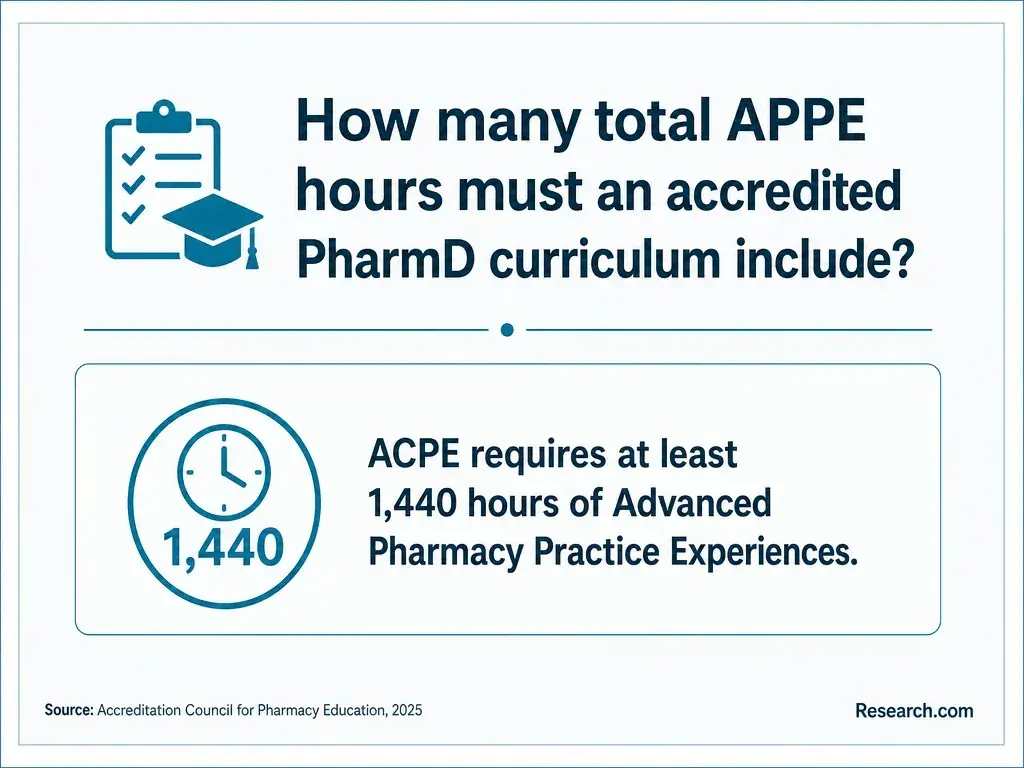
Request separate decisions for professional classroom courses, skills laboratories, introductory pharmacy practice experiences (IPPEs), and advanced pharmacy practice experiences (APPEs). IPPEs and APPEs are supervised clinical education, so a school may require detailed site, hour, preceptor, and competency records - or require you to complete its own experiences. Do not assume pharmacy employment replaces a rotation.
If your earlier education was in biology or chemistry, pharmacy doctorate options after chemistry may help you identify programs to investigate. Ask each one whether those courses meet undergraduate prerequisites; they usually should not be treated as professional Pharm.D. courses without an explicit evaluation.
Ask for the minimum grade for each type of credit. A school may apply different rules to undergraduate prerequisites and professional coursework. Also ask whether it accepts pass/fail work, repeated courses, quarter-system credits, or courses taken several years ago. Meeting a minimum grade does not establish equivalency.
For any disputed course, ask which learning outcomes or laboratory components are missing and whether a syllabus review, approved substitution, or placement assessment is possible. Request confirmation of whether a repeated course replaces the original grade for transfer purposes or whether both attempts are reviewed.
This matters particularly for applicants exploring pharmacy programs for career changers: admission with a requirement still outstanding is not the same as receiving transfer credit for it.
A school may accept previously completed undergraduate courses toward its admission prerequisites. That is different from transferring credit into the professional Pharm.D. curriculum. Ask for a prerequisite-by-prerequisite review covering subject, laboratory, minimum grade, course age, and whether an unfinished course must be completed before enrollment.
Check rules for community-college courses, online laboratories, Advanced Placement or International Baccalaureate credit, and international coursework when relevant. A bachelor's degree is not a universal Pharm.D. entry requirement; schools set their own prerequisite and admission rules. If you use PharmCAS, its application process does not replace a school's own equivalency decision or supplemental requirements.
When understanding pharmacy school admissions, distinguish eligibility from acceptance: satisfying every prerequisite does not guarantee a place in the class.
There is no nationwide transferable-credit maximum. Ask whether the school caps professional transfer credits, requires a minimum amount of coursework completed in residence, or limits transfer from a particular program or course level. Then ask how many of your credits will satisfy required courses and how many will count only as electives.
A credit total alone can mislead. If a required course is offered only in a particular term or is a prerequisite for later clinical work, accepted credit elsewhere may not advance your graduation date. Compare pharmacy degree programs with shorter timelines by credential and actual remaining requirements; a short pharmacy-related degree may not be a Pharm.D.
Ask for the school's document checklist and submission deadline before requesting records. A preliminary review may use unofficial copies, while a final award commonly depends on official records and approval by the receiving school.
Prepare a course-by-course packet so reviewers can evaluate more than titles:
- Transcripts from every institution attended, including records of repeated or in-progress courses.
- Catalog descriptions and syllabi from the term you took each course, including laboratory details.
- For clinical experiences, available hour logs, settings, learning objectives, evaluations, and preceptor information.
- Any required explanation or evaluation of international coursework, if applicable.
If you completed one of the quickest online pharmacy study routes, identify the institution and exact credential on your records. Admissions cannot infer professional Pharm.D. equivalency from a program's speed or pharmacy-related title.
Yes. Each receiving program sets its own equivalency and residency rules, regardless of whether instruction is delivered on campus or partly online. Ask whether transferred courses replace required online classes and whether you must still attend scheduled live sessions, campus laboratories, or in-person assessments.
Also confirm who arranges and approves IPPE and APPE sites, whether placements near your home are possible, and whether you may need to travel. State authorization to enroll where you live, approval for clinical placements, and eligibility for pharmacist licensure in a state are distinct questions. An online pathway does not necessarily mean a fully remote or self-paced Pharm.D.
Use review online pharmacy doctorate programs as a starting point, then verify each program's current format, ACPE status, authorization, and individual transfer decision directly.
It might, but only if the accepted courses change your required schedule. Ask the school to provide a term-by-term completion plan showing remaining tuition-bearing credits, mandatory fees, clinical experiences, and the earliest realistic graduation term. Compare that plan with the option of staying at your current school.
Account for repeated prerequisites or professional courses, delayed entry into a cohort, lost time from work, and travel or housing for labs and rotations. A lower advertised tuition rate can cost more overall if transferring adds a term. If you expect to borrow, ask financial aid to evaluate your specific enrollment and eligibility under the rules for your aid year; federal borrowing rules changed for many new graduate and professional borrowers beginning July 1, 2026.
Comparing affordable Doctor of Pharmacy options is most useful after you know your remaining requirements and total expected costs, rather than tuition alone.
How can you compare PharmD transfer policies before choosing a school?
Use the same fields for every school and fill them from a written evaluation. The comparison below separates an attractive credit total from the outcomes that matter: required coursework, time, and cost.
| Decision field | School A | School B |
| Professional courses replacing requirements | ________ | ________ |
| Credits accepted only as electives | ________ | ________ |
| Prerequisites still outstanding | ________ | ________ |
| IPPE/APPE work still required | ________ | ________ |
| Entry term and projected graduation term | ________ | ________ |
| Estimated remaining tuition, fees, and travel | ________ | ________ |
| Conditions or unresolved evaluations | ________ | ________ |
Before committing, follow this sequence to turn the comparison into a decision:
- Request each school's written course-by-course evaluation and identify any decision that remains conditional.
- Obtain a term-by-term schedule and ask whether course sequencing or clinical placements could delay it.
- Compare total remaining cost and practical attendance requirements, including time away from work.
- Confirm the receiving program's current ACPE status and check the state board requirements relevant to where you intend to seek licensure.
Choose based on the strongest confirmed path to completing an accredited Pharm.D., not the largest provisional credit award. Online Pharm.D. program timelines can help frame schedule questions, but only the receiving school can tell you how your credits affect its sequence. Completing the degree is also distinct from obtaining a pharmacist license, which requires satisfying the applicable state board's requirements.
Other Things You Should Know About PharmD
Often, yes, but application timing and eligibility vary. Ask whether the receiving school requires you to remain in good standing and when it needs final grades or confirmation of withdrawal.
It may. Schools can require disclosure and records of academic or conduct history. Ask about eligibility before paying application fees, and answer application questions accurately.
Do not assume they can. Ask the receiving school how it evaluates international study and distinguish admission or credit decisions from the separate licensing pathway for internationally educated pharmacists.
Some schools offer a review or appeal process. Ask for the reason for denial, the deadline, and whether additional syllabi or clinical documentation could change the decision. An appeal does not guarantee credit.
- .14 Evaluation and Review Process for Transfer of Courses and Credits. | Library of Maryland Regulations https://regs.maryland.gov/us/md/exec/comar/13B.06.02.14
- Transfer Dispute - Texas Higher Education Coordinating Board https://www.highered.texas.gov/transfer-dispute/
- What Should Constitute an Acceptable Advanced Pharmacy Practice Experience? - PMC https://pmc.ncbi.nlm.nih.gov/articles/PMC4857632/
- Transferring Credits to UT Dallas https://enroll.utdallas.edu/transfer/transferring-credits/
- Doctor of Pharmacy - UMKC Catalog https://catalog.umkc.edu/colleges-schools/pharmacy-home-page/doctor-of-pharmacy/
- What Is a PharmD Degree? Doctor of Pharmacy Guide | West Coast University https://westcoastuniversity.edu/blog/what-is-a-pharmd-degree-and-how-to-transfer-in
- FAQ | OSU College of Pharmacy - Oregon State University https://pharmacy.oregonstate.edu/programs-admissions/pharm-d/faq
- Transfer Students | Xavier University of Louisiana https://www.xula.edu/collegeofpharmacy/transferstudents.html
- Transfer Credit | Western Michigan University https://wmich.edu/transfer/credit
- PharmD FAQs - UNC Eshelman School of Pharmacy https://pharmacy.unc.edu/education/pharmd/pharmd-admissions-faqs/