
PharmD Employment Outcomes: Data to Request

Co-Founder and Chief Data Scientist
A pharmacy school's employment rate can look impressive without showing how many graduates responded, whether they became licensed pharmacists, or whether residency positions were counted as jobs. If you are comparing Doctor of Pharmacy (Pharm.D.) programs, those missing details matter as much as the headline figure.
This guide gives you a usable request list and comparison method so you can judge career outcomes alongside program cost, training goals, and the risk of borrowing for a result the school cannot guarantee.
Key Things You Should Know
- Request outcomes for the entire graduating class, including the number whose destination is unknown; a rate based only on survey respondents may overstate what the school knows.
- Separate licensed pharmacist jobs, postgraduate training, other work, and unemployment. The Bureau of Labor Statistics projects 5% growth for pharmacist employment in 2025-2035, but that national projection does not predict placement from a particular program.
- Compare programs using the same cohort, follow-up date, job definition, and salary method - and ask for the underlying counts before relying on any percentage.
What PharmD employment outcomes should you request from a pharmacy school?
Ask each school for a written outcomes report covering its most recent graduating class and, if available, several preceding classes. The essential request is a destination for every graduate at a stated point after graduation, with unknown destinations shown rather than excluded. Ask whether the school verified outcomes through employers or training programs, relied on graduate surveys, or combined methods.
Use this worksheet to record comparable figures. Enter counts as well as published rates; an unanswered cell is itself useful information when evaluating a claim.
| Outcome field | Program A | Program B |
| Graduating class and follow-up date | ________ | ________ |
| Total graduates; respondents; unknown destinations | ________ | ________ |
| Licensed pharmacist employment; other employment | ________ | ________ |
| Residency; fellowship; further education | ________ | ________ |
| Seeking work; not seeking work | ________ | ________ |
| Salary respondents and salary measure | ________ | ________ |
Keep entry pathways in mind when interpreting a cohort. Students arriving with prior coursework may have different costs or timelines; a school's policy on how pharmacy programs review transfer credits does not, by itself, tell you whether credit applies to the professional Pharm.D. curriculum.
How does ACPE accreditation affect PharmD employment-outcomes reporting?
The Accreditation Council for Pharmacy Education (ACPE) accredits professional pharmacy education programs, not individual pharmacists. Check the program's current status in ACPE's official program directory, then review the school's published outcomes and request the detail its public pages omit. ACPE accreditation is not a standardized employment-rate guarantee: it does not mean every school reports destinations, salaries, and response rates in a format that permits direct comparison.
Keep three checks separate: professional-program accreditation, the institution's accreditation, and any state authorization relevant to distance education. None replaces the state board's pharmacist-licensure requirements. If you are considering online Pharm.D. program options, also confirm required in-person activities and clinical placements; online coursework does not make a professional program fully remote.
Which PharmD employment metrics reveal a program's career success?
The most revealing metric is a destination breakdown with both counts and clearly defined rates. For each rate, identify its denominator: all graduates, graduates with known outcomes, survey respondents, or applicants to a particular training pathway. A high employment rate among respondents says less when many classmates cannot be accounted for.
Look beyond initial placement to pharmacist licensure, job setting, full-time versus part-time status, and whether the role required a Pharm.D. Ask when each measure was collected. The Bureau of Labor Statistics projects about 12,500 pharmacist openings per year during 2025-2035; that describes the national occupation, not the share available to new graduates of one school.
Do not count pharmacy technician positions as pharmacist placements. Technician work is a separate occupation that does not ordinarily require a Pharm.D.; if it matches your goal, compare shorter pharmacy programs with career potential before taking on the time and cost of a professional doctorate.
A useful destination report distinguishes pharmacist employment from postgraduate training and from work that does not require a pharmacist license. It should also identify graduates pursuing further education, seeking work, not seeking work, and unreachable graduates. These categories prevent a combined "positive outcome" rate from obscuring the result you actually want.
Ask schools to describe how they classify a graduate who has accepted a position but has not yet obtained a license, and whether the report is a snapshot or tracks later changes. A residency is structured postgraduate training; a fellowship may emphasize research, industry, or another specialized area. Neither is the same as a permanent pharmacist job.
Also check who is in the reported cohort. An online Pharm.D. for students with prior science study may attract people with different backgrounds from another pathway. Compare their outcomes only after confirming which graduates each report includes.
Start with the same graduating period and approximately the same follow-up interval. Then align the denominator, the treatment of unknown outcomes, and what qualifies as employment. If one school includes residents and fellows in "employed" while another reports them separately, recalculate from the published counts where possible. If the counts are unavailable, treat the rates as noncomparable.
Compare like with like on program length and student circumstances, too. Pharmacy programs with faster completion options may change how long students pay tuition or forgo earnings, but a shorter timeline does not establish stronger placement. Read employment results alongside total educational cost, published licensure-exam outcomes, and the settings in which graduates actually work.
A useful decision rule is to favor the program with clearer, more complete evidence when two headline rates are similar - not the one with the larger unexplained percentage. Do not interpret small differences between cohorts as proof that one school caused better career outcomes.
Request the median starting base salary, the number of graduates who supplied pay information, the collection date, and a breakdown by role, setting, geography, and full-time status where sample sizes permit. Ask whether the figure includes signing bonuses, overtime, residency stipends, or fellowship compensation. A pooled average can be misleading when those forms of pay are mixed.
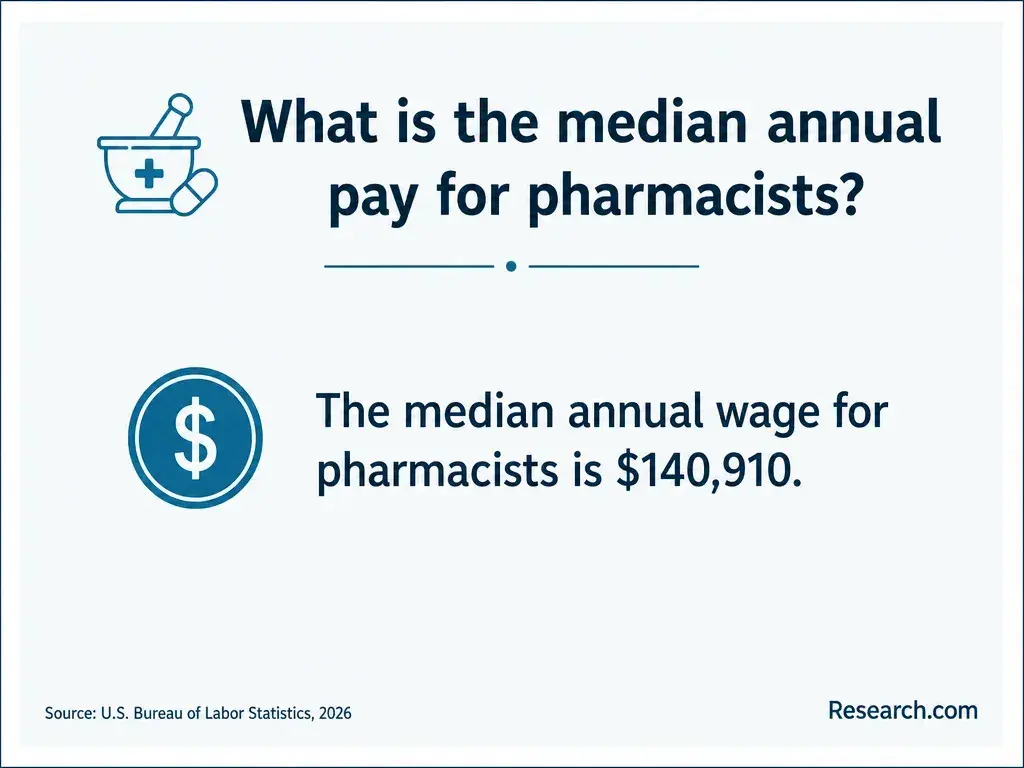
The Bureau of Labor Statistics reports pharmacist median annual pay of $140,910 in May 2025. That is the national median across the occupation, not an expected offer for a new Pharm.D. graduate. Use a school's documented starting-pay data for a closer comparison, while recognizing that sparse salary responses can skew it.
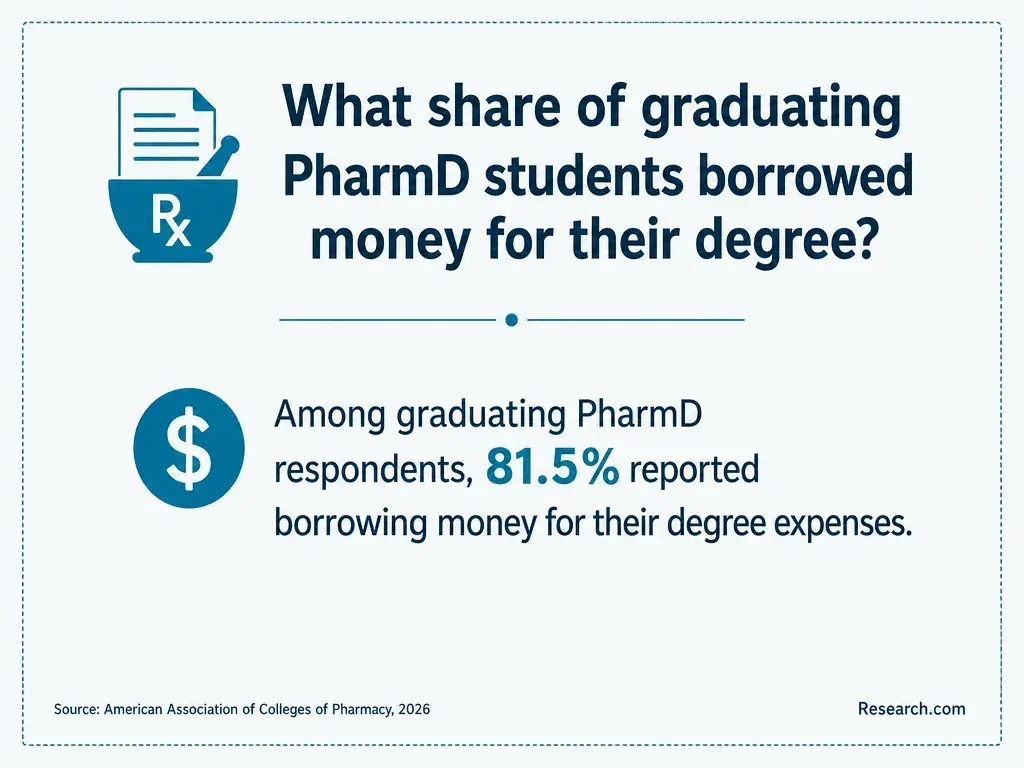
Set likely earnings against the full cost of attendance, borrowing terms, and time away from paid work - not tuition alone. Pharmacy doctorate financial planning should account for fees, clinical-placement travel, and other required expenses. Before relying on any loan estimate, confirm current eligibility and limits with the financial aid office; federal borrowing rules changed for many new graduate and professional borrowers beginning July 1, 2026.
Ask for separate counts of graduates who applied, received interviews or offers, and entered a residency or fellowship. For residencies, find out whether a reported match rate covers all graduates or only Match participants, and whether positions obtained outside the Match are reported separately. For fellowships, ask how offers were confirmed and what kinds of programs graduates entered.
Postgraduate year one (PGY1) and postgraduate year two (PGY2) residencies serve different training stages; a fellowship is a distinct pathway. Neither postgraduate training nor Board of Pharmacy Specialties certification automatically confers a state pharmacist license. Direct employment may be the better route for someone whose target role does not call for additional training.
Consider the extra time and compensation trade-off before treating a training placement as equivalent to a job offer. General comparisons of online doctorate program length cannot substitute for the Pharm.D. curriculum and any postgraduate training your particular career goal may require.
Request a setting-level breakdown - such as community pharmacy, hospital or health system, ambulatory care, managed care, industry, and government - along with the graduate's role. A setting alone is not enough: employment at a hospital or pharmaceutical company does not necessarily mean the graduate holds a licensed pharmacist position. Ask whether a role is direct employment, residency training, fellowship training, or other work.
Match that breakdown to your intended career rather than judging the program by its largest destination category. If your goal is pharmacist practice, confirm what share of known outcomes involved pharmacist roles and how many graduates had obtained licensure by the reporting date. State boards set licensing requirements; completing the Pharm.D. or passing the North American Pharmacist Licensure Examination (NAPLEX) does not, by itself, issue a license.
If your goal does not require pharmacist licensure, investigate whether a different credential would suffice. Claims about fast-track online pharmacy education should not be mistaken for a promise that a professional Pharm.D. can be completed entirely online or on that schedule.
A response rate tells you how much of a class supplied information, not whether the responding graduates represent everyone. Ask for the total number of graduates, the number with verified or reported destinations, and the number with unknown destinations. Then ask whether salary and employment figures use the same respondents; salary surveys often cover a smaller group.
Missing outcomes are especially important if graduates who have not found work are less likely to answer a survey. The reverse is also possible, so do not assume a particular direction of bias without evidence. Instead, give more weight to reports that show their collection methods, underlying counts, and consistent definitions across graduating classes.
Consider whether admissions pathways changed between the cohorts you are comparing. Pharmacy degree eligibility requirements vary by school; a change in who enrolls can complicate a simple before-and-after interpretation of employment rates.
What questions help verify a pharmacy school's PharmD outcomes claims?
Send the same short request to each program and retain the written replies. These questions test whether a published claim describes the outcome you care about.
- Which graduating class does this claim cover, and when were its outcomes checked?
- How many students graduated, how many have known destinations, and how many remain unknown?
- Does "employed" include residencies, fellowships, positions awaiting licensure, part-time work, or jobs that do not require a Pharm.D.?
- Can you provide underlying counts by practice setting, postgraduate pathway, and work-seeking status?
- How many graduates supplied salary information, and what pay components and employment settings does the figure include?
- Which outcomes were independently confirmed, and may I review the report's definitions and collection method?
Compare the responses with the program's public disclosures and current ACPE status before paying a deposit. If an advisor discusses pharmacy school requirements and exceptions, get any admission condition in writing as well; an employment claim does not resolve whether you can enter or complete that particular pathway.
Other Things You Should Know About PharmD
Yes. Ask whether it can introduce you to graduates working in your target setting. Their experiences can clarify job-search support, but a few conversations are not a substitute for class-wide outcomes data.
Yes, if the school offers distinct pathways. Ask whether its published figures combine them and whether separate results are available. Do not assume graduates had the same schedules, placement locations, or job markets.
It may show where past graduates worked, but that does not predict your result. Confirm licensure requirements with the relevant state board and ask the program about clinical-placement availability in your intended location.
Request it before accepting an offer or paying a nonrefundable deposit. That leaves time to clarify definitions, compare schools, and incorporate the evidence into your cost and career decision.
- Trends in the Pharmacist Workforce and Pharmacy Education | nih.gov https://pmc.ncbi.nlm.nih.gov/articles/PMC6418852/
- Recent Employment Statistics | NYU School of Global Public Health https://publichealth.nyu.edu/careers/recent-employment-statistics
- Employment Trends for Doctor of Pharmacy Graduates of Research-Intensive Institutions, 2013-2017 - ScienceDirect https://www.sciencedirect.com/science/article/abs/pii/S0002945923012950
- Post-Graduation Results - Rutgers University https://careers46.rutgers.edu/Public/new_webpage_GradSurveyHome2025.cfm
- Emerging Trends from the 2024 National Pharmacy Workforce Study - School of Pharmacy https://pharmacy.wisc.edu/2025/06/16/emerging-trends-from-the-2024-national-pharmacy-workforce-study/
- 2026 Graduates Step into Community Pharmacy Careers | UConn Today https://today.uconn.edu/2026/06/2026-graduates-step-into-community-pharmacy-careers/
- PharmD Outcomes Data | University of the Pacific https://www.pacific.edu/pharmacy/outcomes-data


