Can Community College Credits Count Toward a PharmD?

Co-Founder and Chief Data Scientist
Community college can be a practical place to complete pre-pharmacy coursework, but a course that earns college credit will not necessarily satisfy a Doctor of Pharmacy (Pharm.D.) admission requirement. That distinction matters before you pay for a semester of classes or delay an application.
This guide explains which credits may count, where online labs and transfer rules create problems, and how to check a school's requirements. You'll leave with a way to decide whether community college is the right starting point for your Pharm.D. plan.
Key Things You Should Know
- Yes. Many Pharm.D. programs consider community college coursework for admission prerequisites, but the receiving school decides whether each course and lab meets its requirements.
- Prerequisite credits are not generally a substitute for the professional Pharm.D. curriculum; completing the degree and obtaining a state pharmacist license are also separate steps.
- Before enrolling, confirm course equivalencies, lab format, grades, and total cost with each target school. The PCAT was retired in January 2024, so an old checklist requiring it needs updating.
Can community college credits count toward PharmD prerequisites?
Yes, if the pharmacy school accepts the courses as equivalents to its pre-professional prerequisites. These are undergraduate classes completed before entering the professional Pharm.D. program. Acceptance is not automatic: a college may award transferable credit while a pharmacy school decides that the course does not fulfill a particular admissions requirement.
Before registering, send each target school the community college's course number, description, credit value, and lab details. Ask for a written equivalency determination when one is available. A general transfer-credit award is less useful than confirmation that, for example, a specific class satisfies a specific prerequisite. Guidance on transfer credits for pharmacy school can help frame those questions, but the receiving program's current policy controls.
Do not confuse prerequisite acceptance with transferring into the professional Pharm.D. curriculum. Schools evaluate those requests separately, and completed pre-pharmacy courses ordinarily do not replace professional pharmacy courses or supervised clinical experiences.
Which community college courses do PharmD programs accept?
Programs commonly evaluate community college science, mathematics, communication, and general education courses. The key is course equivalence, not the subject name alone: a survey science class intended for nonmajors may not satisfy a prerequisite intended for science majors.
The comparison below shows where to look for mismatches before choosing classes. It does not represent a universal Pharm.D. course list.
| Course area | What can affect acceptance |
| Biology and chemistry | Major-level content, required sequence, laboratory component, and any course-age rule |
| Mathematics and statistics | The school's specified subject and level, rather than a general math elective |
| Anatomy, physiology, and microbiology | Whether a combined course is accepted and whether a lab is required |
| English and other general education | Writing or communication content and the school's permitted substitutions |
If you have already studied biology, chemistry, or pre-pharmacy, compare your transcript against each school's current checklist rather than retaking courses by assumption. Doctor of Pharmacy pathways after pre-pharmacy study offer a useful starting point for comparing routes, but admissions staff must determine how your individual courses apply.
Do pharmacy schools accept online community college credits?
Some do, but policies may differ for online lectures and online laboratories. A school might accept an online lecture while requiring an in-person science lab, or it might evaluate a particular online lab's hands-on components. Do not assume that a transcript's failure to identify delivery format means the format is acceptable.
Ask whether the target program accepts the exact online course and lab before paying for it, and keep the syllabus if the school requests a review. The same distinction matters when you compare online Doctor of Pharmacy programs: online instruction does not mean the professional degree can be completed entirely from home. Required labs, campus activities, and in-person clinical rotations may still affect where you can live and work.
For a U.S. pharmacist education pathway, verify the professional Pharm.D. program's status with the Accreditation Council for Pharmacy Education (ACPE) using its current program records. Do not substitute the university's institutional accreditation for ACPE professional-program accreditation. Also check the pharmacy board in the jurisdiction where you intend to seek licensure, particularly if a program's status or pathway raises eligibility questions.
Institutional accreditation, ACPE accreditation, and authorization to enroll distance-learning students in a state answer different questions. Approval for a clinical placement may require another check. Even when reviewing lower-cost online Pharm.D. pathways, establish the program's current accreditation and your state-specific eligibility before comparing prices. ACPE accredits programs; it does not license graduates.
Requirements vary by school. A program may specify science sequences and labs, mathematics, writing, other general education courses, minimum grades, a minimum GPA, or a total number of undergraduate credits. It may also set limits on how old science coursework can be. A stated minimum establishes eligibility to be considered, not a promise of admission.
Use each school's current admissions page and, when applicable, its PharmCAS directory listing to build a course-by-course checklist. Check deadlines, required materials, and whether courses can be in progress when you apply or must be finished before enrollment. Not every school uses PharmCAS. Comparing pharmacy school acceptance criteria can help you identify questions, but only a school's current requirements can resolve a close course match. The Pharmacy College Admission Test (PCAT) was retired in January 2024; do not plan around an outdated PCAT requirement.
Not necessarily. Some Pharm.D. programs admit applicants who complete specified undergraduate prerequisites without earning a bachelor's degree; others have different degree or credit requirements. Community college can therefore be part of a shorter pre-professional route, but it is not proof that you qualify for every school.
Compare the schools you would actually attend before deciding whether to finish an associate degree, transfer to a four-year college, or pursue a bachelor's degree. A bachelor's may preserve other career or application options, but completing extra coursework costs time and money if your target programs do not require it. Some pharmacy programs before all requirements are complete may allow an application with coursework in progress; confirm what must be completed before matriculation.
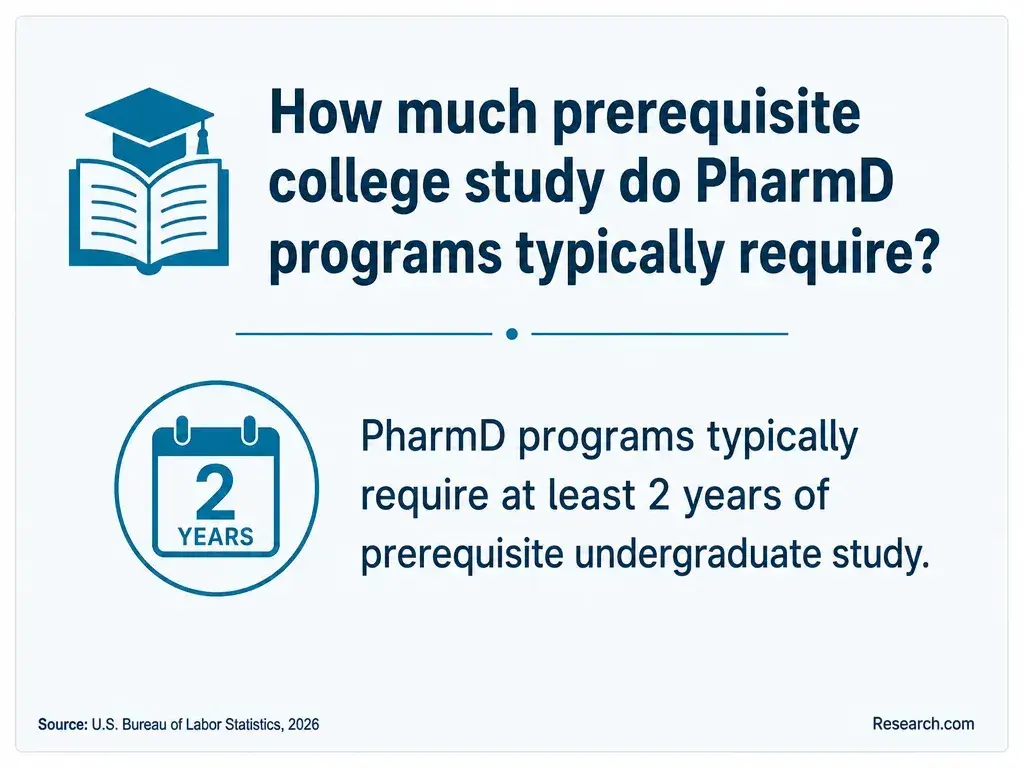
Pre-professional study often takes around two years of full-time coursework, while a traditional professional Pharm.D. curriculum commonly takes four years. Your actual timeline depends on placement, course sequencing, transfer acceptance, and whether you study part time. A missed prerequisite offered only in certain terms can delay an application more than its credit value suggests.
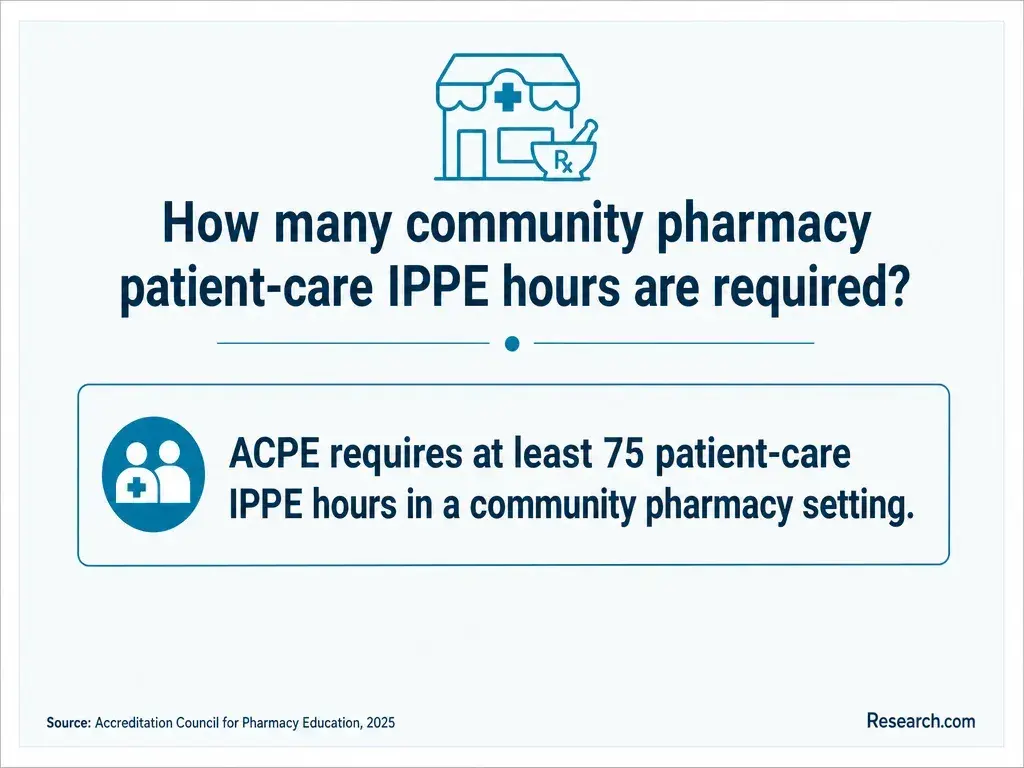
Some pharmacy degree programs with accelerated timelines compress the professional phase, but they may leave less room for paid work or schedule changes. Compare the full path from your current transcript through graduation - not just the advertised length of the Pharm.D. phase. Introductory and advanced pharmacy practice experiences, often called IPPEs and APPEs, are supervised components of professional training and require scheduling beyond classroom study.
There is no reliable nationwide price for this route: community college tuition varies by residency and college, while Pharm.D. tuition and required fees vary by program and enrollment status. The useful comparison is total cost to complete your remaining prerequisites and the professional degree, not community college tuition alone. Add books, lab supplies, application charges, commuting, and any extra course needed because a credit was not accepted. For the professional phase, account for required equipment, clinical-placement travel or housing, and licensure-related expenses.
Request current tuition and fee schedules from your shortlisted schools and compare the same academic-year and residency categories. Then check your individual aid eligibility. Federal borrowing rules changed for many new graduate and professional borrowers beginning July 1, 2026, so do not budget on the assumption that older Grad PLUS access or loan limits will apply to you. Comparisons of pharmacy degree affordability and completion time are most useful after you account for accepted credits and required in-person commitments.
A Pharm.D. is an educational credential, not a pharmacist license. For U.S.-educated applicants, state boards generally require qualifying pharmacy education, the North American Pharmacist Licensure Examination (NAPLEX), and other jurisdiction-specific steps. These can include intern registration or experience, an application, a background check, and a law examination. Check the board where you intend to practice: do not assume every jurisdiction uses the Multistate Pharmacy Jurisprudence Examination (MPJE), because examination arrangements vary and some jurisdictions began moving to the Uniform MPJE (UMPJE) in 2026.
Passing the NAPLEX alone does not authorize practice. Nor does a fast credential with "pharmacy" in its name replace a qualifying Pharm.D.; shortest online doctoral programs in other fields should not be mistaken for pharmacist-licensure pathways. Internationally educated pharmacists may have different certification and board requirements.
What careers, salaries, and job outlook follow a PharmD?
A licensed pharmacist may work in community, hospital, ambulatory care, or other pharmacy settings, subject to employer requirements and state scope-of-practice rules. The Bureau of Labor Statistics reports pharmacists' median annual pay of $140,910 in May 2025 and projects 5% growth for 2025-2035, with about 12,500 openings per year. Those occupation-wide figures are context for evaluating a substantial education investment, not a prediction of an individual graduate's pay or job offer.
Residency training can help with some practice goals, but it is not required for every pharmacist job. A fellowship is a different postgraduate route, often oriented toward particular industry or research roles; specialty board certification is a separate credential, not a state license. If your goal is technician work rather than pharmacist practice, assess that route separately: fast online pharmacy program choices may lead to credentials with different duties and licensing requirements, not a shortened Pharm.D.
Other Things You Should Know About PharmD
They may. Ask each pharmacy school how it evaluates college courses taken during high school, and ensure the awarding college can provide an official transcript.
Only if the receiving pharmacy school permits credit by examination for that specific requirement. Science prerequisites and labs may have stricter rules, so obtain confirmation before relying on CLEP.
Usually the question is whether the individual courses satisfy admission requirements, not whether you earned an associate degree. Confirm your target school's degree and total-credit rules.
Do not assume so. Application services and individual schools can evaluate repeated courses differently; ask how both attempts affect prerequisite eligibility and GPA review.
- Admissions Frequently Asked Questions and Tips | ucsf.edu https://pharmd.ucsf.edu/admissions/faq-tips
- Transfer student policy - Doctor of Pharmacy | Physician Assistant Studies https://applebaum.wayne.edu/pharmd/transfer-policy
- Admission Requirements | ufl.edu https://admissions.pharmacy.ufl.edu/steps-to-apply/application-requirements/
- Columbus State Community College | Pharmacy https://admissions.osu.edu/standards/standard.aspx
- Prospective Students | Ernest Mario School of Pharmacy https://pharmacy.rutgers.edu/info-for/prospective-students/
- Community College to PharmD | kgi.edu https://www.kgi.edu/future-students/cc-to-pharmd.html
- Pre-Health: Pharmacy Preparation | uoregon.edu https://cas.uoregon.edu/pre-health-pharmacy-preparation
- Transfer Pharm.D. Applicants - Pharmacy Advising Center https://advising.pharmacy.uconn.edu/faq/transfer-pharmd-applicants/
- Prerequisite Coursework | School of Pharmacy https://www.pharmacy.pitt.edu/academics/doctor-pharmacy/apply-pharmd-program/prerequisite-coursework
- FAQ | OSU College of Pharmacy - Oregon State University https://pharmacy.oregonstate.edu/programs-admissions/pharm-d/faq