Questions to Ask a Pharmacy School About State Licensure Eligibility

Co-Founder and Chief Data Scientist
A pharmacy school can admit you without necessarily meeting every requirement for the state where you plan to practice. That distinction matters especially if you are comparing online programs, expect to complete rotations across state lines, or may move after graduation.
This guide gives prospective Doctor of Pharmacy (Pharm.D.) students specific questions to ask schools and state boards, plus a comparison worksheet. Use it to identify gaps before you commit to a program, not after you have paid tuition or scheduled clinical training.
Key Things You Should Know
- Ask the school for its current ACPE professional-program accreditation status and a written explanation of how its Pharm.D. curriculum supports licensure in your intended state; confirm the requirements with that state's board of pharmacy.
- Check intern registration, supervised experience, the NAPLEX, and the jurisdiction's current law-exam rules separately. A Pharm.D. degree or passing exam score does not itself issue a license.
- Licensure eligibility deserves a full-cost comparison: clinical placements and required travel can change both expense and time away from work. For career context, the U.S. pharmacist median annual pay was $140,910 in May 2025, not a guaranteed starting salary.
Does the pharmacy school meet ACPE accreditation requirements for licensure eligibility?
Ask: "What is this specific Pharm.D. program's current Accreditation Council for Pharmacy Education (ACPE) status, and will it have the status my intended state requires when I graduate?" Check the program - not just the university - in ACPE's official program directory, and ask the school to explain any status or location-specific questions in writing. ACPE accredits professional pharmacy programs; institutional accreditation addresses the institution more broadly.
Also ask when the school will notify students of an accreditation-status change and what support it would offer if one affected their plans. Accreditation, permission to enroll distance-learning students, and permission to place students at clinical sites are separate questions. A list of low-cost and shorter pharmacy degree programs may include credentials other than an ACPE-accredited Pharm.D.; check the exact credential before treating any option as a pharmacist-licensure pathway.
Will this PharmD program qualify me for pharmacist licensure in my state?
Ask: "Has the school determined that this program's education meets pharmacist-licensure requirements in the state where I intend to apply? What qualifications or additional steps does that determination identify?" Request the school's current state-specific professional-licensure disclosure. Then ask the state board of pharmacy whether it accepts the program and what else an applicant must complete. A school's eligibility determination is useful evidence, but the board makes licensing decisions.
Use this worksheet when comparing schools. Enter each school's written response, then record what the intended licensing board confirms; an unanswered cell is a reason to keep investigating.
| Comparison field | School A | School B | State board confirmation |
| ACPE professional-program status | ________ | ________ | ________ |
| Education eligibility determination for intended state | ________ | ________ | ________ |
| In-state rotation and intern-registration feasibility | ________ | ________ | ________ |
| Remaining exam or application requirements | ________ | ________ | ________ |
Do not confuse entry into a degree with eligibility to practice. Pharmacy programs with alternative entry pathways may offer flexibility before matriculation, but applicants still must complete the professional curriculum and satisfy the licensing board's requirements.
What state-specific education and examination requirements must graduates meet?
Ask the school and board: "Which requirements apply to someone educated in this program who will seek an initial pharmacist license in my state?" Requirements may include an accepted Pharm.D., pharmacist-intern registration, qualifying supervised experience, the North American Pharmacist Licensure Examination (NAPLEX), a jurisprudence or pharmacy-law examination, and an application with other board-required documentation. Requirements and the order in which applicants complete them vary by jurisdiction.
In particular, ask which law examination the board currently uses, if any. Do not assume it is the Multistate Pharmacy Jurisprudence Examination (MPJE): jurisdictional rules and use of the Uniform MPJE (UMPJE) can change. Ask whether experience earned during school counts, whether the board requires additional hours, and when exam eligibility can be granted. Comparing pharmacy doctorate program length is worthwhile, but a faster curriculum does not waive state licensing steps.
Ask: "Which required courses, assessments, and advising services prepare students for the NAPLEX and the law examination used in my intended jurisdiction?" Look for a clear account of how students are assessed in pharmacotherapy, calculations, medication safety, and pharmacy law - not merely a claim that graduates are "exam-ready." State-specific law preparation matters if you will apply outside the school's home state.
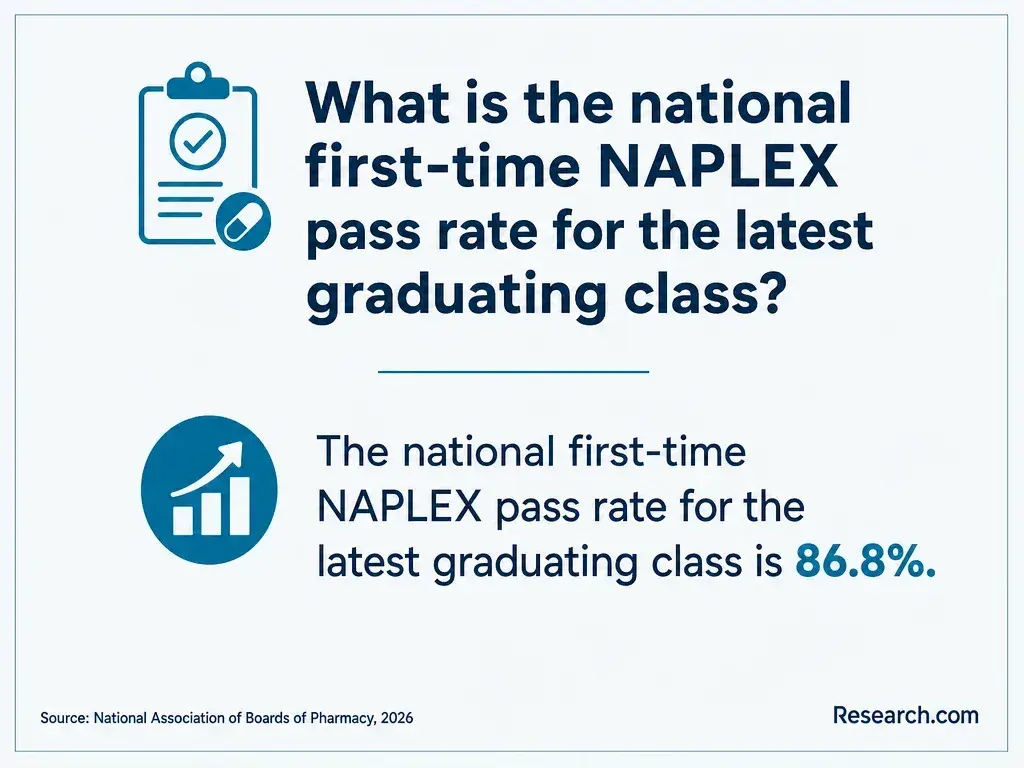
Request the school's latest published NAPLEX results with the testing period, cohort size, and whether the figure describes first-time candidates. Use results as one indicator, not a prediction of your outcome; ask what support is available to students who struggle and how graduates receive help with exam applications. When considering doctoral degree timeline options, weigh the pace against the time you will need for assessments and exam preparation. Passing the NAPLEX or a law exam is only one part of licensure.
Ask: "What introductory pharmacy practice experiences (IPPEs) and advanced pharmacy practice experiences (APPEs) are required, where can I complete them, and which hours will my intended board accept?" IPPEs introduce supervised practice during the professional curriculum; APPEs are more extensive supervised experiences later in the program. Ask for the published schedule, settings, attendance expectations, site-approval process, and the school's role in finding and assigning placements.
Before relying on a proposed site, confirm who secures a preceptor and whether you need intern registration, immunizations, a background check, or travel. Ask the board how it documents and credits hours; a school rotation does not automatically satisfy every jurisdiction's experience rule. Prior undergraduate study is a different issue: transfer coursework toward pharmacy prerequisites may reduce courses needed before entry, but it does not automatically replace professional clinical experiences.
Ask: "May students enrolled from my state complete every required IPPE and APPE there, and which placements can the school actually arrange or approve?" Obtain separate answers about the school's authorization to enroll you, its ability to support in-state placements, and your eligibility for any required intern registration. These are not interchangeable approvals.
Also request the schedule for live classes, in-person labs, campus visits, assessments, and rotations. "Online" describes some instruction, not necessarily a fully remote or self-paced degree. If you are comparing pharmacy doctorate programs with distance learning, ask whether a local site is assured, whether you may propose one, and what happens if a placement falls through. Required travel or daytime rotations may make full-time employment impractical even when lectures are online.
Ask: "For each state where I may practice, what has the school determined about educational eligibility, and what requirements would remain after graduation?" Compare the school's disclosures with each board's current rules. A degree accepted for initial licensure in one state does not mean a second state will issue a license automatically; exam, experience, application, and license-transfer rules may differ.
If a move is likely, ask how the school supports students planning rotations or initial applications in another jurisdiction. Confirm the intended board's rules before committing to a location for training. Short online pharmacy course completion timelines can describe credentials other than a licensure-qualifying Pharm.D.; speed alone says nothing about multistate pharmacist eligibility.
Ask: "Which prerequisite undergraduate courses, labs, minimum grades, and academic standards apply to my entry pathway, and what must be finished before I matriculate?" Pre-pharmacy coursework is preparation for admission, not the professional Pharm.D. curriculum. A completed bachelor's degree is not universally required. Request a course-by-course review if you have community-college, online-lab, advanced-placement, international, older, or repeated coursework; the receiving school decides what it accepts.
Ask whether the school uses PharmCAS, requires a supplemental application or interview, and permits prerequisites to remain in progress when you apply. The PCAT was retired in January 2024, so do not plan around taking it. Pharmacy programs with flexible entry requirements may help broaden a shortlist, but a published minimum is neither an admission guarantee nor evidence of state licensure eligibility.
Ask: "What is the expected time from my current coursework to graduation, and what is the itemized cost for my entering cohort?" Get tuition and mandatory fees by academic year or term, plus estimated costs for prerequisite courses, books and clinical resources, technology, labs, campus visits, rotation travel or housing, background checks, immunizations, and licensing applications and exams. Ask which costs can change and whether delayed rotations would add terms or fees.
Compare offers using the same starting point and cost period, not one school's per-credit tuition against another's estimated total. Budget-friendly pharmacy degree programs may still require substantial in-person spending. Request a personalized aid estimate: federal borrowing rules changed for many new graduate and professional borrowers beginning July 1, 2026, so do not assume an older loan package or unrestricted Grad PLUS access applies to you. A lower price is a weaker bargain if a program cannot support the placements or licensure pathway you need.
What pharmacist career outcomes and licensure support does the school provide?
Ask: "What help will I receive with intern registration, board applications, exam eligibility, documentation of experience, and applications in another state?" Ask who handles each request after graduation and how long records remain accessible. For outcomes, request recent, clearly labeled results for graduates' licensure exams, employment, and postgraduate placements; check the cohort and whether nonrespondents are excluded.
The Bureau of Labor Statistics projects 5% pharmacist employment growth for 2025-2035 and about 12,500 openings per year. Those national projections provide context, not a promise of a local job or a particular role. Students exploring Doctor of Pharmacy pathways for career transitions should compare the time and cost of meeting prerequisites with their intended pharmacist role. A pharmacy technician credential is a different pathway; residency or fellowship training may help with particular careers, while specialty board certification is distinct from - and does not replace state licensure.
Other Things You Should Know About PharmD
It may. Disclosure and review rules vary by state and can differ from a school's admissions decision. Ask the intended board about its process before enrolling; answer application questions accurately.
Not necessarily. Internationally educated pharmacists may need additional credentialing and must follow the intended board's rules. Do not assume a foreign degree is evaluated like a U.S. ACPE-accredited Pharm.D.
Yes. Renewal schedules and continuing-education requirements vary by jurisdiction. Check the board's current rules for the state where you hold a license.
Accommodation processes are separate from admission to pharmacy school. Review the examination administrator's current documentation and timing requirements, and ask your board whether it has any additional procedures.
- .04-2 Supervised Professional Experience - Practice-Oriented Programs. | Library of Maryland Regulations https://regs.maryland.gov/us/md/exec/comar/10.36.01.04-2
- Frequently Asked Questions: Certification Procedures for Title IV of the HEA | U.S. Department of Education http://www.ed.gov/laws-and-policy/higher-education-laws-and-policy/higher-education-policy/ope-guidance-documents/frequently-asked-questions-certification-procedures-title-iv-of-hea
- Virginia Board of Pharmacy - FAQ https://www.dhp.virginia.gov/Boards/Pharmacy/PractitionerResources/FAQ/
- Limited (Intern) Permit | Office of the Professions - Nysed https://www.op.nysed.gov/professions/pharmacist/license-requirements/limited-intern-permit
- Pharmacists - Texas State Board of Pharmacy https://www.pharmacy.texas.gov/consumer/broch5.asp
- School of Pharmacy and Pharmaceutical Sciences | University of Connecticut Academic Catalog https://catalog.uconn.edu/undergraduate/pharmacy/
- FAQ | OSU College of Pharmacy - Oregon State University https://pharmacy.oregonstate.edu/programs-admissions/pharm-d/faq
- Experiential Education | Washington State University https://pharmacy.wsu.edu/pharmd/experiential-services/
- Accreditation - Texas A&M College of Pharmacy https://pharmacy.tamu.edu/about/acpe-self-study.html