How to Plan Study Time Across a PharmD Semester

Co-Founder and Chief Data Scientist
A Doctor of Pharmacy (Pharm.D.) semester can change shape quickly: a manageable week of lectures may be followed by lab checkoffs, overlapping exams, or an introductory clinical experience. If you are entering pharmacy school - or trying to regain control of your current schedule - you need a plan that accounts for those shifts rather than a fixed daily study target. This guide shows you how to budget study time, choose what to study first, and revise your schedule when coursework or rotations take more time than expected.
Key Things You Should Know
- Build the semester plan from the syllabus: mark exams, lab assessments, assignments, and experiential commitments before filling ordinary study blocks.
- Set a weekly study budget from the time you actually have, then protect recurring review, practice, and catch-up blocks; there is no universal Pharm.D. study-hour requirement.
- Shift time toward the next consequential assessment and your weakest skills, but keep brief review sessions for cumulative material throughout the semester.
How should you plan study time across a PharmD semester?
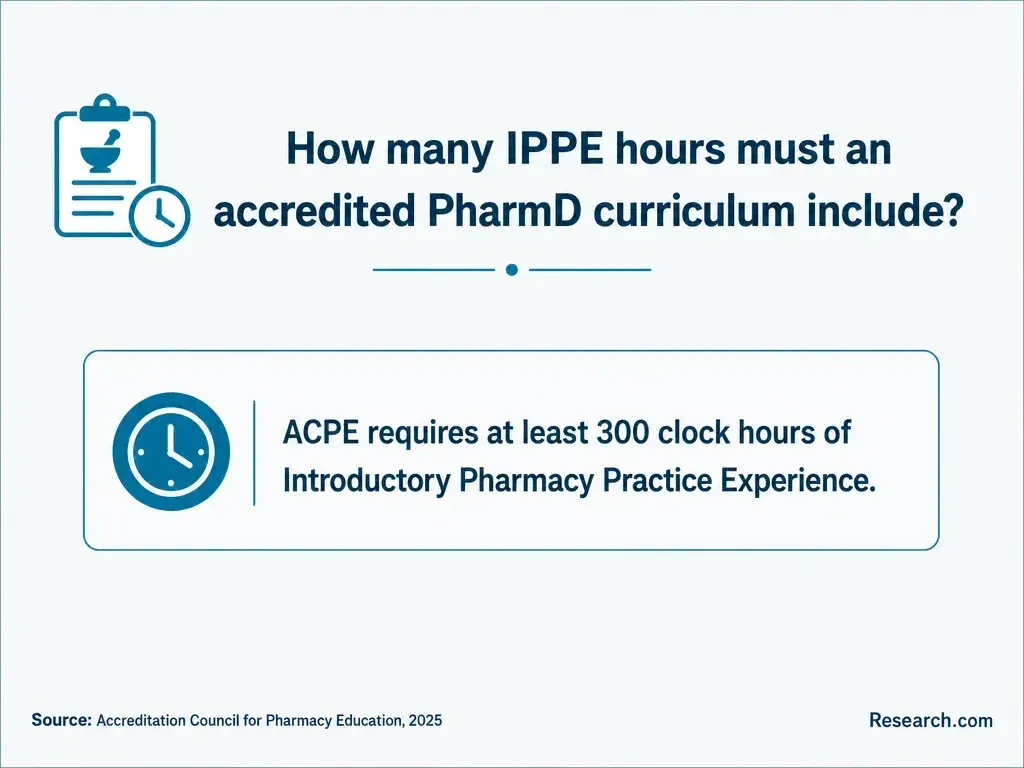
Plan at three levels: the full semester for deadlines, each week for available hours, and each study session for a specific learning task. Start with your program calendar and each course syllabus. Record exam dates, graded labs, case presentations, assignments, and introductory pharmacy practice experiences (IPPEs). These are supervised experiences that may occur alongside classroom courses.
Then identify the weeks with overlapping assessments or unusually long campus or site days. Begin exam practice before those weeks arrive, and leave a small block of unscheduled time each week for work that runs long. Revisit the plan after the first graded assessments: if practice problems reveal a gap in calculations, move time toward calculations rather than continuing to divide hours evenly among courses.
Calendar compression matters when comparing accelerated Pharm.D. degree options. A shorter program timeline does not remove the need for repeated practice or scheduled clinical experiences; ask for the actual term calendar before assuming you can keep the same work hours.
How many hours should PharmD students study each week?
There is no reliable single number for every Pharm.D. student. Course load, prior preparation, laboratory work, commute, assessment timing, and learning needs all affect the answer. Rather than copying someone else's target, calculate your available hours after class, required experiences, work, commuting, meals, sleep, and other fixed commitments.
Use those remaining hours to schedule focused work, not merely time with notes open. For example, if you can protect five two-hour blocks, you have a proposed 10-hour weekly study budget - not evidence that 10 hours will be sufficient. Test it against assignments and quiz results, then add time, reduce optional commitments, or seek course support if the work consistently exceeds the budget.
Time is also an affordability consideration: students comparing affordable online Pharm.D. programs should assess whether required live sessions and clinical placements leave enough hours for their expected paid work. Lower advertised tuition does not create more usable study time.
How can you balance PharmD coursework, labs, rotations, and work?
Put obligations you cannot move on the calendar first. These may include lectures, lab attendance, site shifts, and paid work. Next, reserve preparation before each lab or patient-care activity and follow-up time afterward; otherwise, experiential work can crowd out the studying that makes it useful.
If you work, compare your job schedule with the busiest required weeks, not an average week. Ask your employer about reduced or flexible shifts before exam clusters and placements. IPPE and advanced pharmacy practice experience (APPE) schedules depend on the school, site, and preceptor; do not assume a job shift, nearby placement, or current employment can substitute for a required experience.
For students returning to school, pharmacy school routes for returning students can help frame the admission decision. Once enrolled, however, any outstanding preparation and the professional curriculum still need separate places in your schedule.
Allocate time by the work a course demands and your performance in it, not by its title alone. Pharmacotherapy often requires integrating disease states, medicines, monitoring, and patient factors; calculations require accurate independent practice. A course with frequent labs or cases may also need preparation time that is easy to overlook.
The table distinguishes common study demands. Use it to diagnose where your time is going, then check your own syllabi and assessment results before changing your schedule.
| Coursework | Why time demand may rise | Useful sign to watch |
| Pharmacotherapy and patient cases | Requires applying information across topics | You recognize facts but struggle to justify a care plan |
| Pharmacology and medicinal chemistry | Builds on mechanisms and earlier science | New concepts expose gaps in prerequisite knowledge |
| Pharmacy calculations | Requires dependable accuracy under assessment conditions | Errors recur even when the method seems familiar |
| Skills labs and experiential preparation | Combines preparation, performance, and feedback | Checkoffs or site tasks need more rehearsal than expected |
Students entering from biology or chemistry can use pharmacy degree options for science majors to think about the transition. Prior science coursework may help with foundations, but it does not replace practice applying knowledge to pharmacy cases.
Make a fresh schedule each week, ideally after checking the learning management system and all course calendars. This sequence turns deadlines into a workable plan rather than a wish list.
- Enter classes, labs, site shifts, work, travel, and personal commitments as fixed blocks.
- List the week's graded work and upcoming exams; note what must be started now for later deadlines.
- Assign focused blocks to specific outputs, such as solving a calculation set or explaining a treatment choice without notes.
- Place brief retrieval reviews between classes or on lighter days, and reserve an open block for spillover.
- At week's end, compare planned work with completed work and move unfinished priorities into the next schedule.
If prerequisite or prior credit decisions affect your course sequence, resolve them with the school before building a long-term calendar. Pharmacy transfer planning is a separate question from weekly time management: the receiving program decides whether and how credit applies.
Active learning means retrieving and applying information instead of repeatedly rereading it. After a lecture, close the slides and explain a drug's use, major precautions, and monitoring considerations in your own words. Then check the course materials for omissions. For cases, practice stating a recommendation and defending it using the information provided.
Match the method to the assessment: work calculations without looking at solved examples, rehearse lab skills under the conditions your instructor specifies, and revisit missed questions after you understand the error. Use approved course resources and supervision; classroom practice is not permission to provide independent patient care.
Some students comparing affordable short pharmacy programs may not need a Pharm.D. for their goal. Their study plans can differ substantially because shorter pharmacy-related credentials do not ordinarily qualify someone for pharmacist licensure.
Start with the instructor's stated objectives and assessment format. As each topic is taught, create a small set of recall questions or cases and return to them over subsequent weeks. Before an exam, spend more time on errors that reveal a misunderstanding than on material you can already explain accurately.
For a cumulative assessment, maintain a running list of foundational topics - such as calculations, drug information evaluation, and earlier pharmacotherapy concepts - rather than trying to relearn the semester at the end. Schedule practice under realistic time limits when appropriate, then review why each missed answer was wrong.
Be cautious about treating quickest online pharmacy study routes as substitutes for the professional Pharm.D. curriculum or its assessments. A shorter pharmacy-related program may serve a different career goal; it does not remove the academic and supervised training required in a Pharm.D. pathway.
Separate flexible study periods from nonnegotiable attendance. An online or hybrid Pharm.D. may still have live classes, timed exams, in-person labs or campus sessions, and in-person IPPEs and APPEs. Confirm the specific program's requirements rather than assuming recordings make every activity asynchronous.
Block time for watching or attending instruction, completing practice, and asking questions; do not let video viewing consume the entire study budget. Keep the program calendar, course deadlines, time zones, and any campus travel in one place. Students evaluating online pharmacy education options should obtain a sample weekly timetable and ask how clinical sites are arranged and approved. Online delivery, state authorization, ACPE professional-program accreditation, and eventual state licensure eligibility are distinct matters.
During APPEs, replace a lecture-centered plan with one built around site hours, preparation, feedback, and recovery. Ask the preceptor what you should prepare for the next day and when presentations or other deliverables are due. Keep a short record of questions to research using approved resources, and leave time to act on feedback.
Confirm placement timing and requirements with your school. Programs and sites may require onboarding, immunizations, background checks, intern registration, travel, or schedule changes; the school's placement process and applicable state rules determine what is permitted. Do not assume every rotation can be near home or performed through current employment.
Even when comparing fast online doctoral study, treat required in-person pharmacy experiences as fixed commitments rather than hours that can be condensed into spare evenings. If a placement makes paid work unrealistic, plan that trade-off before the rotation begins.
What tools can help PharmD students track assignments and study progress?
A calendar, the school's learning management system, and a simple task tracker are enough if you use them consistently. The calendar shows when work can happen; the task tracker shows what must be produced; an error log shows what still needs practice. Avoid maintaining several competing deadline lists.
Track progress by evidence, not time alone: note which case types you can explain, which calculation errors recur, and which lab skills need feedback. Review the tracker weekly and remove tasks that no longer match course priorities. Prospective students researching how competitive is pharmacy school admission can use the same system for application deadlines, but should keep admissions tasks separate from a current Pharm.D. course plan.
Other Things You Should Know About PharmD
Use solo time to find what you cannot yet explain, then use a group to test reasoning and discuss cases. Agree on a specific task so a meeting does not replace independent practice.
Identify the earliest concept you no longer understand, contact the instructor or available academic support, and prioritize upcoming graded work. Trying to recopy every missed note can delay the practice you need most.
No. The North American Pharmacist Licensure Examination (NAPLEX) is part of the pharmacist licensure process, while course assessments follow your program's curriculum. Use course learning objectives for current classes and check licensing requirements with the jurisdiction where you intend to apply. Passing the NAPLEX alone does not issue a license.
Not generally. Residency is postgraduate training that some roles require or prefer; it is distinct from completing a Pharm.D. and meeting state licensure requirements. Whether to pursue one depends on the positions you want and their hiring criteria.
- Student Pharmacists' Perceptions of Testing and Study... - PMC https://pmc.ncbi.nlm.nih.gov/articles/PMC3073110/
- Direct Assessment (Competency-Based) Programs | ed.gov http://www.ed.gov/laws-and-policy/higher-education-laws-and-policy/higher-education-policy/direct-assessment-competency-based-programs
- Advising & Academics " Pharm.D. Students " | ufl.edu https://students.pharmacy.ufl.edu/student-affairs/advising-academics/
- Using Retrieval Practice to Increase Student Learning | wustl.edu https://ctl.wustl.edu/resources/using-retrieval-practice-to-increase-student-learning/
- Do All Pharmacy Programs Offer Experiential Education? | Belmont University https://www.belmont.edu/stories/articles/2024/pharmacy-program-experiential-education.html
- Time Managment Calculator | School of Chemical Sciences | Illinois https://scs.illinois.edu/time-managment-calculator
- Essential Study Strategies for PharmD Final Exams | MCPHS https://www.mcphs.edu/academics/schools/pharmacy/leadership-in-pharmacy-education-institute/networking-and-support/learning-resources
- Online Student Services | CU School of Pharmacy https://pharmacy.cuanschutz.edu/current-students/distance-degree-and-programs/student-services
- Credit Hours and Calculation - Office of Online Education | Wake Forest University https://oe.wfu.edu/program-development-2/credit-hours-and-calculation/
- Experiential Education - Albany College of Pharmacy and Health Sciences https://www.acphs.edu/pharmacy/doctor-of-pharmacy-pharmd/experiential-education/