How to Apply to the St. John Fisher Online PharmD Program

Co-Founder and Chief Data Scientist
Applying to an online Doctor of Pharmacy (Pharm.D.) program involves more than submitting an online application. St. John Fisher University's pathway combines online coursework with in-person training, so applicants need to check both academic eligibility and whether the schedule and travel requirements are workable.
This guide walks through the application, prerequisites, accreditation, clinical experiences, costs, and licensure considerations. Use it to identify what to confirm with Fisher before spending money on prerequisite courses or committing to a cohort.
Key Things You Should Know
- Apply through PharmCAS for St. John Fisher's online Pharm.D. pathway, then complete any program-specific interview and enrollment steps required for your application cycle.
- Plan for a four-year professional curriculum that includes online instruction, required in-person activities, and supervised clinical rotations - not a fully remote or self-paced degree.
- Before accepting an offer, obtain a written prerequisite review and confirm the current tuition, travel commitments, clinical-placement arrangements, and rules in the state where you intend to practice.
How do you apply to the St. John Fisher online Pharm.D. program?
Start with the current St. John Fisher listing in the Pharmacy College Application Service (PharmCAS) and the Wegmans School of Pharmacy's admissions instructions. PharmCAS collects the common application, but Fisher sets its own program requirements, interview process, and deadlines. If you are still finishing prerequisites, ask which courses may remain in progress rather than assuming you must wait another cycle; other pharmacy degree options without every prerequisite completed may use different rules.
Use this sequence to avoid an incomplete or mistimed application:
- Check the current online-pathway entry term, PharmCAS deadline, prerequisite list, and any separate Fisher instructions.
- Request official transcripts from every college attended and arrange the recommendations specified for the current cycle.
- Enter coursework accurately in PharmCAS and submit early enough to allow for transcript receipt and application verification.
- Respond to any interview invitation and provide additional materials Fisher requests directly.
- If admitted, review the offer, deposit deadline, outstanding course conditions, and required checks or health documentation before enrolling.
Do not build an application plan around the Pharmacy College Admission Test (PCAT): it was retired in January 2024. Submission, PharmCAS verification, an interview, and final enrollment are separate milestones; meeting a deadline does not guarantee admission.
What are the admission requirements for St. John Fisher's online Pharm.D.?
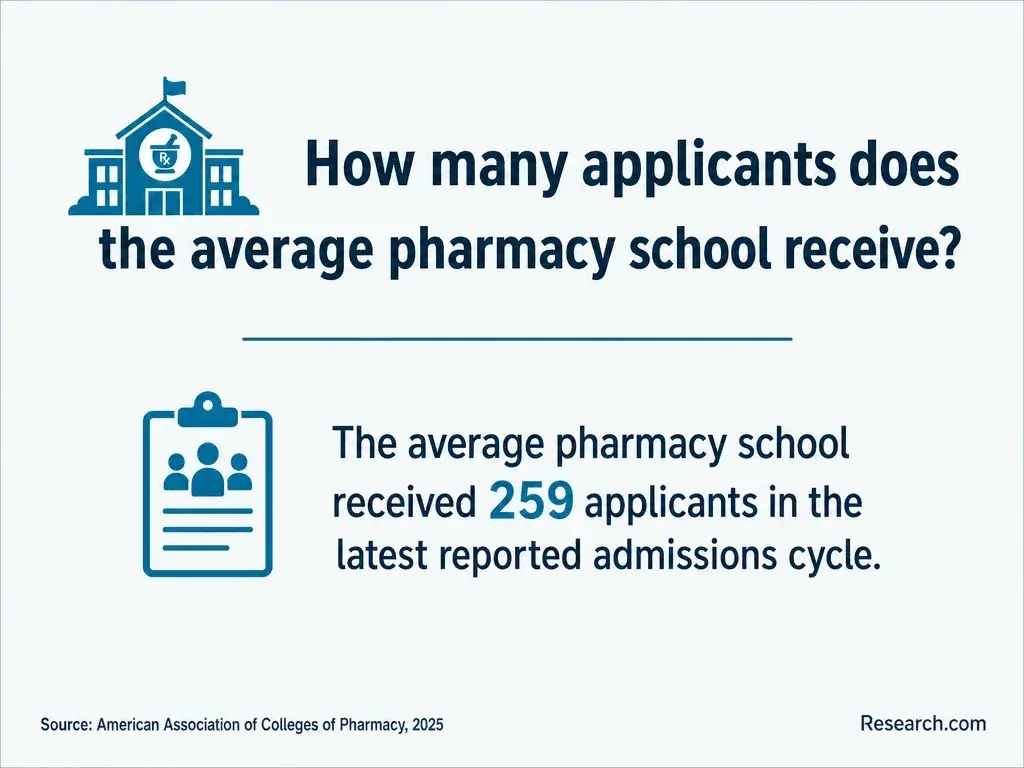
Applicants need qualifying pre-professional college coursework and must satisfy the online pathway's current admissions review. Pre-professional credits are undergraduate courses completed before the professional Pharm.D. curriculum; they are not a pharmacy degree. A completed bachelor's degree should not be assumed to be mandatory simply because the credential sought is a doctorate.
Fisher evaluates academic preparation alongside the application materials and interview. Ask admissions to confirm the current minimum credit and grade thresholds, required recommendations, coursework-completion deadline, and any conditions attached to an offer. A published minimum establishes eligibility for review, not a competitive score or a promise of admission. General guides to pharmacy school acceptance criteria can help frame questions, but Fisher's current requirements control your application.
If you previously attended a professional pharmacy program, disclose that history and request a separate review of your standing and potential professional-course credit. Admission and advanced standing are different decisions.
Is St. John Fisher's online Pharm.D. program accredited?
The Wegmans School of Pharmacy's professional Pharm.D. program is accredited by the Accreditation Council for Pharmacy Education (ACPE). The online pathway leads to that professional degree; "online" describes part of its delivery, not a substitute for professional-program accreditation. Confirm the school's current listing and status in ACPE's program directory before enrolling, particularly if accreditation is central to your state's licensing rules.
Keep three checks separate: ACPE accredits the professional pharmacy program; institutional accreditation applies to the university; and distance-education authorization concerns whether the university can enroll a student in a particular state. None alone establishes that a proposed clinical site is approved or that a graduate will receive a pharmacist license. Apply those same checks when comparing online pharmacy education options.
Expect substantial undergraduate preparation in biological and chemical sciences, mathematics, and general education before entering the professional curriculum. The precise courses, laboratory components, allowable substitutions, minimum grades, and deadline for completing them must come from Fisher's current prerequisite worksheet or admissions review. A course with a familiar title is not automatically equivalent to Fisher's requirement.
Send admissions your transcript and, for any uncertain course, its catalog description or syllabus. Specifically ask how Fisher will treat community-college credit, advanced-placement credit, repeated courses, online labs, older science courses, and coursework still in progress. The receiving school decides whether previous credit meets a prerequisite; a general list of pharmacy programs for students with prior coursework cannot establish your individual equivalencies.
Resolve missing prerequisites before budgeting for enrollment. An additional laboratory course can affect both your start date and your total cost, even if you otherwise qualify for admission.
Both pathways lead toward Fisher's professional Pharm.D., but the location of instruction changes the weekly experience - not the need for hands-on pharmacy education. This comparison highlights commitments to verify with the school before choosing a pathway.
| Decision factor | Online pathway | Campus pathway |
| Class attendance | Online instruction with scheduled participation requirements to confirm for the entering cohort | Regular in-person instruction on campus |
| Hands-on learning | Required in-person activities; confirm immersion dates and locations | Campus-based practical instruction; confirm the published schedule |
| Clinical training | In-person supervised experiences at approved sites | In-person supervised experiences at approved sites |
| Planning constraint | Technology, travel, and time away for immersions and rotations | Regular campus attendance plus rotation travel where applicable |
Choose the online pathway if living near campus is impractical and you can reliably attend its scheduled sessions, immersions, and rotations. Choose campus study if regular in-person access better supports your learning and living arrangements. Ask Fisher for cohort-specific schedules rather than treating "online" as asynchronous or assuming either pathway is accelerated. If shorter programs are part of your search, compare their actual degree and experiential requirements with accelerated online pharmacy programs.
Fisher's professional pharmacy curriculum develops knowledge of medicines and patient care through pharmaceutical sciences, pharmacotherapy, medication safety, communication, and practice experiences. Sciences explain how drugs work and are formulated; pharmacotherapy applies that knowledge to treatment decisions; patient-care training develops skills such as evaluating medication regimens and communicating recommendations under appropriate supervision. Consult the current catalog for exact course titles and sequence rather than assuming every topic is a separately named course.
These professional courses follow, rather than replace, undergraduate prerequisites. That distinction matters for applicants considering pharmacy education after undergraduate science coursework: a biology or chemistry background may satisfy some entry requirements, but it does not substitute for the Pharm.D. patient-care curriculum.
Plan around a four-year professional program, subject to Fisher's current cohort calendar and your ability to meet progression requirements. Prerequisite courses may add time before entry. Request the current academic year's online-pathway tuition and mandatory-fee schedule directly from Fisher rather than relying on a prior cohort's advertised price.
The tuition quote is only one part of the decision. To compare affordable Doctor of Pharmacy options, ask Fisher for a program-length cost estimate that accounts for prerequisite courses, required technology and materials, campus-immersion travel, and possible rotation travel or temporary housing. Also ask which costs are billed by the university and which you arrange independently.
Request a financial aid estimate for your entry year and student classification before assuming a particular federal loan will cover the difference. Federal borrowing rules changed for many new graduate and professional borrowers beginning July 1, 2026; aid eligibility and applicable transition rules require an individual determination. Compare the resulting borrowing need with the time you may be unable to work during clinical training.
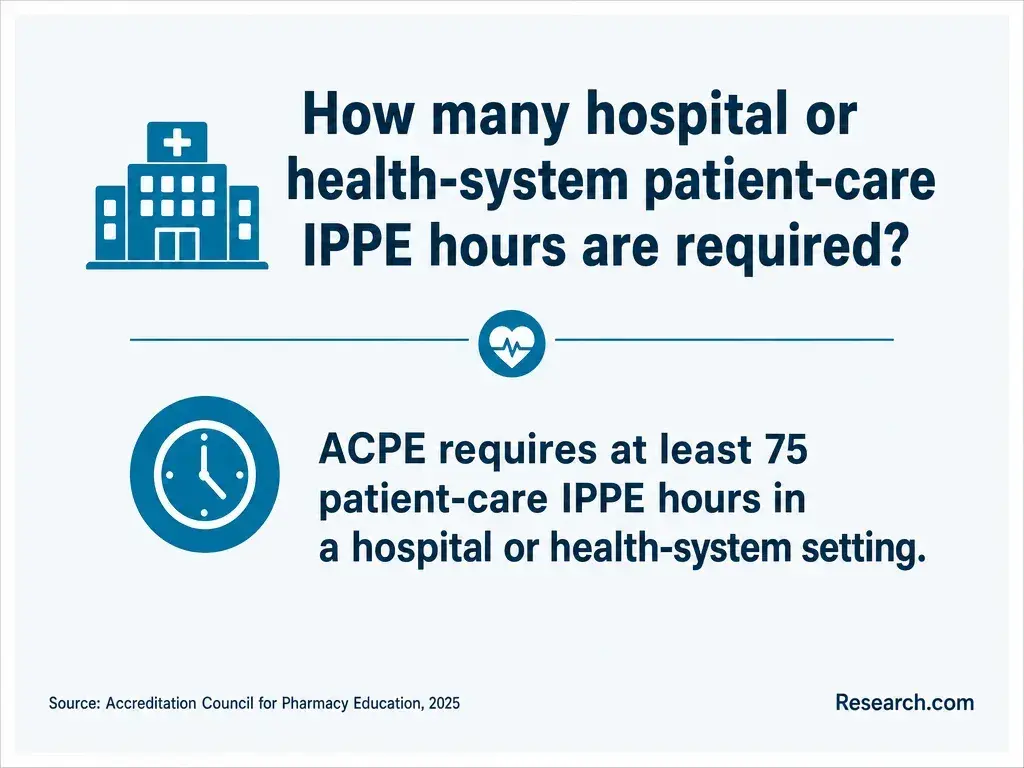
Online classes do not replace in-person clinical education. Pharm.D. students complete introductory pharmacy practice experiences (IPPEs), which introduce supervised work in practice settings, and advanced pharmacy practice experiences (APPEs), which involve more sustained clinical and practice responsibilities later in the program. Ask Fisher for its current rotation schedule, required settings, site-approval process, and placement support; do not assume an existing job can count as a rotation or that every placement will be near home.
Clinical sites may require student or intern registration, background checks, immunizations, onboarding, and availability during assigned hours. State rules and site capacity can also affect where a student may rotate. Confirm who secures and approves sites, what happens if a local site is unavailable, and how much notice you receive before travel. Claims about fast-track online pharmacy education deserve particular scrutiny if they appear to omit the supervised experiences required for a professional Pharm.D.
Graduating from an ACPE-accredited Pharm.D. program is an important educational step toward U.S. pharmacist licensure, but it does not automatically authorize practice in any state. Applicants generally must meet the destination board's education and supervised-experience rules, pass the North American Pharmacist Licensure Examination (NAPLEX), meet any applicable jurisprudence-exam requirement, and complete that board's application and other conditions. Jurisdictions differ: do not assume every board uses the Multistate Pharmacy Jurisprudence Examination (MPJE), particularly as some began transitioning to the Uniform MPJE (UMPJE) in 2026.
Before applying, contact the board where you expect to seek your first license and ask about intern registration, recognition of your planned rotations, examinations, and any state-specific conditions. Confirm separately that Fisher can enroll you where you live and arrange permissible clinical training there. Guides to how long online doctoral programs take address degree timing, not the additional steps a pharmacy board controls.
What careers and salaries can you pursue with a Pharm.D. degree?
After obtaining the required state license, a Pharm.D. graduate may pursue pharmacist roles in community pharmacies, hospitals, ambulatory care, specialty pharmacy, or other settings, subject to employer requirements. The U.S. Bureau of Labor Statistics reports pharmacist median annual pay of $140,910 in May 2025 and projects 5% employment growth from 2025-2035. That occupational median covers pharmacists across settings and experience levels; it is not an expected starting salary or a forecast for Fisher graduates.
Some clinical or specialized positions favor postgraduate training. A residency provides supervised practice after graduation; a fellowship generally emphasizes a defined area such as research or industry work. Board certification is a separate credential with its own eligibility rules, not a pharmacist license. None is universally required for every pharmacist job.
If your goal is a pharmacist license, compare the full educational investment with your likely work plans. If your goal is a pharmacy-adjacent role that does not require pharmacist licensure, first check whether a less extensive credential would suffice. That distinction is essential when weighing an affordable route through pharmacy education against a professional Pharm.D.
Other Things You Should Know About PharmD
PharmCAS may carry forward certain information for returning applicants, but you must review the current cycle's instructions, update required sections, and submit a new application. Check which transcripts or recommendations must be provided again.
Ask Fisher and PharmCAS which transcript evaluation and English-language documentation apply to your education. Do not assume a foreign course meets a prerequisite based only on its translated title.
Yes. Contact the university's accessibility office about accommodations for an interview or other admissions activity, and follow any separate PharmCAS procedures that apply. Make the request early enough for the process to be completed before your scheduled activity.
Do not assume an offer carries over to another cohort. Ask Fisher admissions whether deferral is available, what deadline applies, and whether you would need to update coursework or application materials.
- Eligibility Requirements | Federal Student Aid https://studentaid.gov/understand-aid/eligibility/requirements
- Experiential Education in Pharmacy Curriculum - PMC - NIH https://pmc.ncbi.nlm.nih.gov/articles/PMC7839036/
- Doctor of Pharmacy (Pharm.D.) | Program Requirements | St. John Fisher University https://www.sjf.edu/graduate-programs/doctor-of-pharmacy-pharmd/program-requirements/
- Step Two: PharmCAS Application - UMKC School of Pharmacy https://pharmacy.umkc.edu/admissions/pharmd-application-process/step-two-pharmcas-application.html
- Applying Without U.S. Citizenship or Permanent Resident Status | PharmD Degree Program https://pharmd.ucsf.edu/admissions/intl
- Application Process - Pharmacy | UT Tyler https://www.uttyler.edu/academics/colleges-schools/pharmacy/admissions/application-process/index.php
- PharmD Program How to Apply - UK College of Pharmacy https://pharmacy.uky.edu/apply/pharmd-program/pharmd-how-apply
- International Applicants - UW School of Pharmacy https://sop.washington.edu/pharmd/admissions/international-applicants/
- PharmD Application Process - School of Pharmacy https://pharmacy.wisc.edu/pharmd/application-process/
- Applying to the Program - Fisher Pharm.D. Online | SJF-PHA https://onlinepharmd.sjf.edu/admissions/applying-to-the-program/