
2027 Can Your AAS in Criminal Justice Transfer into an Online BS in Business Administration?
Audited and Verified:
Our Editorial and Data Verification Process
Research.com uses government datasets, official education statistics and primary institutional information to support its career and degree guides. Our review process checks factual accuracy, occupational definitions, source dates and the requirements associated with the credentials discussed.
How This Article Was Fact-Checked
Our editorial team verifies salary estimates, employment projections, education requirements and program information against original data providers and official organizations. Salary figures are checked against the relevant occupational definitions and reporting periods. Information about licensure, accreditation and required in-person training is reviewed separately.
Fact-checked and verified on:

Co-Founder and Chief Data Scientist
An AAS in Criminal Justice can be a starting point for an online BS in Business Administration, but the credits that transfer may not all shorten the degree. Applied criminal justice courses, general education requirements, and the business core are evaluated differently.
For AAS graduates considering a move into business or administrative work, that distinction affects both cost and graduation timing. This guide explains what to request from schools, how to read a credit evaluation, and how to compare programs before committing.
Key Things You Should Know
- Yes, a criminal justice AAS can qualify you to apply to an online BS in Business Administration; admission and the application of transfer credits are separate decisions.
- An AAS may contain roughly two years of coursework, but a school's transfer limit is not a promise that those credits will satisfy two years of bachelor's requirements.
- Compare official degree audits, not advertised transfer maximums, to identify remaining business courses, prerequisites, residency credits, cost, and likely completion time.
Can an AAS in Criminal Justice transfer into an online BS in Business Administration?
Yes, many online bachelor's programs consider applicants with an Associate of Applied Science (AAS) in Criminal Justice. An AAS is generally designed around occupational coursework, however, rather than the lower-division requirements of a particular bachelor's degree. The receiving university decides whether to admit you, which courses to accept, and where accepted credits fit in its BS curriculum.
That last decision matters most. A criminal justice course may transfer as a free elective without replacing accounting, economics, statistics, or another required business course. Some universities have AAS-to-bachelor's agreements or generous elective space; others require substantially more coursework after transfer. When exploring ranked American online business degree options, use each school's policies as a starting point, then request an evaluation of your own transcript before choosing.
How many Criminal Justice AAS credits transfer to a Business Administration bachelor's degree?
There is no dependable number based on the AAS title alone. Schools may accept a course for transfer, apply it to a specific degree requirement, or count it only toward a transfer-credit ceiling. Even a generous acceptance decision can leave a student with substantial general education and business requirements to finish.
Ask for a written degree audit that separates credits into general education, business prerequisites and core, electives, and credits that do not apply. Check whether the evaluation is preliminary or final, whether any courses need syllabi for review, and how many credits must be earned at the university. If your goal is specifically project work, compare project management bachelor's credit transfer rules too: a specialized degree may use your credits differently from a general business BS.
What accreditation should an online Business Administration degree have?
First, verify that the university holds institutional accreditation from an accreditor recognized by the U.S. Department of Education or the Council for Higher Education Accreditation. Accreditation matters for evaluating an institution's academic standing and can affect federal aid eligibility and later credit-transfer decisions. The online delivery format does not replace the need to check the institution itself.
AACSB, ACBSP, and IACBE are business-focused accreditors, but their scope differs; verify whether the specific business school and degree you are considering are covered. Business-specific accreditation may matter to you, but it does not guarantee that criminal justice credits will satisfy business requirements. If a specialized project management degree is also on your shortlist, an accredited online project management tuition guide can help frame the comparison; confirm each institution's current accreditation and program details directly.
Broadly transferable courses, such as college writing, speech, mathematics, social science, or statistics, may satisfy general education requirements if their content and credit hours match. Criminal justice courses more often fill electives, although a school may approve a particular course for another requirement. A course about criminal law, for example, should not be assumed to replace business law.
Course titles are not enough to establish equivalence. Supply descriptions or syllabi for courses in statistics, research methods, ethics, public administration, or personnel management that appear relevant to your proposed degree. A criminal justice personnel course might demonstrate useful preparation without replacing a required HR course. If HR is the intended destination, understanding human resources degree levels can help you decide whether general business or a more focused curriculum better fits that goal.
Expect the school to request official transcripts from every college attended and to review its transfer GPA and good-standing rules. Requirements may differ for admission to the university and entry into the business major. Some programs allow students to complete missing mathematics, accounting, or economics courses after admission; others require particular prerequisites first.
Before applying, ask admissions which requirements apply to AAS holders, then ask the business adviser when any missing prerequisites must be completed. Confirm application deadlines and fees rather than assuming an online program uses rolling admission. No-application-fee online college choices may reduce the cost of exploring options, but a waived fee says nothing about how your credits will apply.
Completion time depends on the approved degree audit, not simply on having finished an associate degree. Missing general education courses, business prerequisites, upper-division requirements, and university residency credits can all extend the path. Accounting or statistics prerequisites may also delay later finance or analytics courses if they are not offered when you need them.
Request a term-by-term plan showing when required online courses are offered and whether they have live sessions, group work, or fixed deadlines. Compare full-time and part-time plans against your work schedule; "online" does not necessarily mean self-paced. American colleges offering fast-track business bachelor's are worth considering if speed is important, but an accelerated calendar helps only if your transfer evaluation and available time make its course load feasible.
Your likely cost is driven by the courses still required after the official transfer evaluation. Compare tuition for those courses, mandatory online or technology fees, books and software, and any proctoring or travel costs. Also check whether tuition differs by residency or enrollment intensity and whether an additional term would add fees.
Ask financial aid for an aid estimate based on your planned enrollment, not a schoolwide average. Grants and loans depend on eligibility, while employer reimbursement may arrive only after you complete a course. Use affordable colleges for online business degrees to build a shortlist, then compare each school's estimated remaining-degree cost. The lowest advertised tuition may not be the least expensive path if fewer AAS credits apply.
A BS in Business Administration commonly combines general education with introductory accounting, economics, marketing, management, finance, operations, and quantitative coursework. Programs may also require business law, information systems, strategy, or a capstone. Exact requirements and any available concentrations vary by school; a few electives do not necessarily constitute a formal concentration.
For a criminal justice AAS graduate, the largest new academic demands may be financial statements, spreadsheets, statistics, and business decision-making. Review course descriptions and prerequisites rather than assuming your previous research-methods or public-administration coursework replaces them. If you will remain employed while studying, degree options for working business administration students can help you examine scheduling alongside curriculum. Ask specifically how presentations, team assignments, and any capstone fit around work.
The combination of criminal justice and business study may be useful for administrative, operations, compliance-support, HR-support, or project-coordination roles in government, nonprofits, security-related organizations, or private companies. Your experience matters: someone who has handled scheduling, case documentation, budgets, vendor communication, or team coordination can show relevant evidence beyond a new degree.
Target a function rather than assuming the BS leads directly to management. Compare job postings for the work you want, identify missing skills, and seek a course project or supervised work assignment that demonstrates them without disclosing confidential records. If project coordination is the clear goal, online project management degrees with lower tuition may be worth comparing with a general business BS. Neither degree alone confers a project-management credential or guarantees a managerial position.
What salaries and job outlook can Business Administration graduates expect?
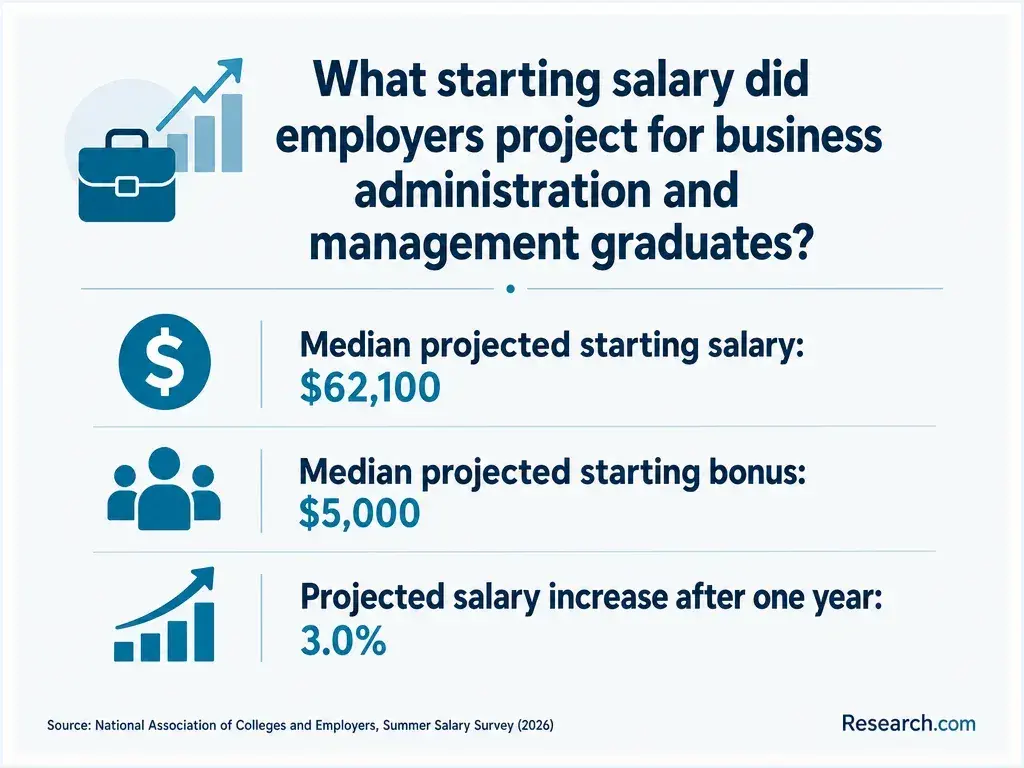
There is no single salary or growth rate for BS in Business Administration graduates. U.S. Bureau of Labor Statistics figures describe occupations, not the earnings of people with a particular degree. The examples below show possible destinations, including roles that may require relevant experience or additional skills.
The table reports national occupation-wide median annual pay in May 2025 and projected U.S. employment change from 2025 to 2035. Use it to compare career directions, not to estimate an entry-level offer.
| Occupation | Median annual pay | Projected growth |
| Human resources specialist | $75,940 | 6% |
| Market research analyst | $78,760 | 7% |
| Project management specialist | $102,320 | 7% |
These figures include experienced workers and people with varied educational backgrounds. Compare local postings, required experience, and your likely starting role before borrowing for a degree. If a shorter completion route would materially reduce your costs or time away from full-time work, investigate quick online bachelor's pathways, but base the financial comparison on credits actually applied and a manageable course schedule.
Other Things You Should Know About Business Administration
Usually, no. Ask each bachelor's program whether it admits AAS graduates directly and lets them complete missing business prerequisites after transfer.
Possibly, if the university offers prior-learning assessment and your experience meets its documentation rules. Employment alone does not award credit; ask about assessment fees and whether any awarded credit applies to the BS.
Many schools have a review or appeal process. Request the reason for the decision and submit a detailed syllabus or other requested evidence to the transfer office or academic department.
Compare the actual degree audits rather than relying on the labels. The better choice is the program that applies more of your credits to requirements while providing the business coursework relevant to your goal.
- Accreditation in the U.S. | ed.gov http://www.ed.gov/laws-and-policy/higher-education-laws-and-policy/college-accreditation/accreditation-in-the-us
- Academic Standards | Pikes Peak State College Academic Catalog https://catalog.pikespeak.edu/academic-standards/
- How Do Transfer Credits Work When You Go Back to School? | Whitworth Online https://online.whitworth.edu/news-articles/how-do-transfer-credits-work-when-you-go-back-to-school/
- Bachelor's Degree Requirements | University of Oregon Academic Catalog https://catalog.uoregon.edu/admissiontograduation/bachelorrequirements/
- Career & Technical Awards General Education Requirements | austincc.edu https://catalog.austincc.edu/academic-planning/core-curriculum-general-education/career-and-technical-awards-general-education-requirements/
- Transfer Credit FAQs | Office of the University Registrar https://registrar.umd.edu/transfer-credit/transfer-credit-faqs
- Degree Requirements - The University of Texas at San Antonio https://catalog.utsa.edu/undergraduate/bachelorsdegreeregulations/degreerequirements/
- Program: Criminal Justice AA | tulsacc.edu https://catalog.tulsacc.edu/preview_program.php
- College of Business | Texas A&M University-San Antonio Catalog https://catalog.tamusa.edu/undergraduate/business/
- Request Transfer Evaluation | TCC.edu https://www.tcc.edu/forms/request-transfer-evaluation/


