PharmD Program Comparison Checklist for Applicants

Co-Founder and Chief Data Scientist
Two Doctor of Pharmacy (Pharm.D.) programs can lead toward the same professional degree while differing substantially in prerequisites, total cost, clinical placements, and scheduling. Those differences matter if you need to keep working, move for rotations, or borrow to cover living expenses.
This guide gives prospective U.S. pharmacy students a comparison checklist they can use with each school's current disclosures. It also explains which claims to verify before paying an enrollment deposit, so you can narrow your choices based on licensure eligibility, practical fit, and financial risk - not just advertised tuition or program format.
Key Things You Should Know
- Start with the program's current Accreditation Council for Pharmacy Education (ACPE) status and the licensing rules in the state where you intend to practice; a Pharm.D. alone is not a pharmacist license.
- Compare the full cost of attendance and required time away from work, not tuition alone. New federal graduate and professional borrowers face changed loan rules beginning July 1, 2026.
- Use several outcome measures together: published first-time NAPLEX results, graduation and attrition data, rotation support, and career destinations. No single measure predicts your result.
What should a PharmD program comparison checklist include?
A useful checklist compares the same evidence for every program. Copy the fields below into a spreadsheet, record the publication date of each school's information, and leave a cell blank rather than treating an unanswered question as a favorable result.
| Comparison field | Program A | Program B |
| ACPE professional-program status and date checked | _____ | _____ |
| Prerequisites still needed; application deadline | _____ | _____ |
| Professional-program length and required schedule | _____ | _____ |
| Tuition, required fees, and estimated living costs | _____ | _____ |
| Campus visits, rotation locations, and placement support | _____ | _____ |
| Published graduation, attrition, and first-time NAPLEX outcomes, with cohort years | _____ | _____ |
| State authorization and intended-state licensure questions | _____ | _____ |
| Unresolved questions and response from the school | _____ | _____ |
First eliminate programs that cannot meet a nonnegotiable requirement, such as a required location or an acceptable path to licensure. Then compare the remaining choices on cost, schedule, support, and outcomes. Applicants missing coursework can explore pharmacy degree eligibility options, but must confirm each school's rules for courses in progress before applying.
How does ACPE accreditation affect PharmD program licensure eligibility?
ACPE accredits professional pharmacy degree programs, not individual pharmacists. Graduation from an ACPE-accredited Pharm.D. program is the standard U.S.-educated route toward pharmacist licensure; the state board still determines whether an applicant meets its education, training, examination, and other requirements. Check the specific program and its current status in ACPE's official directory, particularly if a school describes a new or developing program.
Institutional accreditation addresses the college or university as a whole and does not replace ACPE professional-program accreditation. Likewise, permission to enroll an online student in a state does not establish that its clinical placements are approved there or that its graduates meet that state's licensing requirements. Ask both the school and your intended state board about any uncertainty before enrolling. This check is especially important when comparing accelerated pharmacy education options: a faster schedule does not change the need to verify program status.
What are the admission requirements for PharmD programs?
Admissions rules vary by school. Compare required undergraduate pre-pharmacy courses and labs, minimum grades and GPA, credit totals, course-age limits, and whether a bachelor's degree is required. These prerequisites come before the professional Pharm.D. curriculum; a bachelor's degree is not a universal entry requirement. A published minimum establishes eligibility to be considered, not a likelihood of admission.
Check whether each school uses the Pharmacy College Application Service (PharmCAS), then separate PharmCAS requirements from school-specific supplements, recommendations, interviews, deposits, and deadlines. Confirm how the school evaluates community-college, advanced-placement, online-lab, international, repeated, and transfer coursework. The receiving school decides whether prior credits satisfy its requirements. The Pharmacy College Admission Test (PCAT) was retired in January 2024, so an older checklist that calls for it is outdated. Lists of pharmacy programs with flexible entry requirements can generate possibilities, but current school policies must settle the comparison.
"Online" describes some instruction, not necessarily the entire degree. An online or hybrid Pharm.D. may still require live classes, campus labs or immersions, in-person assessments, and supervised clinical rotations. Campus-based programs also require time outside lectures for labs and rotations. Compare actual calendars rather than assuming either format is more flexible.
The table separates the scheduling differences most likely to affect work, housing, and travel plans. Requirements vary by program, so use its current academic calendar and experiential education policies for your final comparison.
| Factor | Online or hybrid program | Campus-based program |
| Class attendance | May include scheduled live sessions | Typically includes scheduled on-campus sessions |
| Hands-on training | May require campus visits; clinical rotations occur in person | Labs are generally on campus; clinical rotations may be elsewhere |
| Location costs | Potential travel or temporary housing for visits and rotations | Potential relocation, commuting, and rotation travel |
| Work compatibility | Depends on live sessions and rotation blocks | Depends on class and rotation schedules |
Ask who arranges rotation sites, whether a site near your home is possible, and whether you may need to travel or reduce work hours. Compare those answers - not just recorded-lecture availability - when reviewing online Pharm.D. program options.
Professional coursework commonly develops knowledge of medications, therapeutics, patient assessment, drug information, pharmacy law, and medication safety. Programs also teach students to apply that knowledge through simulations, labs, and supervised patient-care experiences. A strong undergraduate chemistry background may help with foundational science, but it does not replace professional patient-care training; applicants comparing Pharm.D. programs for chemistry majors should still inspect the complete curriculum.
Introductory pharmacy practice experiences (IPPEs) introduce supervised practice during the curriculum. Advanced pharmacy practice experiences (APPEs) provide more intensive supervised rotations, often across multiple settings. Compare each school's published sequence, sites, preceptor oversight, and placement responsibilities. Students may need intern registration, background checks, immunizations, or travel, depending on the site and state. Do not assume an existing pharmacy job can substitute for a required rotation.
The timeline has two parts: any prerequisite undergraduate study you still need and the professional Pharm.D. program. Professional schedules commonly span several academic years, while accelerated and other pathways sequence coursework differently. Compare each school's published calendar, including summer terms and rotations, rather than relying on the word "accelerated."
For cost, request the school's current academic-year tuition and fee schedule and estimated cost of attendance. Include remaining prerequisites, books and resources, equipment, background checks, campus visits, rotation travel or housing, and licensing expenses. Compare costs over the entire expected enrollment period, alongside earnings you may give up during full-time rotations. Guides to online pharmacy school cost options are a starting point, not a substitute for a personalized estimate.
Ask the financial aid office to explain your classification and eligibility under rules applicable to your entry date. Federal borrowing rules changed for many new graduate and professional borrowers beginning July 1, 2026; do not assume an older loan-limit example or automatic Grad PLUS access applies to you. A lower tuition quote may cease to be the cheaper choice if it requires substantially more travel, living expenses, or prerequisite coursework.
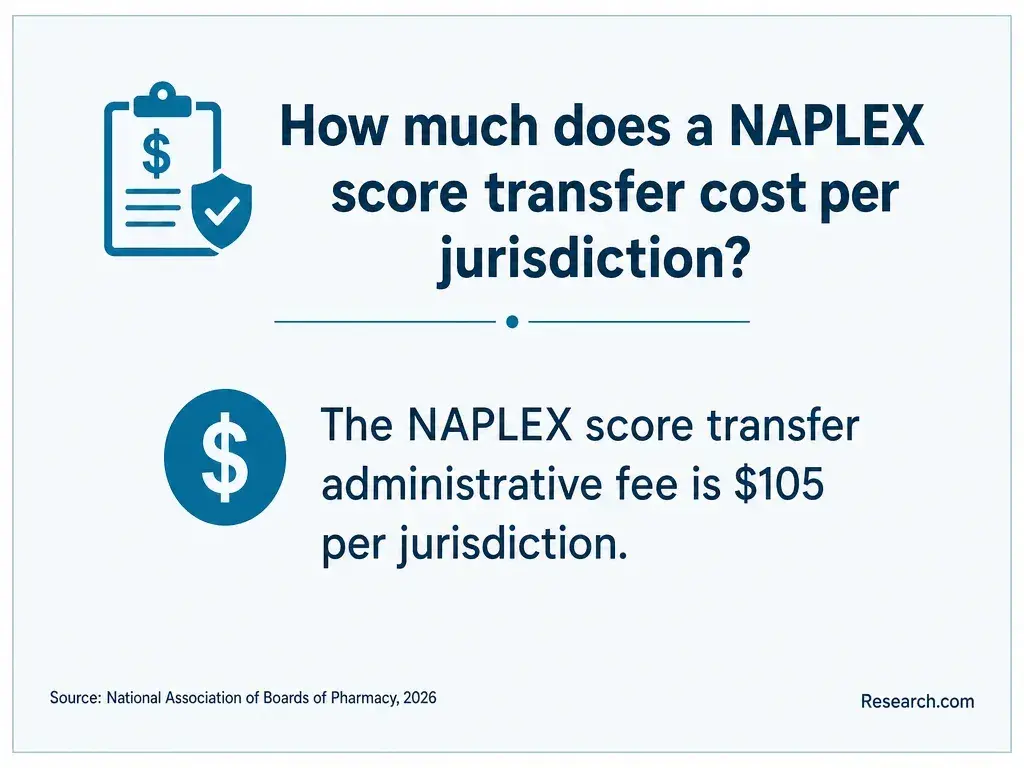
A Pharm.D. program supplies professional education and supervised experiences; a state board issues the pharmacist license. U.S.-educated applicants generally must satisfy board requirements and pass the North American Pharmacist Licensure Examination (NAPLEX). A jurisdiction may also require a jurisprudence examination or another assessment. Do not assume it uses the Multistate Pharmacy Jurisprudence Examination (MPJE): some jurisdictions began transitioning to the Uniform MPJE (UMPJE) in 2026. Check the intended board and the National Association of Boards of Pharmacy for current requirements.
Compare programs' opportunities to apply therapeutics knowledge, practice calculations and clinical reasoning, receive feedback, and prepare for examinations. Ask how they support students who struggle; a review course is not proof of strong outcomes. Licensure also takes time after graduation, so claims about online pharmacy degree duration should not be mistaken for a guaranteed timeline to practice as a pharmacist. Passing an exam alone does not issue a license.
Licensed pharmacists work in community, hospital, ambulatory-care, health-system, and other settings, with duties shaped by employer needs and state scope-of-practice rules. If you have a particular setting in mind, compare the programs' rotation access, faculty support, and published graduate destinations rather than assuming every Pharm.D. offers the same exposure.
Postgraduate year one (PGY1) residency offers broad, structured practice training; PGY2 residency focuses further on a practice area. Fellowships often emphasize research or industry-related work. These are distinct from state licensure and are not universal hiring requirements. Board of Pharmacy Specialties certification is another, separate credential with its own eligibility rules. Conversely, someone seeking a pharmacy-adjacent role rather than pharmacist practice should compare whether a less extensive credential would meet that goal. Lists of short online doctorate programs should not be treated as lists of substitutes for an ACPE-accredited Pharm.D.
The Bureau of Labor Statistics reports median annual pay of $140,910 in May 2025 for pharmacists and projects 5% employment growth from 2025-2035, with about 12,500 openings per year. These are occupation-wide figures, not starting-salary offers or estimates for a particular school's graduates. Location, setting, hours, and experience can change an individual result.
Use those figures as context for evaluating debt and time out of the workforce, not as a promised return. Ask schools for clearly defined graduate employment information, and compare likely borrowing with the work you actually want to pursue. If your goal does not require pharmacist licensure, investigate lower-cost pharmacy degree pathways before committing to a professional doctorate; a pharmacy technician pathway, for example, leads to a separate occupation that does not ordinarily require a Pharm.D.
How can applicants evaluate PharmD outcomes and choose a reputable program?
Look for outcomes reported with their cohort year and denominator. A school's first-time NAPLEX pass rate is useful, but it excludes students who did not reach the exam; read it alongside graduation, attrition, and time-to-degree information. Residency placement figures need context too: ask how many graduates applied, not only how many matched. Where schools report outcomes differently, note the limitation rather than forcing a precise ranking.
Before paying a deposit, complete these checks in order. They turn the comparison worksheet into a decision based on verifiable information.
- Confirm the program's current ACPE status and ask your intended state board about any licensure uncertainty.
- Obtain written answers on remaining prerequisites, credit evaluation, program schedule, and rotation placement.
- Compare personalized full-program costs and current financial aid eligibility, including travel and time away from work.
- Review outcome definitions and cohort years; ask the school to explain missing or unusually selective reporting.
- Choose among the remaining programs according to your career setting, geographic constraints, and manageable financial risk.
A red flag is an assurance that prior courses "will transfer" before the receiving school evaluates them. Resources on how to transfer courses into a pharmacy degree can help frame the question, but request a school-specific evaluation that distinguishes prerequisite credit from entry into the professional curriculum.
Other Things You Should Know About PharmD
Possibly, but professional-course transfer is school-specific and may be limited by sequencing, available seats, and rotation requirements. Get a written credit evaluation before leaving your current program.
Not necessarily. Internationally educated applicants may need foreign graduate certification and must meet the intended state board's rules. A foreign pharmacy degree should not be assumed equivalent to graduation from a U.S. ACPE-accredited Pharm.D. program.
No. A dual degree may support a particular career interest, but it does not replace pharmacist licensing requirements. Compare its added cost and time with the work you hope to do.
Yes, if possible. Ask how published schedules compare with actual workloads and how the school responds when a rotation site changes. Treat individual accounts as context alongside official policies and outcomes.
- Rule 3358:5-7-14 | Student location policy. https://codes.ohio.gov/ohio-administrative-code/rule-3358:5-7-14
- Understanding College Costs | studentaid.gov https://studentaid.gov/resources/prepare-for-college/students/choosing-schools/consider-costs
- Cost of Attendance (Budget) | 2025-2026 Federal Student Aid Handbook https://fsapartners.ed.gov/knowledge-center/fsa-handbook/2025-2026/vol3/ch2-cost-attendance-budget
- Cost of Attendance - Financial Aid and Scholarships | The University of Utah https://financialaid.utah.edu/tuition-and-fees/cost-of-attendance.php
- Experiential Rotation Manual | ufl.edu https://oep.pharmacy.ufl.edu/student-resources/experiential-policies-and-procedures/
- PharmD Degree Program renews accreditation through 2030 | ucsf.edu https://pharmacy.ucsf.edu/news/2022/02/pharmd-degree-program-renews-accreditation-through-2030
- Program Overview | Experiential Education https://pharm.ucsf.edu/experiential/overview
- Cost of Attendance - Texas One Stop https://onestop.utexas.edu/managing-costs/cost-tuition-rates/cost-of-attendance/
- Experiential Learning Manual - School of Pharmacy https://www.pharmacy.pitt.edu/experiential-learning-manual
- Accreditation Status - Doctor of Pharmacy (PharmD) https://pharmsci.uci.edu/degrees-programs/doctoral-programs/pharmd/accreditation-status/