Specialty Pharmacy Career Path After a PharmD

Co-Founder and Chief Data Scientist
A Pharm.D. can lead to specialty pharmacy, but it does not determine how you enter the field. Some graduates move into specialty dispensing and patient-support roles after licensure; others pursue residency training before seeking more clinically focused positions.
If you are deciding whether additional training is worth the time and cost, this guide explains the work, compares entry routes, and shows what to verify before committing.
Key Things You Should Know
- A Pharm.D. graduate generally needs state pharmacist licensure to practice as a specialty pharmacist; a residency or specialty certification is not universally required.
- The median annual pay for the broader pharmacist occupation was $140,910 in May 2025, according to the Bureau of Labor Statistics (BLS); it is not a specialty-pharmacist salary figure.
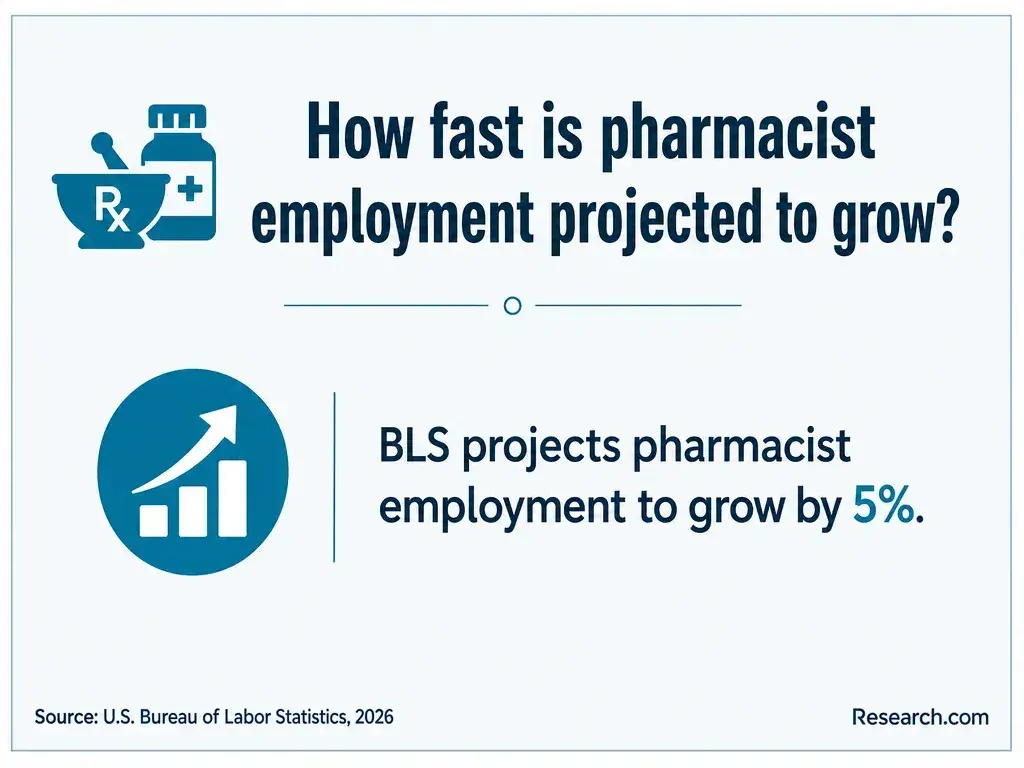
- BLS projects 5% growth for pharmacists during 2025-2035. Choose between direct employment and postgraduate training based on the duties and hiring requirements of the jobs you want.
What is a specialty pharmacy career after earning a PharmD?
Specialty pharmacy focuses on medications and services for patients with complex conditions, such as cancer, multiple sclerosis, or inflammatory diseases. Depending on the position, a pharmacist may assess prescriptions, counsel patients, monitor adherence and adverse effects, coordinate with prescribers, or help patients navigate access to treatment. The setting might be a health-system specialty pharmacy, an independent or chain pharmacy, or a payer-affiliated organization.
The defining feature is the work - not a separate degree called a specialty Pharm.D. Some positions emphasize dispensing operations and access; others emphasize clinical assessment and ongoing patient care. Before pursuing another credential, read job descriptions for the duties you want. In particular, do not confuse short online pharmacy degree timelines with a route that replaces a professional Pharm.D. or pharmacist licensure.
What education and licensure are required for specialty pharmacy practice?
For a U.S.-educated applicant, the usual foundation is a Doctor of Pharmacy degree from a program accredited by the Accreditation Council for Pharmacy Education (ACPE), followed by pharmacist licensure in the jurisdiction of practice. Pre-pharmacy undergraduate coursework prepares a student to apply; it is not the professional Pharm.D. curriculum. Students planning pharmacy education after a pre-pharmacy track should distinguish those two stages when estimating their time to practice.
State boards set licensing requirements. These commonly include the North American Pharmacist Licensure Examination (NAPLEX) and any applicable jurisdiction-specific law examination or other requirements; do not assume every jurisdiction uses the same jurisprudence exam. Completing the degree or passing an exam alone does not issue a license. ACPE accredits professional programs, while institutional accreditation and authorization to enroll an online student in a particular state are separate matters. Internationally educated pharmacists generally face a different eligibility pathway and should check the relevant board and National Association of Boards of Pharmacy requirements.
How do PharmD graduates enter specialty pharmacy careers?
Direct employment is a viable route when an employer offers the supervision and training needed for a newly licensed pharmacist. Pharm.D. students can prepare through relevant advanced pharmacy practice experiences, work in a specialty pharmacy, and projects involving patient counseling, medication access, or quality improvement. A postgraduate year one (PGY1) residency can broaden practice skills; a relevant postgraduate year two (PGY2) residency can support applications for more specialized clinical roles. Neither is a universal hiring requirement.
A practical sequence keeps the career decision tied to actual openings:
- Collect job postings in the setting and clinical area you want, separating required qualifications from preferred ones.
- Seek rotations, internships, or projects that expose you to the listed responsibilities.
- Confirm the licensing rules for the jurisdiction where you intend to work, then compare direct-hire opportunities with residency requirements and compensation.
If you have not yet entered pharmacy school, pharmacy programs with flexible entry requirements may help you identify options, but admission policies do not change the licensure requirements you will face after graduation.
Job titles are not standardized. The comparison below focuses on responsibilities and hiring signals, which are more useful than a title alone when deciding where to apply.
| Role | Typical focus | What to check in postings |
| Specialty dispensing pharmacist | Prescription assessment, dispensing oversight, counseling, and coordination of refills | Licensure, dispensing experience, workflow expectations, and patient contact |
| Clinical specialty pharmacist | Therapy assessment, monitoring, and collaboration with care teams | Condition-specific experience and whether residency is required or preferred |
| Specialty pharmacy manager | Staff supervision, quality processes, service operations, and compliance | Leadership experience, operational responsibilities, and performance measures |
| Medication access pharmacist | Resolving coverage barriers and coordinating access to prescribed therapy | Clinical duties, payer-facing work, and experience with access processes |
A pharmacy technician may work alongside these pharmacists, but it is a separate occupation that does not ordinarily require a Pharm.D. If you are still choosing a professional degree, compare pharmacy doctorate options against the pharmacist roles you actually want - not against pharmacy-adjacent titles with different educational requirements.
A PGY1 pharmacy residency provides structured postgraduate practice across areas that may include patient care, operations, and quality improvement. A relevant PGY2 residency builds on that foundation with a narrower clinical focus. Specialty pharmacy exposure varies by program, so a residency's name alone does not establish how much time residents spend in a specialty pharmacy. ASHP-accredited residency programs have defined training standards; applicants should check each program's accreditation, prerequisites, application process, and participation in the ASHP Match.
A fellowship is a different type of postgraduate position, often centered on research, industry, or a defined professional project rather than residency-style practice training. Its structure and application process depend on the sponsor. Both routes carry an opportunity cost: time spent in postgraduate training is time not spent earning a pharmacist's full employment compensation. Before applying, ask whether the roles you seek require that training, prefer it, or provide comparable development through employment. Likewise, shortened Doctor of Pharmacy pathways affect the education leading to the degree; they do not shorten an employer's residency requirements.
Pharmacotherapy, pharmacokinetics, patient assessment, and drug-information coursework provide a foundation for evaluating complex medication regimens. Specialty practice also calls for clear counseling, documentation, medication-safety judgment, and the ability to work with prescribers, nurses, patients, and access teams. The relevant clinical knowledge depends on the therapies and conditions in a particular job.
Use electives and advanced rotations to test whether you prefer longitudinal patient follow-up, dispensing operations, or a disease-focused clinical role. Ask prospective sites what you will do under supervision, rather than assuming a rotation labeled "specialty" provides every skill. If you are bringing prior college coursework into a Pharm.D. application, how pharmacy programs review transfer credits matters: the receiving school decides which courses satisfy prerequisites or degree requirements.
No single specialty certification is required for every specialty pharmacist job. Employers may value credentials for particular roles, but a certification is distinct from a state pharmacist license and cannot authorize practice on its own. The Certified Specialty Pharmacist (CSP) credential and Board of Pharmacy Specialties credentials have different issuing organizations, eligibility rules, examinations, and renewal requirements. Check the current rules of the credentialing body and the requirements of your target employer before paying for preparation.
Certification is generally a later decision: first identify the practice area and experience you need, then determine whether a credential adds value for the positions you want. For prospective students, pharmacy schools and prerequisite completion is an admissions question, not a shortcut to specialty certification or pharmacist licensure.
BLS reports a median annual pay of $140,910 in May 2025 for pharmacists overall. That figure is useful context, but it combines practice settings and does not establish what a newly licensed specialty pharmacist - or a pharmacist in a particular specialty - will earn. Location, employer, duties, experience, and schedule can change an offer.
Compare actual job offers with residency stipends and the costs of any additional training. If you are still selecting a Pharm.D. program, Doctor of Pharmacy programs with manageable tuition can be a starting point, but compare total educational cost, clinical-placement travel, and borrowing needs rather than tuition alone. Federal loan rules changed for many new graduate and professional borrowers beginning July 1, 2026, so confirm your own eligibility and available financing with the school's financial aid office.
BLS projects 5% employment growth for pharmacists during 2025-2035, with about 12,500 openings per year projected. These are occupation-wide estimates, not a forecast of specialty pharmacy vacancies. They indicate that pharmacist opportunities should continue to arise, but local openings and competition for clinically focused positions may differ substantially.
Look for evidence closer to your intended job: recent postings in your preferred region, employer requirements, and whether a position involves dispensing, direct patient care, or management. When weighing school cost against career timing, pharmacy degree affordability and completion time are relevant, but neither predicts a specialty job offer.
How can you choose a reputable specialty pharmacy training program?
Choose training by the work it prepares you to do. For a Pharm.D. program, verify current ACPE professional-program accreditation and ask how specialty-related electives and rotations are arranged. For a residency, check its accreditation status, actual learning experiences, preceptors, licensure prerequisites, and where graduates have pursued work. For a fellowship, examine the sponsor, deliverables, supervision, and whether its focus matches your goal; do not assume it is interchangeable with a residency.
Before committing, ask for specifics that affect both learning and cost:
- How much supervised time will I spend on the specialty services relevant to my target job?
- Who arranges rotations or training sites, and could participation require travel or relocation?
- What are the application, licensure, compensation, and completion requirements?
- Can the program show how its training aligns with qualifications in current job postings?
A red flag is a promise of licensure, certification, or employment based solely on completing training. If you are evaluating an online Pharm.D. route before postgraduate training, online doctorate time to completion should also be weighed against required in-person labs and clinical rotations; online instruction does not make pharmacist preparation fully remote.
Other Things You Should Know About PharmD
Yes. Ask about specialty-focused electives, supervised rotations, internships, and student projects. Access and responsibilities vary by school and site.
Many do, through counseling or follow-up, but the amount of patient contact depends on the job. Ask whether a position is primarily clinical, dispensing-focused, operational, or access-focused.
No. Specialty pharmacy also serves patients receiving therapies for conditions such as multiple sclerosis and inflammatory diseases. The conditions covered depend on the employer and service.
Look for access-focused internships and job descriptions, then check whether the position requires a pharmacist license. Some pharmacy-adjacent access roles have different education requirements, so a Pharm.D. may not be necessary for every such job.
- Advancing Patient Care Through Specialty Pharmacy... - PMC https://pmc.ncbi.nlm.nih.gov/articles/PMC10398086/
- Pharmacy Residency Programs - What Is a Residency? | PCOM https://www.pcom.edu/pharmacy/news/pharmacy-residency-programs.html
- Career Paths for Pharmacists - Doctor of Pharmacy https://pharmacy.wisc.edu/pharmd/careers/
- 100 Careers in Pharmacy | UConn School of Pharmacy and Pharmaceutical Sciences https://pharmacy.uconn.edu/100-careers-in-pharmacy/
- What Can You Do With a PharmD Degree? | Bouvé College of Health Sciences https://bouve.northeastern.edu/news/what-can-you-do-with-a-pharmd-degree/
- Pharmacy Career Outlook: Is a Career in Pharmacy Worth It? | Roseman University https://www.roseman.edu/student-experience/news/pharmacy-career-outlook-is-a-career-in-pharmacy-worth-it/
- Your Roadmap to a Career in Managed Care Pharmacy | AMCP.org https://www.amcp.org/your-roadmap-career-managed-care-pharmacy
- Preparing for a Career in Specialty Pharmacy | Pharmacy Times https://www.pharmacytimes.com/view/preparing-for-a-career-in-specialty-pharmacy
- Specialty | pharmacist.com https://www.pharmacist.com/Career/Career-Pathways/Career-Option-Profiles/Specialty
- From PharmD Graduate to PGY1 Pharmacy Resident | accp.com https://careers.accp.com/career-resources/on-the-job-3/from-pharmd-graduate-to-pgy1-pharmacy-resident-a-clinical-pharmacy-career-path-137