
How to Check State Authorization for an Online PharmD

Co-Founder and Chief Data Scientist
An online Doctor of Pharmacy (Pharm.D.) program may accept students in your state yet still leave important questions about clinical rotations and pharmacist licensure. For prospective students, those distinctions can determine whether a program is a workable route to practice - not just whether its classes are accessible. This guide shows you what to confirm with the school and your state board of pharmacy, which answers to get in writing, and which warning signs should stop you from paying a deposit.
Key Things You Should Know
- Confirm three separate matters: the school can enroll you where you live, its Pharm.D. program has an appropriate ACPE accreditation status, and your intended licensing board accepts the pathway.
- Ask whether introductory and advanced clinical rotations can be completed at approved sites in your state; permission to take online classes does not settle placement rules.
- Get a written, location-specific answer before enrolling, then check your board's current intern registration, examination, and licensing requirements yourself.
How can you check state authorization for an online PharmD program?
State authorization concerns whether a school may offer distance education to students in a particular location. Start with the institution's state-authorization disclosures, but do not assume that a general statement covers every part of a professional Pharm.D. program. If you are comparing pharmacy schools offering online Pharm.D. study, check each institution separately.
Use this sequence before applying or paying a deposit:
- Identify the state where you will be physically located while taking online courses, plus any state where you expect to complete in-person requirements.
- Find the school's current distance-education authorization disclosures and its contact for professional-licensure questions.
- Ask the school, in writing: "May I enroll in this specific entry-level Pharm.D. pathway while located in my state?" Request any conditions or exclusions.
- Ask separately whether required campus visits and clinical placements are permitted and feasible in your intended locations.
- Save the dated response and repeat the check if you move, change rotation states, or defer enrollment.
A school may rely on a state authorization reciprocity agreement for some distance-education activity. That is not a blanket approval of clinical sites or a finding that graduates qualify for pharmacist licensure.
Does state authorization guarantee pharmacist licensure after an online PharmD?
No. Authorization addresses the school's ability to offer education to you in a location; pharmacist licensure is a separate decision made under a jurisdiction's laws and board rules. Even short online pharmacy degree timelines should not be taken as evidence that a credential meets entry-level pharmacist licensing requirements.
These terms answer different questions. Keep them separate when reading program disclosures:
| Check | What it establishes | What it does not establish |
| State authorization | Whether the school may offer applicable education to a student in a location | Acceptance of the degree for a pharmacist license |
| ACPE professional-program accreditation | The accreditation status of a specific pharmacy education program | Permission to enroll from every state or an individual license |
| State board licensure review | Whether an applicant meets that jurisdiction's education and other licensing rules | Automatic licensure upon graduation or exam completion |
Ask the school whether its program meets educational requirements for initial licensure in your intended jurisdiction, and confirm the answer with that jurisdiction's board. A written school disclosure is important evidence, but the board controls the licensing decision.
Is the online PharmD program accredited by ACPE?
Check the Accreditation Council for Pharmacy Education's official professional-program directory for the specific Pharm.D. program and campus or pathway you are considering. Record its listed status and ask the school how that status applies to the online or hybrid cohort. This check matters just as much when considering accelerated online pharmacy programs.
ACPE accredits professional pharmacy education programs; it does not accredit individual pharmacists or issue licenses. Institutional accreditation is another, separate check, and neither form of accreditation substitutes for state authorization.
If a program has a developing or other nonstandard accreditation status, ask your intended board how it treats graduates of that status rather than assuming it is equivalent to a fully accredited program.
First establish that the credential is an entry-level professional Pharm.D. intended to prepare graduates for initial pharmacist licensure. Pre-pharmacy undergraduate coursework, a pharmaceutical sciences degree, and some programs designed for pharmacists who are already licensed serve different purposes.
That distinction is especially important when exploring pharmacy doctorate options after biology. Request answers to these questions from the school's licensure-disclosure or experiential-education staff, then compare them with the intended board's published rules:
- Does this exact pathway meet the educational requirements for initial pharmacist licensure in my intended jurisdiction? Is the school's determination "meets," "does not meet," or "has not determined"?
- What ACPE status will apply to my cohort, and are there location-specific restrictions?
- What supervised experience, intern registration, and in-person activities will I need, and who approves the placements?
- Which requirements remain my responsibility after graduation, including applications, exams, and background checks?
If the school cannot determine whether its program meets your jurisdiction's educational requirements, treat eligibility as unresolved. Seek clarification from the board before committing.
Use the pharmacy board for the state or jurisdiction where you intend to seek your first pharmacist license. Its licensing pages, applications, statutes, and regulations are more decisive than a general school summary. The National Association of Boards of Pharmacy (NABP) can help you identify boards and examination processes, but the relevant board's current instructions govern your application.
Look for rules on acceptable pharmacy education, intern registration and experience, examinations, background checks, and application deadlines. If a requirement is unclear for an online or hybrid cohort, contact the board with the school's exact program name and ACPE status. A list of short online doctorate programs cannot establish that a particular doctorate satisfies pharmacist licensing rules.
The North American Pharmacist Licensure Examination (NAPLEX) is part of the U.S. pharmacist licensing process, but passing it does not itself issue a license. Jurisprudence testing varies by jurisdiction: check whether your intended board requires the Multistate Pharmacy Jurisprudence Examination (MPJE), the newer Uniform MPJE (UMPJE), another law assessment, or no separate jurisprudence exam.
Confirm current eligibility and registration procedures with NABP and the board. Experiential education within the Pharm.D. curriculum and any board-required intern hours are related but not necessarily interchangeable.
Ask the board how it counts your program's supervised experience, whether intern registration must begin before rotations, and whether additional hours are required. For students entering through pharmacy programs for career changers, prior work in another field should not be assumed to count as pharmacist intern experience.
Choose among programs only after the authorization, accreditation, and intended-state licensure checks are satisfactory. Then compare required live classes, campus visits and hands-on labs, IPPE and APPE placement support, total cost, and whether the schedule permits your intended work arrangement. To reduce the cost of pharmacy school, compare required travel and rotation-related expenses alongside tuition.
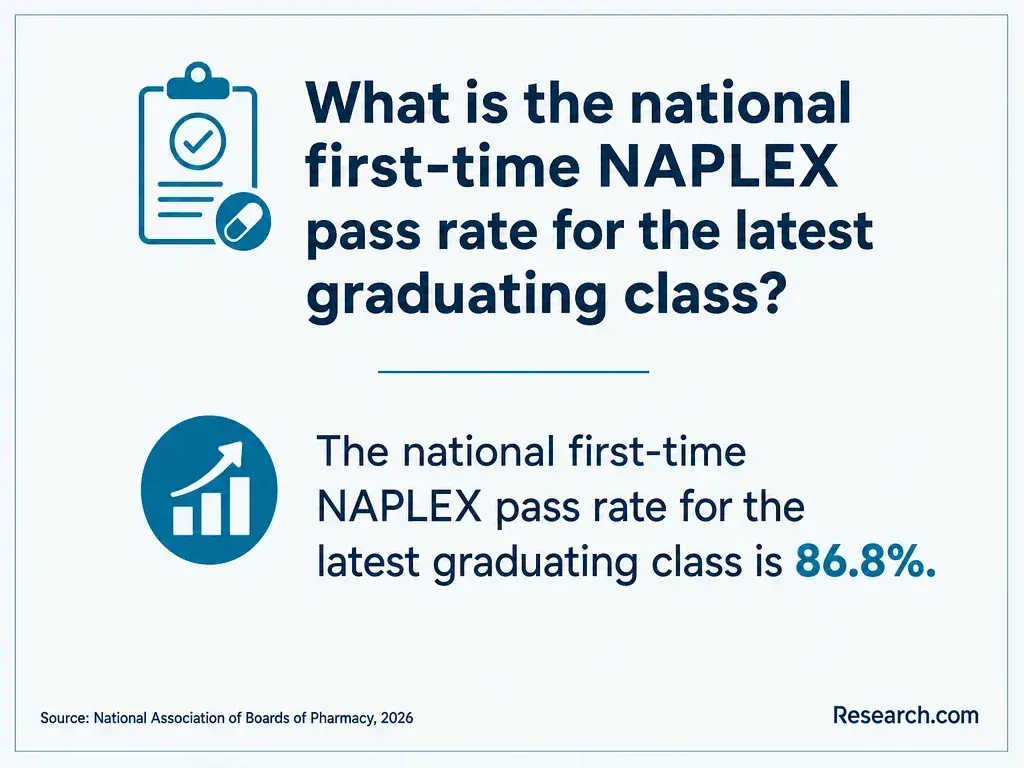
Published NAPLEX outcomes can add context, but examine the cohort and reporting period rather than treating a pass rate as a personal prediction. A lower-priced program may be a poor fit if it cannot support required placements where you can realistically complete them; a more expensive program is not automatically better. Give greatest weight to documented eligibility and workable in-person logistics.
Schools set their own prerequisite courses, laboratory and grade rules, application materials, interviews, and deadlines. Some require a bachelor's degree; others admit applicants who complete specified pre-professional college coursework.
Those prerequisites are not the professional Pharm.D. curriculum. The Pharmacy College Admission Test (PCAT) was retired in January 2024, so it should not be treated as a current exam applicants can schedule.
Have each school review your transcript against its current requirements, particularly if you have community-college, online-lab, international, or older coursework. The receiving school decides whether previous courses apply; previous credit does not automatically shorten the professional degree. If you need to evaluate credits for pharmacy prerequisites, request a written course-by-course determination before planning an enrollment date.
What costs and career outcomes should you evaluate before enrolling?
Build a budget that includes tuition and mandatory fees, prerequisite courses, technology and supplies, campus travel, rotation travel or housing, lost work time, and licensing expenses. Check aid eligibility for your specific program and enrollment period: federal graduate and professional borrowing rules changed for many new borrowers beginning July 1, 2026.
Do not assume an earlier loan limit or access to Grad PLUS will apply to you. Missing pharmacy school prerequisites can also add time and expense before the professional program begins.
For career context, the Bureau of Labor Statistics reports median annual pay of $140,910 in May 2025 for pharmacists and projects 5% employment growth, 2025-2035, with about 12,500 openings per year. These national figures describe the occupation, not a new graduate's expected offer or a return on a particular program's tuition.
Licensure is necessary to practice as a pharmacist; a residency, fellowship, or specialty board certification is a distinct potential next step, not an automatic requirement for every pharmacist job.
Other Things You Should Know About PharmD
Tell the school before the move. Your new physical location can affect distance-education authorization, in-person requirements, and placement options. Recheck the state where you plan to seek licensure, too.
No. Pharmacy technician and pharmacist are different occupations with different education and licensing requirements. Technician experience may be valuable, but it does not replace a qualifying professional pharmacy education.
Not necessarily. Internationally educated applicants may face a separate credential-evaluation and certification pathway as well as jurisdiction-specific licensing requirements. Ask the intended board which pathway applies to your education before enrolling in another degree.
Yes. Reconfirm the school's disclosures, your intended board's requirements, and placement availability for your new starting cohort. Keep updated written responses with your enrollment records.
- 18VAC110-21-60. Procedure for gaining practical experience. | virginia.gov https://law.lis.virginia.gov/admincode/title18/agency110/chapter21/section60/
- NYS Pharmacy: License Requirements - Office of the Professions https://www.op.nysed.gov/professions/pharmacist/license-requirements
- Pharmacist Licensure Guide | Department of State https://www.pa.gov/agencies/dos/resources/professional-licensing-resources/licensure-processing-guides-and-timelines/pharmacist-guide
- South Carolina Board of Pharmacy | sc.gov https://llr.sc.gov/bop/exam.aspx
- (General) Subject: Final Regulations for State Authorization | ed.gov https://fsapartners.ed.gov/knowledge-center/library/electronic-announcements/2016-12-19/general-subject-final-regulations-state-authorization
- Pharmacist Last updated 05/26/2026 | oregon.gov https://apps.oregon.gov/SOS/LicenseDirectory/LicenseDetail/1324
- License Verifications - Texas State Board of Pharmacy https://www.pharmacy.texas.gov/dbsearch/default.asp
- Drake University's PharmD Program Earns Reaccreditation https://news.drake.edu/2023/02/07/pharmd-reaccreditation-2023/
- State Authorization of Distance Education | Distance Education at SOU https://distanceed.sou.edu/state-authorization/
- Accreditation - Texas A&M College of Pharmacy https://pharmacy.tamu.edu/about/acpe-self-study.html


