Can You Become a Pharmacist with a Bachelor's Degree?

Co-Founder and Chief Data Scientist
A bachelor's degree can prepare you for pharmacy school, but it does not usually qualify you to practice as a pharmacist in the United States. That distinction matters if you are choosing an undergraduate major, considering a career change, or weighing the cost of a professional degree. This guide explains which credentials you need, whether you can skip the bachelor's degree, and what to check before committing to a Pharm.D. program. You can use it to map the shortest appropriate path from your current education to your career goal.
Key Things You Should Know
- A bachelor's degree alone does not qualify a new U.S. applicant for pharmacist licensure; the usual path requires a Doctor of Pharmacy (Pharm.D.) degree and a state license.
- You may be able to enter a Pharm.D. program without finishing a bachelor's degree if you complete that school's required undergraduate prerequisite courses.
- Pharmacists had median annual pay of $140,910 in May 2025, according to the Bureau of Labor Statistics, but compare that career prospect with the time and full cost of pharmacy school.
Can you become a pharmacist with a bachelor's degree?
Not with a bachelor's degree alone if you are seeking initial U.S. pharmacist licensure. A bachelor's in biology, chemistry, pharmaceutical sciences, or another field may satisfy some pharmacy-school prerequisites, but it is not the professional pharmacy degree required on the usual U.S.-educated licensure path. A pharmacy technician credential also leads to a different occupation, not a pharmacist license.
If you already have a bachelor's degree, compare your transcript with the prerequisites of specific Pharm.D. programs before enrolling in more courses. You may need only missing prerequisites; you may not need another undergraduate degree. A guide to how students transition from pre-pharmacy to a Pharm.D. can help frame that comparison, but the receiving school decides which courses satisfy its rules.
What degree do you need to become a pharmacist?
For a new U.S.-educated pharmacist, the standard professional credential is a Doctor of Pharmacy (Pharm.D.) from a program accredited by the Accreditation Council for Pharmacy Education (ACPE). Undergraduate pre-pharmacy courses prepare you to enter that program; they are not the professional curriculum.
The distinction matters when you compare programs labeled "pharmacy." The table shows what each educational route can - and cannot - do for an aspiring pharmacist.
| Route | Role in the pathway | Qualifies a new U.S. graduate for pharmacist licensure? |
| Undergraduate prerequisites or bachelor's degree | May satisfy Pharm.D. admission requirements | No |
| ACPE-accredited Pharm.D. | Provides professional pharmacy education and supervised practice experiences | Meets the usual educational requirement; additional state licensure requirements still apply |
| Pharmacy technician education | Prepares students for a separate support occupation | No |
If your goal is a pharmacy-related job rather than pharmacist practice, compare the duties and credential requirements before paying for a doctorate. Resources on pharmacy school application readiness are more relevant if pharmacist licensure remains your goal but your prerequisites are incomplete.
Do pharmacists need a Pharm.D. and state license?
New U.S.-educated pharmacists generally need both. Graduating from an ACPE-accredited Pharm.D. program does not itself grant permission to practice. Applicants must meet their state board of pharmacy's requirements, which commonly include the North American Pharmacist Licensure Examination (NAPLEX), applicable pharmacy-law testing, and any required practical experience, background review, or other conditions.
Check the board where you intend to practice rather than assuming every jurisdiction uses the Multistate Pharmacy Jurisprudence Examination (MPJE). Jurisdictions may have different law-exam arrangements, including the Uniform MPJE (UMPJE), and exam requirements can change. Passing an exam is not the same as receiving a license.
Some previously licensed pharmacists entered the profession under older education rules, and internationally educated pharmacists have a distinct eligibility process. Neither exception makes an ordinary bachelor's degree a current substitute for the professional pathway. Likewise, a degree listed among the shortest online doctoral programs cannot replace an accredited Pharm.D. simply because it carries a doctoral title.
Yes, at programs that admit applicants after specified undergraduate prerequisite coursework. Other schools may require or prefer a completed bachelor's degree. The relevant question is whether your courses, labs, grades, and credit totals meet the particular program's entry requirements - not whether you have spent a set number of years in college.
If you attended multiple colleges, ask each pharmacy school to evaluate your coursework. A school may accept a course as an admission prerequisite without awarding transfer credit toward the professional Pharm.D. curriculum. That distinction is especially important if you hope to apply prior college credits to pharmacy programs: the receiving school determines how, or whether, those credits count.
Requirements vary by school. Programs specify their own prerequisite subjects and labs, minimum grades or GPAs, credit rules, application materials, interviews, and conditions for completing courses still in progress. A published minimum makes you eligible to be considered; it does not guarantee admission. The Pharmacy College Admission Test (PCAT) was retired in January 2024, so it should not appear in a current application plan as a test you need to schedule.
Before applying, check these items against each school's current admissions page and, where applicable, its PharmCAS listing:
- Which prerequisite courses and labs are missing, and can you finish them before enrollment?
- Will the school accept your community-college, online, advanced-placement, repeated, or older coursework?
- Does the school use PharmCAS, require a separate application, or set an earlier deadline for supporting materials?
If you are comparing pharmacy schools with accessible admissions, do not stop at a minimum GPA. Compare prerequisite fit, accreditation, total cost, and outcomes as well; an easier application threshold says little about whether a program is the right investment.
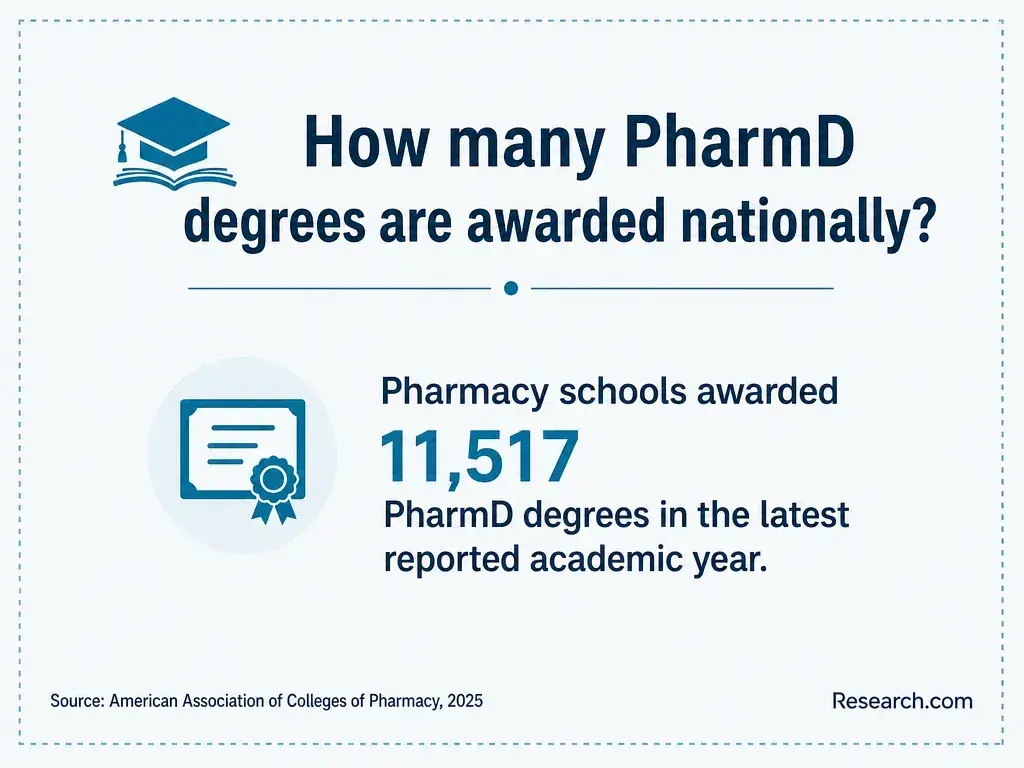
Many Pharm.D. professional curricula take about four academic years after prerequisite study, although program structures vary. Your total timeline depends on which prerequisites you have completed, whether a program requires a bachelor's degree, and the school's course sequence. A completed bachelor's degree may cover prerequisites without shortening the professional curriculum.
Some schools offer condensed calendars. When exploring how accelerated Pharm.D. programs work, compare the actual time from your starting point to graduation - not just the advertised length of the professional phase. A faster schedule can leave less room for paid work, and supervised clinical experiences still must fit into the calendar.
Some programs deliver academic instruction online and hold ACPE professional-program accreditation, but eligibility depends on the specific program and jurisdiction. Verify the program's current status in ACPE's official records. Institutional accreditation and permission to enroll distance-education students in your state are separate matters; neither substitutes for ACPE professional-program accreditation or approval of any required clinical placement.
"Online" does not necessarily mean self-paced or entirely remote. Ask about live classes, campus visits, hands-on labs, introductory pharmacy practice experiences (IPPEs), and advanced pharmacy practice experiences (APPEs). These supervised experiences involve practice sites and may require travel, time away from work, intern registration, and site clearances. When comparing online pharmacy education options, confirm who arranges placements and whether your intended state permits the program's planned activities there.
Pharm.D. students build on prerequisite science through study of medications, their effects, and their use in patient care. Professional coursework commonly covers pharmacotherapy, calculations, medication safety, drug information, law and ethics, and communication with patients and care teams. Labs, simulations, IPPEs, and APPEs help students apply that knowledge under appropriate supervision; exact courses and placements vary by program.
This depth explains why a short pharmacy-related credential is not interchangeable with a Pharm.D. If an advertised program appears in a guide to online pharmacy education duration, check its exact award and intended occupation. A program that can be finished quickly may be useful for another goal, but its title alone does not establish pharmacist-licensure eligibility.
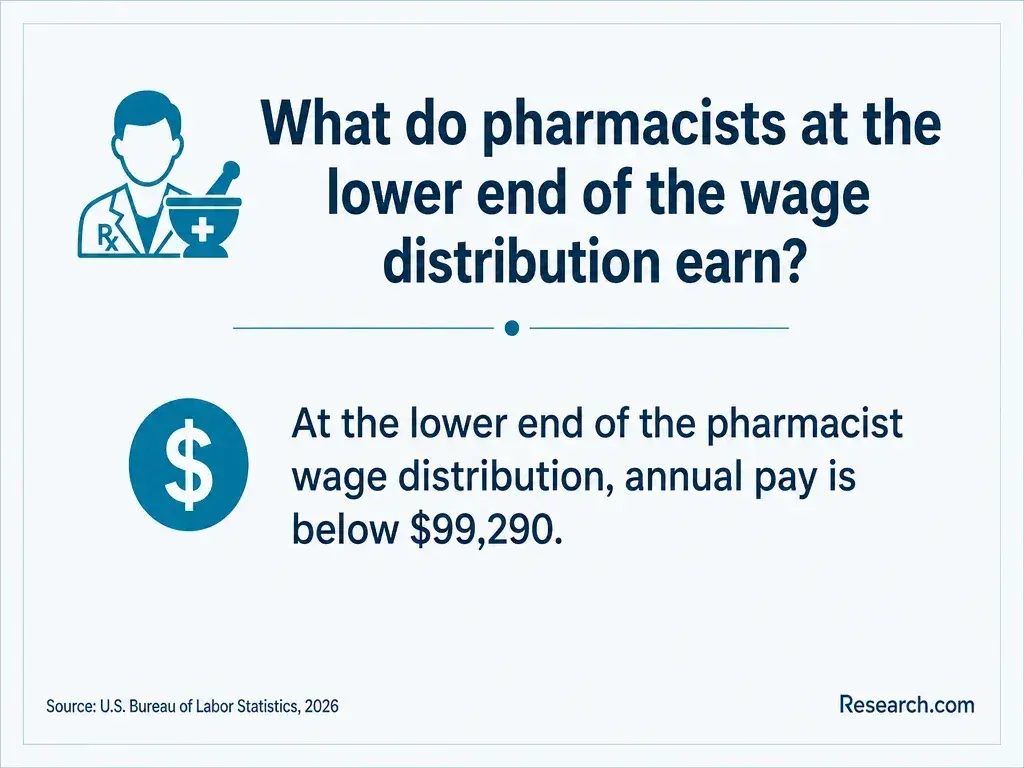
The U.S. Bureau of Labor Statistics reports median annual pay of $140,910 in May 2025 for pharmacists and projects 5% job growth, 2025-2035, with about 12,500 openings per year. Those national figures describe the occupation, not a salary or job offer promised to an individual graduate. Location, setting, experience, and available positions affect outcomes.
Consider that earning potential alongside tuition, borrowing, prerequisite courses, and years of study. Pharmacy technician work is a separate route: BLS reports median annual pay of $45,750 in May 2025 for technicians. If you are comparing low-cost and shorter pharmacy degree programs, verify which occupation each credential actually prepares you for before comparing its price with a Pharm.D.
How do you choose an accredited pharmacy school?
Start with the nonnegotiables: current ACPE professional-program accreditation, admission eligibility, and a feasible route to licensure where you plan to work. Then compare the full cost and schedule. Advertised tuition alone can omit fees, supplies, prerequisite courses, campus travel, clinical-placement expenses, and licensing costs. Federal student-aid rules changed for many new graduate and professional borrowers beginning July 1, 2026, so confirm your own eligibility and borrowing options with each school's financial-aid office rather than relying on an older loan estimate.
Use this sequence before paying an application deposit:
- Confirm the program's ACPE status and ask your intended state board about any education or placement eligibility questions.
- Request a written prerequisite review and a term-by-term curriculum and clinical schedule.
- Compare total estimated educational costs, aid eligibility, required travel, and time you may need away from work; use like-for-like figures when you compare online Pharm.D. costs.
- Review the school's published NAPLEX results in context, and ask how it supports students who struggle academically or need placements outside the local area.
A school may be a poor fit even if it is accredited: unresolved prerequisite gaps, unaffordable borrowing, or clinical travel you cannot manage can derail the plan. If your aim is pharmacist practice, choose a pathway you can complete and finance - not merely the cheapest or fastest program advertised.
Other Things You Should Know About PharmD
Do not assume so. A school must determine whether any prior experience meets its educational policies, and technician employment does not automatically replace required IPPEs or APPEs.
Not for every pharmacist job. A residency is postgraduate training that some positions require or prefer; it is not a substitute for state licensure. Fellowships and specialty board certifications serve different purposes.
Internationally educated applicants follow rules specific to their education and intended state. Depending on eligibility, the process may involve the National Association of Boards of Pharmacy's Foreign Pharmacy Graduate Examination Committee certification and additional state requirements. A degree title alone does not establish eligibility.
Not automatically. Ask the second state's board about license transfer and its current exam, background-check, and other requirements before accepting a position there.
- Foreign Pharmacy Graduates | texas.gov https://www.pharmacy.texas.gov/applicants/foreign-pharm-grad.asp
- Pharmacist Licensure Guide | Department of State https://www.pa.gov/agencies/dos/resources/professional-licensing-resources/licensure-processing-guides-and-timelines/pharmacist-guide
- Admissions: USC Mann PharmD Program https://mann.usc.edu/program/doctor-of-pharmacy-pharmd/admissions/
- What Is a PharmD Degree? Doctor of Pharmacy Guide | West Coast University https://westcoastuniversity.edu/blog/what-is-a-pharmd-degree-and-how-to-transfer-in
- Admissions | College of Pharmacy (COP) https://pharmacy.cnsu.edu/admissions/
- Discover the Doctor of Pharmacy (PharmD) at UNT Health https://www.unthealth.edu/college-of-pharmacy/doctor-of-pharmacy-pharmd.html
- PharmD Prerequisites - Doctor of Pharmacy https://pharmacy.wisc.edu/pharmd/prerequisites/
- Pharmacy | Pre-Health Advising https://prehealth.ucmerced.edu/health-careers/pharmacy
- PharmD FAQs - UNC Eshelman School of Pharmacy https://pharmacy.unc.edu/education/pharmd/pharmd-admissions-faqs/
- FAQ | OSU College of Pharmacy - Oregon State University https://pharmacy.oregonstate.edu/programs-admissions/pharm-d/faq