
Pharmacist licensure checklist for out-of-state graduates

Co-Founder and Chief Data Scientist
Graduating from a pharmacy school in one state does not automatically qualify you to practice in another. The right application route depends on whether you already hold a pharmacist license, where you completed supervised training, and what your destination state requires.
This guide gives U.S.-educated Pharm.D. graduates a checklist for choosing between licensure by examination and license transfer, gathering evidence, and avoiding delays. If you earned your pharmacy degree outside the United States, ask the destination board about its separate foreign-graduate pathway before using this checklist.
Key Things You Should Know
- No pharmacist license yet? Start with the destination board's licensure-by-examination requirements, even if your Pharm.D. was earned in another state.
- Already licensed? Ask whether the destination board accepts license transfer; passing the NAPLEX or holding another state's license does not authorize practice there.
- Check three potential bottlenecks before applying: accepted internship hours, the jurisdiction's current law-exam requirement, and documents that must come directly from your school or another board.
What Are the Requirements for Pharmacist Licensure After Graduating Out of State?
For a U.S.-educated graduate, the destination state board generally evaluates the professional Doctor of Pharmacy (Pharm.D.) education, supervised experience, examination results, application disclosures, and required fees. Graduation is not licensure: the board must approve and issue the license before you practice as a pharmacist in that jurisdiction.
The first decision is which application route describes your current status. Use this comparison before requesting records or paying for an exam:
| Your status | Likely route to investigate | Main distinction |
| Graduated, never licensed as a pharmacist | Licensure by examination | The destination board reviews graduate eligibility, experience, and required exam results. |
| Hold an active pharmacist license elsewhere | License transfer, if the destination board permits it | The board reviews your existing license and any additional local requirements. |
| Earned a pharmacy degree outside the United States | Foreign-graduate pathway | Additional certification and board requirements may apply before examination or licensure. |
Undergraduate pre-pharmacy science courses are preparation for admission, not a substitute for the professional Pharm.D. Readers still choosing a school can compare pharmacy degree entry options but should confirm that the eventual professional program meets the board's education rules.
How Do You Transfer a Pharmacist License to Another State?
License transfer is a route for an already licensed pharmacist; it does not move a school transcript or automatically convert one state's license into another. The National Association of Boards of Pharmacy (NABP) administers a license transfer process used by participating boards, but the destination board decides whether to grant its license.
Follow this sequence before changing jobs or setting a start date:
- Confirm that the destination board accepts license transfer from your situation, including any conditions involving the status or history of your existing license.
- Review the board's law exam, application, experience, background check, and license verification requirements.
- Submit the appropriate NABP transfer request and the destination board's separate application, if required; arrange any records the board requires directly from their issuing source.
- Wait for the destination board to issue and verify your new license before practicing under that state's authority.
Academic credit transfer is different. If you are still completing a degree, pharmacy degree programs for transfer students address a school's credit decisions—not pharmacist license transfer.
Which Exams Are Required for Out-Of-State Pharmacist Licensure?
The North American Pharmacist Licensure Examination (NAPLEX) assesses knowledge for entry-level pharmacist practice. A destination board may also require a pharmacy law assessment. Depending on the jurisdiction and its current rules, that may be the Multistate Pharmacy Jurisprudence Examination (MPJE), the Uniform Multistate Pharmacy Jurisprudence Examination (UMPJE), a different assessment, or no separate jurisprudence exam. Some jurisdictions began transitioning from the MPJE to the UMPJE in 2026; check the board's current instructions rather than booking a familiar exam by default.
If you have not taken the NAPLEX, confirm the board's eligibility approval process before registering. If you have already taken it, ask whether a previously requested NAPLEX score transfer is available and accepted for your application; score transfer and license transfer are different processes. An existing pharmacist may have different exam obligations under a license transfer route. Exam passage alone never issues a license.
A faster Doctor of Pharmacy route may shorten education for an eligible student, but it does not waive the destination board's exams or licensing decision.
For U.S.-educated applicants, an Accreditation Council for Pharmacy Education (ACPE)-accredited professional pharmacy program is the standard education route boards commonly recognize. Confirm the program's accreditation status for the period relevant to your attendance and check the destination board's exact education rule, particularly if the program's status changed. ACPE accredits programs; it does not certify or license individual pharmacists.
Do not substitute a university's institutional accreditation for ACPE professional-program accreditation. Likewise, permission to offer distance education in a state is not a promise that its graduates will qualify for pharmacist licensure there. When comparing online pharmacy school programs, verify the professional program, required in-person training, and the destination board's eligibility rules separately. A pharmaceutical sciences, pharmacology, or pharmacy technician degree does not automatically meet the Pharm.D. education requirement.
A Pharm.D. includes supervised experiential education, but states can differ in how they recognize that experience for licensure. The destination board may ask whether hours were earned through school-supervised rotations or separate intern employment, when they were completed, and whether you held the required intern registration where the work occurred. Do not assume a school's record of hours is automatically accepted without board review.
Introductory pharmacy practice experiences (IPPEs) and advanced pharmacy practice experiences (APPEs) are parts of professional education; a board's licensure-hour rule is a separate question. Ask the destination board whether your school must certify hours, whether additional hours are required, and what documentation it accepts for experience earned out of state. If hours are missing, clarify registration and supervision requirements before working to make them up.
Descriptions of pharmacy programs with shorter completion times may include credentials other than a licensure-qualifying Pharm.D. A short program cannot replace required professional education and accepted supervised experience.
Build a document file around the destination board's current checklist. Some records must be sent directly by the school, testing organization, or licensing board, so having a personal copy may not satisfy the requirement.
Check which of these items applies to your route and who must submit it:
- Completed board application, identity information, and any required identity verification or background-check materials.
- Official Pharm.D. transcript or school certification of degree completion and, where requested, experiential education.
- Intern registration or supervised-hour verification from the appropriate school, employer, or board.
- NAPLEX and applicable law exam results, or information needed to match existing results to your application.
- Verification of every pharmacist license the board requests, including disclosures about discipline or other reportable matters.
- Application payment and any jurisdiction-specific forms or attestations.
If graduation is pending, ask what can be submitted early and what must wait until the degree is awarded. Guidance on pharmacy school application readiness concerns admission to a degree program; a pharmacist license application has its own completion and documentation rules.
Use licensure by examination when you need an initial pharmacist license and the destination board confirms that this is the correct route. An out-of-state Pharm.D. graduate should choose the intended practice jurisdiction first, rather than assuming the school's home state must issue the first license.
This application sequence helps keep board approval, exam registration, and graduation records in the right order:
- Read the destination board's initial-licensure instructions and confirm education, intern hours, exam, and background-check eligibility.
- Submit the board application and arrange official school and experience records as instructed.
- Complete NABP exam registration and follow the board's eligibility process before scheduling each required exam.
- Monitor both the board and exam-account status, correct missing items promptly, and confirm that the board has issued the license before beginning pharmacist work.
Prior science coursework can help someone enter a Pharm.D. program, but it cannot stand in for graduation or an initial license. If you are still planning your education, compare pharmacy programs for students with science credits separately from this licensing sequence.
There is no dependable nationwide processing time or total price. The amount depends on NABP charges where applicable, destination-board application and license fees, any required exam, background checks, and record-verification charges. The timeline depends on board review, exam availability, and how quickly third parties send acceptable records. Obtain the current fee schedule and processing guidance from both NABP and the destination board before budgeting or accepting a start date.
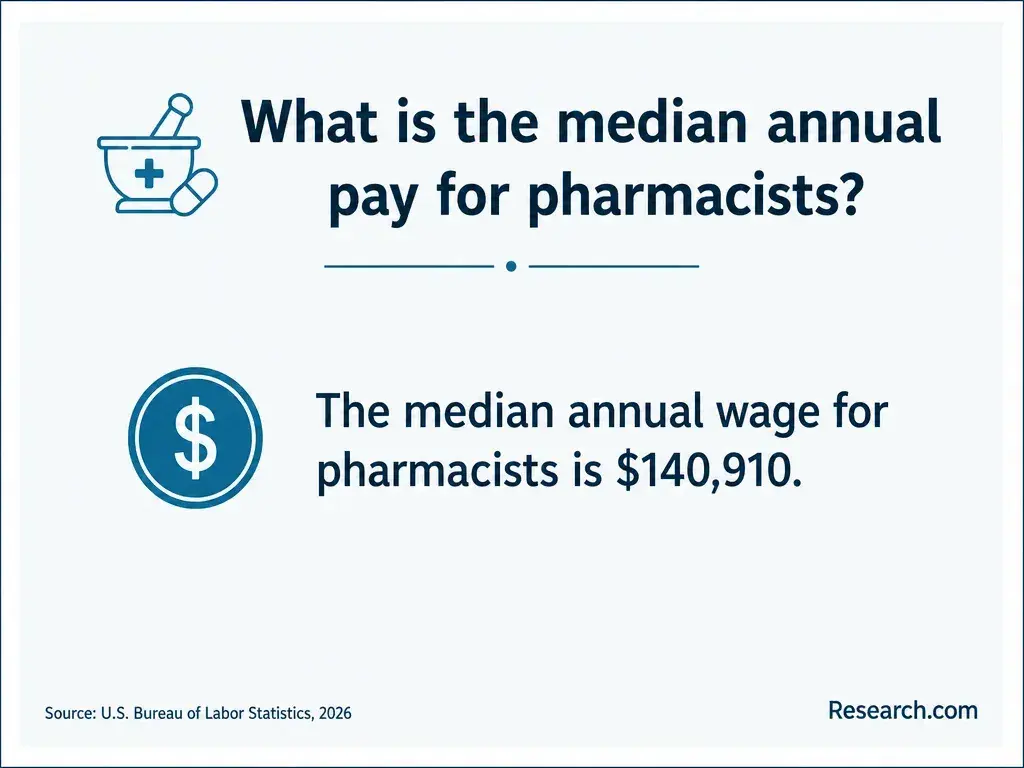
The practical cost is not just application fees: a delayed license can postpone pharmacist employment. For context—not a prediction of an applicant's earnings—the Bureau of Labor Statistics reports median annual pay for pharmacists of $140,910 in May 2025. That makes a proposed job start date worth checking against the employer's policy for applicants whose license is still pending.
If you have not yet enrolled, compare the full cost of Doctor of Pharmacy programs with manageable tuition separately from licensing expenses; a lower tuition figure will not eliminate exam, travel, or state application costs.
A pharmacist license is issued by a jurisdiction, not carried nationwide by the Pharm.D. degree. States can differ in initial and transfer eligibility, accepted internship experience, law assessments, renewal schedules, continuing education, and rules governing services such as immunization or collaborative practice. A license in one state does not itself authorize patient care in another.
Compare the rules for where patients are served as well as where you live or your employer is based. That distinction matters for remote services and telepharmacy; do not assume an employer's multistate operations cover your individual licensing obligations. Scope-of-practice permissions may also require training, registration, or conditions beyond an active pharmacist license.
Someone comparing cost-effective pharmacy degree options should therefore include the likely practice states in the decision. A degree's price and delivery format do not make state practice rules uniform.
How Can You Verify a State Board’s Pharmacist Licensure Requirements?
Use the destination board of pharmacy's current application instructions and rules as the deciding source; use NABP's current process information for the services it administers. Record what the board says for each state you are considering, then seek written clarification when your graduation date, hours, prior exam results, or license history make an instruction ambiguous.
This worksheet keeps the comparison focused on facts that can change your route, timing, or budget. Enter the board's answer and the date you checked it rather than relying on an undated summary.
| Requirement to compare | Destination state A | Destination state B |
| Board and date checked | _____ | _____ |
| Initial examination or license transfer route | _____ | _____ |
| Accepted internship experience | _____ | _____ |
| Current law assessment, if any | _____ | _____ |
| Required records and direct senders | _____ | _____ |
| Published fees and processing guidance | _____ | _____ |
Before committing to a school or job, confirm any unresolved item with the board and retain its response. Rankings of the shortest online doctoral programs cannot establish pharmacist eligibility: verify that the credential is a qualifying professional pharmacy degree and that the destination board accepts your application route.
Other Things You Should Know About PharmD
Ask the residency program about its licensure deadline and whether it permits a temporary training status. Residency admission does not itself authorize pharmacist practice; the program and state board determine what activities are permitted while licensure is pending.
Possibly, but technician registration and permitted duties are governed separately by state law and employer policy. A Pharm.D. does not automatically grant technician registration or allow you to perform pharmacist-only duties.
Tell the licensing board and follow its instructions for documenting the name change. Use the same identifying information consistently across applications and exam accounts so records can be matched.
No. Specialty board certification is a separate credential with its own eligibility rules. It does not replace the pharmacist license required to practice in a jurisdiction.
- Pharmacist Licensure by Exam - Texas State Board of Pharmacy https://www.pharmacy.texas.gov/applicants/pharmacist-exam.asp
- Reciprocal Licensure Information | ky.gov https://pharmacy.ky.gov/professionals/Pages/Reciprocal-Licensure-Information-.aspx
- Pharmacist Licensure | iowa.gov https://dial.iowa.gov/licenses/health-professions/pharmacy/pharmacist-licensure
- Pharmacist Licensure Guide | Department of State https://www.pa.gov/agencies/dos/resources/professional-licensing-resources/licensure-processing-guides-and-timelines/pharmacist-guide
- Graduation & Licensure | Washington State University https://pharmacy.wsu.edu/pharmd/experiential-services/graduation-licensure/
- 3 CCR 719-1-4.00.00 - LICENSING | State Regulations | US Law | LII / Legal Information Institute https://www.law.cornell.edu/regulations/colorado/3-CCR-719-1-4.00.00
- Pharmacist Licensure By Exam | ncbop.org https://www.ncbop.org/licensurebyexam.html
- Electronic Licensure Transfer Program (eLTP) | nabp.pharmacy https://nabp.pharmacy/programs/licensure/licensure-transfer/
- International Students and Graduates | AACP https://www.aacp.org/resource/international-students-and-graduates
- Post-B.S. Pharm.D. Programs for Current Pharmacists | PharmCAS https://www.pharmcas.org/school-directory/explore-and-compare/post_bs_programs


