PharmD Application After a Pre-Pharmacy Track

Co-Founder and Chief Data Scientist
Finishing a pre-pharmacy track puts you closer to applying for a Doctor of Pharmacy (Pharm.D.) program, but it does not automatically make you eligible for every school - or secure admission. The next decision is whether your courses meet each program's requirements and whether the time and cost of a professional degree fit your goal of becoming a pharmacist.
This guide shows you how to check eligibility, apply through PharmCAS when required, compare programs, and plan for the education and licensing steps that follow.
Key Things You Should Know
- Pre-pharmacy coursework is preparation, not a Pharm.D. degree or an admission guarantee; check each school's course, lab, grade, and deadline rules before applying.
- A common route is roughly two years of prerequisites followed by a four-year Pharm.D., but prerequisite loads and accelerated professional programs vary by school.
- Choose an ACPE-accredited professional program with a manageable total cost and workable rotation schedule; graduation alone does not grant a pharmacist license.
How does a pre-pharmacy track prepare you for a PharmD application?
A pre-pharmacy track is a set of undergraduate courses intended to prepare you for professional pharmacy study. It usually builds a foundation in science, mathematics, and communication. It may be part of a bachelor's degree, but a completed bachelor's degree is not a universal condition for Pharm.D. admission.
The track can also help you test your interest in patient care and medication use. Pharmacy observation, employment, volunteering, or conversations with practicing pharmacists can give you examples to discuss in an application, although schools differ in whether they require such experience. If you already have substantial biology or chemistry coursework, compare it course by course with the requirements of pharmacy programs for students with science credits; a pre-pharmacy label on your transcript is less important than what you completed.
What are the admission requirements for PharmD programs after pre-pharmacy coursework?
Requirements differ by program. Schools may specify prerequisite subjects, laboratories, minimum grades or GPA, a minimum number of undergraduate credits, recommendations, written responses, and an interview. Some admit applicants with the required coursework but no bachelor's degree; others have different degree or credit expectations. A published minimum establishes eligibility, not how competitive your application will be.
Check the current school admissions page and PharmCAS school directory for each program's rules. Confirm whether unfinished courses may remain in progress when you apply, when they must be completed, and whether older, repeated, Advanced Placement, International Baccalaureate, community-college, or online coursework counts. Use information about pharmacy school application eligibility as a starting point, not a substitute for the school's current policy. The Pharmacy College Admission Test (PCAT) was retired in January 2024, so it is not a current exam to schedule.
How do you apply to PharmD programs through PharmCAS?
PharmCAS is the centralized application service used by many, but not all, U.S. Pharm.D. programs. Its application does not replace a school's supplemental materials, interview, or enrollment requirements. Start with a program list and work backward from each school's deadline; submission, transcript receipt, and application verification are distinct steps.
Use this sequence to avoid a complete-looking application that misses a school-specific requirement:
- Confirm whether each school uses PharmCAS and note its deadline, supplemental application, and interview process.
- Enter coursework accurately, request required transcripts and evaluations, and ask recommenders early enough to meet the relevant deadlines.
- Submit the application and any school-specific materials; monitor both PharmCAS and school communications for missing items.
- If admitted, check the offer's deposit, prerequisite-completion, and matriculation deadlines before accepting.
Some schools permit outstanding courses at application but require them before enrollment. If that describes you, compare pharmacy degree options without every prerequisite completed against each school's stated completion deadline. Permission to apply with a course in progress is not permission to skip it.
Common prerequisite subjects include general and organic chemistry, biology, mathematics, and writing; schools may also specify anatomy, physiology, microbiology, physics, statistics, or social sciences. Exact courses, credits, laboratories, allowable substitutions, and minimum grades are program-specific. Do not assume a course called "chemistry for health professions," for example, satisfies a school's chemistry requirement without confirmation.
The practical test is a course-by-course comparison between your transcript and each school's current prerequisite list. If a title, lab, or credit value does not clearly match, send the school the course description or syllabus and request an evaluation. The receiving school decides whether prior credit applies; coverage of pharmacy school prior learning credits cannot guarantee that a particular course will satisfy a prerequisite or transfer into the professional Pharm.D. curriculum.
No. Even when a track is designed around one pharmacy school, admission may depend on meeting current requirements, submitting a complete application, and succeeding in any required interview or selection process. Ask whether an affiliated pathway offers a formal conditional admission agreement, what conditions apply, and what happens if you miss one.
If you are uncertain about becoming a licensed pharmacist, resolve that question before paying for additional prerequisites or applications. Doctoral programs with flexible timelines may serve other academic or career goals, but they are not substitutes for the professional Pharm.D. education required on the U.S.-educated pharmacist licensure pathway.
The timeline depends on how many prerequisites you already have and the professional program's design. The comparison below separates preparation from the Pharm.D. itself so you can estimate time still required rather than treating all routes as equivalent.
| Stage or route | Typical planning expectation | What can change it |
| Pre-pharmacy preparation | Often about two years of undergraduate coursework | Starting credits, course sequencing, and school-specific prerequisites |
| Traditional Pharm.D. | Commonly four professional years | The program's published calendar and progression rules |
| Accelerated Pharm.D. | A shorter professional calendar at some schools | Year-round study, admission rules, and limited time for outside work |
Check the actual calendar behind faster Doctor of Pharmacy routes. A shorter calendar can mean denser terms rather than fewer professional requirements, and missing a prerequisite offered only once a year can erase a potential time saving.
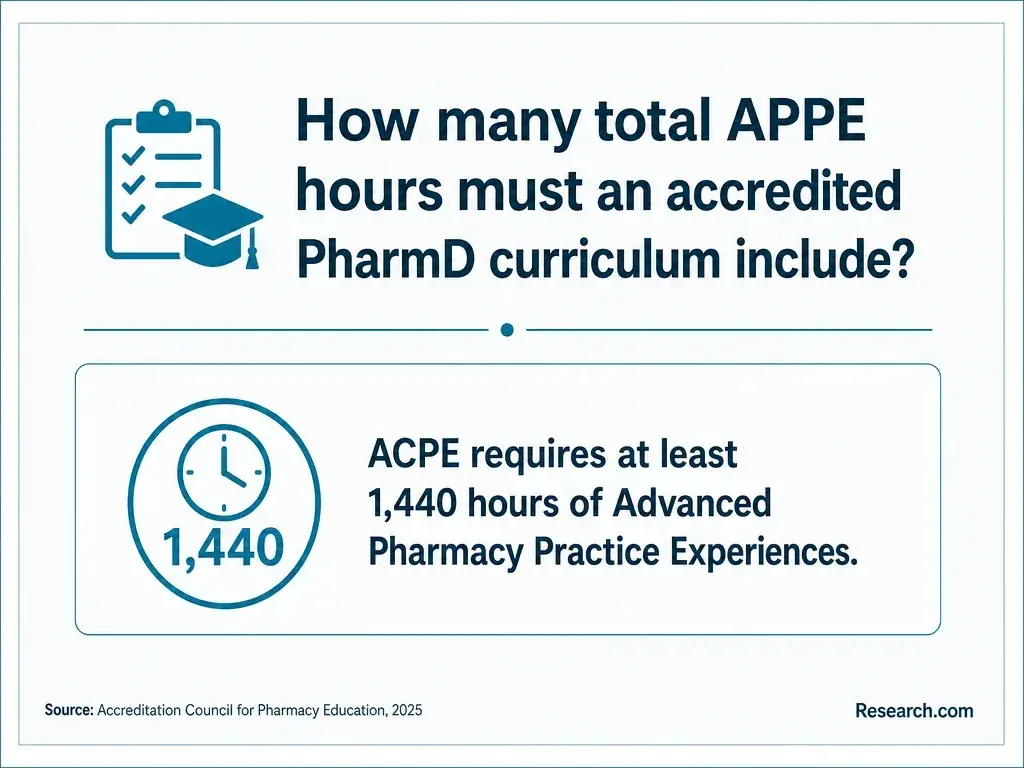
An Accreditation Council for Pharmacy Education (ACPE)-accredited professional Pharm.D. program combines pharmaceutical and clinical sciences with medication-use, communication, and patient-care training. Students also complete supervised introductory pharmacy practice experiences (IPPEs) and more advanced pharmacy practice experiences (APPEs). Those experiences are part of the professional degree, not replacements for undergraduate prerequisites.
Before enrolling, check the program's current ACPE professional-program status, published curriculum, rotation arrangements, and requirements for travel, background checks, immunizations, or intern registration. ACPE accreditation concerns the professional program; it is different from an institution's accreditation and from authorization to enroll an online student in a particular state. Pharmacy degree options with shorter study periods may fit other goals, but a short pharmacy-related credential does not replace an accredited Pharm.D. for this licensure pathway.
Possibly, but acceptance and scheduling depend on the school. A Pharm.D. program may accept some online prerequisites while restricting online science laboratories. A program described as online or hybrid may still require live classes, campus sessions, hands-on assessments, and in-person IPPEs and APPEs. "Online" does not necessarily mean self-paced or compatible with full-time work.
When comparing leading online pharmacy degree programs, ask for the current attendance calendar and who arranges or approves rotation sites. Confirm whether placements can occur near home, whether travel is likely, and whether your state permits enrollment and the proposed clinical placements. State authorization for distance education is separate from eligibility for pharmacist licensure.
There is no reliable single price for this pathway: your remaining prerequisites, school, residency status, program length, and rotation locations all matter. The table separates charges you can usually find on a school's published cost pages from expenses that require a more personal estimate.
| Cost category | What to include in your comparison |
| Pre-pharmacy study | Remaining courses, laboratory charges, and any additional terms needed for sequencing |
| Professional program | Tuition, mandatory fees, books, required technology, and supplies |
| Participation and rotations | Travel, possible temporary housing, health requirements, background checks, and time away from paid work |
| After graduation | Licensure applications, required examinations, and any chosen postgraduate training |
Compare a school's full cost of attendance, not just advertised online Doctor of Pharmacy tuition. Ask its financial aid office how it classifies your enrollment and which aid rules apply to your start date. Federal borrowing rules changed for many new graduate and professional borrowers beginning July 1, 2026; do not assume older Grad PLUS access or loan limits apply to your plan.
What careers, salaries, and licensing requirements follow a PharmD degree?
A Pharm.D. can prepare graduates to pursue pharmacist licensure, but the degree does not issue a license. State boards set requirements, typically including an eligible degree, the North American Pharmacist Licensure Examination (NAPLEX), and other jurisdiction-specific steps. Check the board where you intend to practice for intern-hour rules and any jurisprudence examination: do not assume every jurisdiction uses the MPJE, particularly as some transitioned to the UMPJE beginning in 2026.
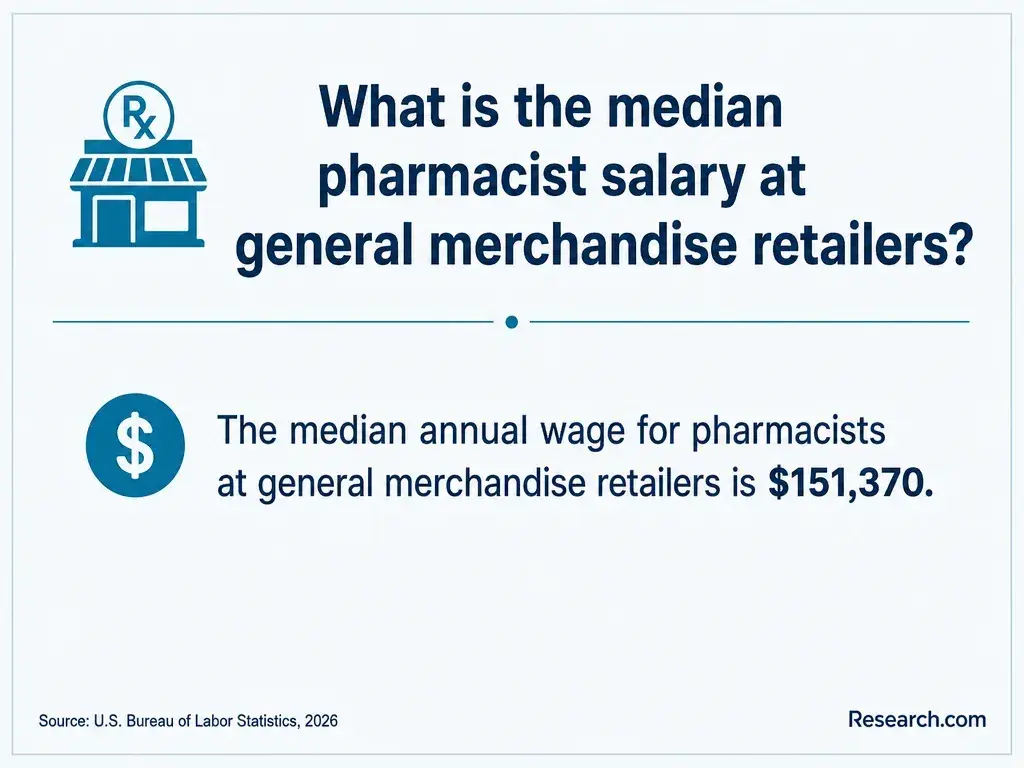
Licensed pharmacists work in settings that include community pharmacies, hospitals, ambulatory care, and specialty pharmacy. The Bureau of Labor Statistics reports pharmacist median annual pay of $140,910 in May 2025 and projects 5% job growth, 2025-2035. Those occupation-wide figures are context for planning, not a starting-salary promise or a forecast for a particular specialty or location.
A residency, fellowship, or specialty board certification may support particular career goals, but none substitutes for state licensure or is universally required for pharmacist employment. If your goal is a pharmacy-adjacent job rather than pharmacist practice, compare shorter pharmacy programs with career potential before committing to the longer Pharm.D. route. Pharmacy technician work, for example, is a separate occupation and does not ordinarily require a Pharm.D.
Other Things You Should Know About PharmD
Follow each school's rules. Choose people who can describe your academic work, reliability, communication, or relevant experience with specific examples, rather than someone who knows you only by title.
Generally, yes. Before reapplying, ask whether the school offers feedback and identify what you can materially improve, such as prerequisite performance, experience, or interview preparation.
Deferral is school-specific and should never be assumed. Ask for the policy and any conditions in writing before missing an acceptance or deposit deadline.
Compare written costs, curriculum calendars, rotation logistics, and conditions of admission. Track each deposit and response deadline, and withdraw from offers you will not use according to the schools' instructions.
- Are Prerequisite Courses Barriers to Pharmacy Admission or the Keys to Student Success? - PMC https://pmc.ncbi.nlm.nih.gov/articles/PMC10159397/
- PharmD Timeline for Application | jefferson.edu https://www.jefferson.edu/academics/colleges-schools-institutes/pharmacy/programs/doctor-of-pharmacy/timeline.html
- PharmD Application Process | pitt.edu https://www.pharmacy.pitt.edu/academics/doctor-pharmacy/apply-pharmd-program/pharmd-application-process
- PharmD Admissions | osu.edu https://pharmacy.osu.edu/education/doctor-pharmacy/pharmd-admissions
- Become a Pharmacist: Explore PharmD Pathways | Pacific University https://www.pacificu.edu/blog/become-pharmacist-explore-pacifics-flexible-degree-paths
- PCAT (Pharmacy College Admission Test) | indiana.edu https://guidebook.hppla.indiana.edu/pharmacy/pcat.html
- Undergraduate/PharmD Pharmacy Programs FAQs | Purdue University College of Pharmacy https://pharmacy.purdue.edu/undergraduate-pharmd-pharmacy-programs-faqs/
- PharmD Application Process and Requirements | umich.edu https://pharmacy.umich.edu/pharmacy-programs/pharmd-program/application-process-requirements/
- PharmD Prerequisites - Doctor of Pharmacy https://pharmacy.wisc.edu/pharmd/prerequisites/
- Tuition and Financial Aid - Texas A&M College of Pharmacy https://pharmacy.tamu.edu/pharmd/cost.html