PharmD Eligibility With International Coursework

Co-Founder and Chief Data Scientist
Coursework completed outside the United States may put a Doctor of Pharmacy (Pharm.D.) degree within reach, but a transcript evaluation does not guarantee that a pharmacy school will accept the credits.
This guide is for applicants with foreign college courses, including international students and U.S. residents who studied abroad. It explains how to check prerequisites, document your education, compare program costs, and separate Pharm.D. admission from eventual pharmacist licensure, so you can decide whether to apply now, take additional courses, or investigate another pathway.
Key Things You Should Know
- International college coursework can meet Pharm.D. prerequisites, but each school decides which evaluated courses, grades, and laboratory credits it will accept.
- Ask each target school which credential evaluator and documents it requires before paying for an evaluation or repeating a course; an evaluation is not an admission or transfer-credit decision.
- A U.S. Pharm.D. is typically a four-year professional program after prerequisites. Graduation alone does not grant a pharmacist license; state requirements and licensing examinations follow.
What does international coursework mean for PharmD eligibility in the United States?
International coursework generally means college-level classes taken outside the United States. For Pharm.D. admission, the important question is whether a school will count those classes toward its pre-professional prerequisites, courses completed before entering the professional degree. Recognition of a foreign institution or degree does not, by itself, establish that an individual class meets a particular prerequisite.
First identify your starting point. An applicant with overseas biology and chemistry courses may need only a school-specific prerequisite review. Someone who already qualified as a pharmacist abroad should also investigate the separate foreign-educated pharmacist licensure pathway; applying to a U.S. Pharm.D. is not automatically required or faster. Likewise, accelerated pharmacy education options do not necessarily give advanced standing for a foreign pharmacy degree.
Can international students apply to U.S. PharmD programs?
Yes, some U.S. Pharm.D. programs admit international students, but eligibility is program-specific. A school may assess prerequisite completion, English proficiency, financial documentation, and its ability to support the applicant's immigration status. Admission and permission to study or participate in clinical placements are distinct matters.
Check the current pharmacy admissions criteria against each school's own requirements rather than assuming a published minimum GPA makes admission likely. Before applying, ask whether the program accepts your visa category, whether it requires U.S. coursework, and whether its experiential placements have additional eligibility conditions. Some schools use the Pharmacy College Application Service (PharmCAS); others set different application procedures. The Pharmacy College Admission Test (PCAT) was retired in 2024 and is not a current exam to plan around.
Are international college credits accepted for PharmD prerequisites?
They can be, but acceptance is never automatic. The receiving pharmacy school determines whether foreign credits satisfy its courses, laboratory components, grades, and coursework-age rules. It may accept a lecture yet require an additional lab, or require certain sciences to be completed at a U.S. or Canadian institution.
The distinction below helps you interpret a favorable evaluation without mistaking it for prerequisite approval.
| Review | What it establishes | What it does not establish |
| Foreign credential evaluation | A report describing the credential, coursework, grades, or U.S. equivalencies | That a Pharm.D. program accepts a course |
| Prerequisite review by the school | Whether courses satisfy that program's entry requirements | Admission or credit within the professional curriculum |
| Professional-course transfer review | Whether prior pharmacy coursework may count toward the Pharm.D., if permitted | Automatic advanced standing based on prerequisite credit |
To evaluate credits for pharmacy prerequisites, send each target school course descriptions and lab details before enrolling in replacement classes. Obtain its decision in writing where possible, particularly if a disputed course affects your application date.
Schools commonly require an evaluation by an approved credential-evaluation service, but the required service, report type, and submission route vary. A course-by-course report may translate grades and credits into U.S. equivalents; it cannot decide whether, for example, your organic chemistry class fulfills a school's laboratory requirement. PharmCAS instructions and a school's supplemental instructions may also differ.
Use this sequence to avoid paying for the wrong report or missing a deadline:
- Ask each school which evaluator, report type, language documents, and delivery method it accepts.
- Request official records and any required certified translations from the issuing institution early.
- Submit the evaluation as directed, then request a school-specific prerequisite review for uncertain courses.
- Confirm when the evaluation and all other records must arrive, not just when the application must be submitted.
If a review identifies gaps, pharmacy admission pathways for nontraditional students may help you compare options. Verify whether your chosen school permits prerequisites to remain in progress and when they must be completed.
Requirements commonly include chemistry and biology sequences, often with labs, plus subjects such as mathematics, statistics, microbiology, anatomy or physiology, and writing. The exact courses, credit hours, acceptable substitutions, minimum grades, and recency limits vary. A bachelor's degree is not universally required; qualifying prerequisite coursework may be enough for some programs.
For a science graduate, the most efficient route depends on what the school accepts - not the title of the previous degree. Compare an overseas syllabus with the school's course descriptions, including lab format and content. If you are considering online Pharm.D. options for science graduates, check whether any missing prerequisites and their labs may be taken online. Do not assume online prerequisite policies match the delivery format of the professional program.
Some do. A program may specify an accepted test, minimum score, score-validity period, and circumstances in which it waives testing - for example, based on previous education in English. Citizenship alone may not determine whether a waiver applies. Check both university-level graduate or professional admissions rules and pharmacy-program rules before scheduling a test.
Delivery format does not eliminate this question: pharmacy schools offering online Pharm.D. study may still require proof of English proficiency for admission and effective communication in in-person clinical training. Ask admissions staff to confirm a waiver in writing if your previous institution taught in English but is outside a country named in the published exemption policy.
A traditional professional Pharm.D. curriculum typically takes four academic years after prerequisites, accelerated schedules and time needed to fill prerequisite gaps change the total timeline. Previous international study may reduce the prerequisites you need, but it does not automatically shorten the professional curriculum.
Published tuition is only one part of the decision. The following costs are worth comparing across your target schools using their current published charges and your likely placement locations.
| Cost category | Why it may differ for an applicant with international coursework |
| Prerequisites and evaluation | Unaccepted courses, translations, and credential reports can add costs before enrollment. |
| Professional tuition and required fees | Rates may depend on residency status, campus, and academic year. |
| Participation and clinical training | Supplies, immunizations, background checks, travel, or temporary housing may be necessary. |
| Licensure preparation | Examination, application, and related charges arise after or near graduation. |
Use each school's current cost-of-attendance estimate alongside its pharmacy doctorate tuition and fees. Ask its financial aid office which aid rules apply to your citizenship or eligible noncitizen status and entry date. Federal borrowing rules changed for many new graduate and professional borrowers beginning July 1, 2026; do not budget on the assumption that older loan limits or Grad PLUS access still apply to you.
An online or hybrid Pharm.D. can be eligible, but the decision depends on the specific program. Verify its professional-program accreditation status in the Accreditation Council for Pharmacy Education (ACPE) program records. Separately check institutional accreditation, authorization to enroll you where you live, and whether the program's education meets the rules of the state where you intend to seek licensure. These are different approvals.
Online instruction does not mean the degree is fully remote. Ask about scheduled classes, campus labs or immersions, introductory and advanced pharmacy practice experiences (IPPEs and APPEs), placement approval, and possible travel. If your priority is simply doctoral study with a shorter time commitment, compare that goal separately: a shorter doctorate in another field is not a substitute for the professional education required to become a pharmacist.
U.S. Pharm.D. graduates generally seek a pharmacist license from a state board of pharmacy. Requirements commonly include graduation from an eligible program, supervised experience as required by the jurisdiction, the North American Pharmacist Licensure Examination (NAPLEX), and any applicable law examination or other board requirements. Some jurisdictions use the Multistate Pharmacy Jurisprudence Examination (MPJE), some transitioned to the Uniform MPJE (UMPJE) beginning in 2026, and others have different rules. Check your intended board and the National Association of Boards of Pharmacy (NABP) for the current process. Passing an exam alone does not issue a license.
Overseas pharmacy graduates pursuing licensure without a U.S. Pharm.D. face a different eligibility review, including foreign-graduate certification where required. Do not confuse quickest online pharmacy study routes with a qualifying Pharm.D. or the foreign-graduate licensure pathway; a short certificate or pharmacy technician program does not qualify someone for pharmacist licensure.
What careers, salaries, and job outlook can PharmD graduates expect?
Licensed pharmacists work in settings including community pharmacies, hospitals, ambulatory care, and specialty pharmacy. A Pharm.D. can also support some industry or research paths, though hiring requirements vary. Postgraduate residencies and fellowships are distinct training options; neither is universally required for pharmacist employment, and specialty board certification is separate from state licensure.
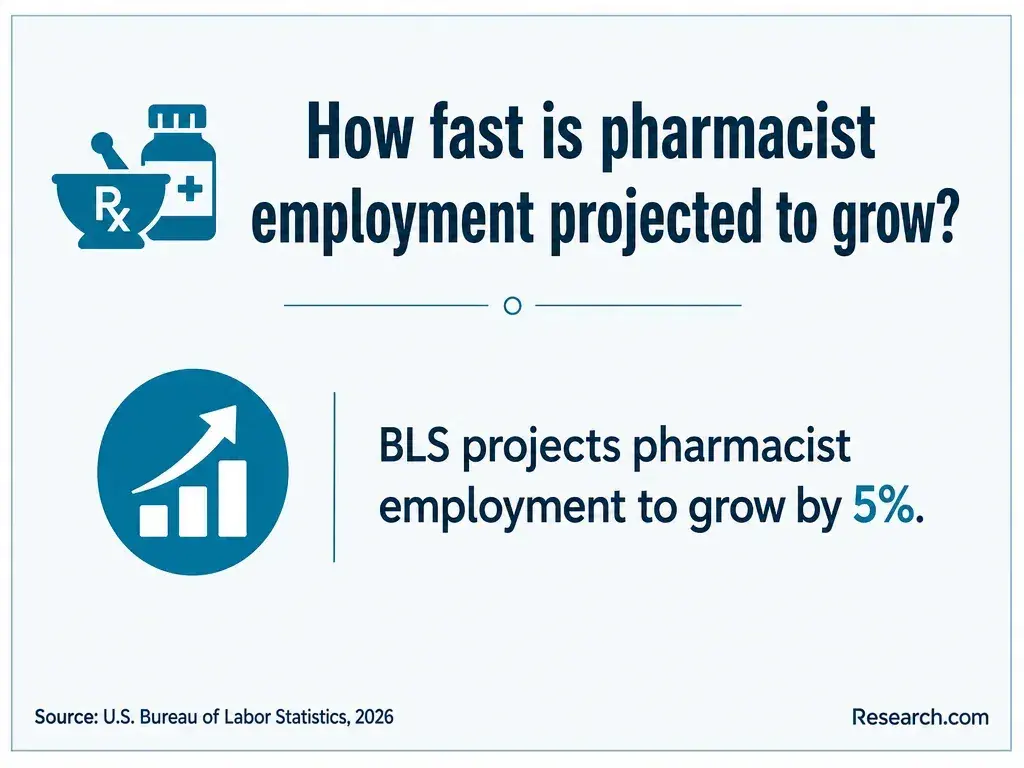
According to the U.S. Bureau of Labor Statistics, pharmacists' median annual pay was $140,910 in May 2025, with 5% projected job growth, 2025-2035, and about 12,500 openings per year projected. That occupation-wide median is not a starting-salary promise or a forecast for a particular location. Before committing to years of prerequisite and professional study, compare the pharmacist role with lower-cost pharmacy degree pathways if your goal is pharmacy-adjacent work rather than a pharmacist license. Pharmacy technician work, for example, is a separate occupation that does not ordinarily require a Pharm.D.
Other Things You Should Know About PharmD
Possibly. NABP's Foreign Pharmacy Graduate Examination Committee (FPGEC) certification is part of a separate route for eligible foreign-educated pharmacists. Eligibility depends on your education and the jurisdiction's rules; certification itself is not a pharmacist license.
Not by itself. Confirm immigration-related participation requirements with the school's international student office and verify that you can meet placement, intern-registration, and site requirements before enrolling.
Eligibility depends on citizenship or qualifying noncitizen status, not simply admission to a U.S. school. Ask the financial aid office to assess your status under current federal rules and identify any institutional funding available to you.
No. Applicants using overseas undergraduate courses to satisfy Pharm.D. prerequisites generally do not need to be licensed pharmacists. A prior pharmacy qualification may trigger additional document requests, so disclose it according to each school's application instructions.
- Recognition of Foreign Qualifications | ed.gov http://www.ed.gov/about/initiatives/international-affairs/recognition-of-foreign-qualifications
- Pharmacist Licensure Guide | Department of State https://www.pa.gov/agencies/dos/resources/professional-licensing-resources/licensure-processing-guides-and-timelines/pharmacist-guide
- Are Prerequisite Courses Barriers to Pharmacy Admission or the Keys to Student Success? - PMC https://pmc.ncbi.nlm.nih.gov/articles/PMC10159397/
- PharmD Prerequisites - Doctor of Pharmacy https://pharmacy.wisc.edu/pharmd/prerequisites/
- International Concerns & Coursework | College of Pharmacy | University of Houston https://uh.edu/pharmacy/admissions/pharmd/international-concerns-and-coursework/
- Verifying Your Prerequisite Course Work | ucsf.edu https://pharmd.ucsf.edu/admissions/reqs/academic/verify
- International Applicants - UW School of Pharmacy https://sop.washington.edu/pharmd/admissions/international-applicants/
- International Credentials & Applicants | miami.edu https://www.grad.miami.edu/graduate-education/international-credentials-and-applicants/index.html
- Prerequisites - College of Pharmacy - University of Minnesota https://www.pharmacy.umn.edu/doctor-pharmacy/admissions/how-apply/prerequisites
- English Proficiency Information | Office of Admissions https://admissions.tc.umn.edu/admissions/international-admission/english-proficiency-information