PharmD Travel and Lodging Costs for Clinical immersions

Co-Founder and Chief Data Scientist
A Pharm.D. program's advertised tuition may not reveal the cost of getting to required clinical sites - or staying near them. That gap matters when a placement is far from home, a campus visit requires an overnight stay, or a rotation prevents you from working your usual hours. This guide is for prospective and current U.S. pharmacy students comparing programs or preparing for experiential education. It explains which expenses to count, how placement and housing policies affect them, and what to confirm before committing to a program or signing a lease.
Key Things You Should Know
- Budget separately for campus immersions, introductory pharmacy practice experiences (IPPEs), and advanced pharmacy practice experiences (APPEs); a nearby placement for one does not guarantee nearby placements for the others.
- Tuition rarely tells you whether transportation, temporary housing, or site-related expenses are covered. Request the program's 2026-27 cost-of-attendance allowance and its written reimbursement and placement policies.
- Federal borrowing rules changed for many new graduate and professional students beginning July 1, 2026. Confirm your individual aid eligibility before treating an approved expense as money you can borrow.
What travel and lodging costs do PharmD clinical immersions typically include?
A clinical immersion is an in-person learning requirement, but schools use the term differently. It may mean a campus skills session, an off-campus clinical experience, or both. IPPEs introduce supervised pharmacy practice; APPEs are more advanced, sustained rotations. Their locations and schedules can create different costs.
The categories below separate recurring commuting expenses from costs that arise mainly when you must stay away from home. They are useful for checking whether a school's published estimate matches your likely placements.
| Cost category | Expenses to account for | When it can matter most |
| Transportation | Fuel or transit fares, parking, tolls, flights, and airport transfers | Repeated site visits or distant campus requirements |
| Lodging | Short-term rent or hotel stays, deposits, and utilities | Rotations beyond a practical daily commute |
| Living expenses away from home | Groceries and other day-to-day costs, potentially alongside rent at home | Temporary relocation without the ability to end an existing lease |
| Placement-related requirements | Possible background checks, immunizations, site onboarding, or intern registration | When requirements differ by site or state |
A comparison of pharmacy program tuition and length is incomplete unless it also accounts for these in-person expenses. Ask whether the quoted budget assumes local placements, campus trips, or temporary relocation.
How much should PharmD students budget for clinical immersion expenses?
There is no reliable nationwide per-student travel figure: costs depend on assigned sites, trip frequency, transportation, and whether you maintain housing in two places. Build a placement-specific estimate rather than applying one school's allowance to another school's schedule.
Use these steps for each required campus visit and likely rotation period; keep uncertain placements as separate scenarios rather than averaging them away.
- Record the location, dates, expected workdays, and whether daily commuting is feasible.
- Estimate round-trip travel plus daily transportation, parking, and tolls.
- Add temporary rent or lodging, deposits, and living costs that will not be covered by your existing household budget.
- Add site-specific compliance expenses and a reserve for placement changes or nonrefundable bookings.
- Sum the periods, then subtract only support the school has confirmed in writing.
For a usable comparison, calculate a local-placement scenario and a distant-placement scenario for each school. If you are researching a low-cost online pharmacy doctorate, do not treat lower advertised tuition as a lower total cost until you have priced its required travel.
Does an online PharmD program cover travel and lodging for clinical rotations?
Not necessarily. Online coursework does not make supervised clinical training virtual, and "online" does not establish that a school will pay for campus visits, rotations, or housing. Programs may help identify or approve sites near a student, but placement availability, preceptor capacity, and school policy determine what is possible.
When comparing online Doctor of Pharmacy degree options, request the required in-person calendar and ask who secures sites, what geographic limits apply, whether travel is reimbursed, and who pays if a local site falls through. Also verify whether the school can enroll you in your state and arrange approved experiences there; distance-education authorization and clinical placement permission are separate questions.
Tuition generally pays for instruction, not every cost of attending an in-person experience. A school may separately charge required fees or include some learning resources while leaving transportation, lodging, and site compliance expenses to students. "Included in the cost of attendance" has a different meaning: it may be an expense the financial aid office recognizes, not an expense the school pays.
Request an itemized tuition-and-fee schedule and a written list of provided resources, placement charges, reimbursements, and student-paid costs. If you expect previous coursework to reduce your overall bill, confirm pharmacy transfer planning rules with the receiving school. Credit accepted toward prerequisites does not necessarily replace professional Pharm.D. courses or shorten clinical requirements.
The most effective savings usually come from placement planning, not last-minute bargain hunting. A nearby approved site can reduce lodging costs, but students should not assume they may select their own preceptor or substitute a current job for a required rotation.
These steps can lower avoidable expenses without putting a placement at risk:
- Ask the experiential education office when sites are assigned and how geographic preferences are considered.
- Compare the full commute with temporary housing, including parking, deposits, and rent you must continue paying at home.
- Check school-approved housing leads or permitted house-sharing arrangements before making a nonrefundable booking.
- Ask about schedule changes and cancellation rules before purchasing flights or signing a short-term lease.
Do not assume a shorter course calendar means fewer trips. Information about how quickly can an online pharmacy degree be completed may cover credentials other than an entry-to-practice Pharm.D.; obtain the actual Pharm.D. experiential calendar before budgeting.
Potentially. A school's financial aid office sets a cost of attendance that can account for eligible living and transportation expenses, subject to federal rules and the student's circumstances. That does not mean every expense is reimbursed or that aid will cover its full cost. Ask whether a documented distant rotation can justify a budget adjustment, what evidence is required, and when approved aid would be available.
Federal loan eligibility depends on your student classification, enrollment, existing aid, and applicable rules. Changes beginning July 1, 2026, affect borrowing for many new graduate and professional students, so do not rely on an older Grad PLUS description or another student's loan limit. Additional prerequisite coursework may also have different aid treatment from the professional curriculum; pharmacy application eligibility pathways should be checked against your school's specific aid and admission policies.
Travel depends on the school's experiential network, available preceptors, required practice settings, placement sequence, and your location. Site onboarding and state intern-registration rules may constrain a preferred placement. A school may consider commuting preferences without guaranteeing that every required experience will be local.
Calendar design matters too. Students considering pharmacy degree programs with accelerated timelines should compare the spacing of campus sessions and rotations, not just the completion date: concentrated experiences can make temporary relocation or time away from paid work harder to avoid. Ask for the most recent published placement process and a representative experiential calendar, while recognizing that individual assignments can change.
Policies vary. A program might share housing leads, coordinate with a site that offers accommodations, permit students to arrange their own short-term rentals, or provide no housing assistance. A housing referral is not the same as a paid room or a guaranteed placement.
Ask the experiential office whether housing is available for each distant site, who signs and pays for it, and what happens if dates change. Review any lease against the actual rotation calendar. General comparisons of online doctoral study duration cannot establish how long a Pharm.D. student will need temporary housing; only the program's in-person requirements and assigned placements can do that.
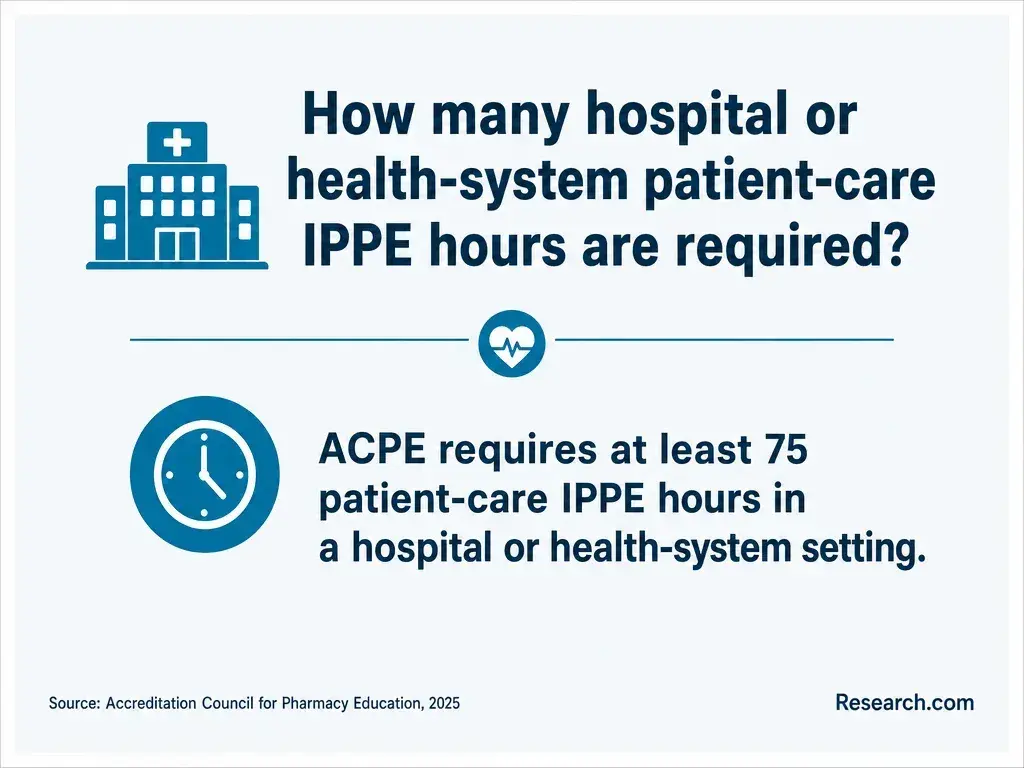
The Accreditation Council for Pharmacy Education (ACPE) accredits professional Pharm.D. programs and sets standards for supervised experiential education, including IPPEs and APPEs. Those standards do not promise a placement near home, paid travel, or school-provided lodging. Check a program's current professional accreditation status directly with ACPE before enrolling.
ACPE accreditation is distinct from an institution's accreditation and from authorization to offer distance education in your state. It also does not itself license graduates: state boards set pharmacist licensure requirements. When reviewing pharmacy school admission requirements, verify those separate statuses rather than treating admission eligibility as proof that a proposed clinical placement or later licensure path will be approved.
How should students compare PharmD programs by clinical immersion costs?
Compare the same categories for every program: required campus trips, placement geography, student responsibility for securing sites, likely commuting or relocation, written housing support, total tuition and mandatory fees, and the aid office's treatment of rotation expenses. Request a local and a distant-placement scenario from each school; neither should be mistaken for a guaranteed assignment.
A lower-tuition program may cost more overall if it requires repeated travel or housing away from home. Conversely, a higher-priced program's nearby placement network is valuable only if its policy and capacity make local assignments realistic for you. Applicants comparing Pharm.D. programs for chemistry majors should also account for any remaining prerequisites separately from professional-degree immersion costs.
Before paying a deposit, get the experiential calendar, placement policy, itemized charges, housing policy, and financial aid estimate in writing. The strongest choice is the program whose plausible total cost and travel commitment you can manage - not simply the one with the lowest advertised tuition.
Other Things You Should Know About PharmD
Usually, if the site and school permit it. Check parking rules, your auto insurance coverage, and whether reliable transportation is required before accepting a placement.
Contact the school's disability services office early to discuss reasonable accommodations and the experiential requirements. Do not assume a clinical requirement can be completed remotely.
Placements and schedules can change. Ask when assignments become final and who bears nonrefundable costs before booking.
Do not assume they are. Tax treatment depends on your circumstances and current tax rules; consult a qualified tax professional before claiming an expense.
- Publication 463 (2025), Travel, Gift, and Car Expenses | Internal Revenue Service https://www.irs.gov/publications/p463
- Receiving Financial Aid | studentaid.gov https://studentaid.gov/complete-aid-process/receive-aid
- Frequently asked questions, per diem | U.S. General Services Administration https://www.gsa.gov/travel/plan-a-trip/per-diem-rates/faqs
- Cost of Attendance (Budget) | 2025-2026 Federal Student Aid Handbook https://fsapartners.ed.gov/knowledge-center/fsa-handbook/2025-2026/vol3/ch2-cost-attendance-budget
- Experiential Education Site Selection Policy | ucsf.edu https://pharmd.ucsf.edu/policies/site-selection
- PharmD Student Voices: A Clinical Training Explainer | Doctor of Pharmacy https://pharmacy.wisc.edu/2025/08/13/pharmd-student-voices-a-clinical-training-explainer/
- PharmD Remote Pathway | CU School of Pharmacy https://pharmacy.cuanschutz.edu/degreesandprograms/pharmd/remote-pharmd
- Experiential Education | Washington State University https://pharmacy.wsu.edu/pharmd/experiential-services/
- Experience Training Schedule | UNC Eshelman School of Pharmacy https://pharmdstudenthandbook.web.unc.edu/experiential-program/experience-schedule/
- What Happens in Pharmacy Clinical Rotations? | Chapman Blogs https://blogs.chapman.edu/pharmacy/2026/04/22/what-happens-in-pharmacy-clinical-rotations/