PharmD transfer credit evaluation timeline

Co-Founder and Chief Data Scientist
Key Things You Should Know
- There is no nationwide Pharm.D. transfer credit evaluation deadline. Allow several months before your intended start date for document collection, academic review, and an admission decision.
- Prerequisite undergraduate credits and professional Pharm.D. credits undergo different reviews; acceptance of a course does not guarantee placement in the next professional year.
- Request a written course-by-course decision and a projected graduation term before paying a deposit or leaving your current program.
What Is a PharmD Transfer Credit Evaluation Timeline?
A Pharm.D. transfer credit evaluation timeline is the sequence from requesting a review to receiving a decision about how prior coursework applies to the receiving school's degree. It is not simply the time needed to read a transcript. Admissions staff may first determine eligibility; faculty may then compare course content and assessments; experiential education staff may separately assess clinical experiences. A final decision may depend on admission, receipt of official records, or completion of courses still in progress.
Ask what the school means by "evaluation." A preliminary opinion can help you decide whether to apply, but it may not reserve a seat or guarantee credit. The receiving school controls the final decision under its current pharmacy degree transfer credit policies. Request the conditions and expected decision date in writing.
How Long Does PharmD Transfer Credit Evaluation Take?
No standard number of days applies across U.S. pharmacy schools. A straightforward prerequisite review may move faster than a professional-course review requiring syllabi, faculty input, and a comparison with a sequenced curriculum. Seat availability, committee meeting dates, and the timing of official transcripts can also determine whether a transfer is possible for your preferred term.
Use the following sequence to build a timeline backward from the receiving school's application and enrollment deadlines. Start several months ahead when professional coursework is involved, and get school-specific dates rather than treating that buffer as a promised turnaround time.
- Ask whether the school accepts professional Pharm.D. transfers for your intended entry term and when it will begin reviewing credits.
- Request required materials from your current school immediately, including detailed syllabi that may take time to retrieve.
- Confirm when your file becomes complete and whether admission and credit decisions are issued together or separately.
- Ask for the date by which you will receive a written credit map and projected graduation term, leaving time to evaluate an offer before its deposit deadline.
If speed matters, compare a transfer with starting anew in one of the fast-track Doctor of Pharmacy programs. An accelerated calendar is not necessarily faster for a transfer student if previously completed professional courses do not satisfy its sequence.
Which PharmD Credits Can Transfer Between Pharmacy Schools?
First distinguish pre-professional prerequisites—undergraduate courses used to qualify for admission—from professional Pharm.D. coursework completed after entering pharmacy school. A school may accept a biology prerequisite yet decline to substitute a therapeutics course in its professional sequence. Students entering pharmacy education after undergraduate science coursework should ask for a prerequisite audit, not assume they qualify as professional-year transfers.
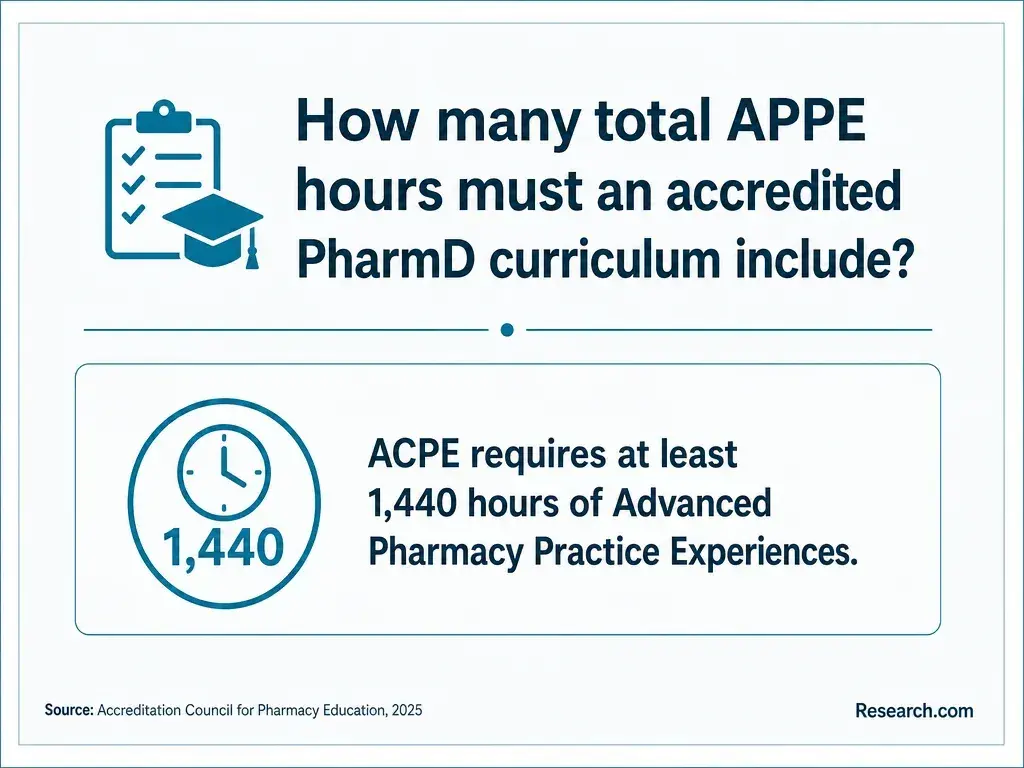
Professional credit is most likely to be considered when the receiving school can verify comparable content, credit or contact hours, learning outcomes, grading, and the point at which the course fits its curriculum. Integrated courses can be difficult to match to stand-alone courses. Introductory pharmacy practice experiences (IPPEs) and advanced pharmacy practice experiences (APPEs) need separate review of hours, settings, supervision, and documented competencies. Neither accreditation at both schools nor a similar course title guarantees acceptance.
The useful question is not just "How many credits transfer?" Ask which degree requirements they fulfill and whether an unmatched required course is offered soon enough to avoid delaying the next course or rotation.
Requirements differ by school and by whether you seek prerequisite or professional credit. Before ordering records, ask which materials are needed for a preliminary review and which must be official before credit becomes final. The following documents commonly help reviewers establish what you completed and whether an exception or substitution is possible:
- Transcripts from every college or pharmacy program attended, with official copies submitted as the receiving school directs.
- Catalog descriptions and full syllabi from the term each professional course was taken, including objectives, topics, grading, and contact hours.
- Documentation of completed IPPEs or APPEs, such as settings, hours, preceptor verification, and evaluations, if experiential credit is requested.
- Descriptions of courses in progress and their expected completion dates, plus any school-requested record of academic or professional standing.
A brief catalog description may be insufficient to establish a professional-course match. If you are missing a prerequisite rather than seeking a professional transfer, ask whether the school permits completion before matriculation or another documented exception; pharmacy school requirements and exceptions are program-specific, not automatic credit awards.
The Accreditation Council for Pharmacy Education (ACPE) accredits professional pharmacy education programs, not individual courses or pharmacists. Its standards address the program as a whole, including educational outcomes and experiential education. A receiving program therefore needs to establish that transferred work supports its requirements. ACPE accreditation at your current school is important context, but it does not compel another school to accept a course or rotation.
Check the current ACPE status of the receiving professional program separately from the university's institutional accreditation. Neither status establishes whether an online student may enroll from a particular state or complete clinical placements there. Be particularly careful when comparing Pharm.D. options with fast online doctoral study: a short doctorate in another field does not substitute for the professional pharmacy education required for the U.S.-educated pharmacist pathway.
Credit eligibility and admission eligibility are separate decisions. A receiving school may require available space in a particular cohort, completed prerequisite courses, minimum grades or GPA, satisfactory standing at the current school, an interview, recommendations, and school-specific application materials. Some schools use PharmCAS; others set their own application process. A completed bachelor's degree is not a universal Pharm.D. admission requirement, and the retired PCAT is not a current exam applicants can take.
Ask admissions whether it accepts applicants from another professional Pharm.D. program at all, which year or term a transfer could enter, and whether an offer is conditional on final grades or standing. If professional transfer is unavailable, pharmacy programs with varied admission routes may help you identify other application pathways—but admission flexibility does not establish professional-credit eligibility.
Employer Confidence in Online vs. In-Person Degree Skills, Global 2024

Accepted credits save time only when they replace required work in the receiving school's sequence. A student could receive substantial elective credit yet still wait for a required course offered in a later term. Conversely, a smaller number of well-matched required credits may preserve the intended graduation date.
Use this comparison to request equivalent information from each school. It separates credits awarded from the costs and scheduling consequences that determine whether transferring is worthwhile.
| Decision factor | What to confirm in writing | Why it matters |
| Credits applied | Requirements satisfied, not just credits posted | Elective credit may not shorten the program. |
| Course sequence | Entry term, remaining required courses, and projected graduation term | An infrequently offered course can create a delay. |
| Experiential education | Accepted IPPE/APPE work and remaining placements | Additional rotations may affect travel, housing, and work schedules. |
| Full cost | Remaining tuition and fees, plus required supplies, travel, and living costs | A lower tuition rate may not offset extra enrollment time. |
Compare the written remaining-cost estimates with staying at your current school, including any lost earnings from a later graduation. Lists of affordable online Pharm.D. programs are a starting point, not a substitute for a personalized transfer and cost evaluation. If borrowing is necessary, obtain current financial-aid advice: federal rules changed for many new graduate and professional borrowers beginning July 1, 2026, and eligibility depends on the student and aid year.
They can if their published policies permit it, but online delivery does not change who awards credit or remove hands-on requirements. Ask a prospective program whether transfer students enter a fixed cohort, attend live classes or campus sessions, and complete in-person IPPEs and APPEs on its schedule. Also ask who approves placements, whether travel is likely, and what intern-registration or site requirements apply.
When comparing Doctor of Pharmacy distance learning programs, verify three distinct matters: the professional program's ACPE status, authorization to enroll you from your state, and the feasibility of required clinical placements. None of those checks, by itself, determines whether your previous professional courses transfer or whether you can maintain a full-time work schedule.
A transfer does not create a separate pharmacist license. After completing the receiving school's Pharm.D. requirements, a graduate must meet the licensing board's rules in the jurisdiction where they intend to practice. Those typically include the North American Pharmacist Licensure Examination (NAPLEX), along with jurisdiction-specific requirements such as a law examination, intern experience, or background review. Depending on the jurisdiction, the law examination may be the MPJE, the UMPJE, or another process; passing an exam alone does not issue a license.
Before transferring—especially across state lines—check whether your planned rotations require intern registration and whether the receiving program can support placements consistent with your intended licensing jurisdiction. Do not confuse affordable short pharmacy programs with a licensure-qualifying Pharm.D.; pharmacy technician and other pharmacy-adjacent credentials serve different roles.
How Can Students Compare PharmD Programs With Fair Transfer Policies?
A fair policy makes the review criteria, documentation, decision-maker, and conditions of any credit award clear enough for you to compare offers. It does not have to award identical credit for courses with different content. Give greater weight to a school that provides a written degree audit and realistic graduation projection than to one that advertises a high possible credit limit without explaining course placement.
Send the same questions to each school so the answers are comparable before you commit:
- Which of my completed courses satisfy the named professional requirements, and which count only as electives?
- Who reviews professional courses and rotations, and when will I receive a final written decision?
- What is my earliest feasible graduation term, including remaining rotations and courses that are not offered every term?
- What could change the credit decision after admission, and is there a process to request reconsideration?
Keep your current enrollment plans intact until you understand the receiving school's conditions and deadlines. If preserving prior professional coursework is unlikely, compare the time and cost of starting a different Pharm.D. program against staying put. If your goal does not require pharmacist licensure, the quickest online pharmacy study routes may be worth examining—but they should not be mistaken for a shortcut to the Pharm.D.
Other Things You Should Know About PharmD
Some schools permit reconsideration, but procedures vary. Ask for the policy and deadline, then submit the specific syllabus, assessment, or experiential record that addresses the reason credit was denied.
They may, but the receiving school determines the credit conversion and whether the course meets a particular requirement. Request both the converted credit value and the requirement it satisfies.
First confirm that the offer, credit map, and entry term are final or understand every remaining condition. Check both schools' withdrawal, deposit, and refund deadlines before making an irreversible change.
Policies vary, and a school may require a course-by-course credential review or decline professional-course substitutions. Internationally educated pharmacists should also check the distinct licensure pathway applicable to their education; a transfer evaluation is not a licensing determination.
- What's Next in the ACPE Accreditation Standards Revision Process? - PMC https://pmc.ncbi.nlm.nih.gov/articles/PMC3631724/
- Transfer Credit Evaluation | Office of Admissions https://admissions.tc.umn.edu/admissions/transfer-admission/transfer-credit-evaluation
- Academic Guidelines for Progression in the Doctor of Pharmacy Curriculum | UNC Eshelman School of Pharmacy https://pharmdstudenthandbook.web.unc.edu/academic-guidelines/academic-progression-guidelines/academic-guidelines-for-progression-in-the-doctor-of-pharmacy-curriculum/
- Pharmacy Admissions | Albany College of Pharmacy and Health Sciences https://www.acphs.edu/admissions-aid/pharmacy-admissions/
- Transfer Credit Appeals | About the University of Cincinnati https://www.uc.edu/about/registrar/credit/transfer/appeals.html
- PharmD Prerequisites - Doctor of Pharmacy https://pharmacy.wisc.edu/pharmd/prerequisites/
- Transfer Evaluation Appeal Process | TCC.edu https://www.tcc.edu/service-support/registrar/transfer-evaluation/transfer-evaluation-appeal-process/
- Transferring Credit | Undergraduate Admissions https://admissions.northeastern.edu/application-information/transferring-credit/
- Accreditation - Texas A&M College of Pharmacy https://pharmacy.tamu.edu/about/acpe-self-study.html
- Prerequisite Coursework | School of Pharmacy https://www.pharmacy.pitt.edu/academics/doctor-pharmacy/apply-pharmd-program/prerequisite-coursework