Pharmacy Career Growth After the First Five Years

Co-Founder and Chief Data Scientist
After five years in pharmacy practice, experience alone may not bring the role, schedule, or compensation you want. The next move could be a clinical position, a specialty, management, or a different practice setting - but each has different hiring expectations and costs. This guide is for practicing pharmacists weighing those options and prospective Pharm.D. students who want to understand the longer-term career path. You'll learn which qualifications matter, where demand differs, and how to test a move before committing time or money to additional training.
Key Things You Should Know
- Five years of experience can position a licensed pharmacist for senior practice or management roles, but it does not automatically replace specialized experience, residency training, or an employer's hiring requirements.
- The U.S. Bureau of Labor Statistics reports median pharmacist pay of $140,910 in May 2025; that occupation-wide figure is not a five-year salary or a forecast of what a promotion will pay.
- Choose a target role first, then compare actual job postings, required credentials, training costs, and likely time away from work before enrolling in another program.
What career paths can pharmacists pursue after their first five years?
Common paths include deeper patient-care practice, operations leadership, and work outside traditional dispensing. The best next step depends less on the number of years worked than on the responsibilities you can demonstrate and the qualifications employers request.
This comparison shows what each path typically emphasizes and the main hurdle to check before pursuing it.
| Path | Typical work | Key hurdle |
| Clinical or ambulatory care | Medication assessment, care-team collaboration, and follow-up | Relevant patient-care experience; some employers prefer or require residency or certification |
| Specialty pharmacy | Complex therapies, patient support, and care coordination | Therapy-area knowledge and experience with specialty workflows |
| Operations or leadership | Staffing, quality, budgets, and regulatory compliance | Evidence of managing people and improving outcomes |
| Industry or other nontraditional roles | Medical information, drug safety, or related work | Role-specific experience; some positions favor fellowship training |
For an already licensed pharmacist, another entry-level pharmacy degree is generally not the route to advancement. Prospective students considering fastest online pharmacy degree programs should check the exact credential: a shorter pharmacy-related degree is not necessarily a professional Pharm.D. or a route to pharmacist licensure.
How does pharmacist salary change after five years of experience?
There is no standard five-year raise. The Bureau of Labor Statistics reports median annual pay for U.S. pharmacists of $140,910 in May 2025, across experience levels and practice settings. It does not establish what a pharmacist with exactly five years of experience earns. Location, shift differentials, employer, responsibility, and hours can matter more than tenure alone.
Compare total compensation, not just base pay: include bonuses, retirement contributions, benefits, paid leave, and any loss of income during training. A clinical move may improve fit without increasing immediate pay; a management offer may pay more while adding on-call or staffing obligations. For someone still choosing a Pharm.D., compare those possibilities against online Doctor of Pharmacy tuition and the full cost of attendance. An already licensed pharmacist should instead weigh the incremental cost of the specific training a target job requires.
What advanced roles can pharmacists qualify for after five years?
Potential roles include pharmacy manager, clinical pharmacist, medication safety pharmacist, specialty pharmacist, and informatics pharmacist. Five years may meet an experience threshold, but titles are not standardized: one employer's clinical pharmacist position may accept demonstrated direct-care experience, while another requires residency training. Informatics roles may place greater weight on implementation and workflow experience than on years spent dispensing.
Read postings for the minimum requirement separately from preferred qualifications. Check licensure, setting-specific experience, supervisory history, and any required credential before assuming you qualify. If you are researching these roles before entering the profession, confirm pharmacy degree eligibility requirements separately from job requirements. Pre-pharmacy coursework and admission to a Pharm.D. program are distinct from completing the professional degree and obtaining a state pharmacist license.
Start by naming the clinical work you want - such as hospital staffing with clinical responsibilities, ambulatory care, or medication management - rather than treating "clinical" as one job. Then compare postings in your area with the patient-care work you already perform. Counseling, immunizations where authorized, medication reviews, and resolving therapy problems can provide relevant examples, but they may not substitute for inpatient experience or residency where an employer requires it.
A transition is more credible when you can document clinical decisions and outcomes without disclosing protected patient information. These steps help identify a realistic bridge role:
- Select a target setting and review multiple current postings for required versus preferred qualifications.
- Ask pharmacists in that setting which skills are hardest for new hires to demonstrate.
- Seek relevant responsibilities, supervised experience, or an internal transfer before paying for a credential.
- Reassess whether a residency, certification, or additional coursework closes a specific hiring gap.
For readers entering pharmacy from a science background, Pharm.D. programs for biology majors address an earlier transition. Biology coursework alone does not qualify someone to practice as a pharmacist.
No specialty is the strongest choice in every market. Ambulatory care, oncology, infectious diseases, critical care, and specialty pharmacy can offer deeper responsibilities, but local hiring, available training, and your preferred patient population determine whether a path is practical. Informatics and medication safety may appeal to pharmacists who want to improve systems rather than focus primarily on individual encounters.
Judge a specialty by the work available to you, not its title. Ask whether nearby employers hire for it, whether openings require prior specialty practice or postgraduate training, and whether the daily work suits you. Specializing can narrow your options if you need geographic flexibility. Prospective Pharm.D. students comparing online Pharm.D. schools to compare should examine experiential placements and elective opportunities, without assuming a particular rotation or specialty job is guaranteed.
Not universally. A postgraduate year one residency (PGY1) develops broad practice skills; a postgraduate year two residency (PGY2) adds focused specialty training and commonly follows PGY1 or qualifying experience under program rules. A fellowship typically serves a different purpose, often emphasizing research or industry work. An American Society of Health-System Pharmacists (ASHP)-accredited residency, an employer's preferred credential, and a legal licensing requirement are different things.
Board of Pharmacy Specialties (BPS) certification recognizes expertise in a defined area; it does not grant a state pharmacist license. Eligibility varies by specialty and may include particular practice experience or training. Before applying, check the current rules with the residency program or certification body and confirm what target employers require. Account for application costs, possible relocation, and foregone earnings as well as the training's value. Likewise, accelerated online pharmacy programs concern the route into pharmacy education, not a replacement for postgraduate training.
Begin with a project that has a defined problem and a measurable result: improving a workflow, reducing an error risk, training colleagues, or coordinating a service. Seek responsibility for the budget, staffing, or compliance decisions behind that project where your role permits. These examples give a hiring manager more evidence than a general claim that you are "ready to lead."
Ask for feedback from staff and supervisors, then look for stretch assignments such as precepting or committee work. Management education can be useful when a target role calls for finance or organizational skills, but it is not automatically a prerequisite. Compare the time and cost of a course or degree with what you can learn through supervised leadership at work. Options marketed as fast online doctoral study should be evaluated against the actual requirements of pharmacy leadership jobs; a second doctorate may offer little advantage for the role you want.
Continuing education (CE) requirements are set by the state boards that license pharmacists. Renewal periods, required hours, approved activities, and topic-specific requirements vary by jurisdiction and can change. Pharmacists holding licenses in more than one state should check each board's current rules rather than assume one CE record satisfies every license.
Keep completion records and distinguish license-renewal CE from training that makes you competitive for a new role. A CE course can sharpen a skill, but it does not by itself confer board certification, expand legal scope of practice, or replace a required degree. Similarly, pharmacy program preparation requirements apply to prospective students; a practicing pharmacist's CE obligations are a separate matter.
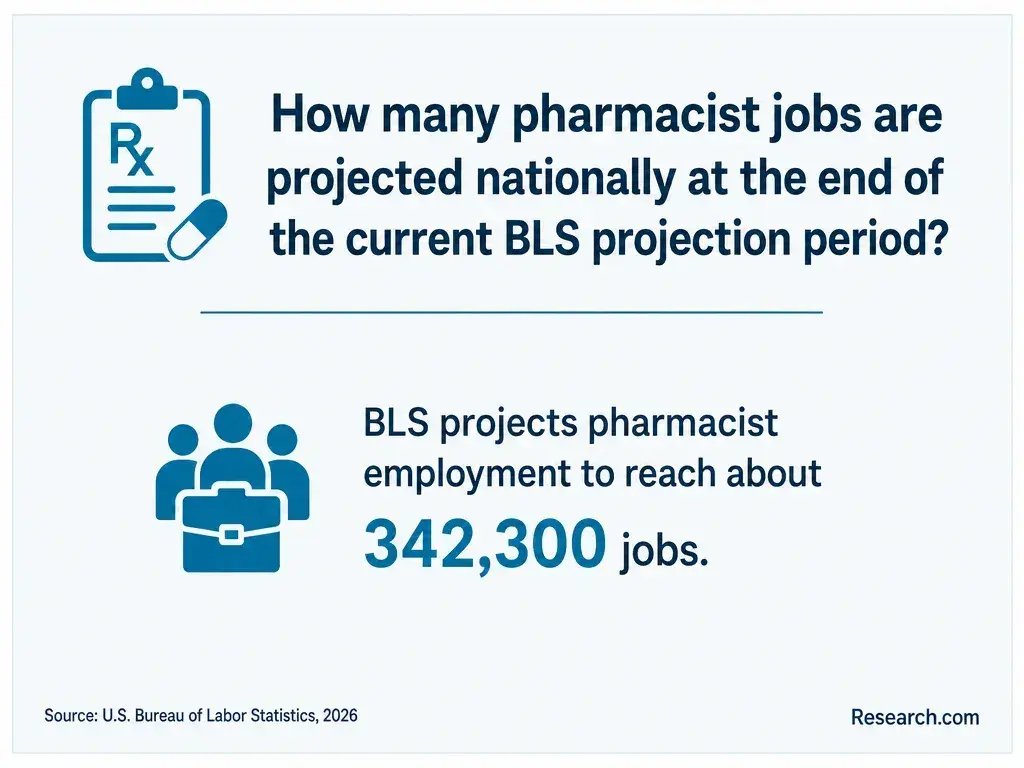
The Bureau of Labor Statistics projects 5% growth in U.S. pharmacist employment from 2025 to 2035, with about 12,500 openings per year projected. Those figures describe pharmacists as an occupation, not guaranteed openings in a particular city, specialty, or practice setting.
Demand can differ among community pharmacies, hospitals, ambulatory clinics, long-term care, and specialty operations. Openings may reflect replacement needs as well as growth, while an attractive specialty position may still draw many qualified applicants. Check recent local postings, required experience, and shift expectations before relocating or retraining. If you have not yet entered the profession, compare pharmacy degree programs with shorter timelines by credential and licensure relevance - not by speed alone - before using the national outlook to justify the investment.
How should pharmacists choose a graduate program or career development pathway?
Work backward from a specific job posting. If the gap is supervisory experience, seek a leadership assignment; if it is specialized clinical practice, investigate relevant experience, residency, or certification eligibility. Consider a graduate program only when its curriculum and credential address a gap that less costly experience or focused training cannot reasonably close.
Use this sequence before committing to tuition or leaving a job:
- Identify a target role and separate its legal licensing requirements from employer minimums and preferences.
- Ask employers or practitioners which qualifications successful candidates actually demonstrate.
- Compare the full training cost, schedule, potential relocation, and income you may give up.
- Verify the program's current credential, accreditation where relevant, admission rules, and any hands-on or in-person requirements.
- Set a decision point for reviewing your progress if the target role remains unavailable.
For prospective Pharm.D. students, how pharmacy programs review transfer credits can affect time and cost; the receiving school decides how prior coursework applies. Practicing pharmacists should first ask whether another degree is needed at all. Neither program completion nor an additional credential guarantees promotion or changes state licensure automatically.
Other Things You Should Know About PharmD
Yes, though access to projects, supervisory duties, and benefits may differ by employer. Ask whether the part-time role offers experience relevant to your target position.
Describe your responsibilities, approved aggregate results, and process improvements. Follow employer policy and privacy law; do not include identifiable patient details in applications or interviews.
No. The destination board determines eligibility and its application, examination, and other requirements. Check that board before accepting a job that requires its license.
Choose one relevant project or skill to build in your current position, document the result, and review target postings periodically. That creates evidence for a later move without requiring an immediate resignation.
- Role of Pharmacy Residency Training in Career Planning - PMC https://pmc.ncbi.nlm.nih.gov/articles/PMC4319808/
- Considering a Career in Pharmacy? What You Need to Know | PCOM https://www.pcom.edu/pharmacy/career-in-pharmacy.html
- Different Types of Pharmacists: 5 Career Options | Bouvé College of Health Sciences https://bouve.northeastern.edu/news/different-types-of-pharmacists-5-career-options/
- Rewards, recognition, and advancement for clinical pharmacists | wiley.com https://accpjournals.onlinelibrary.wiley.com/doi/10.1002/jac5.1775
- Exploring career choices of pharmacy graduates over 15 years: A cross-sectional evaluation - ScienceDirect https://www.sciencedirect.com/science/article/pii/S1877129724000595
- Is a Career in Pharmacy Worth It? | University of Findlay https://pharmdonline.findlay.edu/blog/pharmacy-career-worth-it
- 2024 National Pharmacist Workforce Study | AACP https://www.aacp.org/node/3746