How to Compare Pharmacy School Tuition and Outcomes

Co-Founder and Chief Data Scientist
A lower pharmacy school tuition bill does not necessarily mean a lower total cost - or a better path to becoming a pharmacist. Prerequisite coursework, clinical rotations, borrowing, and licensing preparation can change the value of a Doctor of Pharmacy (Pharm.D.) program. This guide is for prospective U.S. students comparing schools or reconsidering whether a Pharm.D. fits their career goal. It shows you which costs and outcomes to put side by side, which published figures need context, and what to verify before accepting an offer.
Key Things You Should Know
- Compare the full cost of attendance and expected borrowing, not tuition alone; rotation travel and time away from work can change the result.
- Confirm each program's current ACPE status, then compare first-time NAPLEX results using the same reporting period and examine outcomes beyond test scores.
- For salary context, the U.S. Bureau of Labor Statistics reports median annual pay of $140,910 in May 2025 for pharmacists - not a starting salary or a return promised by any school.
How do pharmacy school tuition and career outcomes compare?
Compare programs on the same time horizon: the coursework you still need, every year of the professional program, and the costs of reaching licensure. Then examine outcomes that relate to your goal, such as first-time licensing exam performance, graduation, residency placement, or employment. A school's tuition and an outcome measured for a different graduating class do not form a reliable return-on-investment calculation.
This worksheet keeps the same comparison fields for each school. Use each program's current disclosures and financial aid estimate to fill the blanks; keep annual costs separate from total-program estimates.
| Comparison field | Program A | Program B |
| Tuition basis and academic year | _____ | _____ |
| Required fees and remaining prerequisites | _____ | _____ |
| Estimated living and rotation-related costs | _____ | _____ |
| Grants, scholarships, and estimated borrowing | _____ | _____ |
| Graduation rate and cohort definition | _____ | _____ |
| First-time NAPLEX pass rate, year, and candidate count | _____ | _____ |
| Career outcome measured and response rate | _____ | _____ |
Start with the schools' published cost-of-attendance budgets and ask what they omit. If you are considering a hybrid pathway, compare online pharmacy school cost options using the same cost categories as campus programs. Favor the lower-cost choice when its accreditation, placement logistics, and outcomes meet your needs; paying more calls for a specific, relevant advantage - not a general reputation claim.
What does ACPE accreditation mean for pharmacy school quality?
The Accreditation Council for Pharmacy Education (ACPE) accredits professional Pharm.D. programs against education standards. Check the specific program and its current status in ACPE's official directory, including any notes about its stage or conditions.
Institutional accreditation applies to the university; state authorization concerns permission to provide education in a state. Neither substitutes for checking the Pharm.D. program's ACPE status or your intended licensing board's requirements.
Accreditation is a threshold, not proof that two schools have identical teaching, student support, clinical sites, or results. Compare published NAPLEX outcomes by exam year and first-time candidate group, and consider cohort size before treating a rate difference as meaningful.
Ask for graduation and career-outcome definitions as well. A list of best online Doctor of Pharmacy programs can help you identify options, but it cannot replace a current ACPE lookup or verification of where you may complete rotations.
How much does pharmacy school cost beyond tuition?
Your relevant figure is the cost of completing the pathway from your current starting point, not just the advertised Pharm.D. tuition. Costs differ by school, location, existing coursework, and clinical assignment.
Request an itemized estimate that addresses these commonly overlooked expenses before you compare offers:
- Mandatory university and professional-program fees, textbooks, clinical references, equipment, and technology.
- Unfinished prerequisite courses and any extra term needed to complete them.
- Background checks, immunizations, required documentation, and possible intern-registration costs.
- Campus visits, rotation travel or temporary housing, and income lost when clinical schedules limit paid work.
- Licensing applications, examinations, and preparation costs after graduation.
Subtract aid that does not need to be repaid before estimating borrowing, and distinguish a scholarship renewable throughout the program from a one-time award. For many new graduate and professional borrowers, federal loan rules changed beginning July 1, 2026; confirm your own eligibility and current limits with each school's aid office rather than assuming older Grad PLUS access applies.
Low-cost and shorter pharmacy degree programs may be worth considering if your goal does not require pharmacist licensure, but a different credential is not a substitute for a Pharm.D. when licensure is the goal.
Pharm.D. admission generally begins with undergraduate pre-professional coursework; the Pharm.D. itself is the subsequent professional curriculum. Some schools admit applicants without a completed bachelor's degree, while others have different degree or credit expectations.
Compare each school's required subjects, labs, minimum grades, course-age rules, and whether unfinished courses may be completed before enrollment.
A prior bachelor's degree does not automatically satisfy every science prerequisite or shorten the professional program. Schools also decide whether community-college, AP/IB, online-lab, repeated, or previously earned coursework meets their rules.
If you are exploring pharmacy admissions for students with prior credits, request a written prerequisite review and distinguish credit accepted for admission from credit awarded within the Pharm.D. curriculum.
An online or hybrid Pharm.D. may reduce routine commuting, but it does not remove hands-on training. Compare scheduled live classes, required campus labs or immersions, assessments, and in-person clinical rotations with a campus program's timetable. Neither format is automatically cheaper or easier to combine with full-time work.
Ask who secures and approves introductory and advanced pharmacy practice experience sites, whether placements near home are possible, and what happens if a suitable site is unavailable.
State authorization to enroll online, permission for a clinical placement, and eligibility for pharmacist licensure are separate questions. Published online Pharm.D. program timelines can help frame a comparison, but confirm the actual sequence and travel obligations for your cohort before relying on a projected completion date.
Professional Pharm.D. study typically combines biomedical and pharmaceutical sciences, pharmacotherapy, medication safety, patient assessment, counseling, and pharmacy law.
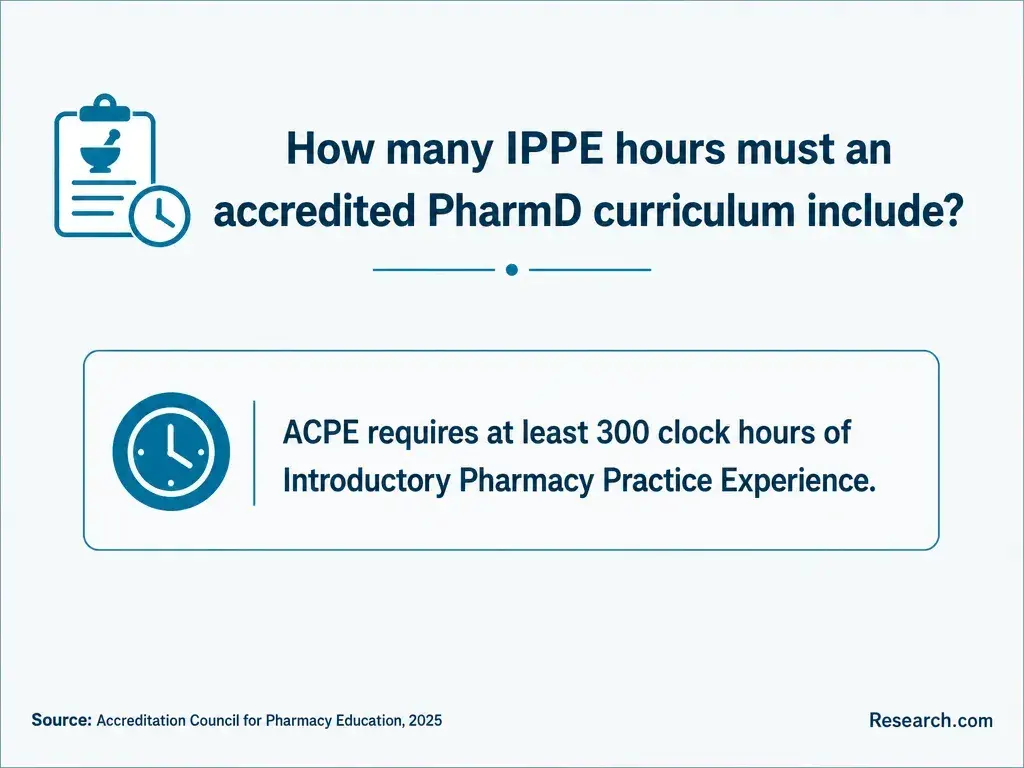
Supervised introductory pharmacy practice experiences (IPPEs) expose students to practice earlier in the program; advanced pharmacy practice experiences (APPEs) provide more sustained rotations later. Schools determine their curricula and placements within applicable standards, so compare their published schedules rather than assuming identical experiences.
For an outcome-focused comparison, look at the settings available for rotations that match your interests and ask how sites and preceptors are assigned.
Also check whether prior professional coursework could count if you change schools: the receiving program decides what transfers, and prerequisite credit is not the same as transfer into its Pharm.D. curriculum. Review how pharmacy programs review transfer credits before treating a transfer as a way to shorten the degree.
Schools commonly review prerequisite completion and grades, transcripts, recommendations, interviews, and evidence that an applicant understands pharmacy practice. Requirements, deadlines, supplemental applications, and use of the Pharmacy College Application Service (PharmCAS) vary by program.
A published minimum GPA is an eligibility threshold, not an admission prediction. The Pharmacy College Admission Test (PCAT) was retired in January 2024, so it should not be treated as a current routine test requirement.
Use each school's current admissions page and, where applicable, its PharmCAS directory entry to separate required materials from recommendations. Comparing pharmacy school acceptance criteria is useful only when you also check whether you can finish the prerequisites on time and afford the resulting pathway. An easier entry point is not necessarily a stronger financial or licensing outcome.
Licensed pharmacists work in settings including community pharmacies, hospitals, ambulatory care, specialty pharmacy, and industry-related roles; responsibilities and hiring expectations differ.
The U.S. Bureau of Labor Statistics projects 5% growth for pharmacist employment from 2025 to 2035. That national projection signals opportunities across the occupation, not demand for every specialty or a job offer for each graduate.
A residency offers structured postgraduate practice training; a fellowship generally emphasizes specialized work such as research or industry experience. Neither is universally required for pharmacist employment, and specialty board certification is a separate credential, not a license.
If you are transitioning into a Doctor of Pharmacy program from another science field, compare schools' clinical exposure and support for your intended setting rather than assuming the Pharm.D. alone opens every role.
The Bureau of Labor Statistics reports median annual pay of $140,910 in May 2025 for U.S. pharmacists. That occupation-wide midpoint is not a new graduate's expected offer: employer, practice setting, location, hours, and experience can change compensation substantially. Compare actual opportunities in places you would work, alongside local living costs and your likely debt payments, before estimating whether a program's added price is worthwhile.
Pharmacy technicians are a separate occupation that does not ordinarily require a Pharm.D. For someone whose goal is to enter pharmacy support work rather than become a licensed pharmacist, short-duration pharmacy programs may merit comparison. They should not be evaluated as though they lead to the same responsibilities, licensing pathway, or salary market as a Pharm.D.
What licensing exams and professional standards apply to pharmacists?
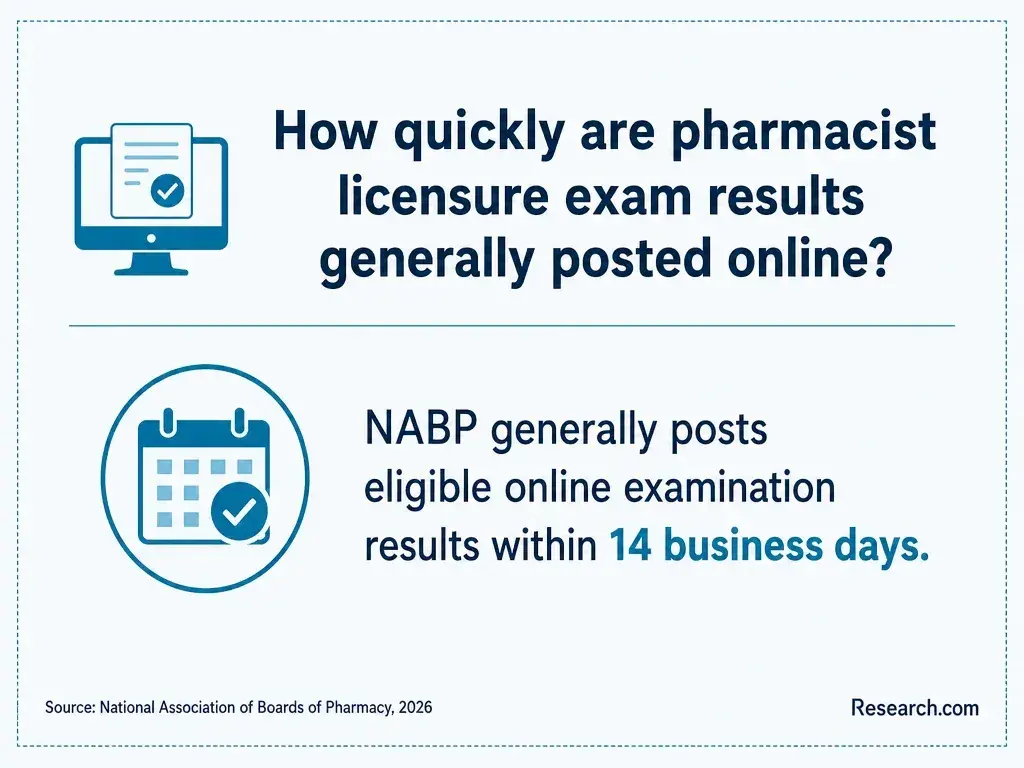
Finishing a Pharm.D. does not itself grant a pharmacist license. U.S.-educated graduates generally must meet their state board's eligibility rules and pass the North American Pharmacist Licensure Examination (NAPLEX), along with any applicable law examination and other state requirements.
Jurisdictions differ: do not assume every board requires the Multistate Pharmacy Jurisprudence Examination (MPJE), particularly as some began using the Uniform MPJE (UMPJE) in 2026. Check the board where you intend to practice and current National Association of Boards of Pharmacy instructions.
Before paying a deposit, confirm that the program's accreditation and your planned clinical experiences align with that board's eligibility rules. Ask about intern registration and any state-specific conditions for rotations.
Passing an exam, earning a certificate, or completing postgraduate training does not independently issue a license; applicants exploring pharmacy degree programs for transfer students and internationally educated applicants may face a different credentialing pathway.
Other Things You Should Know About PharmD
Not on that figure alone. Check whether rates cover first-time candidates, the exam year, and the size of the group tested. Then weigh the result against total cost, graduation, clinical placements, and your career goal.
Use the award terms, not just the headline amount. Confirm renewal conditions, which terms it covers, and whether it changes other aid before estimating what you must borrow.
Ask for the latest available result, its definition, and the number of students included. If the school cannot provide it, mark that outcome as unknown rather than assuming it matches another school's published result.
Possibly, if its relevant training and support justify the added cost for your goal. Compare how each school defines and reports placements, and remember that residency selection is competitive; no program can promise a match.
- Cost of Attendance (Budget) | 2025-2026 Federal Student Aid Handbook https://fsapartners.ed.gov/knowledge-center/fsa-handbook/2025-2026/vol3/ch2-cost-attendance-budget
- Incorporating ACPE Standards in a Holistic Approach to School Operations and Accreditation - PMC https://pmc.ncbi.nlm.nih.gov/articles/PMC6498212/
- What are graduation, retention, and transfer rates? | studentaid.gov https://studentaid.gov/help/graduation-retention-transfer-rates
- Tuition & Fees - Touro College of Pharmacy https://tcop.touro.edu/admissions--aid/tuition-and-fees/
- Accreditation Updates- Outcomes and Indicators - ACPE https://acpe.edu/detail-pages/news/2024/02/05/accreditation-updates--outcomes-and-indicators
- Cost of Attendance " Pharm.D. Admissions " | ufl.edu https://admissions.pharmacy.ufl.edu/financial-aid/anticipated-expenses/
- Key Outcomes | The Ohio State University College of Pharmacy https://pharmacy.osu.edu/education/doctor-pharmacy/key-outcomes
- Initial Employment Plans of PharmD Graduates from Ten Public Colleges/Schools of Pharmacy, 2018-2022 - ScienceDirect https://www.sciencedirect.com/science/article/abs/pii/S0002945924000305
- FAQ | OSU College of Pharmacy - Oregon State University https://pharmacy.oregonstate.edu/programs-admissions/pharm-d/faq