
How PharmD programs evaluate transfer coursework

Co-Founder and Chief Data Scientist
A course that appears on your transcript may satisfy a Pharm.D. prerequisite, transfer into the professional curriculum, or count for neither. Those outcomes have different effects on admission, tuition, and graduation time. This guide is for applicants bringing credits from another college or pharmacy school. It explains how receiving programs review coursework, what evidence they need, and how to compare written credit decisions before committing to a program.
Key Things You Should Know
- The receiving Pharm.D. program decides whether prior work satisfies an admission prerequisite or replaces professional coursework; one decision does not imply the other.
- Course content, labs, credit units, grades, recency, and the institution where you studied can all affect the decision. Even accepted professional credit may not shorten a fixed course sequence.
- Request a written, course-by-course evaluation and a revised graduation and cost estimate before paying a deposit or leaving your current program.
How do PharmD programs evaluate transfer coursework?
Programs generally make two separate determinations. First, admissions staff check whether prior undergraduate courses satisfy pre-professional prerequisites - the science, mathematics, and other coursework required before entering the Doctor of Pharmacy (Pharm.D.) curriculum. Second, if you previously attended a pharmacy school, academic staff may consider whether professional courses can replace parts of their own Pharm.D. curriculum.
The receiving school controls both decisions. It may compare official transcripts, course descriptions, syllabi, lab work, credit hours, grades, and when the courses were taken. Professional-course review may also involve faculty and the experiential education office. A preliminary admissions opinion is not necessarily a final award of credit; ask when the decision becomes binding and whether it depends on successful completion of courses still in progress.
If you are moving between professional programs, start with each school's published policy for pharmacy school transfer admission, then request an individual evaluation. Acceptance into a program, acceptance of credits, and placement into a particular professional year are separate decisions.
Which transfer credits do PharmD programs accept?
Undergraduate biology, chemistry, mathematics, writing, and other courses may satisfy prerequisites when they match the receiving school's requirements. These credits ordinarily establish eligibility to enter the Pharm.D. program; they do not replace professional pharmacy courses. Applicants continuing their pharmacy education after a pre-pharmacy track should check each required course and lab individually rather than assuming a completed major covers them.
Prior professional coursework - such as pharmacotherapy or pharmacy practice - faces a more detailed review because curricula integrate knowledge and skills across courses and clinical experiences. A course can be academically similar yet fail to replace a required course if its assessments, timing, or practice components differ. Credits from pharmacy technician training, pharmaceutical sciences, or other pharmacy-related study do not automatically substitute for professional Pharm.D. work.
Ask the receiving school to label each course as a satisfied prerequisite, accepted professional credit, elective credit, or no applicable credit. That distinction reveals whether the award actually changes your remaining requirements.
Do PharmD programs accept credits from online or community colleges?
Some do, but the answer is course- and school-specific. A program may accept a community-college lecture while setting different rules for upper-level science work or laboratories. It may accept an online lecture but require evidence of how an online lab developed and assessed hands-on skills. Institutional accreditation alone does not guarantee that a course meets a particular Pharm.D. prerequisite.
Check the current admissions policy for the course's institution, format, lab, grade, and completion date. If you are considering a new course online, obtain written confirmation before enrolling. When comparing where to choose an online Pharm.D. program, also distinguish acceptance of online prerequisites from the delivery of the professional degree: hands-on activities and in-person clinical rotations may still be required.
Course equivalency means that the receiving school judges earlier study sufficient to meet a specific requirement. Reviewers may examine topics covered, instructional and lab hours, credit units, learning outcomes, assessments, and the place of the course within a sequence. Similar course titles are not proof of equivalence; conversely, differently named courses may cover the required material.
A useful submission pairs each proposed transfer course with the receiving school's requirement and includes the syllabus from the term you actually attended. If your background does not match a standard prerequisite, look for the school's rules on substitutions or other pharmacy school requirements and exceptions. An exception must be approved by the receiving program; it is not created by an applicant's interpretation of a course description.
For a professional-course match, ask whether the decision also satisfies associated labs or experiential requirements. Approval for lecture content alone may leave a separate requirement - and its scheduling consequences - in place.
There is no nationwide Pharm.D. transfer GPA or minimum course grade. Schools publish their own standards, and a program may use different rules for prerequisite completion, admission eligibility, and awarding professional transfer credit. A grade that meets a minimum requirement does not guarantee admission or a course equivalency.
Check how each school treats repeated courses, withdrawals, pass/fail grades, and courses still in progress. Ask whether it calculates a prerequisite GPA, overall GPA, or separate science GPA, and whether earlier attempts remain in that calculation. Published minimums describe eligibility, not necessarily how competitive pharmacy school admission will be for a particular applicant.
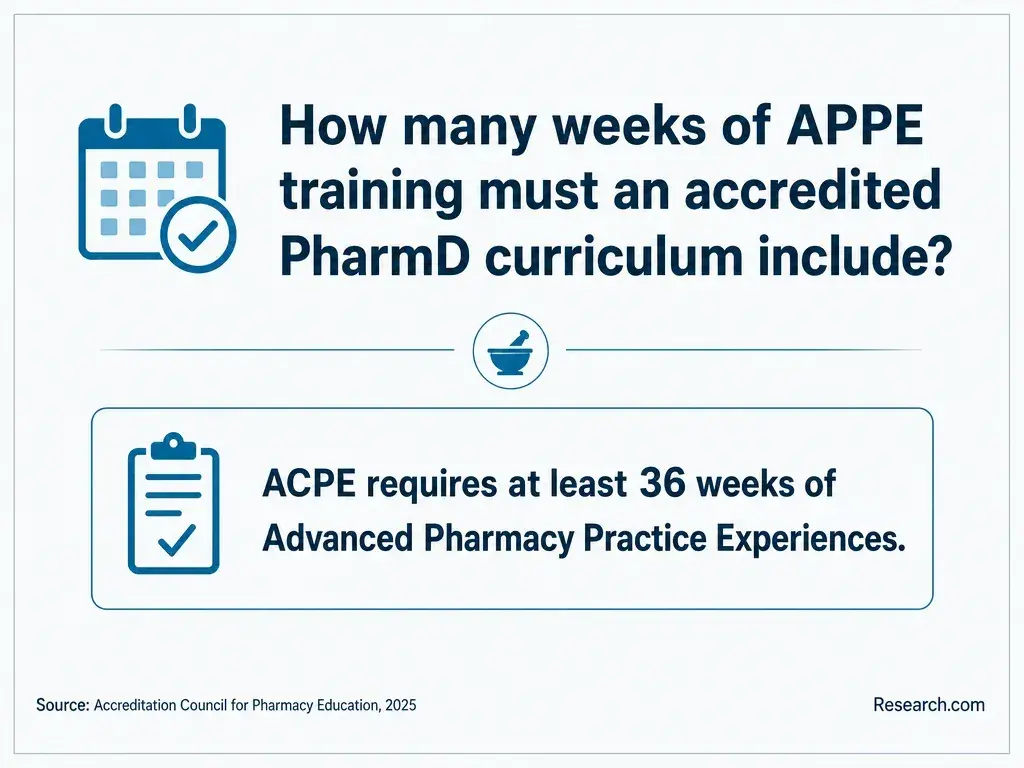
Possibly, but accepted credits and earlier graduation are not the same thing. A school may teach required professional courses only in a set sequence or admit transfers only into specified points in that sequence. It may also require students to complete its own skills assessments, introductory pharmacy practice experiences (IPPEs), or advanced pharmacy practice experiences (APPEs). Prior rotations are not automatically interchangeable.
Request a term-by-term plan showing the courses and clinical experiences you would still complete, your entry point, and the earliest feasible graduation date. Compare that plan with published accelerated pharmacy school options if finishing sooner is your main goal. Neither an accelerated label nor a large award of transfer credit proves that your personal path will be shorter.
Requirements vary, and professional-program transfers may need more documentation than applicants transferring undergraduate prerequisites. Assemble the following early so reviewers can evaluate both admission eligibility and the courses you hope to replace:
- Official transcripts from every required college or pharmacy school, submitted through the school's specified process.
- Term-specific syllabi and lab descriptions for courses proposed as equivalents, plus the receiving school's requested course-mapping form, if any.
- Records of completed pharmacy practice experiences, including settings, hours, objectives, and evaluations, when professional experiential credit is under review.
- Any required academic-standing statement, explanation of a departure from a prior program, recommendations, or school-specific application materials.
Ask whether the school uses PharmCAS and whether it requires a supplemental application; not every program follows the same process. If earlier records come from shorter online pharmacy study options, identify the exact credential and institution. A transcript from a pharmacy-related program documents your work but does not, by itself, establish equivalence to Pharm.D. coursework.
The Accreditation Council for Pharmacy Education (ACPE) accredits professional pharmacy programs, not individual transferred courses or pharmacists. Before enrolling, verify the receiving program's current ACPE status and ask how its approved transfer plan fulfills its graduation requirements. Institutional accreditation and authorization to enroll distance-education students are distinct matters; neither replaces ACPE professional-program accreditation.
Graduation also does not itself grant a pharmacist license. State boards determine licensure eligibility, which generally involves required examinations and other jurisdiction-specific conditions. The North American Pharmacist Licensure Examination (NAPLEX) is a licensing exam; a jurisprudence exam, if required, depends on the jurisdiction and may be the MPJE or UMPJE. If you expect to complete clinical experiences across state lines, ask the program about placement approval and any applicable intern registration.
Be cautious about treating lists of how long online doctoral programs take as evidence that a different doctorate - or a faster-looking schedule - meets pharmacist licensure requirements. For this decision, the receiving Pharm.D. program's approved curriculum and your intended state board's rules matter.
Transferred credit can lower costs only if it removes courses you otherwise would have paid to take. Compare the receiving school's written remaining-course plan with its tuition structure: a per-credit charge may respond differently to transfer credit than a term-based charge. Additional terms caused by course sequencing can offset savings.
Build an estimate that includes mandatory fees, books and clinical resources, required equipment, background checks and immunizations, rotation travel or housing, and any prerequisites you must retake. An online Pharm.D. cost comparison is a starting point, not a substitute for your individual post-transfer cost of attendance. Confirm financial aid eligibility for your program and entry date with its aid office; federal borrowing rules changed for many new graduate and professional borrowers beginning July 1, 2026.
How should students compare PharmD transfer policies and programs?
Compare written outcomes, not headline promises to "accept transfer credits." The table separates decisions that are easy to conflate; complete it for each school before accepting an offer.
A program that accepts fewer credits may still be the better financial choice if its remaining cost is lower or its sequence lets you graduate sooner. Conversely, a generous credit award has limited value if it leaves you waiting for a required course or relocating for rotations. When reviewing pharmacy programs that may offer strong value, use your own remaining requirements rather than an advertised price or timeline.
Before committing, obtain the final credit evaluation, a term-by-term completion plan, and a personalized cost estimate. If any decision remains provisional, ask what evidence could change it and when you must decide whether to enroll.
Other Things You Should Know About PharmD
It depends on the school and the subject. Some programs accept documented exam credit for certain prerequisites but require college coursework or a graded lab for others. Check both the exam-credit policy and the specific prerequisite.
The receiving school converts them to its required credit unit and checks whether the course covers enough material. A course can meet a subject requirement but still fall short of the required credit amount.
Many schools consider applicants with unfinished courses, but they set their own limits and completion deadlines. Confirm what may remain outstanding at application and what must be finished before matriculation.
Some schools permit reconsideration when you provide additional evidence, such as a detailed syllabus or lab schedule. Ask which office handles appeals, the deadline, and whether a revised decision can arrive before your enrollment deposit is due.
- Transfer Dispute - Texas Higher Education Coordinating Board https://www.highered.texas.gov/transfer-dispute/
- .14 Evaluation and Review Process for Transfer of Courses and Credits. | Library of Maryland Regulations https://regs.maryland.gov/us/md/exec/comar/13B.06.02.14
- Transfer or Advanced Standing Policy | usc.edu https://mann.usc.edu/program/doctor-of-pharmacy-pharmd/admissions/transfer-or-advanced-standing-policy/
- Pharmacy Admissions | Albany College of Pharmacy and Health Sciences https://www.acphs.edu/admissions-aid/pharmacy-admissions/
- Transfer Pharm.D. Applicants - Pharmacy Advising Center https://advising.pharmacy.uconn.edu/faq/transfer-pharmd-applicants/
- PharmD Program Transfer Policy - Worcester/Manchester | MCPHS https://www.mcphs.edu/academics/programs/pharmacy-pharmd-accelerated/transfer-policy
- Prospective Students | Ernest Mario School of Pharmacy https://pharmacy.rutgers.edu/info-for/prospective-students/
- Verifying Your Prerequisite Course Work | ucsf.edu https://pharmd.ucsf.edu/admissions/reqs/academic/verify
- Transfer student policy - Doctor of Pharmacy | Physician Assistant Studies https://applebaum.wayne.edu/pharmd/transfer-policy
- PHARMD. PROGRAM TRANSFER INFORMATION | Long Island University https://www.liu.edu/~/media/files/pharmacy/admissions/liu-bk-pharmd-trn-info.ashx


