How to Become a Board-Certified Pharmacotherapy Specialist

Co-Founder and Chief Data Scientist
Board certification can demonstrate advanced pharmacotherapy expertise, but it is not the first credential an aspiring pharmacist needs. If you are choosing a Doctor of Pharmacy (Pharm.D.) program, weighing a residency against clinical employment, or deciding whether to apply for the BCPS exam, the sequence matters.
This guide separates degree, licensure, training, and certification requirements so you can identify the route you qualify for, budget for the process, and avoid committing to education or training that does not serve your career goal.
Key Things You Should Know
- To pursue Board Certified Pharmacotherapy Specialist (BCPS) certification, first meet the Board of Pharmacy Specialties' pharmacist degree, license, and practice-experience or residency requirements; then pass its exam.
- The main training routes are three years of qualifying pharmacotherapy practice, a qualifying PGY1 residency plus one year of practice, or a qualifying PGY2 residency in pharmacotherapy.
- Verify the current BPS criteria before applying. BCPS is separate from a state pharmacist license and does not guarantee a higher salary. The median pay for the broader pharmacist occupation was $140,910 in May 2025, not a BCPS-specific figure.
What is a board-certified pharmacotherapy specialist?
A Board Certified Pharmacotherapy Specialist is a pharmacist who has met the Board of Pharmacy Specialties (BPS) eligibility requirements and passed its pharmacotherapy certification exam. Pharmacotherapy is the use and monitoring of medicines to prevent or treat disease. BCPS recognizes broad clinical medication-management knowledge; it is a professional certification, not a degree, residency, or license to practice.
A BCPS pharmacist might assess treatment plans, monitor effectiveness and adverse effects, recommend medication changes to a care team, and help develop safe-use practices. Actual responsibilities depend on the employer and state law. Someone considering pharmacy degree options for science majors should distinguish this pharmacist pathway from pharmaceutical sciences or pharmacology degrees, which do not automatically qualify a graduate for pharmacist licensure.
What are the eligibility requirements for BCPS certification?
For a U.S.-educated applicant, BPS requires a pharmacy degree that meets its educational criteria, an active pharmacist license, and qualifying training or practice in pharmacotherapy. Applicants also must pass the BCPS examination. BPS evaluates the substance of practice experience, not merely a job title: the experience route requires at least half of practice time to fall within pharmacotherapy's scope.
The routes differ in how a pharmacist establishes that experience. Review the current BPS eligibility guide before selecting one, particularly if your residency has a different accreditation status, your work spans multiple roles, or you trained outside the United States. Internationally educated pharmacists should check BPS's degree and licensing criteria rather than assume that a non-U.S. degree or license qualifies.
If you have not entered pharmacy school, pharmacy application eligibility pathways concern admission to a Pharm.D. program - not eligibility for BCPS. Admission, pharmacist licensure, and specialty certification are separate decisions.
How do you become a board-certified pharmacotherapy specialist?
Start with your current credential and work backward from BPS eligibility. This sequence helps prevent the common mistake of preparing for an exam before establishing that your degree, license, and experience qualify.
- Complete a qualifying professional pharmacy degree, then meet your state board's requirements to obtain a pharmacist license.
- Choose and document a qualifying BCPS route: pharmacotherapy practice, PGY1 residency followed by qualifying practice, or a qualifying PGY2 pharmacotherapy residency.
- Compare your duties and training records with the current BPS eligibility guide; retain employment verification and residency documentation.
- Apply through BPS during an available application window, prepare using its current exam content outline, and pass the BCPS exam.
- Maintain your pharmacist license and meet BPS's ongoing certification and recertification requirements.
The timeline therefore depends heavily on where you begin. Claims about online pharmacy program length should not be mistaken for the time needed to earn a qualifying Pharm.D., become licensed, gain clinical experience, and obtain BCPS certification. A short online pharmacy credential does not replace those steps.
The usual U.S. education route is a professional Pharm.D. from a program accredited by the Accreditation Council for Pharmacy Education (ACPE). Undergraduate pre-pharmacy courses are admission preparation, not the professional degree. ACPE accredits pharmacy programs; it does not certify individual pharmacists. Institutional accreditation and authorization to enroll online students address different questions.
After graduation, a prospective pharmacist must satisfy the applicable state board's licensing rules, which generally involve the North American Pharmacist Licensure Examination (NAPLEX) and may involve a jurisdiction-specific law exam and other conditions. Jurisdictions do not all use the same law exam: some use the MPJE, some transitioned to the UMPJE beginning in 2026, and requirements can change. Passing an exam or earning a Pharm.D. does not itself issue a license. BCPS applicants must separately meet BPS's active-license criteria.
If you are still planning admission, check each school's pharmacy school prerequisites and eligibility against its current catalog. Prerequisite credits, labs, grades, and bachelor's-degree expectations vary; none should be confused with BPS requirements.
A postgraduate year one (PGY1) pharmacy residency provides structured, supervised practice across clinical settings. For the BCPS route, a qualifying PGY1 must be followed by a year of qualifying pharmacotherapy practice. A qualifying postgraduate year two (PGY2) pharmacotherapy residency offers a more focused route. The alternative is three years of qualifying pharmacotherapy practice without relying on a residency route.
Choose based on the work you can actually obtain, not on an assumption that residency is mandatory. Residency can provide mentorship and access to clinical roles but involves an application process, a fixed training schedule, and forgone earnings relative to some pharmacist jobs. Direct employment may better fit a licensed pharmacist who already has substantial clinical responsibilities, but a job dominated by dispensing or unrelated duties may not satisfy BPS's pharmacotherapy threshold. A fellowship is a distinct form of postgraduate training and should not be assumed to substitute for a qualifying residency.
For students considering pharmacy degree programs with accelerated timelines, finishing the professional degree sooner does not remove the subsequent licensing and BCPS experience requirements. Ask a prospective residency program about its accreditation and training scope, and ask BPS how an unusual employment history would be evaluated before relying on either route.
The BCPS exam tests the application of pharmacotherapy knowledge to patient-care decisions, along with related professional and practice-management knowledge. Preparation commonly involves interpreting clinical information, choosing and monitoring drug therapy, evaluating evidence, preventing medication-related harm, and applying statistics or research findings. Use the current BPS examination content outline to establish the tested domains and their weighting rather than relying on an older review course's outline.
Build a study plan around weaknesses revealed by your practice history: a pharmacist who primarily treats one patient population may need broader review than a generalist who routinely covers several conditions. The exam assesses knowledge; it does not authorize independent prescribing or expand a pharmacist's legal scope of practice.
If you are selecting a school years before you will sit for the exam, evaluate whether its curriculum and in-person clinical placements offer broad patient-care preparation. Even leading online pharmacy degree programs should be assessed for hands-on requirements and rotation opportunities - not treated as direct BCPS exam-preparation programs.
Budget for more than the initial application. BPS publishes its current application and examination charges, annual certification-maintenance charges, and recertification policies; approved continuing-education providers may charge separately. Fees and refund rules can change by application cycle, so check the BPS fee schedule when you are ready to apply rather than relying on an older quoted price.
Certification also carries a time cost: exam preparation, documentation, and ongoing learning continue after the initial pass. BCPS certification follows a seven-year recertification cycle, with BPS-approved continuing education or a recertification examination available under its current rules. Confirm the applicable deadlines and credit requirements directly with BPS.
If you have not yet earned a Pharm.D., BCPS fees will be a small part of a much larger educational decision. Compare affordable pharmacy doctoral education using total tuition, mandatory fees, travel for in-person activities, and clinical-placement costs - not advertised tuition alone. Ask an employer whether it reimburses certification expenses, but do not assume reimbursement or a pay increase.
BCPS pharmacists work in settings that need broad medication-management expertise, including hospitals, health systems, ambulatory care clinics, and integrated care teams. Their roles may emphasize direct patient care, transitions of care, medication safety, formulary work, education, or quality improvement. Employers set hiring criteria, so BCPS may be preferred for a position without being legally required.
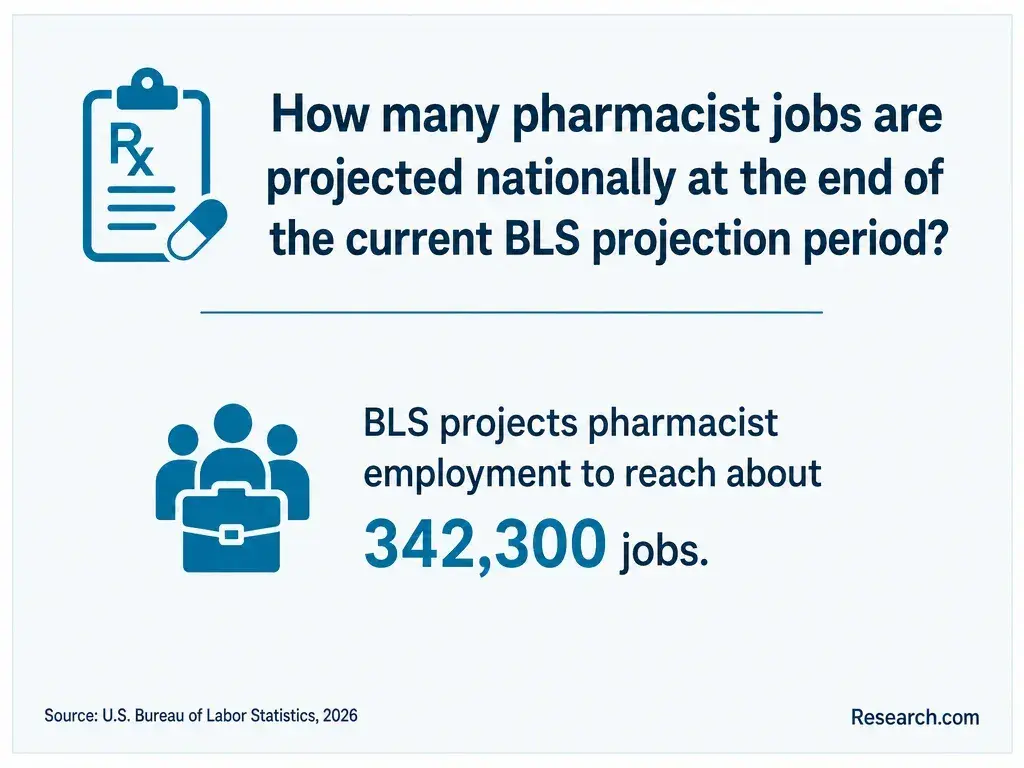
The Bureau of Labor Statistics projects 5% growth for pharmacists from 2025 to 2035. That is an outlook for the broad occupation, not a forecast of BCPS-specific openings. A pharmacist targeting a narrow clinical role should therefore examine actual postings for required experience, residency preferences, and certification expectations.
BCPS is less relevant if your goal is a pharmacy-adjacent job that does not require pharmacist licensure. In that case, compare the time and requirements of the pharmacist route with doctoral degree timeline options only after confirming which credential employers seek. A shorter doctorate does not qualify its holder to practice as a pharmacist.
The Bureau of Labor Statistics reports median annual pay of $140,910 for pharmacists in May 2025. It does not publish a separate BCPS median, so that figure cannot establish a certification pay premium or predict an individual offer. Compensation can differ by employer, location, responsibilities, schedule, and experience.
Assess the financial decision against a real alternative: compare offers for positions you could obtain with and without BCPS, including any employer support for fees and study time. If you are still choosing a Pharm.D., pharmacy program value and duration matters more than assuming certification will repay additional tuition. Residency stipends and time away from full pharmacist earnings also belong in that comparison.
How do you choose an accredited pharmacy program for BCPS preparation?
Choose a Pharm.D. program that can support the first steps toward your intended practice, not one that advertises a shortcut to BCPS. Verify the professional program's current ACPE status, then compare clinical curriculum, introductory and advanced pharmacy practice experiences, licensure preparation, published outcomes, and total cost. An online or hybrid format still requires attention to hands-on training, placement logistics, and any campus attendance.
Use these questions to test whether a program supports the clinical opportunities you need and whether its cost and schedule are workable.
- What is the program's current ACPE professional accreditation status, and what are its published NAPLEX outcomes?
- Who arranges or approves clinical rotations, and could required sites involve travel, housing, or time away from work?
- Which rotations expose students to broad pharmacotherapy, and what support is available for residency applications or clinical job searches?
- What is the full expected cost, including fees and required in-person activities, and which prerequisite courses will the school accept?
If you have prior college coursework, investigate pharmacy programs that accept transfer credits, but obtain a school-specific evaluation. Acceptance of prerequisite credit does not mean credit will transfer into the professional Pharm.D. curriculum. No school can promise eventual residency placement, licensure, or BCPS eligibility; your later training and practice must also meet BPS rules.
Other Things You Should Know About PharmD
No. Wait until BPS confirms that you have earned certification and follow its rules for using the designation.
Because an active pharmacist license is part of BPS eligibility, address a lapse promptly. Check BPS policies and your state board's reinstatement rules rather than assuming certification remains unaffected.
No. A BPS credential does not replace a pharmacist license in a jurisdiction where you intend to practice. Check that jurisdiction's board requirements.
Potentially, yes. Each BPS credential has its own eligibility, examination, maintenance, and recertification requirements, so pursue an additional specialty only if it matches your practice and career goals.
- Domains of the Subject Matter Requirements | ca.gov https://docs.ctc.ca.gov/Document/Download/30671
- Board Certified Pharmacotherapy Specialist (BCPS) | osd.mil https://www.cool.osd.mil/usn/credential/index.html
- CE FAQ | Pharmacists - Texas State Board of Pharmacy https://www.pharmacy.texas.gov/licensees/ce-pharmacist-faq.asp
- Candidate's Guide | bpsweb.org https://bpsweb.org/candidates-guide/
- BCPS Application Process 2026: Step-by-Step Guide | BCPS Exam Prep https://bcpspharmexam.com/blog/bcps-application-process-2026-step-by-step-guide