PharmD Programs That Waive the PCAT for the Current Cycle

Co-Founder and Chief Data Scientist
If you are looking for a Pharm.D. program that waives the PCAT, an old "PCAT optional" list may lead you in the wrong direction. The Pharmacy College Admission Test was retired in January 2024, so the useful decision is no longer which schools waive an available exam.
It is which Doctor of Pharmacy programs are accepting applicants in your cycle and meet your requirements for prerequisites, cost, location, and clinical training. This guide identifies programs to investigate and shows you how to confirm their current rules before you spend time or money applying.
Key Things You Should Know
- The PCAT was retired in January 2024; applicants cannot take it for the current admissions cycle. Check whether a school considers previously earned scores rather than looking for a new-test waiver.
- A PCAT-free application is not an admission shortcut: prerequisite courses, grades, interviews, and other requirements remain school-specific.
- Before applying, confirm the program's current admissions listing and ACPE status, then compare total costs and clinical-placement obligations - not just its testing policy.
Which PharmD programs waive the PCAT for current applicants?
"PCAT waiver" is now largely an outdated search term. The exam is no longer offered, so no applicant can submit a newly earned PCAT score. The programs below are established U.S. Pharm.D. programs to investigate without planning to take the test. This is a starting list, not confirmation that each school has an open seat, a particular deadline, or identical rules on historical scores in your application cycle.
Use the same checks for every school: its current PharmCAS directory entry or direct-application instructions, its own admissions page, and its ACPE record. The locations below help narrow the list before you compare program-specific requirements.
| Pharm.D. program to investigate | Location | Current-cycle decision to confirm |
| University of Florida College of Pharmacy | Gainesville, Florida | Application route, prerequisite rules, and deadlines |
| UNC Eshelman School of Pharmacy | Chapel Hill, North Carolina | Application route, prerequisite rules, and deadlines |
| University of Michigan College of Pharmacy | Ann Arbor, Michigan | Application route, prerequisite rules, and deadlines |
| University of Pittsburgh School of Pharmacy | Pittsburgh, Pennsylvania | Application route, prerequisite rules, and deadlines |
| University of Minnesota College of Pharmacy | Minnesota | Campus options, application route, and deadlines |
Do not interpret inclusion as a recommendation or an admission guarantee. If your academic record or work history is less conventional, compare these candidates with pharmacy programs for nontraditional applicants, then obtain a school-specific prerequisite review. A program that accepts your coursework may be a better choice than one with a more familiar name.
Is the PCAT required for admission to PharmD programs?
No applicant can take the PCAT now: its final administration was in January 2024. That makes "PCAT not required," "PCAT optional," and "PCAT waived" materially different from what those phrases meant when the test was available. A school may still describe how it treats an older score, but you should not delay an application to prepare for a new PCAT sitting.
Instead, determine whether the program evaluates applicants through PharmCAS - the centralized pharmacy-school application service - or through its own process. Then check whether it requires a supplemental application, interview, recommendations, or other assessments. PharmCAS participation does not make those school-level rules uniform.
If you are missing a requirement, look into pharmacy programs with alternative entry pathways, but get written confirmation of which requirements may be completed later. "Apply with a course in progress" does not necessarily mean "enroll without completing it."
What are the admission requirements for PCAT-free PharmD programs?
Removing the PCAT does not remove academic screening. Schools commonly evaluate prerequisite coursework, transcripts, grades, recommendations, and interviews; the exact requirements and their relative importance vary. Some admit students after specified undergraduate prerequisites without requiring a completed bachelor's degree. Others offer different entry pathways. A published minimum GPA or grade is an eligibility threshold, not a prediction of admission.
Before paying an application fee, compare each school against your actual transcript. This is particularly important if you are considering an online Pharm.D. for students with prior science study: substantial science coursework may satisfy some prerequisites without automatically satisfying all of them. Ask admissions to distinguish an informal review from an official course-equivalency decision.
For each candidate, record the application deadline, required materials, minimum grades, interview format, and date by which unfinished prerequisites must be completed. Check the school's instructions directly even when you also use PharmCAS; a missing supplemental step can leave an otherwise complete application ineligible for review.
The Accreditation Council for Pharmacy Education (ACPE) accredits professional pharmacy education programs; it does not license pharmacists. Check ACPE's current professional-program directory for the institution, exact Pharm.D. program, and listed accreditation status. If a school advertises a new campus, pathway, or delivery format, ask how that option relates to the accredited professional program rather than assuming every similarly named offering is covered in the way you expect.
Use this sequence before paying a deposit:
- Find the exact program in ACPE's professional-program records and read its current status.
- Match the school's published curriculum and location or pathway to the option you intend to enter.
- Ask the school and your intended state board whether that pathway meets the educational requirements relevant to licensure; check distance-education authorization separately if you will study from another state.
Institutional accreditation, ACPE professional-program accreditation, permission to enroll an online student in a state, and eligibility for that state's pharmacist license answer different questions. Check all applicable ones even if you are prioritizing an affordable route to a Pharm.D.; a lower advertised price cannot resolve a missing approval or placement problem.
Prerequisites are undergraduate, pre-professional courses completed before the professional Pharm.D. curriculum. Programs commonly specify science courses such as chemistry and biology, often with labs, alongside mathematics, writing, or other general education. The required subjects, credit totals, accepted substitutes, minimum grades, and rules for older coursework are set by each school - not by a nationwide PCAT-waiver standard.
If you already have college credits, a course title alone may not establish equivalence. Ask the receiving program to evaluate laboratory format, course level, quarter-to-semester conversion where relevant, and any AP, IB, community-college, online, international, repeated, or military coursework you plan to use. Pharmacy school credit transfer options are worth comparing, but acceptance toward an undergraduate prerequisite is different from transfer into the professional Pharm.D. curriculum. The receiving school decides how prior credit applies.
A PCAT waiver does not shorten the degree. Students generally complete required pre-professional coursework first and then enter a sequenced professional Pharm.D. curriculum. Professional programs commonly run four academic years, while some accelerated pathways use a different calendar. Your total time depends on what prerequisites you have finished, when you can enter, and the program's actual course and rotation schedule.
When comparing an accelerated option with a conventional calendar, ask for a term-by-term plan showing breaks, required attendance, and clinical rotations. A shorter calendar may leave less time for paid work or prerequisite catch-up. General comparisons of online doctoral program duration should not be used to estimate a professional Pharm.D. timeline: pharmacy training includes supervised, in-person practice that cannot be inferred from an unrelated doctorate.
The professional curriculum builds from pharmaceutical and biomedical science into medication therapy, patient assessment, communication, drug information, and safe medication use. Students also complete supervised experiential education. Introductory pharmacy practice experiences (IPPEs) introduce practice settings; advanced pharmacy practice experiences (APPEs) involve more sustained clinical and operational responsibilities later in the program. These are distinct from undergraduate prerequisites and from pharmacist licensure after graduation.
Experiential obligations matter when you compare whether you can complete a Pharm.D. on an accelerated schedule. Ask who arranges and approves sites, which rotations may require travel or time away from work, and whether you must obtain intern registration, immunizations, background checks, or other site clearances. A nearby placement or substitution of your current pharmacy job should not be assumed unless the program confirms it.
Some Pharm.D. pathways deliver portions of instruction online, and applicants to them likewise cannot take a new PCAT. "Online" does not necessarily mean asynchronous, self-paced, or fully remote. A pathway may require live classes, scheduled assessments, hands-on campus sessions, and in-person IPPEs and APPEs. Those requirements can make it difficult to maintain an unrestricted full-time work schedule.
Compare the published schedule, campus attendance, clinical-site approval process, and authorization to enroll students where you live before comparing best online Doctor of Pharmacy programs. Ask separately whether your intended state permits the school to enroll you and whether its education and supervised experience will support your planned licensure application. Neither answer follows automatically from the other.
A Pharm.D. is an education credential, not a pharmacist license. For U.S.-educated applicants, state boards set licensure requirements that generally include qualifying education, required practical experience, the North American Pharmacist Licensure Examination (NAPLEX), and any applicable law examination or other state requirements.
Do not assume every jurisdiction uses the Multistate Pharmacy Jurisprudence Examination (MPJE): jurisdictional requirements vary, and some began transitioning to the Uniform Multistate Pharmacy Jurisprudence Examination (UMPJE) in 2026. Check the board where you plan to practice and the National Association of Boards of Pharmacy's current exam instructions.
Passing an exam does not itself issue a license; the state board must approve the application. Internationally educated pharmacists may face a separate credential-evaluation and certification pathway before state licensure. Nor does a shorter credential identified in a guide to online pharmacy education duration substitute for the professional degree required for the usual U.S.-educated pharmacist route. Pharmacy technician training prepares people for a different occupation.
What careers, salaries, and job outlook can PharmD graduates expect?
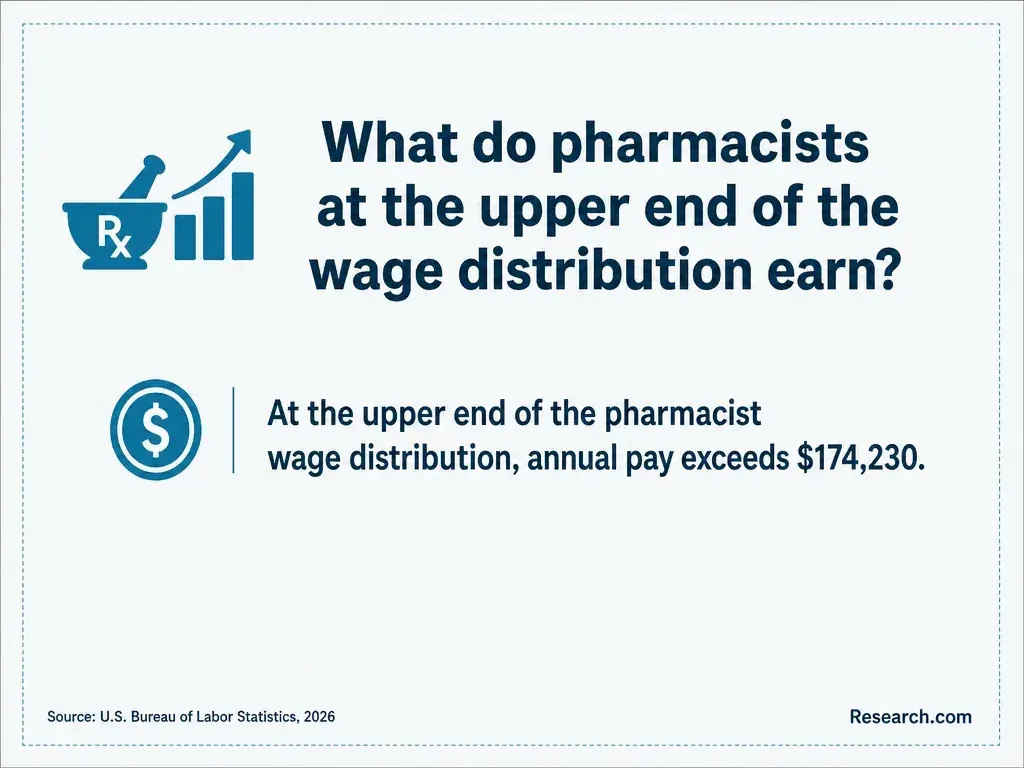
Licensed pharmacists work in community pharmacies, hospitals, health systems, ambulatory care, and other settings. The Bureau of Labor Statistics reports median annual pay of $140,910 in May 2025 for pharmacists and projects 5% job growth, 2025-2035. These occupation-wide figures are context, not an expected starting salary or a forecast for any particular Pharm.D. graduate, location, or specialty.
Residency training can support entry into some clinical roles; fellowships often emphasize a different training focus, such as industry work. Neither is universally required for pharmacist employment. Specialty board certification is also distinct from state licensure, with eligibility rules set by the relevant certifying body.
To judge value, compare pharmacy degree costs and duration using each school's current tuition and required fees alongside prerequisite expenses, supplies, rotation travel, and potential time away from work. Confirm your own aid eligibility and current federal borrowing rules rather than assuming older graduate-loan options still apply. Choose a program whose admissions requirements you can meet and whose training, location, and likely total cost support your intended licensure and career plans.
Other Things You Should Know About PharmD
Not at every school. Check each program's current policy to see whether experience is required, recommended, or simply one way to demonstrate understanding of the profession.
Yes, provided you follow each program's application instructions and deadlines. Budget for any separate application or supplemental fees before building a long list.
They may. Admission to a Pharm.D. program does not automatically establish eligibility for a second degree; ask how and when applicants are selected for each component.
Usually, but review the next cycle's instructions and ask whether the program offers feedback. Strengthening missing coursework or other identified weaknesses is more useful than resubmitting an unchanged application.
- PharmD FAQs - UNC Eshelman School of Pharmacy https://pharmacy.unc.edu/education/pharmd/pharmd-admissions-faqs/
- Doctor of Pharmacy (PharmD) - Prospective Students https://www.pharmacy.umaryland.edu/academics/pharmd/prospective-students/
- Admissions Frequently Asked Questions and Tips | ucsf.edu https://pharmd.ucsf.edu/admissions/faq-tips
- FAQ | OSU College of Pharmacy - Oregon State University https://pharmacy.oregonstate.edu/programs-admissions/pharm-d/faq
- PharmD Application Process | pitt.edu https://www.pharmacy.pitt.edu/academics/doctor-pharmacy/apply-pharmd-program/pharmd-application-process
- PharmD Application Process and Requirements | umich.edu https://pharmacy.umich.edu/pharmacy-programs/pharmd-program/application-process-requirements/
- CU Pharmacy implements changes designed to streamline the admissions process https://news.cuanschutz.edu/pharmacy/student-perspectives/pcat-no-longer-required-cu-pharmacy-implements-changes-designed-to-streamline-the-admission-process
- Admission Requirements | ufl.edu https://admissions.pharmacy.ufl.edu/steps-to-apply/application-requirements/
- PharmCAS Program User Guide - Liaison International https://help.liaisonedu.com/WebAdMIT/Getting_Started/CAS_Program_User_Guides/PharmCAS_Program_User_Guide
- Pharmacy College Admission Test | AACP https://www.aacp.org/resource/pharmacy-college-admission-test