
How to verify an online PharmD meets state education rules

Co-Founder and Chief Data Scientist
An online Doctor of Pharmacy (Pharm.D.) may let you complete some coursework from home, but that does not establish that the degree meets the rules where you want to practice. For prospective U.S. pharmacy students, the costly mistake is enrolling before checking the professional program, required in-person training, and the intended licensing state separately. This guide shows you which records to inspect, which questions to put in writing, and when a program's answer is not enough to make enrollment a sound decision.
Key Things You Should Know
- Verify the specific Pharm.D. program in ACPE's program directory; institutional accreditation and permission to enroll online students are separate checks.
- Ask your intended state board whether the program's education and supervised experience satisfy its rules, then confirm where you can complete required in-person rotations.
- A Pharm.D. is not a pharmacist license: graduates must also meet board requirements, including the NAPLEX and any applicable jurisprudence exam.
What Makes an Online Pharmd Program Valid for State Licensure?
For a U.S.-educated applicant, the essential education check is whether the specific professional Pharm.D. program has an Accreditation Council for Pharmacy Education (ACPE) status acceptable to the intended state board. The applicant must also complete required supervised experience and the board's remaining licensing steps. Online delivery does not remove those requirements.
Keep three approvals distinct: ACPE evaluates the professional pharmacy program; an institutional accreditor evaluates the college or university; and state authorization concerns whether the institution may offer distance education to a student in a particular state. Authorization to enroll is not a determination that the degree qualifies its graduate for pharmacist licensure there. Compare online Pharm.D. pathways for future pharmacists on these separate points rather than relying on an "online accredited" label.
Before applying, identify where you expect to study, complete rotations, and seek your first license. Those may be different states, with different rules and approvals.
Is an Online Pharmd Program Accredited by ACPE?
Some Pharm.D. programs with online coursework have ACPE accreditation, but the word "online" does not establish a program's status. Search ACPE's official professional-program directory for the school and its Pharm.D. program. Read the current status and any notes rather than treating an institution-wide accreditation claim as confirmation.
Check that the credential is a professional Pharm.D., not a pharmacy technician program, a pharmaceutical sciences doctorate, or a postgraduate nonprofessional degree. Even short doctoral degree completion options in related fields do not substitute for the professional pharmacy education required of U.S.-educated pharmacist applicants.
If the program is new or its status is unclear, ask its accreditation office for the exact program name and status, then confirm that information directly in ACPE's records and with your intended board. Do not infer future approval from a school's plan to seek accreditation.
How Do You Check State-Specific Pharmacist Education Requirements?
Start with the board of pharmacy for the state where you intend to seek your initial pharmacist license. Its current application instructions and statutes or regulations—not a school's general statement that graduates are "licensure eligible"—control your application. If the wording is unclear, request an answer from the board that addresses your exact program and circumstances.
Use this sequence to turn broad eligibility language into a decision you can document:
- Find the board's pharmacist-by-examination requirements and note its rules for an accredited professional degree, intern registration, supervised hours, and examinations.
- Tell the board the school's exact Pharm.D. program name, its ACPE status, your location, and any planned out-of-state rotations; ask whether any additional education or experience rule applies.
- Ask the school whether it can enroll a student in your state and separately whether its proposed in-state clinical placements are permitted and available.
- Save dated board guidance, program disclosures, and written replies; check them again before paying a nonrefundable deposit or arranging rotations.
Admission flexibility is not licensure flexibility. A school may consider applicants with prerequisites still in progress; pharmacy programs before all requirements are complete still must enforce their conditions for matriculation and graduation, while the board applies its own licensing rules.
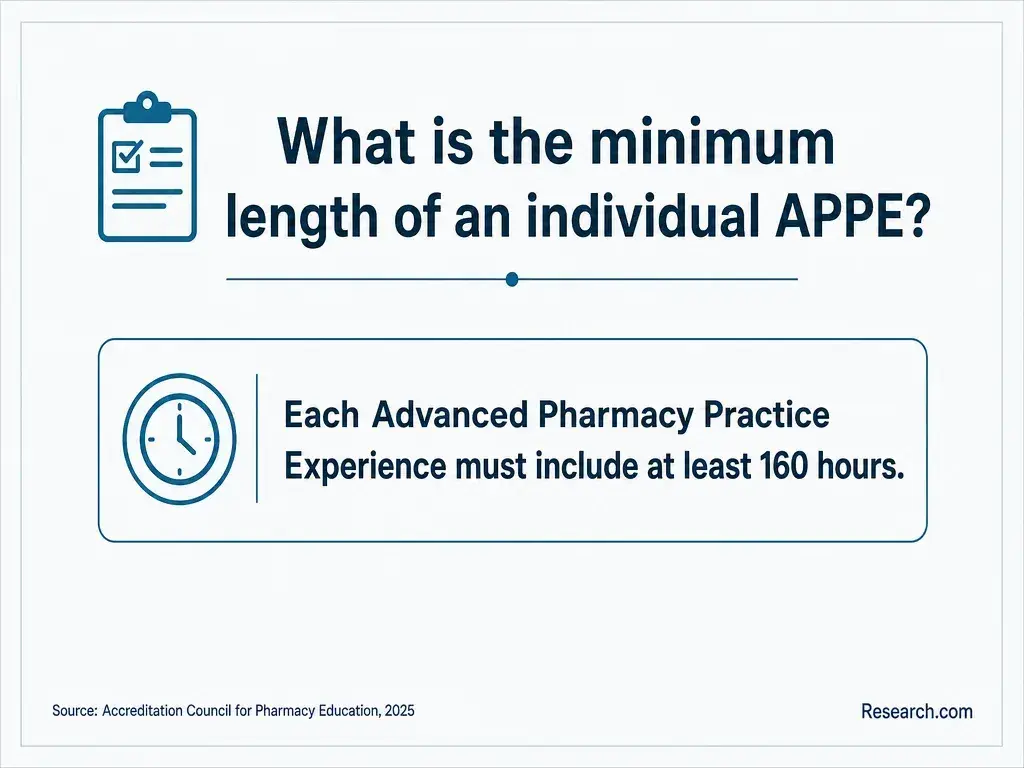
An ACPE-accredited professional Pharm.D. includes supervised experiential education. Introductory pharmacy practice experiences (IPPEs) develop early practice skills; advanced pharmacy practice experiences (APPEs) are later, more intensive rotations. Online lectures do not turn either into a fully remote requirement. Programs may also require campus visits, hands-on labs, or in-person assessments.
Ask the experiential education office—not just admissions—who secures sites and preceptors, whether placements near your home are possible, and what happens if a site is unavailable. Confirm the rotation calendar, attendance expectations, travel or temporary housing needs, and whether you need intern registration, immunizations, or a background check in each placement state. A job in a pharmacy should not be assumed to replace a rotation.
That scheduling constraint matters if you are comparing quickest online pharmacy study routes: a short pharmacy-related credential is not a shortcut around professional Pharm.D. clinical requirements.
The North American Pharmacist Licensure Examination (NAPLEX) assesses knowledge for pharmacist licensure. Applicants must follow the intended board's eligibility and application process and the National Association of Boards of Pharmacy (NABP) examination procedures. Passing the NAPLEX alone does not issue a license.
Check the board's current jurisprudence requirement as well. Depending on the jurisdiction, applicants may face the Multistate Pharmacy Jurisprudence Examination (MPJE), the Uniform MPJE (UMPJE), a different state-law assessment, or no separate jurisprudence exam. UMPJE adoption began in some jurisdictions in 2026; do not register for an exam based on another state's requirements. Boards may also require completed supervised experience and other application materials.
Prior science education does not waive this licensing sequence. A reader considering pharmacy school for biology and chemistry graduates should verify both admission credit and the requirements that will apply after the Pharm.D.
Requirements belong to the individual school. Compare its current admissions page and, if it uses the service, its current PharmCAS listing for prerequisite courses and labs, minimum grades, GPA rules, application materials, interviews, deadlines, and any conditions that must be met before classes begin. Some schools require a specified set of undergraduate prerequisites rather than a completed bachelor's degree.
Pre-pharmacy courses are preparation for admission, not the professional Pharm.D. curriculum. Ask how the school evaluates online labs, community-college work, older courses, repeated courses, and previously earned credits; the receiving school decides what applies. Use a pharmacy school prerequisites comparison to form questions, not as a substitute for the school's current policy. The Pharmacy College Admission Test (PCAT) was retired in January 2024 and is not a currently available admissions exam.
Time depends on how many prerequisites you have finished, the program's fixed professional-course sequence, and its rotation schedule. "Online" does not necessarily mean self-paced: live classes, campus sessions, and full-time clinical placements can limit paid work. Request a term-by-term plan for your own starting credits rather than relying on an advertised shortest completion time.
For cost, compare the school's published tuition and required fees for your entry term with a written estimate of expenses that may not appear in tuition: prerequisite courses, technology, campus travel, rotation travel or housing, screening and immunizations, and licensing exams. A lower advertised price may cost more for a student who must relocate for placements. When reviewing online Doctor of Pharmacy tuition, make sure figures cover comparable academic years and the same portion of the degree.
Ask the financial aid office for an individualized aid-year estimate. Federal borrowing rules changed for many new graduate and professional borrowers beginning July 1, 2026, so do not assume a prior student's loan limits or Grad PLUS access apply to you.
For ACPE-accredited professional programs, the delivery format changes how students participate, not the need to develop pharmacy knowledge, patient-care skills, and supervised practice experience. An online or hybrid program may combine remote coursework with scheduled live sessions, in-person skills training, and IPPEs and APPEs. A campus program concentrates more scheduled learning on site, but its students also complete experiential education.
To compare two programs fairly, inspect their current course sequences and calendars: which sessions require attendance, where hands-on assessments occur, and whether the rotation schedule fits your location and work commitments. If you hope to transfer courses into a pharmacy degree, obtain a school-specific evaluation; acceptance of undergraduate prerequisites does not mean professional Pharm.D. courses will transfer or shorten the sequence.
After meeting state licensure requirements, a graduate of an eligible Pharm.D. program may pursue pharmacist positions in community, hospital, ambulatory, or other settings, subject to employer requirements. The U.S. Bureau of Labor Statistics reports median annual pay of $140,910 in May 2025 for pharmacists and projects 5% growth, 2025-2035, with about 12,500 openings per year. Those occupation-wide figures are not a forecast for graduates of an online program or for a particular specialty or location.
Some roles favor postgraduate training. A residency is supervised practice training; a fellowship generally emphasizes a particular professional or research path; board certification is a separate specialty credential. None replaces a state pharmacist license, and none is required for every pharmacist job.
If your goal is a pharmacy-adjacent role rather than pharmacist practice, compare the actual credential required before committing to a Pharm.D. Some lower-cost online pharmacy degree programs may support different careers, but they do not independently qualify someone for pharmacist licensure.
How Can You Verify an Online PharmD Program Before Enrolling?
Make a file for each program and record the answer, its source, and the date checked. The following checks are most useful before a deposit, move, or work-schedule change:
- Match the exact professional Pharm.D. program and its current status to ACPE's official directory; check institutional accreditation separately.
- Read the intended board's initial-licensure rules and obtain clarification about the degree, supervised experience, and exams if your circumstances are not clearly covered.
- Get written confirmation of distance-education authorization for your location and a separate answer about proposed rotation states and sites.
- Request the actual course and clinical calendar, campus-visit requirements, placement responsibilities, and a full cost estimate for your starting term.
- Compare written answers with official records. Pause if the school promises a fully remote professional degree, guarantees local rotations or licensure, or cannot identify its exact ACPE program status.
Finally, check pharmacy doctorate program length against your documented prerequisite evaluation and rotation calendar. Enroll only when the education pathway, practical schedule, likely total cost, and intended board's requirements align.
Other Things You Should Know About PharmD
It may strengthen an application, but it does not automatically replace professional coursework or required rotations. Ask the school how it evaluates prior experience.
Licensure does not automatically follow you. Check the destination board's license-transfer or new-application process before moving or accepting a position.
Not automatically. Internationally educated pharmacists should ask the intended board which foreign-graduate or U.S. professional-degree pathway applies before enrolling.
Yes. Retain transcripts, rotation documentation, intern-registration records, and licensing correspondence. A board may request evidence during your first application or a later license-transfer application.
- Pharmacists - Texas State Board of Pharmacy https://www.pharmacy.texas.gov/consumer/broch5.asp
- State Licensure Requirements for Students Seeking... - PMC https://pmc.ncbi.nlm.nih.gov/articles/PMC5135425/
- GAC - Chapter 480-2 LICENSURE AS A PHARMACIST https://rules.sos.ga.gov/gac/480-2
- Application Process Transparency - Pharmacist License | Louisiana Board of Pharmacy https://www.pharmacy.la.gov/page/application-process-transparency-pharmacist-license
- Accreditation - Texas A&M College of Pharmacy https://pharmacy.tamu.edu/about/acpe-self-study.html
- Licensure Notice - Fisher Pharm.D. Online | SJF-PHA https://onlinepharmd.sjf.edu/legal/licensure/
- Experiential Education | Washington State University https://pharmacy.wsu.edu/pharmd/experiential-services/
- Experiential Learning Manual - School of Pharmacy https://www.pharmacy.pitt.edu/experiential-learning-manual
- PharmD Remote Pathway | CU School of Pharmacy https://pharmacy.cuanschutz.edu/degreesandprograms/pharmd/remote-pharmd
- Can You Really Earn a Pharm.D. Online? Here's What to Expect - Lake Erie College of Osteopathic Medicine https://lecom.edu/can-you-really-earn-a-pharm-d-online-heres-what-to-expect/


