Pharm.D. Application Timeline for a September Start

Co-Founder and Chief Data Scientist
A September Pharm.D. start requires decisions well before September: which schools accept your coursework, when their applications close, and whether you can finish remaining requirements on time. This guide is for prospective U.S. pharmacy students planning an upcoming fall entry.
This article maps the application cycle, separates PharmCAS deadlines from school-specific deadlines, and shows what to verify before paying fees or accepting an offer. Use it to build a workable schedule rather than assuming every pharmacy school follows the same calendar.
Key Things You Should Know
- For a September 2027 start, begin checking programs and prerequisites in 2026; as of October 2026, confirm each school's live application deadline immediately because some admissions decisions are made on a rolling basis.
- A PharmCAS submission is not necessarily a complete application: transcripts, recommendations, supplemental materials, interviews, and unfinished prerequisites can have separate deadlines.
- Choose a program only after confirming its ACPE professional-program status, total cost, clinical-placement expectations, and the licensure rules of the state where you intend to practice.
When should you start applying to PharmD programs for a September start?
Start planning roughly a year before enrollment, then work backward from each program's published deadlines. For a September 2027 target, that means checking current admissions pages now rather than waiting until spring 2027. Many programs begin classes in August even when applicants describe their goal as a "September start," so confirm the actual orientation and first-day dates.
The following sequence is a planning tool, not a universal PharmCAS calendar. Adjust it to the earliest deadline among the schools on your list.
- About 12 months before entry: Shortlist programs, request a course-by-course prerequisite review if available, and identify courses that must be finished before matriculation.
- Fall through winter: Assemble transcripts, request recommendations early, prepare school-specific materials, and submit once your application is accurate and complete enough for the schools' policies.
- Winter through spring: Attend interviews, monitor application portals, finish in-progress coursework, and compare offers and deposit deadlines.
- Spring through summer: Send required final transcripts and complete the selected school's enrollment, health, background-check, and intern-registration requirements.
If you are considering accelerated pharmacist education, check its entry term and sequencing separately. A shorter professional curriculum does not automatically mean a later application deadline or fewer prerequisites.
What are the key PharmCAS deadlines for September PharmD enrollment?
PharmCAS is the centralized application service used by many, but not all, U.S. Pharm.D. programs. Its cycle dates and processing rules differ from a school's own application deadline. For September 2027 enrollment, use the current PharmCAS directory and each school's admissions page as the controlling calendar; do not rely on a prior cycle's date.
This table separates the deadlines applicants most often confuse. The distinction matters because meeting one date may still leave your file incomplete for admission review.
| Deadline or milestone | Who sets it | Why it matters |
| PharmCAS cycle availability | PharmCAS | Determines when applicants can work in and submit through that cycle. |
| Program application deadline | Individual school | Determines when that school stops accepting applications; policies on submitted versus complete files can differ. |
| Supplemental materials and interview | Individual school | May have separate instructions and deadlines outside the main PharmCAS form. |
| Final transcript and prerequisite completion | Individual school | May be required after an offer but before enrollment. |
Allow time for transcript delivery, recommendation writers, and PharmCAS processing. If a deadline is close, ask the school whether it requires submission, receipt of all materials, or verification by that date. Applicants still finishing courses can explore pharmacy program preparation requirements, but the school, not the application service, decides which requirements may remain in progress.
What are the admission requirements for a September-start PharmD program?
Requirements vary by school and pathway. Common application components include undergraduate transcripts, specified prerequisite courses, recommendations, an interview, and evidence of communication, service, or pharmacy-related experience. A bachelor's degree is not universally required; some schools admit applicants who have completed their specified pre-professional coursework without one.
Read each school's minimum GPA, course-grade, laboratory, and coursework-age rules alongside its selection criteria. A minimum is an eligibility threshold, not a prediction of admission. The Pharmacy College Admission Test (PCAT) was retired in January 2024, so it is not a current exam applicants can plan to take. When comparing pharmacy schools with accessible admissions, prioritize published eligibility rules and your academic fit over an unsupported promise of easy acceptance.
The process begins with school selection, not form submission. First determine whether each target program uses PharmCAS or its own application, then follow that program's instructions through enrollment.
Use this checklist to keep the major stages separate and prevent a submitted application from becoming an incomplete one.
- Match schools to your record: Compare prerequisites, entry term, location, format, accreditation status, and application route.
- Prepare materials: Arrange transcripts and recommendations, document experiences accurately, and complete required statements or supplemental forms.
- Submit and monitor: Check PharmCAS and school portals for missing items, processing updates, and interview invitations.
- Evaluate offers: Compare written conditions, tuition and aid information, deposit terms, and the deadline to accept each place.
- Clear enrollment conditions: Finish required courses and submit final records, then complete any health, screening, or intern-registration steps the school and jurisdiction require.
Prior college credit does not automatically become credit in the professional curriculum. If you are seeking pharmacy school transfer admission, request a written evaluation from the receiving school; transfer into an existing Pharm.D. cohort can follow different rules from applying with undergraduate prerequisites.
Prerequisites are undergraduate, pre-professional courses taken before the professional Pharm.D. curriculum. Schools commonly specify sciences, mathematics, and general education, but the exact courses, labs, credits, acceptable substitutions, minimum grades, and completion dates are school-specific. Do not assume a biology major, chemistry major, or bachelor's degree automatically satisfies them.
For each school, compare your transcript against its current prerequisite list and get clarification on courses with different titles. Ask whether in-progress courses are allowed at application, whether summer completion is permitted before matriculation, and how the school treats AP or IB credit, community-college work, online labs, repeated courses, and older coursework. The receiving school decides how previous credit applies.
Applicants who want to build on prior biology or chemistry coursework should identify gaps early enough to schedule any required lab sequence before the enrollment deadline.
After prerequisites, a traditional professional Pharm.D. curriculum commonly takes four academic years; accelerated programs may use a shorter, more intensive calendar. A program's advertised length does not include missing prerequisites, and a faster schedule may reduce opportunities to earn income during breaks. Compare actual start and graduation dates rather than treating all "three-year" or "four-year" labels as equivalent. Broader doctoral degree length comparisons should not substitute for checking a Pharm.D. program's required clinical training.
Costs are school- and residency-dependent, so request a cost-of-attendance estimate for your entry year. Compare tuition and mandatory fees alongside prerequisite courses, books and software, equipment, immunizations and screening, campus travel, clinical-rotation travel or housing, and eventual licensure expenses. A lower tuition quote may not mean a lower total cost.
Ask the financial aid office which federal loan rules apply to your particular entry cohort. Federal borrowing rules changed for many new graduate and professional borrowers beginning July 1, 2026; do not build a budget around an older Grad PLUS assumption or an unverified borrowing limit.
Some U.S. Pharm.D. programs offer online or hybrid instruction, but "online" does not mean fully remote, self-paced, or compatible with unrestricted full-time work. Programs can require scheduled live classes, on-campus labs or assessments, and in-person introductory and advanced pharmacy practice experiences, known as IPPEs and APPEs. Availability for a September start depends on the specific program's current cohort calendar.
When reviewing top online pharmacy doctorate programs, ask for the required campus dates and a sample weekly schedule. Also ask who arranges and approves clinical sites, whether placements can be near home, and what travel, intern registration, and state restrictions may apply. Distance-delivery authorization, clinical-placement permission, and eventual pharmacist licensure eligibility are separate questions.
Check the specific professional Pharm.D. program in the Accreditation Council for Pharmacy Education (ACPE) program records, including its current status and any relevant conditions. Institutional accreditation concerns the university as a whole; it is not a substitute for ACPE professional-program accreditation. If studying at a distance, separately confirm that the school can enroll you in your state and arrange any required in-person training there.
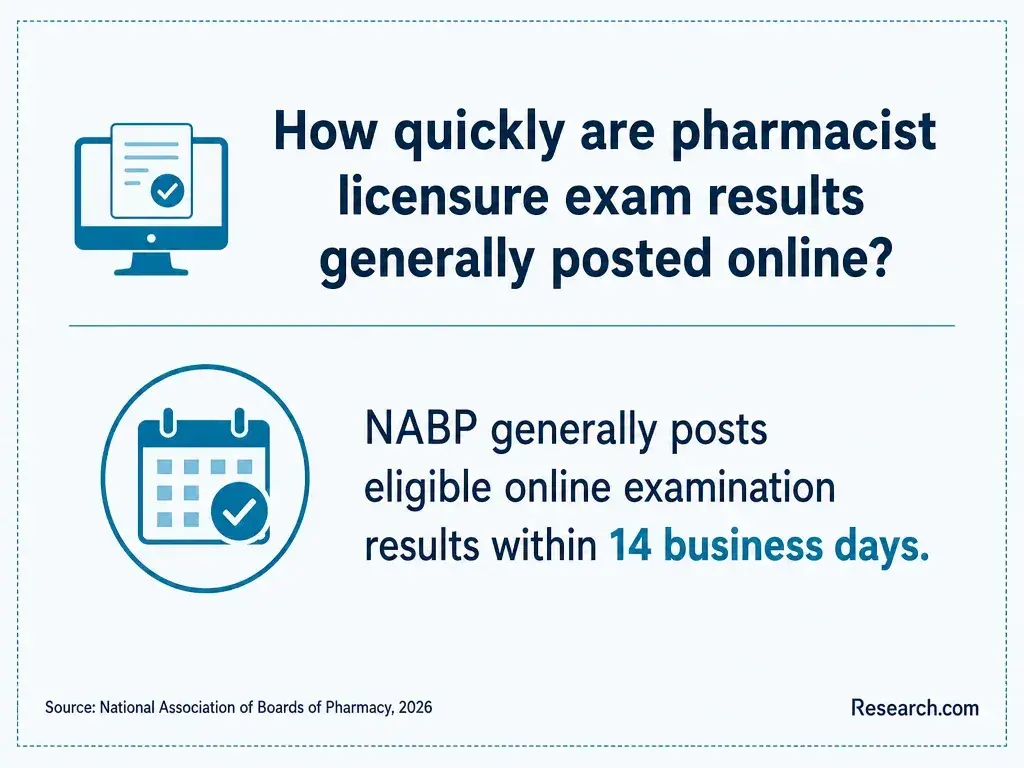
Before committing, consult the pharmacy board in the state where you intend to seek a license about education, intern experience, examinations, and application requirements. The North American Pharmacist Licensure Examination (NAPLEX) is part of the U.S. pharmacist licensing process, but a jurisdiction's law exam requirements differ; do not assume every state uses the MPJE, particularly as some jurisdictions transitioned to the UMPJE beginning in 2026. Graduation or passing an exam alone does not issue a license.
Be especially cautious of online pharmacy degree time to completion claims: a short pharmacy-related degree may be a different credential, not an initial professional Pharm.D. that meets the education requirements for U.S. pharmacist licensure.
After meeting state licensure requirements, pharmacists may work in community, hospital, ambulatory care, specialty pharmacy, industry, or other settings. Entry requirements differ: some roles hire newly licensed pharmacists, while competitive clinical positions may prefer postgraduate residency training. A residency or fellowship is distinct from state licensure, and optional specialty board certification follows its own eligibility rules.
The U.S. Bureau of Labor Statistics reports median annual pay of $140,910 in May 2025 for pharmacists and projects 5% growth for 2025-2035, with about 12,500 openings per year. These are occupation-wide figures, not a starting salary, a specialty-specific forecast, or a guaranteed return on a Pharm.D. For an investment decision, compare your likely debt and time out of the workforce with realistic local opportunities rather than relying on the national median alone. That is more useful than assuming pharmacy program value and duration can be judged by program length alone.
How do you choose the best PharmD program for your goals?
Choose among programs that you can actually enter on schedule and that support your intended licensing state. A September target is useful only if you can meet the school's prerequisite, application, enrollment, and clinical-training conditions without an avoidable delay.
Use the following final checks before paying a nonrefundable deposit. They focus on differences that can change both your start date and your total investment.
- Calendar: Confirm the real first day, the application and deposit deadlines, and the last acceptable date for prerequisite completion.
- Eligibility: Obtain the school's assessment of questionable credits and confirm its current ACPE status and your intended state's licensing requirements.
- Practical fit: Compare class schedules, required campus visits, clinical-placement support, and possible travel or time away from work.
- Financial fit: Compare written cost estimates and your actual aid eligibility, including the effect of the 2026 federal borrowing changes on your cohort.
If two schools are otherwise similar, favor the one with a feasible prerequisite plan, clearer placement logistics, and a sustainable financing plan - not simply the earliest offer. Use pharmacy doctorate financial planning to frame cost questions, then verify every program-specific figure directly with the school.
Other Things You Should Know About PharmD
Yes. Applying to several programs can give you options, but track each school's separate requirements, fees, and response deadlines so that one application does not distract you from another.
No. Schools set their own acceptance and deposit deadlines. Read the offer letter for the response date, conditions, and deposit policy before accepting.
Only if the school permits it. Ask whether deferrals are available, what reasons qualify, and whether your admission offer or deposit would carry over.
Not universally. Some schools value or request it, while others consider broader service and work experience. Check each program's stated requirements rather than treating experience as a nationwide prerequisite.
- Evaluation of an Interview Process for Admission Into a School of Pharmacy - PMC https://pmc.ncbi.nlm.nih.gov/articles/PMC3305931/
- Admissions Step 3: Interview Process | ucsf.edu https://pharmd.ucsf.edu/admissions/interview
- Interview Process - UW School of Pharmacy https://sop.washington.edu/pharmd/admissions/application-procedures/interview-process/
- PharmD Application Process and Requirements | umich.edu https://pharmacy.umich.edu/pharmacy-programs/pharmd-program/application-process-requirements/
- FAQ | OSU College of Pharmacy - Oregon State University https://pharmacy.oregonstate.edu/programs-admissions/pharm-d/faq
- Deadlines | PharmCAS https://www.pharmcas.org/application-instructions/deadlines
- PharmCAS Participating Programs and Deadlines - Liaison https://help.liaisonedu.com/PharmCAS_Applicant_Help_Center/Starting_Your_PharmCAS_Application/Getting_Started_with_Your_PharmCAS_Application/3_PharmCAS_Participating_Programs_and_Eligibility