How to compare PharmD programs by student support

Co-Founder and Chief Data Scientist
Two Doctor of Pharmacy (Pharm.D.) programs can teach similar subjects but offer very different help when a student struggles, needs a clinical placement, or prepares for licensure. Those differences matter before you commit to years of tuition and a demanding schedule. This guide is for prospective U.S. pharmacy students comparing offers or building a school list. It shows which support services to investigate, what evidence to request, and how to weigh that support against cost, program format, and career goals.
Key Things You Should Know
- Compare documented access to academic help, experiential placements, and licensure preparation - not just the number of services advertised.
- Verify Accreditation Council for Pharmacy Education (ACPE) professional-program status and ask who arranges introductory and advanced pharmacy practice experiences; neither accreditation nor a Pharm.D. alone grants a pharmacist license.
- Compare total educational cost with the support you would actually use. The U.S. pharmacist median was $140,910 in May 2025, but that occupational figure is not a graduate salary or a promise of return on tuition.
How does student support differ among PharmD programs?
The meaningful difference is often access. One school may offer scheduled faculty advising and early outreach after a failed assessment; another may expect students to request help independently. A service is more valuable when students know who provides it, how quickly they can reach that person, and whether it remains available during clinical rotations.
Compare support at three pressure points: adjusting to professional coursework, completing experiential requirements, and moving from graduation toward licensure or employment. For Doctor of Pharmacy distance learning programs, ask whether advising, tutoring, and technology help are available when remote students attend class - not merely during campus office hours. Request a demonstration or speak with current students rather than relying on a services page.
What student services should you compare in PharmD programs?
Prioritize services that address a foreseeable obstacle in your own situation. Someone returning to science coursework may need different support from someone managing rotation travel or applying for residency. Students entering Doctor of Pharmacy pathways after pre-pharmacy study should distinguish help with undergraduate prerequisites from tutoring in the professional curriculum.
Use this scorecard for schools on your shortlist. Record a concrete policy, contact, or student-reported example in each blank rather than assigning a score based on marketing language.
| Support to compare | Evidence worth recording | Program A | Program B |
| Academic advising and tutoring | Assigned adviser, appointment availability, and help after poor exam performance | _____ | _____ |
| Well-being and accessibility | Counseling access, accommodation process, and support during rotations | _____ | _____ |
| Experiential education | Placement responsibilities, geographic limits, and help when a site falls through | _____ | _____ |
| Career development | Interview preparation, employer connections, and residency or fellowship advising | _____ | _____ |
| Financial guidance | Published cost of attendance and access to individualized aid counseling | _____ | _____ |
Give extra weight to services you are likely to need. A strong residency office, for example, may matter less than dependable placement and academic support if your immediate goal is community practice.
How can you compare PharmD program accreditation and licensure preparation?
Check each professional program's current status in ACPE's official records. ACPE accreditation concerns the Pharm.D. program; institutional accreditation concerns the college or university. State authorization for distance education is another issue and does not, by itself, establish eligibility for a particular state's pharmacist license.
Ask how the school prepares students for the North American Pharmacist Licensure Examination (NAPLEX), what its published first-time results cover, and whether it reports results consistently across cohorts and delivery formats. Examine cohort size and reporting year before interpreting a pass rate. State boards determine licensure requirements, which can include supervised experience and a jurisprudence examination; do not assume every jurisdiction uses the Multistate Pharmacy Jurisprudence Examination (MPJE), particularly as some adopted the Uniform MPJE (UMPJE) beginning in 2026.
Accreditation also does not mean previous credits will count toward a new program. If you hope to transfer courses into a pharmacy degree, obtain the receiving school's written evaluation separately. Neither transfer approval, graduation, nor passing an examination independently issues a license.
No format is inherently strongest. Campus-based study can make in-person faculty contact and practice labs easier to access; hybrid or online instruction can reduce routine travel. Either can work well if students receive timely help and have a workable plan for required hands-on learning.
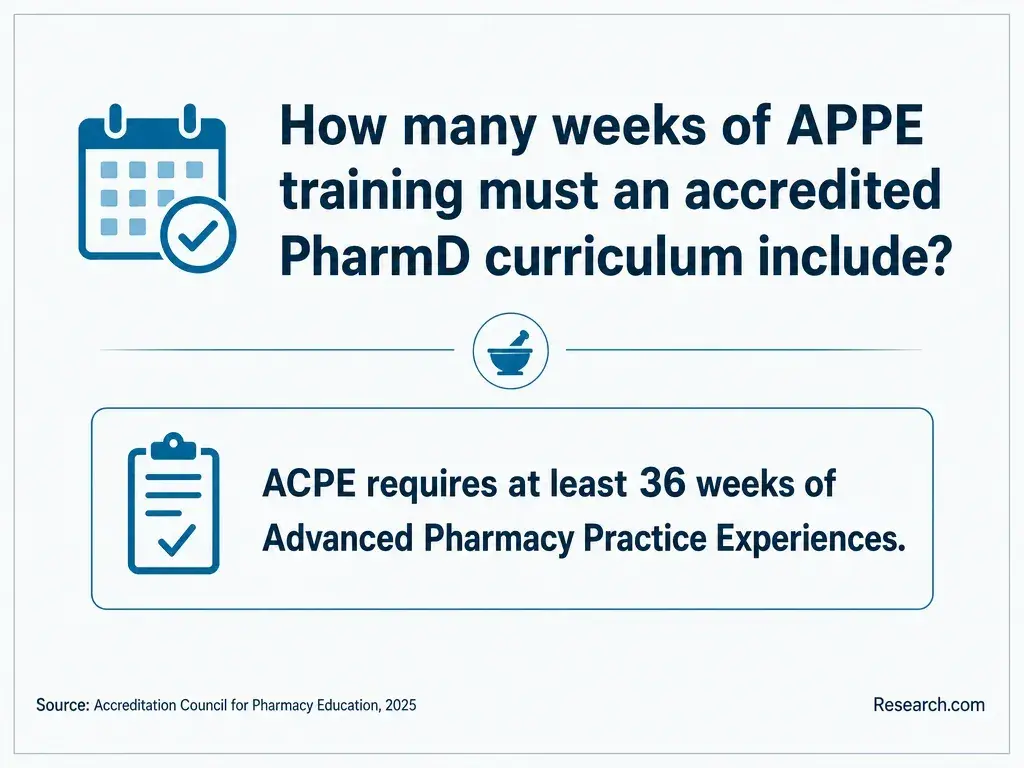
"Online" does not necessarily mean asynchronous, self-paced, or fully remote. Compare live-class times, campus visits, lab schedules, exams, and in-person introductory pharmacy practice experiences (IPPEs) and advanced pharmacy practice experiences (APPEs). Ask who finds and approves sites, whether placements near home are possible, and what happens if travel or time away from work becomes necessary. A list of programs described as having a short online pharmacy degree time to completion may include credentials other than a licensure-qualifying Pharm.D.; verify the credential before comparing schedules.
Pre-pharmacy courses establish the science and general-education foundation; the professional Pharm.D. curriculum builds pharmacy knowledge and supervised patient-care skills. Programs commonly integrate pharmacotherapy, medication safety, calculations, communication, and practice skills with IPPEs and later APPEs. Compare the actual course sequence and assessments, not just course titles.
Ask where students practice counseling and clinical decision-making, how feedback is delivered, and what academic help follows an unsuccessful skills assessment. An accelerated calendar can reduce time before graduation while compressing the time available to recover from a difficult course or arrange rotations. If you want to complete a Pharm.D. on an accelerated schedule, compare its remediation and placement policies as carefully as its end date. Supervised learning is preparation for practice, not permission to practice independently.
Compare each school's current prerequisite courses and labs, minimum grades, application materials, interview policy, deadlines, and rules for coursework still in progress. Some pathways do not require a completed bachelor's degree. A minimum eligibility threshold is not a promise of admission, and schools differ on repeated, community-college, online-lab, and older coursework.
Check whether the school uses the Pharmacy College Application Service (PharmCAS) and whether it also requires a supplemental application. The Pharmacy College Admission Test (PCAT) was retired in January 2024; do not plan around taking it. Applicants considering pharmacy programs for students with varied academic backgrounds should ask which prerequisites may remain unfinished when applying and which must be completed before matriculation. Request an individual course evaluation before paying a deposit if eligibility is uncertain.
Completion time depends on prerequisite preparation and the school's professional curriculum and calendar. An accelerated option may shorten the calendar without reducing the workload or the need for in-person experiences. Compare time until you could begin licensed work, including any missing prerequisites, rather than comparing advertised professional-program lengths alone.
For cost, request the current academic-year cost of attendance and separate tuition from mandatory fees, supplies, technology, background checks, immunizations, campus travel, rotation housing, and licensure expenses. Compare net cost after confirmed aid, not an advertised tuition figure. Strategies to reduce the cost of pharmacy school may include choosing a lower-cost placement region or using approved prerequisite credit, but neither should be assumed available at every school.
Ask the financial aid office to assess your specific eligibility and entry date. Federal borrowing rules changed for many new graduate and professional borrowers beginning July 1, 2026; older descriptions of loan limits or Grad PLUS access may not apply to you. Better support may justify some additional expense, but only if its benefits address a real need and the financing is workable.
A Pharm.D. can lead toward pharmacist roles in community, hospital, ambulatory care, and other settings once the graduate meets the relevant state's licensing requirements. It does not guarantee a job or a particular practice setting. A pharmacy technician is a separate occupation that does not ordinarily require a Pharm.D.; compare the credential with your intended work before committing to professional-school costs.
Ask schools for clearly defined outcomes: who is included in employment reports, when graduates were surveyed, and whether residency placement figures count only applicants. Postgraduate year one (PGY1) and postgraduate year two (PGY2) residencies provide additional structured training; fellowships generally serve different training goals, while specialty board certification is a separate credential. None replaces state licensure, and none is universally required for pharmacist employment. When weighing doctoral programs with accelerated timelines, compare the actual credential and eligibility for your target role, not just the time to a doctorate.
The U.S. Bureau of Labor Statistics reports median pharmacist pay of $140,910 in May 2025 and projects 5% employment growth from 2025 to 2035, with about 12,500 openings per year. These occupation-wide figures do not predict a new graduate's pay, local hiring prospects, or the return on a particular school's tuition.
Compare likely work locations, the roles you would pursue, total borrowing, and time away from paid work. An affordable route through pharmacy education is useful only if its credential meets your career goal and its schedule and clinical requirements are feasible. Ask each school for recent, clearly defined graduate outcomes rather than using the national median as a repayment plan.
How can you identify a reputable PharmD program?
Reputation is best tested with independently checkable status and consistent answers to difficult questions. Do not equate selective admissions, a familiar university name, or easy pharmacy school application eligibility with effective student support.
Before committing, complete these checks for each finalist and keep the responses with your cost comparison:
- Confirm current ACPE professional-program status and check institutional accreditation separately.
- Request the student handbook, current cost of attendance, academic progression and remediation rules, and published NAPLEX outcomes with their reporting years.
- Ask the experiential education office who secures IPPE and APPE sites, what travel students have needed, and how placement problems are resolved.
- Speak with current students or recent graduates about adviser access, response times, and support during rotations; ask the school to explain any gaps between their accounts and its stated policies.
- Confirm admissions eligibility, state authorization where relevant, and the licensing requirements of the state where you intend to practice before paying a deposit.
A warning sign is an inability to obtain clear, current answers about accreditation, placement responsibilities, total cost, or outcomes. Among schools that pass those checks, favor the one whose documented support addresses your most likely obstacles at a cost you can sustain.
Other Things You Should Know About PharmD
Often. Ask whether a student organization hosts open events or whether the school can arrange an unscripted conversation. Respect students' privacy, and seek more than one perspective.
Schools generally have an accommodation process, but arrangements depend on individual circumstances and applicable requirements. Contact the accessibility office early to discuss classroom, lab, and rotation settings without assuming one arrangement carries over automatically.
Possibly, but course schedules and full-time clinical rotations can limit availability. Ask for a sample timetable covering both classroom and APPE periods before relying on employment income.
The school's experiential education policy should explain reassignment and student responsibilities. Ask about backup sites, travel expectations, and whether you may suggest a site; approval is not automatic.
- Types of Financial Aid: Grants, Work-Study, and Loans | studentaid.gov https://studentaid.gov/understand-aid/types
- Making Accommodations | Disability Resources Office https://dro.equalopportunity.ncsu.edu/faculty-staff/making-accommodations/
- Current PharmD Student Advising | Pharmacy Students https://students.pharmacy.wisc.edu/student-services/sop-advising/pharmd-advising/
- Undergraduate PharmD Pathway Options | CU School of Pharmacy https://pharmacy.cuanschutz.edu/degreesandprograms/pharmd/undergraduate-pathway-options
- Tutor Services | cnsu.edu https://pharmacy.cnsu.edu/dept/student-affairs/tutor-services.php
- Reasonable accommodations explained | apa.org https://www.apa.org/pi/disability/dart/toolkit-three