Pharmacist Licensure Requirements for Internationally Educated Applicants

Co-Founder and Chief Data Scientist
A pharmacy degree earned outside the United States does not automatically qualify its holder for a U.S. pharmacist license. The decision is whether to pursue foreign graduate certification or enter a U.S. Doctor of Pharmacy (Pharm.D.) program - and which state's rules to plan around. For internationally educated applicants, that choice affects credential reviews, English testing, supervised practice, exams, and cost.
This guide explains both routes, identifies the requirements that vary by state, and gives you a practical way to check eligibility before paying application or tuition fees.
Key Things You Should Know
- For many internationally educated applicants, the route is Foreign Pharmacy Graduate Examination Committee (FPGEC) certification, followed by the target state's internship, examination, and licensing requirements; certification is not a license.
- FPGEC eligibility generally requires a pharmacy program of at least five years if completed on or after January 1, 2003; different rules apply to earlier graduates. Have your credentials reviewed before assuming your degree qualifies.
- A U.S. Pharm.D. is an alternative, not an automatic shortcut: confirm the program's accreditation, admission rules, total cost, and eligibility for licensure in the state where you intend to practice.
What are the U.S. pharmacist licensure requirements for internationally educated applicants?
Pharmacist licenses are issued by state and territorial boards, not by a national licensing authority. An internationally educated applicant typically needs an accepted educational pathway, board-approved supervised experience, passing examination results, and a completed state application. Many boards require FPGEC certification for graduates of pharmacy schools outside the United States; confirm your target board's policy before starting.
The two educational routes have different entry requirements. The table separates them so you can identify the first decision to make.
| Route | Starting point | What remains after the education requirement |
| Foreign graduate pathway | Qualifying education abroad and FPGEC certification, where required by the board | State-approved experience, licensing exams, and board approval |
| U.S. Pharm.D. pathway | Admission to and completion of a qualifying professional pharmacy program | Applicable state experience, licensing exams, and board approval |
If your foreign degree does not meet FPGEC criteria, investigate pharmacy programs with flexible entry requirements. Flexibility in admission does not waive Pharm.D. graduation or state licensure requirements.
What is FPGEC certification, and why do foreign pharmacy graduates need it?
The National Association of Boards of Pharmacy (NABP) administers FPGEC certification to establish that a foreign pharmacy graduate has met its educational, documentation, English-language, and Foreign Pharmacy Graduate Equivalency Examination (FPGEE) requirements. It is a credential used in the licensing process - not a Pharm.D., permission to practice, or a substitute for state board approval.
Check eligibility before budgeting around the route. NABP's educational standards distinguish applicants by when they completed their pharmacy program; for those who completed it on or after January 1, 2003, the program generally must be at least five years. A later postgraduate qualification should not be assumed to cure an ineligible original pharmacy program: request an eligibility determination under NABP's current rules.
FPGEC certification cannot be replaced by a shorter online credential. General comparisons of online doctorate time to completion are not a way to judge eligibility for foreign graduate pharmacist licensure.
How do internationally educated pharmacists complete the FPGEC application process?
Start with your intended state board's foreign graduate instructions, then follow NABP's current FPGEC application and document-submission instructions. Requirements and processing times can change, and a board may impose conditions beyond certification.
Use this sequence to avoid paying for an exam or educational program before confirming which route is viable:
- Identify the state where you plan to seek your first license and confirm whether it accepts your proposed foreign graduate pathway.
- Review NABP's FPGEC eligibility rules and open an application through its designated process.
- Arrange for educational records and required professional-credential documents to reach the designated evaluators or NABP in the form requested; do not assume applicant-uploaded copies are sufficient.
- Meet the applicable English-test requirements and obtain authorization for the FPGEE under NABP's current scheduling rules.
- After certification, apply for any required intern registration and complete the target board's remaining experience, exams, and licensing steps.
If eligibility fails and you consider pharmacy school instead, compare actual pharmacy school acceptance criteria. Admission policies belong to individual schools; FPGEC application requirements do not establish Pharm.D. admission eligibility.
NABP requires a review of foreign pharmacy education through its designated credential-evaluation process, along with the records specified for the applicant's circumstances. These may include official transcripts, proof of the pharmacy degree, and documentation of a pharmacy license or registration abroad. Follow the current FPGEC instructions for the evaluator, document source, translations, and name discrepancies rather than ordering a general-purpose evaluation independently.
An FPGEC educational evaluation and a U.S. school's credit evaluation answer different questions. The former addresses certification eligibility; the latter determines whether prior study satisfies admissions prerequisites or receives transfer credit. If you may apply to a Pharm.D. program, ask that school how pharmacy programs review transfer credits before counting on advanced standing. Neither evaluation alone grants a U.S. pharmacist license.
FPGEC applicants must meet NABP's specified Test of English as a Foreign Language internet-based test (TOEFL iBT) requirements and pass the FPGEE. Check NABP's current rules for required section scores, accepted test settings, score reporting, eligibility, and exam scheduling before booking either test. A school's English-language admission waiver should not be treated as an FPGEC waiver.
The FPGEE evaluates knowledge relevant to foreign graduate certification; it is distinct from the North American Pharmacist Licensure Examination (NAPLEX), which boards use in licensure. Plan for both if your state requires the foreign graduate route. If testing or educational eligibility makes that route impractical, beware of advertised quickest online pharmacy study routes: a short pharmacy-related program does not, by itself, qualify someone for pharmacist licensure.
Most applicants must pass the NAPLEX and meet their licensing jurisdiction's law-exam requirement, if one applies. Some jurisdictions use the Multistate Pharmacy Jurisprudence Examination (MPJE); transitions to the Uniform Multistate Pharmacy Jurisprudence Examination (UMPJE) began in 2026. Do not register for a jurisprudence exam based on another state's checklist. Confirm the exam, eligibility authorization, and application order with your target board and NABP.
Supervised experience rules also vary. Boards determine how much experience is required, whether foreign experience counts, when hours may begin, and whether intern registration and an approved preceptor are necessary. Get written guidance from your board before arranging work or relocating. Passing exams and recording hours still do not issue a license until the board approves the application.
If a U.S. degree is your alternative, guidance on how to choose an online Pharm.D. program is only a starting point. Verify hands-on attendance, clinical placements, state authorization, and your target board's licensure rules directly.
Yes, if admitted to a U.S. professional Pharm.D. program. This may be the better route when an applicant is ineligible for FPGEC certification or wants a U.S. educational pathway. It can also mean substantial tuition, prerequisite coursework, and time away from work. Foreign pharmacy training does not automatically shorten the professional curriculum.
Verify the program's current Accreditation Council for Pharmacy Education (ACPE) professional-program status and ask how it evaluates international coursework and prior pharmacy study. ACPE accredits programs, not individual pharmacists; institutional accreditation and authorization for online enrollment are separate matters. Pre-pharmacy prerequisites are also distinct from the professional Pharm.D. curriculum. Graduation alone does not confer a license.
Some accelerated Pharm.D. programs compress the schedule, but their admission, experiential education, and attendance rules still apply. Compare the time from your actual starting point - including missing prerequisites - rather than the advertised professional-program length alone.
There is no dependable nationwide total. Credential collection, FPGEC review, test scheduling, state approval to accrue hours, supervised practice, and licensing exams can create delays. A Pharm.D. alternative adds its own admissions and curriculum timeline. Build a budget for document procurement and translation, evaluations, testing, applications, living costs, and possible time away from paid work; for a degree route, add tuition and rotation-related travel or housing.
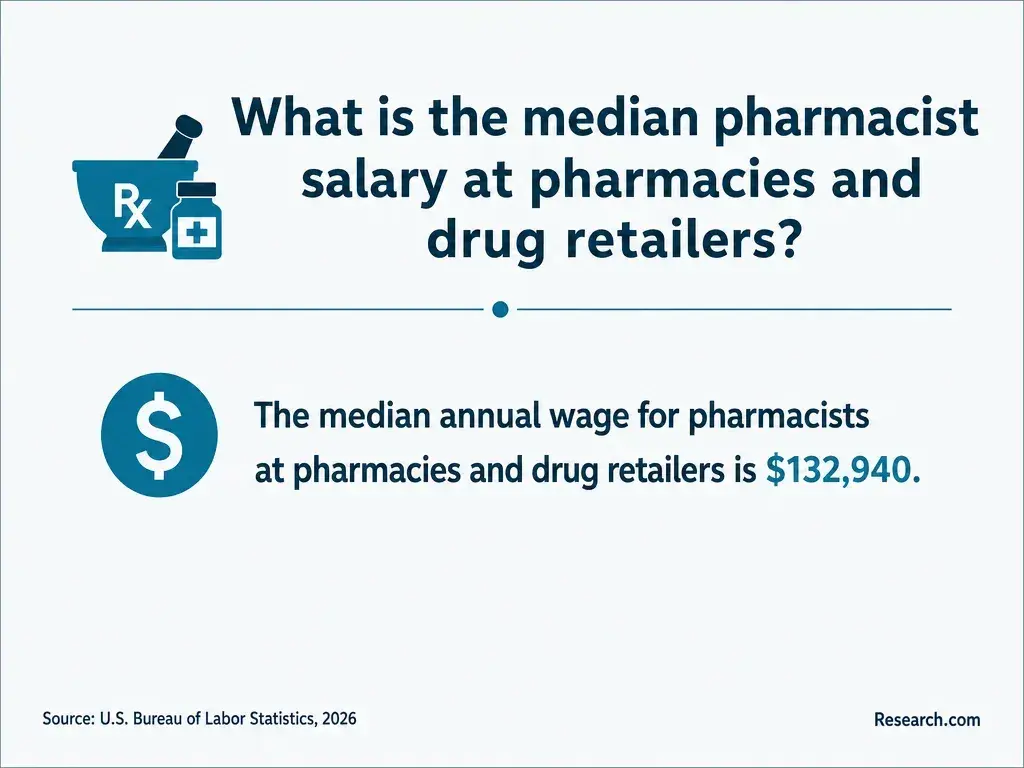
The U.S. Bureau of Labor Statistics reports median pharmacist pay of $140,910 in May 2025. That figure describes employed pharmacists, not what an applicant will earn while completing certification or internship requirements; it cannot establish whether either pathway will repay its cost for you.
When comparing pharmacy programs balancing cost and time, include prerequisites, required in-person training, and the earliest realistic date you could apply for a license. If you plan to borrow for a U.S. degree, obtain a current aid estimate: federal borrowing rules changed for many new graduate and professional borrowers beginning July 1, 2026.
Keep a document inventory for both NABP and your target board; one agency's acceptance of a record does not mean another has received it. Exact forms and submission methods vary, but the following categories are worth checking before you pay an application fee:
- Identity and name-change records matching your applications, examinations, and academic documents.
- Official pharmacy transcripts, degree evidence, required translations, and credential-evaluation records.
- Foreign pharmacy license or registration records, if required for your circumstances.
- FPGEC certification and examination records, as requested by the board.
- Intern-registration records and board-acceptable verification of supervised hours.
- State application materials, which may include background-check or other board-specific disclosures.
If you pursue a U.S. degree instead, request a separate admissions-document checklist. Resources on pharmacy doctorate options after biology can help frame an academic transition, but each school decides which international transcripts, prerequisites, and evaluations it accepts.
How can foreign pharmacy graduates choose an accredited U.S. pharmacy program?
First decide whether a U.S. Pharm.D. solves a specific problem: FPGEC ineligibility, a preferred learning route, or a board requirement. Then confirm each candidate's current ACPE professional-program status and request written answers about international applicant eligibility, prerequisite evaluation, advanced standing, total attendance costs, and clinical placement responsibilities. Check the target board's licensure rules separately.
Compare costs on the same basis: total required tuition and fees, missing prerequisites, travel, and time unavailable for work. An affordable route to a Pharm.D. on advertised tuition may cost more if it requires substantial travel or additional coursework. Ask where in-person labs and introductory and advanced pharmacy practice experiences occur; online instruction does not make those requirements remote.
A practical stopping rule is to avoid committing to a program until the school has explained how it will evaluate your prior education and you have verified its accreditation and the relevant board's licensing pathway. That protects you from paying for credits that do not advance your goal of becoming a licensed pharmacist.
Other Things You Should Know About PharmD
No. Licensure and permission to work in the United States are separate matters. Check your immigration status and employment eligibility independently of board requirements.
Possibly, subject to your state's technician rules and your work authorization. Technician registration or employment does not itself satisfy pharmacist intern requirements; confirm whether any proposed hours count with the board.
Not for pharmacist licensure generally. Some employers prefer or require postgraduate residency training for particular roles, but a residency is separate from licensure.
No. A pharmacist seeking authority to practice in another jurisdiction must meet that jurisdiction's requirements. Check its license-transfer process and any additional examination or documentation rules before making a move.
- NYS Pharmacy: License Requirements - Office of the Professions https://www.op.nysed.gov/professions/pharmacist/license-requirements
- NJDCAAPP | njconsumeraffairs.gov https://www.njconsumeraffairs.gov/phar/Pages/applications.aspx
- Licensing across state lines | hhs.gov https://telehealth.hhs.gov/licensure/licensing-across-state-lines
- ADA Requirements: Testing Accommodations https://www.ada.gov/resources/testing-accommodations/
- I-9, Employment Eligibility Verification | uscis.gov https://www.uscis.gov/i-9
- International Applicants - UW School of Pharmacy https://sop.washington.edu/pharmd/admissions/international-applicants/
- 37 Tex. Admin. Code § 219.1 - Eligibility to Take State Examinations | LII / Legal Information Institute https://www.law.cornell.edu/regulations/texas/37-Tex-Admin-Code-SS-219-1