PharmD Retention and Attrition Data: Questions to Ask

Co-Founder and Chief Data Scientist
A pharmacy school may advertise a strong graduation rate without showing how many students left, changed programs, or needed extra time. If you are choosing a Doctor of Pharmacy (Pharm.D.) program, those differences affect both your likelihood of finishing and your total cost.
This guide explains what retention and attrition figures can - and cannot - tell you, gives you questions to send admissions teams, and shows how to compare answers alongside accreditation, support, licensing outcomes, and cost before you commit.
Key Things You Should Know
- Ask for the number of students who entered each Pharm.D. cohort, remained enrolled, graduated on time or later, transferred, withdrew, or were dismissed - not just a headline retention rate.
- Compare the same cohort and time period across schools. Check whether a published percentage excludes students on leave or counts transfers as successful outcomes.
- Pair retention data with 2026-27 total cost estimates, current ACPE accreditation status, student support, and first-time NAPLEX results; no single measure establishes program quality.
What do PharmD retention and attrition rates measure?
Retention usually describes students who continue in a program from one specified point to another. Attrition describes students who leave. Neither term has a universally useful meaning without the school's definition, starting cohort, measurement date, and treatment of leaves and transfers.
A first-year continuation rate is different from the share of an entering cohort that eventually earns a Pharm.D. Graduation "on time" is different again: a student who repeats a course or takes an approved leave may still graduate and become a pharmacist. Ask whether the school tracks students admitted directly into the professional curriculum separately from undergraduates completing pre-pharmacy prerequisites. The transition from pre-pharmacy to a Pharm.D. is an important distinction because prerequisite students have not necessarily entered the Pharm.D. cohort.
Small cohorts can produce volatile percentages. Request the underlying student counts and several recent entry cohorts, along with an explanation of any unusual change, rather than judging a school by one year's figure.
How can students compare PharmD program retention and attrition data?
Start with each school's own cohort report or a written response from its student affairs office. Record the figures in the same fields below; leave a field marked "not reported" rather than assuming two schools calculate it alike. When reviewing online Doctor of Pharmacy programs, use the same measures for hybrid and campus-based cohorts if a school reports them separately.
This comparison sheet separates the counts behind a rate from its definition. Fill in one column per program using the same entering cohort wherever possible.
| Comparison field | Program A | Program B |
| Professional Pharm.D. entry cohort and starting enrollment | ________ | ________ |
| Students enrolled at the stated follow-up date | ________ | ________ |
| Students graduating on schedule; students graduating later | ________ | ________ |
| Withdrawals, dismissals, transfers, and leaves | ________ | ________ |
| Follow-up date and treatment of leaves and transfers | ________ | ________ |
| First-time NAPLEX pass results and exam-year cohort | ________ | ________ |
A school with lower on-schedule graduation but many students graduating shortly afterward presents a different risk from one with frequent permanent departures. NAPLEX - the North American Pharmacist Licensure Examination - adds context, but its exam-year group may not match the entry cohort in a retention report. Do not combine the measures into a single "success rate."
What questions should applicants ask about PharmD student outcomes?
Send the same questions to each program and request written definitions or a student-outcomes report. Specific answers make it easier to identify both genuine support and gaps in reporting.
- For each recent professional-program entry cohort, how many students started, remain enrolled, graduated on schedule, graduated later, or left without graduating?
- How do you classify academic dismissal, voluntary withdrawal, transfer, an approved leave, and a student who changes to another degree?
- At what point do students most often leave, and what reasons have students reported? Are those reasons documented or staff impressions?
- What are the repeat-course, remediation, and return-from-leave policies, and how might they extend tuition or delay rotations?
- Can you provide first-time NAPLEX results with the exam year, number tested, and an explanation of whether graduates who delayed testing are excluded?
Also ask whether prior coursework can satisfy prerequisites or professional courses; those are different decisions made by the receiving school. Information about pharmacy school prior learning credits can help frame the conversation, but get a written evaluation before counting on credits to shorten your Pharm.D.
The Accreditation Council for Pharmacy Education (ACPE) accredits professional Pharm.D. programs against educational standards. Before applying or depositing, check the program and its current status in ACPE's official program lookup. Ask the school about any status or substantive change you do not understand. Accreditation provides an essential quality and licensure-eligibility check, but it does not mean every student will persist, pass an exam, or receive a license.
ACPE professional-program accreditation is distinct from the university's institutional accreditation. For online or hybrid study, state authorization to enroll a student - and permission to arrange a clinical placement in a particular state - are separate questions. A list of pharmacy degree eligibility options does not replace confirming the exact professional program's accreditation, your admission eligibility, and any location-specific restrictions.
Students may leave because of academic difficulty, financial pressure, health or family circumstances, a change in career goals, or the demands of supervised clinical education. Introductory pharmacy practice experiences (IPPEs) and advanced pharmacy practice experiences (APPEs) can also introduce travel, scheduling, and site-clearance requirements that are difficult to combine with paid work. A departure is not automatically evidence of poor teaching, but repeated departures at the same stage deserve an explanation.
Program pace matters when comparing accelerated pharmacy school options with longer pathways. A shorter calendar may leave less room for employment, remediation, or unexpected interruptions. Ask when courses must be repeated, whether they are offered again promptly, and what happens to aid and rotation timing if progression stops.
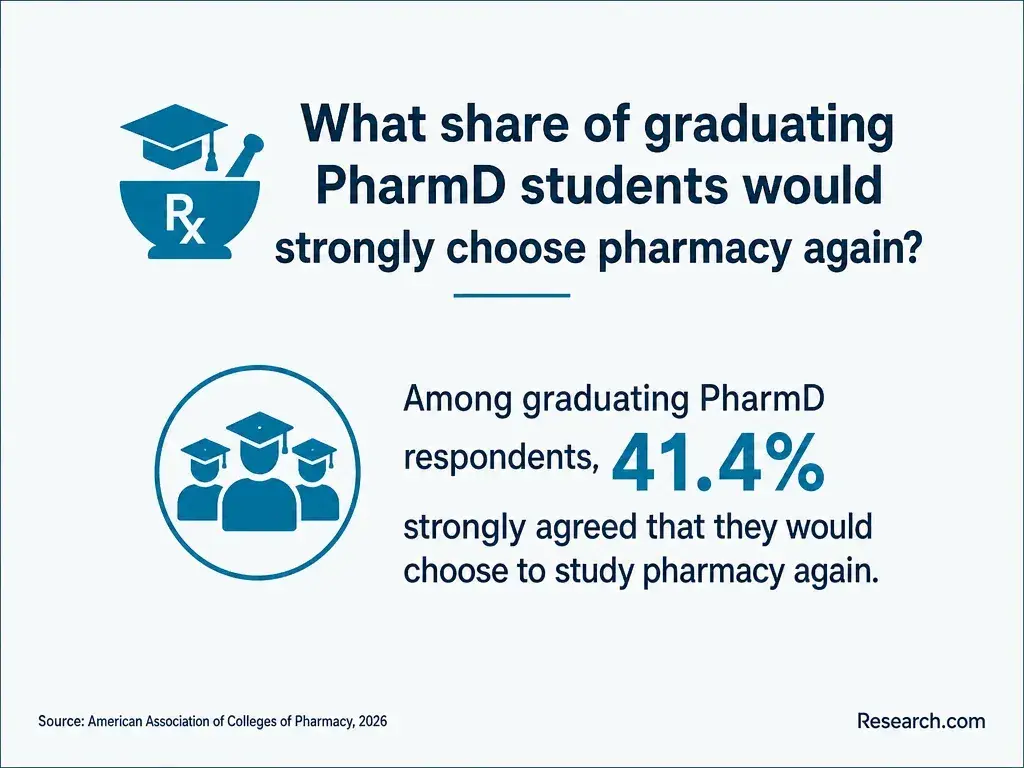
Useful support is timely and accessible, not merely listed in a brochure. Ask who monitors early academic difficulties, how quickly a student can meet a faculty adviser, whether tutoring covers challenging professional courses, and what structured remediation costs or delays. Confirm that counseling, disability accommodations, and financial-aid advice are available to Pharm.D. students, including during rotations.
Clinical-placement support matters, too: determine who finds or approves IPPE and APPE sites and who helps when a placement falls through. If a program advertises flexible scheduling, compare its actual course sequence and required attendance with claims about online pharmacy degree duration. Online instruction does not eliminate in-person labs or clinical rotations, and a faster pharmacy-related degree is not necessarily a Pharm.D. pathway.
Many professional Pharm.D. curricula are designed around four academic years after prerequisite study, while some schools offer accelerated calendars. The student's actual time also depends on remaining prerequisites, course sequencing, leaves, and repeat policies. Compare the school's planned timeline with its cohort's actual graduation timing, not just its advertised duration.
For each school, request a 2026-27 cost-of-attendance estimate covering tuition, mandatory fees, supplies, housing, and transportation. Then ask about costs the standard estimate may not fully capture: prerequisite courses, immunizations and background checks, campus visits, rotation travel or temporary housing, and licensing exams. Advertised tuition alone is not the amount a student must finance. Comparing online pharmacy school cost options still requires accounting for in-person requirements and placement locations.
Ask the financial-aid office which federal loans you personally qualify for under rules applicable to your borrowing and enrollment dates. Federal borrowing rules changed for many new graduate and professional borrowers beginning July 1, 2026; older descriptions of Grad PLUS access or loan limits may not apply. A delayed graduation can add living costs and postpone pharmacist earnings even if tuition per term remains unchanged.
Schools set their own prerequisite courses, laboratory rules, minimum grades, application materials, and deadlines. Some admit students after specified undergraduate prerequisites without requiring a bachelor's degree; others have different pathways. Review the current school directory, the program's admissions page, and its written evaluation of your coursework. The Pharmacy College Admission Test (PCAT) was retired in January 2024, so it is not a current exam to schedule.
Ask whether unfinished prerequisites may remain in progress when you apply, whether older or online laboratory courses count, and when every condition must be completed. A minimum eligibility threshold is not a promise of admission. Guides to pharmacy school prerequisites and eligibility can help you form questions, but the school's current policy controls your application.
A Pharm.D. is an academic credential, not a pharmacist license. U.S.-educated graduates generally pursue licensure through a state board of pharmacy, including eligibility review, the NAPLEX, and any additional jurisdiction-specific examination or requirements. Depending on the jurisdiction, a pharmacy law examination may be the MPJE, the UMPJE, another assessment, or no separate exam. Intern registration and supervised-hour rules can also differ; verify the board's current requirements in the state where you intend to practice.
Ask schools how they support exam preparation and how they report first-time pass results, but do not treat a pass rate as proof that every graduate becomes licensed. Passing an exam alone does not issue a license. Nor do short doctoral degree completion options substitute for the Pharm.D. education and jurisdictional requirements needed to pursue pharmacist licensure.
What careers, salaries, and job outlook follow PharmD graduation?
Licensed pharmacists work in settings that include community pharmacies, hospitals, clinics, and other medication-focused services. The U.S. Bureau of Labor Statistics reports median annual pay of $140,910 in May 2025 for pharmacists and projects 5% growth from 2025-2035, with about 12,500 openings per year. Those occupation-wide figures do not predict a new graduate's pay, local hiring conditions, or the return on a particular school's tuition.
Some graduates seek postgraduate residency training for specific clinical roles; fellowships typically serve different training goals, and specialty board certification is separate from both training and state licensure. None is universally required for pharmacist jobs. Weigh career interests and likely borrowing alongside retention data: budget-friendly pharmacy education options warrant attention, but a lower price should not outweigh serious concerns about accreditation, progression, or clinical placements.
Other Things You Should Know About PharmD
Yes. Ask admissions to connect you with students from different years, including those who have completed rotations. Ask what support was available when a course or placement became difficult, while remembering that individual experiences may not represent an entire cohort.
Not automatically, but it is a reason to seek clarification. Ask for cohort counts or a written explanation of what the school tracks. If you cannot obtain enough information to compare the risk of delay or departure, factor that uncertainty into your decision.
Possibly, but admission and professional-course credit are determined by the receiving school. Course sequencing and experiential requirements can extend completion time even when some credits are accepted.
It is an alternative for someone interested in a different pharmacy occupation, not a route to pharmacist licensure. Technician education and registration or certification requirements vary by state and employer; working as a technician can provide exposure to pharmacy practice but does not replace professional Pharm.D. study.
- Termination Reasons - Study in the States - Homeland Security https://studyinthestates.dhs.gov/sevis-help-hub/student-records/completions-and-terminations/termination-reasons
- Causes and outcomes of at-risk underperforming pharmacy students: implications for policy and practice - PMC https://pmc.ncbi.nlm.nih.gov/articles/PMC11027423/
- What are graduation, retention, and transfer rates? | studentaid.gov https://studentaid.gov/help/graduation-retention-transfer-rates
- Undergraduate Retention and Graduation Rates - COE https://nces.ed.gov/programs/coe/indicator/ctr/undergrad-retention-graduation
- PharmD Students - FAO UNC Eshelman School of Pharmacy https://faopharmacy.unc.edu/organizational-effectiveness-planning-and-assessment-oe/pharmd-students/
- FAQ | OSU College of Pharmacy - Oregon State University https://pharmacy.oregonstate.edu/programs-admissions/pharm-d/faq
- Experiential Education | UK College of Pharmacy https://pharmacy.uky.edu/apply/pharmd-program/curriculum/experiential-education
- Getting Your PharmD: How Long is Pharmacy School? | Pacific University https://www.pacificu.edu/blog/getting-your-pharmd-how-long-pharmacy-school
- Retention Rate and Student Success | Academic Affairs - UAMS https://academicaffairs.uams.edu/irpa/office-of-institutional-studies/student-outcomes/student-success/
- Pharm.D. Student Leave of Absence | utoledo.edu https://www.utoledo.edu/pharmacy/current/pharmd-loa.html