How to Verify a Pharmacy School's ACPE Accreditation Status

Co-Founder and Chief Data Scientist
A pharmacy school's website may say it is accredited, but the claim is worth checking before you pay a deposit or commit to a Doctor of Pharmacy (Pharm.D.) program. Accreditation status can change, and a university's accreditation is not the same as accreditation of its professional pharmacy program.
This guide shows prospective students and applicants how to find the official Accreditation Council for Pharmacy Education (ACPE) record, interpret what it says, and resolve questions with a state licensing board before making an enrollment decision.
Key Things You Should Know
- Search ACPE's official directory for the professional Pharm.D. program at the correct campus; do not rely on a school's general accreditation claim.
- Read the exact status: accredited, candidate, pre-candidate, and accredited with probation do not mean the same thing. Check any notices and effective dates.
- Before enrolling, ask the pharmacy board where you intend to practice whether graduates from that program and status can meet its education requirement.
What is ACPE accreditation for pharmacy schools?
ACPE evaluates U.S. professional Pharm.D. programs against standards for pharmacy education. Its decision concerns the program, not an individual student or pharmacist. A university can hold institutional accreditation while its Pharm.D. program has a different ACPE status - or does not offer an ACPE-accredited Pharm.D. at all.
Check the credential as carefully as the institution name. Undergraduate pre-pharmacy courses prepare students to apply to a professional program; a pharmaceutical sciences or pharmacy technician degree is not a substitute for a Pharm.D. in the usual U.S.-educated pharmacist licensure pathway. This distinction matters for applicants considering pharmacy school for biology and chemistry graduates: prior coursework may satisfy admissions prerequisites, but it does not establish the accreditation status of the professional program.
How can you verify a pharmacy school's ACPE accreditation status?
Use ACPE's official directory of professional pharmacy programs as your starting point. A screenshot or accreditation statement on a school website may be useful context, but the current ACPE record is the stronger check.
- Find the school in ACPE's professional program directory, using its institution name and location rather than a search-engine snippet.
- Open the individual record and confirm that it identifies the Pharm.D. program, including the campus or pathway you are considering.
- Record the exact status, effective information, and any probationary designation or public notice shown; save a dated copy for your records.
- If the listing is absent, unclear, or different from the school's claim, ask the program for its current ACPE status in writing and contact ACPE for clarification.
- Ask your intended state board of pharmacy how that program's status would be treated for licensure when you expect to graduate.
Do this before comparing selectivity. A list of pharmacy schools with accessible admissions can help you build an application list, but easier admission does not verify a program's ACPE record.
Which ACPE accreditation statuses qualify for pharmacist licensure?
State boards set licensure requirements, so no status label alone guarantees that a particular applicant will receive a license. Graduates of an ACPE-accredited Pharm.D. program generally meet the U.S. professional-education component; graduates of a program with candidate status are generally accorded the same rights and privileges as graduates of an accredited program. Confirm how the board applies its rule to your program and graduation date.
Pre-candidate status describes an earlier stage of a developing program. Do not treat it as a promise that the program will advance to candidate status before you graduate. A program listed as accredited with probation remains accredited while ACPE identifies serious compliance concerns; read the notice and check for subsequent decisions.
If you are considering applying to a developing program, pharmacy program admission planning is separate from verifying its status. Get the program's explanation of its accreditation timeline and the relevant board's response in writing before accepting an offer.
Yes. ACPE's review concerns the professional Pharm.D. program, including one that delivers some instruction online. Verify that the specific pathway you plan to enter is covered by the program's ACPE record rather than assuming that an accredited university makes every online offering an accredited Pharm.D.
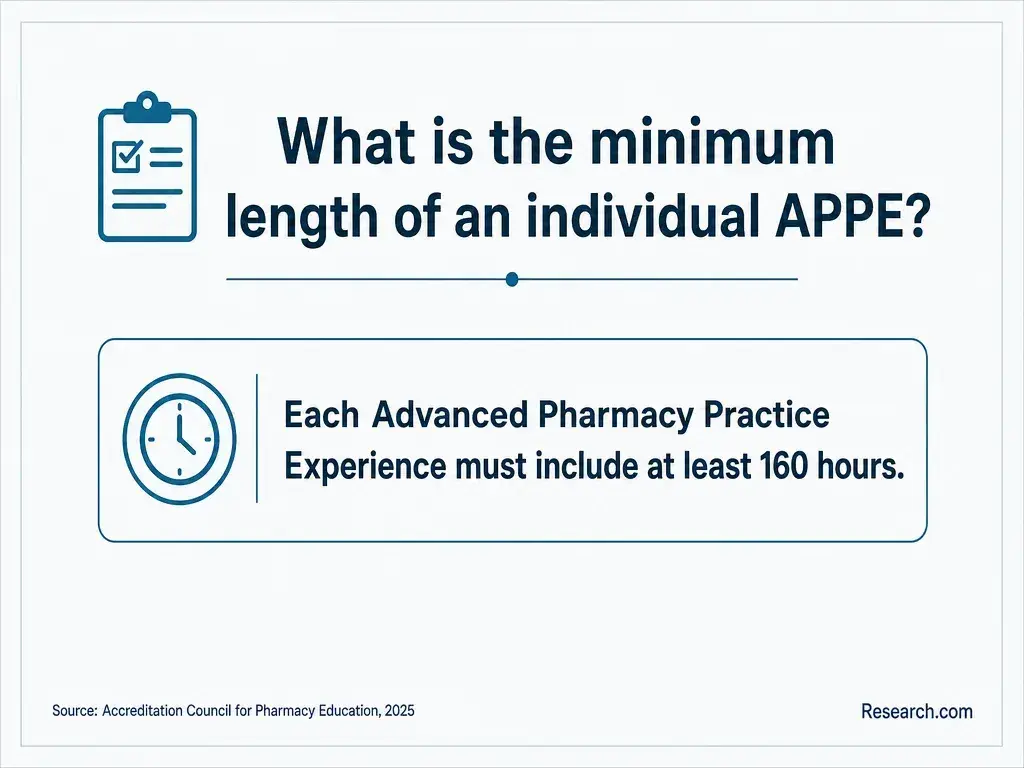
Accreditation does not mean the degree can be completed entirely from home. Ask about scheduled online classes, campus visits, hands-on labs, introductory pharmacy practice experiences (IPPEs), and advanced pharmacy practice experiences (APPEs). Also confirm who arranges or approves placements and whether you may need to travel or register as an intern in a placement state. These practical questions belong in online Pharm.D. program selection.
Finally, check distance-education authorization where you live separately from ACPE accreditation and from the rules governing clinical placements and eventual pharmacist licensure. Each answers a different question.
Candidate status is a recognized stage for a developing Pharm.D. program, not another name for full accreditation. The distinctions below help you interpret a directory entry without treating every listing as equivalent.
| Status | What it indicates | Key uncertainty for an applicant |
| Accredited | ACPE has granted accreditation to the professional program. | Future status can change; check for current notices. |
| Candidate | A developing program has progressed beyond pre-candidate status but has not yet received full accreditation. | Progression to full accreditation is not automatic. |
| Pre-candidate | A new program is at an earlier stage of ACPE's process. | Its status at graduation needs particular scrutiny. |
| Accredited with probation | The program remains accredited, but ACPE has identified serious compliance concerns. | Read the public notice and monitor later decisions. |
Do not assume a shorter or fast-track Doctor of Pharmacy program follows a different accreditation rule. Verify its exact professional program and status just as you would for a longer pathway.
ACPE status addresses the educational program; the state board decides whether an applicant meets its licensing requirements. For U.S.-educated applicants, the process commonly includes an eligible Pharm.D. education, required practical experience, the North American Pharmacist Licensure Examination (NAPLEX), and any jurisdiction-specific law examination or other conditions. Do not assume every jurisdiction uses the MPJE: requirements can differ, and some jurisdictions use the UMPJE. Passing an exam does not itself issue a license.
Likewise, claims about online pharmacy degree time to completion need a credential check: a shorter pharmacy-related degree is not necessarily a licensure-qualifying Pharm.D.
Keep a dated record you can compare with the school's written disclosures. The following checks catch the mismatches most likely to affect an enrollment decision.
- Program identity: Match the institution, campus, professional Pharm.D. credential, and proposed pathway.
- Exact status: Copy ACPE's wording rather than reducing it to "accredited" or "not accredited."
- Timing: Note applicable dates and ask which status is expected to apply when you graduate; do not treat a projection as an ACPE decision.
- Public notices: Read any probation, adverse-action, or other status information and look for subsequent updates.
- Discrepancies: Request written clarification from the school and, where needed, ACPE and your intended licensing board.
If you hope to bring prior credits, verify that separately. A directory entry cannot tell you whether a school will accept prerequisites or professional-course credit; pharmacy programs that accept transfer credits still make their own credit evaluations.
ACPE evaluates whether a professional program meets its standards across areas such as curriculum, student learning and assessment, experiential education, faculty, resources, and continuous improvement. Accreditation is a meaningful baseline, but it is not a ranking or a guarantee that every student will pass a licensing exam.
Use the standards to frame follow-up questions. Ask how the school assesses clinical skills, arranges and evaluates IPPEs and APPEs, responds to student-performance concerns, and reports outcomes. Published NAPLEX results can add context, but compare the reporting periods and examinee groups before drawing conclusions.
General lists of how long online doctoral programs take cannot establish the quality or requirements of a professional Pharm.D.; examine the actual curriculum and supervised experiences instead.
Once two programs clear the accreditation and intended-state eligibility checks, compare what enrollment would actually require of you - not just advertised tuition. The most useful comparison puts cost, schedule, clinical placements, and outcomes on the same footing.
For each program, request its current tuition and required-fee schedule and estimate additional expenses for prerequisite courses, campus travel, rotation travel or housing, supplies, and licensing steps. Ask whether placements can be near home, how much notice students receive, and what work-schedule flexibility is realistic. Compare online Pharm.D. costs using comparable units and your likely total expenses, not a per-credit figure beside another school's full-program price.
Review published outcomes alongside the support offered to students who struggle. The Bureau of Labor Statistics reports pharmacist median annual pay of $140,910 in May 2025; that occupational median is context for a major educational investment, not a prediction of your starting salary or return on tuition.
How can you confirm a program's accreditation with state licensing boards?
Contact the board of pharmacy in the jurisdiction where you expect to seek your first pharmacist license. ACPE can explain its accreditation decision; the board is the authority on how its education, experience, examination, and application rules apply to you.
Give the board the program's official name and campus, its exact ACPE status, your expected graduation date, and any online or out-of-state rotation plans. Ask whether graduation under that status would satisfy its professional-education requirement, what documentation it needs, and whether you must register as an intern before particular experiences. Keep the dated reply and recheck requirements before graduation if your plans or the program's status change.
An unresolved eligibility question is a reason to pause before paying a nonrefundable deposit. When comparing pharmacy degree planning for cost and time, include the risk of delays or additional requirements rather than treating the quickest advertised route as the safest choice.
Other Things You Should Know About PharmD
Search ACPE's directory using both the current and former names. If you cannot confidently match the records, ask the school and ACPE to confirm the program's identity in writing.
You can apply, but a receiving school decides whether to admit you and which courses or experiences it will accept. Ask about transfer rules early; equivalent-looking coursework is not automatically transferable.
ACPE accreditation of a Pharm.D. program does not establish a residency's accreditation. Verify a residency separately through its responsible accreditor and program listing.
Not at every school. Programs set their own prerequisite-course, credit, grade, and degree requirements. Check the current admissions policy for each program before assuming your prior education qualifies.
- DAPIP | Homepage - Office of Postsecondary Education (OPE) https://ope.ed.gov/dapip/
- Accreditation Process | Pharmacy https://www.umes.edu/pharmacy/accreditation-process/
- CPE Program Accreditation - ACPE https://acpe.edu/programs/accreditation
- School of Pharmacy achieves next to final step in attaining full accreditation | Chapman Newsroom https://news.chapman.edu/2016/07/11/school-of-pharmacy-achieves-next-to-final-step-in-attaining-full-accreditation/
- International Services Program | Accreditation Council for Pharmacy Education https://www.acpe-accredit.org/program/international-services-program/
- Accreditation Council for Pharmacy Education (ACPE) | chea.org https://www.chea.org/accreditation-council-pharmacy-education
- ACPE Related Terms - ACPE Manuals - 2025 https://www.manula.com/manuals/acpe/acpe-manuals/2016/en/topic/acpe-related-terms
- ACPE | Joint Accreditation https://jointaccreditation.org/joint-accreditation/accrediting-organizations/acpe/