How to compare PharmD programs by experiential education

Co-Founder and Chief Data Scientist
Two Doctor of Pharmacy (Pharm.D.) programs can meet accreditation requirements yet offer very different clinical experiences. If you are choosing a pharmacy school, the useful comparison is not simply how many rotation hours each advertises. It is where students train, who secures placements, how performance is assessed, and what travel or time away from work the schedule requires. This guide gives you a consistent way to compare experiential education - and identify questions to resolve before you enroll.
Key Things You Should Know
- Compare placement access, required practice settings, preceptor support, assessment, and student costs - not rotation hours alone.
- ACPE professional-program standards require at least 300 hours of introductory pharmacy practice experiences (IPPEs) and 1,440 hours of advanced pharmacy practice experiences (APPEs); ask how each program delivers them.
- Get written answers about who arranges rotations, where you may be assigned, and whether your schedule and state-specific intern requirements allow you to participate.
How does experiential education differ among PharmD programs?
The most consequential differences are often logistical and educational rather than numerical. Compare when rotations begin, the range of available sites, how elective assignments work, whether students can request a geographic area, and how consistently preceptors give feedback. A large site network is useful only if students can actually obtain appropriate placements within it.
Also compare the time built into the curriculum. A compressed pathway may reduce time in school without reducing required experiential work, making its rotation schedule more intense. When reviewing transfer-friendly pharmacy education options, ask separately whether prior coursework changes the professional curriculum; accepted academic credit does not automatically replace supervised rotations.
What experiential education requirements should an accredited PharmD program meet?
The Accreditation Council for Pharmacy Education (ACPE) accredits professional Pharm.D. programs and sets experiential education standards. These include at least 300 IPPE hours and 1,440 APPE hours. IPPEs introduce students to supervised practice; APPEs provide more sustained, advanced responsibilities later in the professional curriculum. Check the program's current ACPE accreditation status and ask for its current experiential handbook - not just a promotional summary.
Pre-pharmacy coursework is different from the professional Pharm.D. curriculum. If you are still comparing pharmacy school prerequisites, do not mistake prerequisite lab or work experience for required IPPE or APPE placements. Institutional accreditation and authorization to enroll an online student are also distinct from ACPE professional-program accreditation.
How do IPPE and APPE rotations prepare PharmD students for practice?
IPPEs let students practice foundational tasks under supervision, such as gathering medication histories, communicating with patients, and observing dispensing and safety workflows. APPEs ask students to apply clinical knowledge more independently - but still under appropriate supervision - through activities such as evaluating medication therapy, presenting recommendations, and documenting care. Responsibilities depend on the site, the student's preparation, and applicable law.
Prior science study can strengthen a student's foundation, but it does not itself provide these supervised practice experiences. Applicants considering an online Pharm.D. for students with prior science study should compare the actual sequence of IPPEs, APPEs, and clinical-skills instruction rather than assuming earlier coursework shortens every requirement.
Look first for reliable access to the core APPE settings: community pharmacy, hospital or health-system pharmacy, ambulatory care, and inpatient general medicine. Then consider electives that match your interests, such as specialty pharmacy, managed care, drug information, or industry. An elective listing is not a promise that a particular site or specialty will be available to every student.
Ask whether the program has enough sites in your preferred region for both required and elective experiences. If you are considering pharmacy programs with shorter completion times, verify the credential described and its rotation schedule: a shorter pharmacy-related program is not necessarily a licensure-qualifying Pharm.D.
Online coursework does not make supervised pharmacy practice remote. Both delivery formats require students to complete in-person experiential training; an online or hybrid program may also require scheduled live classes, campus visits, hands-on labs, or in-person assessments. Neither format guarantees a rotation close to home.
The practical difference is where you live while completing coursework and how you reach required sites. As you review online pharmacy doctorate programs, request a calendar showing campus attendance and rotation blocks, plus the program's policy on placements near your home. Compare that calendar with your work, caregiving, and travel constraints - not with the word "online" alone.
Programs typically approve sites and preceptors, maintain placement agreements, and assign or confirm students according to curriculum requirements and site capacity. Students may be asked for location preferences, but the program's policy determines whether a request can be honored. Ask who finds replacement sites if an assignment falls through and when placements become final.
Placement also depends on student readiness. Required steps may include intern registration or other state-specific permissions, background checks, immunizations, site training, and documentation deadlines. When assessing pharmacy school application readiness, distinguish admission conditions from these later placement conditions. Before committing, get the experiential office's written policy on student-arranged sites, out-of-state rotations, and missed deadlines.
Strong assessment goes beyond recording attendance. Ask to see the competencies and evaluation forms used for IPPEs and APPEs, how often preceptors provide feedback, and what happens if a student is not meeting expectations. Useful evidence includes direct observation, documented clinical work, midpoint feedback, and a clear process for remediation and reassessment.
These questions matter especially when comparing accelerated online pharmacy programs. A faster course sequence should still give students time to develop, demonstrate, and improve practice skills before progressing. Ask how the school checks consistency when different sites or preceptors assess the same competency.
Tuition does not capture the full cost of rotations. Potential expenses include transportation, temporary housing, background checks, immunizations, required technology, and lost wages during full-time APPE blocks. As you compare online pharmacy school cost options, request a program-specific estimate that separates school charges from expenses that depend on where you are placed.
The following questions help expose costs and scheduling conflicts before they become difficult to change:
- When are IPPE and APPE blocks scheduled, and can their dates change after an assignment is announced?
- How far from home might a required placement be, and who pays for travel or temporary housing?
- Can students maintain paid employment during each phase, or do site hours make that impractical?
- Which placement-related expenses are required, and what financial aid options apply to my enrollment and aid year?
Federal borrowing rules changed for many new graduate and professional borrowers beginning July 1, 2026. Have the school's financial aid office explain the rules that apply to your own start date and eligibility rather than relying on an older estimate.
Experiential education is part of completing an accredited professional Pharm.D., but graduation does not itself issue a pharmacist license. State boards determine licensure requirements, including how internship experience is documented or credited, registration rules, examinations, and other application conditions. Before choosing an out-of-state or online pathway, check the board requirements where you intend to seek your first license and ask the program how it supports the required documentation.
The North American Pharmacist Licensure Examination (NAPLEX) is one part of the licensing process. Jurisprudence examination requirements vary by jurisdiction; do not assume every board uses the MPJE, particularly as some jurisdictions transitioned to the UMPJE beginning in 2026. General comparisons of online doctorate completion periods cannot establish pharmacist licensure eligibility: the specific professional degree, accreditation, and state board rules control.
How can students evaluate PharmD experiential education and career outcomes?
Use the same questions for every school and ask for answers from the experiential office, not only admissions. The comparison below is a fillable record of the facts most likely to change your decision; enter published information or written answers rather than assumptions.
For outcomes, compare each school's published NAPLEX results using the same reporting period and population. Ask about residency placement or employment results if those match your goal, while noting how the school defines and verifies each measure. Residency, fellowship, and specialty board certification are distinct paths after pharmacy school; none is universally required for pharmacist employment.
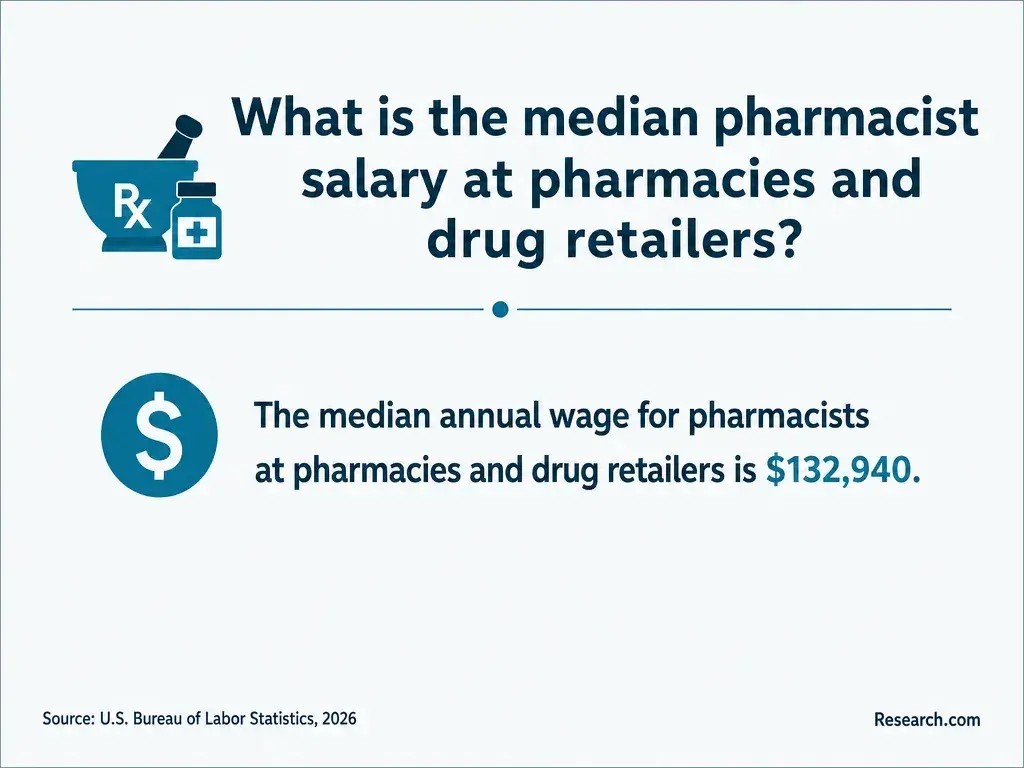
For context, the Bureau of Labor Statistics reports median pharmacist pay of $140,910 in May 2025. That national figure is not a forecast of your earnings or proof that a higher-cost program pays off. Compare total cost and placement access against your likely practice interests; an affordable route through pharmacy education is valuable only if the actual credential and training meet your goal. Favor the program whose documented rotations you can realistically complete - not the one with the longest elective list.
Other Things You Should Know About PharmD
Do not assume so. Technician employment and supervised Pharm.D. experiential education serve different purposes. Ask the program whether any prior experience receives credit under its current policy.
Possibly, but the program must approve the site, preceptor, learning activities, and any conflict-of-interest safeguards. Continued employment does not automatically make a workplace an eligible rotation site.
Do not budget on that assumption. Payment arrangements vary by experience and site; ask the program about its policies and any restrictions on receiving compensation for a rotation.
Only if the program approves it under its curriculum and applicable requirements. Confirm supervision, assessment, travel costs, and whether it fulfills a specific required or elective experience before making plans.
- Advanced Pharmacy Practice Experiences (APPE) | Veterans Affairs https://www.va.gov/loma-linda-health-care/work-with-us/internships-and-fellowships/advanced-pharmacy-practice-experiences-appe/
- The Offering, Scheduling and Maintenance of Elective... - PMC https://pmc.ncbi.nlm.nih.gov/articles/PMC5597112/
- IPPE | UUH https://pharmacy.utah.edu/students/current-students/ippe/ippe
- Advanced Pharmacy Practice Experience (APPE) | R. Ken Coit College of Pharmacy https://www.pharmacy.arizona.edu/advanced-pharmacy-practice-experience-appe
- Pharm D Practice Experience Curriculum | Presbyterian College https://www.presby.edu/graduate-programs/pharmacy/pharmd/practice-experience/
- IPPE Information | Experiential Education https://pharm.ucsf.edu/experiential/ippe
- Advanced Pharmacy Practice Experiences (APPE) | Lake Erie College of Osteopathic Medicine https://lecom.edu/post-graduate-education/pharmacists/advanced-pharmacy-practice-experiences/
- Advanced Pharmacy Practice Experiences | ucsf.edu https://pharmd.ucsf.edu/advanced-pharmacy-practice-experiences
- Program: Pharmacy (PharmD) - University of Southern California https://catalogue.usc.edu/preview_program.php
- Pharmacy Practice Experiences | Doctor of Pharmacy https://pharmacy.wisc.edu/pharmd/pharmacy-practice/