PharmD Patient Assessment Curriculum

Co-Founder and Chief Data Scientist
A PharmD program may list "patient assessment" as a course, a lab, or a skill taught throughout the curriculum. Those labels alone do not show how often students practice with patients, receive feedback, or demonstrate competence before clinical rotations.
This guide is for prospective Doctor of Pharmacy (Pharm.D.) students comparing programs. It explains what assessment training should cover, how to evaluate hands-on and online delivery, and which admissions, cost, and licensure questions to settle before enrolling.
Key Things You Should Know
- A strong PharmD patient assessment curriculum connects interviewing, physical findings, medication review, clinical decisions, documentation, and follow-up - not just memorization of vital-sign techniques.
- Look for repeated skills checkoffs and supervised practice in introductory and advanced pharmacy practice experiences; a course title alone does not establish clinical readiness.
- Patient assessment is part of professional Pharm.D. education, not a substitute for state licensure. The U.S. median annual pay for pharmacists was $140,910 in May 2025, but that occupation-wide figure does not predict an individual graduate's earnings.
What Is Included in a PharmD Patient Assessment Curriculum?
A PharmD patient assessment curriculum teaches students to gather relevant information, interpret it within a pharmacist's role, identify medication-related problems, and determine when to intervene or refer. Schools may teach these abilities in a dedicated course or integrate them across therapeutics, skills labs, and supervised practice.
The components below provide a practical way to compare curricula. Ask for a course map and assessment rubrics, not merely a list of course titles.
| Curriculum component | What students should practice | Evidence to look for |
| Patient interview | Medication history, symptoms, allergies, adherence, and patient goals | Observed interviews with feedback |
| Focused assessment | Relevant vital signs, devices, records, and findings within the pharmacist's authorized role | Hands-on checkoffs using appropriate equipment |
| Clinical reasoning | Connecting findings to therapy, safety concerns, monitoring, and referral | Cases that require justified decisions |
| Care communication | Explaining plans to patients and communicating with other clinicians | Counseling and handoff evaluations |
| Documentation and follow-up | Recording assessments, plans, outcomes, and unresolved questions | Reviewed notes and longitudinal cases |
Undergraduate pre-pharmacy science courses build a foundation but do not replace professional clinical-skills training. Applicants exploring pharmacy degree eligibility options should confirm which prerequisites must be finished before matriculation and when patient assessment begins in the Pharm.D. curriculum.
How Does ACPE Accreditation Shape PharmD Patient Assessment Training?
The Accreditation Council for Pharmacy Education (ACPE) accredits professional Pharm.D. programs against standards that address patient-centered care, learning outcomes, assessment, and experiential education. Accreditation sets expectations for demonstrated competence, but it does not prescribe one universal course title or identical lab schedule. Programs decide how to teach and assess these skills within the standards.
Check a program's current status in ACPE's official program records, then examine its published curriculum and ask how students who fail a patient-assessment checkoff are remediated. This matters when evaluating online Pharm.D. schools to compare: online delivery does not remove hands-on or supervised practice expectations.
ACPE professional-program accreditation is distinct from a university's institutional accreditation and from authorization to enroll an online student in a particular state. None of those statuses, by itself, grants an individual a pharmacist license.
What Skills Do PharmD Students Learn Through Patient Assessment Courses?
Students learn to ask focused, respectful questions; reconcile medication lists; recognize findings that may affect drug therapy; and communicate a defensible plan. Depending on the course and practice setting, training may include blood pressure measurement, symptom assessment, interpretation of laboratory results, device technique, and identifying warning signs that require referral. Students practice under educational supervision and within applicable law; a classroom skill is not independent authority to diagnose or treat.
For pharmacy school for biology and chemistry graduates, the key transition is from understanding science to using patient information in a therapeutic decision. When comparing schools, look for feedback on both the technical result and the reasoning behind it. Accurate measurement is less useful if a student cannot explain what it means for medication safety or the next step in care.
Preparation usually spans anatomy and physiology, pathophysiology, pharmacology, pharmacokinetics, therapeutics, drug information, communication, and clinical-skills coursework. Professional courses should build on pre-pharmacy prerequisites rather than repeat them as a substitute for patient-care training. A useful curriculum map shows when students first learn a skill, when they practice it again in a more complex case, and when they must demonstrate it before rotations.
The Pharmacists' Patient Care Process is a framework for collecting information, assessing the patient and medications, planning care, implementing the plan, and following up. It helps students see patient assessment as part of an ongoing care cycle rather than an isolated physical-exam exercise.
For example, a student may collect a medication history and blood pressure reading, assess possible therapy or adherence issues, propose a plan for preceptor review, communicate an approved intervention, and document what needs reassessment. Ask whether a program evaluates this full sequence across increasingly complex cases. In accelerated Pharm.D. programs, check how the shorter calendar preserves repeated practice and feedback; a faster schedule should not be mistaken for fewer required competencies.
Online instruction can support case discussions, recorded demonstrations, virtual patients, and live feedback. It cannot automatically replace practicing equipment use, being observed with a patient, or completing in-person clinical experiences. A program described as online may require scheduled live classes, campus skills sessions, in-person assessments, and rotations at approved sites.
General information about online doctoral study duration should not be used to estimate a professional Pharm.D. schedule: clinical sequencing and placements can limit flexibility. Before enrolling, obtain the current calendar for required campus visits, live sessions, checkoffs, and rotations. Confirm whether your state permits enrollment, whether planned placement states allow your participation, and whether the program will approve sites near you. Do not assume an existing job can count as a rotation.
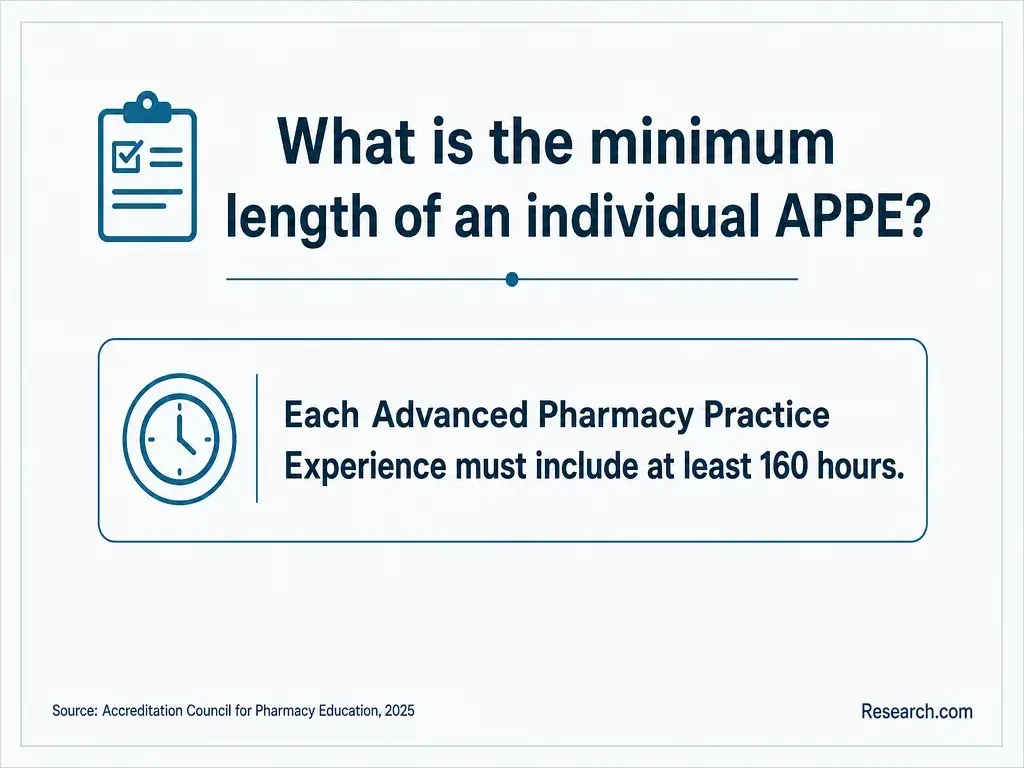
Skills labs provide controlled practice with equipment, classmates, simulated patients, or clinical cases. Faculty may use observed structured encounters and checkoffs to test interviewing, technique, reasoning, documentation, and communication. Introductory pharmacy practice experiences (IPPEs) introduce supervised practice during the professional program; advanced pharmacy practice experiences (APPEs) provide more intensive rotations later in training. Exact scheduling and sites vary by school.
A page about online pharmacy education duration may describe credentials other than the professional Pharm.D. Verify the credential and its experiential requirements before treating a shorter timeline as comparable.
Ask the experiential office these questions before committing, because placement logistics can determine whether a program is workable:
- Who finds and approves IPPE and APPE sites and preceptors, and how far might I need to travel?
- When must I complete intern registration, background checks, immunizations, or site onboarding?
- What happens if a site cancels, a required checkoff is failed, or a placement conflicts with work?
Plan for possible travel, temporary housing, and reduced work hours. A nearby placement should not be treated as guaranteed unless the program explicitly commits to it.
Schools set their own prerequisite courses, laboratory rules, minimum grades, credit requirements, and application procedures. Some admit eligible students without a completed bachelor's degree; others have different pathways. Review the current school admissions page alongside its PharmCAS listing, if it uses PharmCAS, rather than applying another program's thresholds. The Pharmacy College Admission Test was retired in January 2024 and is not a current exam to schedule.
For understanding pharmacy school admissions, distinguish eligibility from competitiveness. A stated minimum does not guarantee admission, and a prerequisite still in progress may be acceptable only if the school permits completion before matriculation. Confirm application deadlines, interviews, recommendations, course-age rules, and how repeated or transferred courses are evaluated.
A Pharm.D. typically follows undergraduate prerequisite study and then a sequenced professional curriculum; the professional phase is commonly four academic years, although some programs use accelerated calendars. The relevant comparison is your remaining time to completion, including unmet prerequisites, required labs, and rotations - not just the advertised length of the professional phase.
Compare an itemized cost of attendance, not tuition alone. Include mandatory fees, supplies, health and background requirements, technology, campus visits, rotation travel or housing, and eventual licensing costs. Published figures and aid eligibility depend on the school and academic year, so an online Doctor of Pharmacy price range is a starting point rather than a personalized total. Ask each financial aid office for its current estimate and for borrowing options applicable to your enrollment date; federal rules affecting many new graduate and professional borrowers changed beginning July 1, 2026.
How Does Patient Assessment Training Support Pharmacist Licensure and Careers?
Patient assessment prepares students for medication-focused care in settings such as community pharmacies, hospitals, and ambulatory care clinics. The Bureau of Labor Statistics projects 5% growth in pharmacist employment, 2025-2035, with about 12,500 openings per year. Those occupation-wide projections provide career context, not a forecast for graduates of any particular program or practice setting.
Completing an accredited Pharm.D. does not itself confer licensure. Graduates must meet the requirements of the state board where they seek to practice, which generally include the North American Pharmacist Licensure Examination (NAPLEX) and may include a jurisdiction-specific law examination and other conditions. Do not assume every jurisdiction uses the MPJE; check the board and National Association of Boards of Pharmacy for its current exam pathway. Residency can provide postgraduate clinical training, while fellowship and optional specialty board certification serve different purposes; none replaces a pharmacist license.
For pharmacy degree planning for cost and time, weigh the expense and time away from work against the kind of patient-care role you actually want. If your goal is pharmacist practice, compare programs on demonstrated assessment training, workable rotations, accreditation, total cost, and eligibility in your intended state - not speed alone. If your goal is a pharmacy technician role, investigate that separate occupation before committing to a Pharm.D.
Other Things You Should Know About PharmD
It depends on the school. Request the required supplies list before budgeting; some programs provide equipment for labs, while others require students to purchase specified items.
Do not assume it can. Technician experience may strengthen an application, but the Pharm.D. program decides whether any prior learning satisfies a professional course requirement.
Policies vary. Ask for the current handbook rules on feedback, remediation, retesting, progression, and any resulting delay to rotations.
Some schools record encounters for grading or feedback. Ask how recordings are used, who can access them, and what privacy rules apply.
- The impact of simulation-based training in medical education | nih.gov https://pmc.ncbi.nlm.nih.gov/articles/PMC11224887/
- Advanced Pharmacy Practice Experiences (APPE) | Veterans Affairs https://www.va.gov/loma-linda-health-care/work-with-us/internships-and-fellowships/advanced-pharmacy-practice-experiences-appe/
- Medication Reconciliation - Patient Safety and Quality - NCBI https://www.ncbi.nlm.nih.gov/books/NBK2648/
- A Call to Action for Integrating Introductory Pharmacy Practice Experiences With Purpose - ScienceDirect https://www.sciencedirect.com/science/article/abs/pii/S0002945924104019
- Žs Patient Care Process Before and After a Redesigne | belmont.edu https://repository.belmont.edu/cgi/viewcontent.cgi
- Types of Clinical Simulation Training | OHSU Admission Requirements and Application Process https://www.ohsu.edu/education/types-clinical-simulation-training
- Pharmacist - Explore Healthcare Careers | Mayo Clinic College of Medicine and Science https://college.mayo.edu/academics/explore-health-care-careers/careers-a-z/pharmacist/
- Standardized Patients | Ohio State College of Medicine https://medicine.osu.edu/departments/clinical-skills-center/standardized-patients
- Advanced Pharmacy Practice Experiences (APPE) | buffalo.edu https://pharmacy.buffalo.edu/academics/pharmd/experiential-education/advanced-pharmacy-practice-experiences--appe-.epa-and-educational-outcomes.html
- PharmD Courses | umaryland.edu https://catalog.pharmacy.umaryland.edu/courses/pharmd