How PharmD Rotations Support Residency Applications

Co-Founder and Chief Data Scientist
Pharm.D. students choosing advanced rotations face a practical trade-off: pursue a specialty early or build broad experience for a postgraduate year one (PGY1) pharmacy residency. Advanced pharmacy practice experiences (APPEs) can provide the clinical examples, preceptor relationships, and evidence of readiness that residency programs evaluate - but rotation choices alone do not secure a position.
This guide explains which experiences to prioritize, how to document and discuss your work, and what to confirm about application timing and eligibility before committing to a rotation schedule.
Key Things You Should Know
- Prioritize APPEs that offer supervised patient-care responsibility, specific feedback, and preceptors who can describe your work - not just a recognizable site name.
- Schedule a relevant APPE early enough to inform application materials or a recommendation letter; a later rotation may still help with interviews and preparation for residency.
- A Pharm.D., residency acceptance, and pharmacist licensure are separate milestones. Confirm each program's application, graduation, and licensure deadlines before building your rotation plan.
How do PharmD rotations strengthen pharmacy residency applications?
Introductory pharmacy practice experiences (IPPEs) expose students to practice earlier in the professional Pharm.D. curriculum. APPEs are later, supervised rotations in which students apply clinical and professional skills. Both differ from undergraduate pre-pharmacy prerequisites: APPEs provide recent, observable evidence that a residency applicant can assess medication-related problems, communicate recommendations, and respond to feedback.
That evidence can appear in a curriculum vitae (CV), application responses, preceptor recommendations, and interviews. A strong example identifies the patient-care question, your supervised contribution, the reasoning behind it, and what you learned. Applicants who entered pharmacy school through varied pharmacy program preparation requirements should focus on this professional-level work rather than treating prerequisite coursework as a substitute for it.
Residency selection is holistic and program-specific. A prestigious site cannot make up for weak performance, and an excellent rotation does not guarantee an interview or a Match position.
Which PharmD rotations best prepare students for residency training?
For many PGY1 applicants, a mix of acute care, ambulatory care, community or population-based practice, and health-system experience offers more useful evidence than several similar electives. The comparison below shows what different settings may let a student demonstrate; available duties depend on the site, preceptor, and student's authorized role.
| Rotation setting | Evidence it may provide | Important limitation |
| Inpatient general medicine | Medication assessment, team communication, and care transitions | Patient volume does not guarantee meaningful student responsibility |
| Ambulatory care | Follow-up, patient education, and longitudinal treatment assessment | Student activities and pharmacist scope vary by site and state |
| Community or population health | Access-to-care problem-solving, counseling, and workflow judgment | Experiences differ substantially between sites |
| Specialty elective | Focused exposure to a prospective practice area | Narrow exposure alone may not show broad PGY1 readiness |
A specialty APPE is most valuable when it tests a genuine interest and offers substantive work. Students in pharmacy doctorate programs with distance learning should ask how in-person APPE sites are approved and whether a desired specialty placement requires travel; online coursework does not make clinical rotations remote.
What residency application requirements do PharmD students need to meet?
Start with each residency program's current listing, not a generic checklist. Participating programs commonly use the Pharmacy Online Residency Centralized Application Service (PhORCAS) for materials and the ASHP Resident Matching Program for ranking and matching, but participation and requirements must be checked for each position. Review the program's deadline, requested CV and statements, recommendation process, interview format, graduation requirement, and pharmacist licensure deadline.
Some programs specify required rotation exposure, academic standing, or additional materials; others evaluate those factors without setting a formal threshold. The admissions standards for pharmacy schools with accessible admissions govern entry into a Pharm.D. program, not eligibility or competitiveness for residency.
Ask the residency contact how an APPE scheduled after applications close is considered. It may appear as a planned experience on a CV, but it cannot support a completed-performance claim or a detailed preceptor letter before the work occurs.
APPE evaluations can help students identify strengths and gaps, but residency programs do not necessarily receive a school's full evaluation forms. Their influence often comes indirectly: the experiences you describe, the feedback you act on, and what a preceptor can credibly say in a recommendation. Never assume that a strong course grade tells a selector how you handled a difficult recommendation or improved after criticism.
Read each evaluation while the experience is fresh. If it identifies a gap - for example, presenting concise assessments - seek another supervised opportunity to practice and ask the next preceptor for specific feedback. Timing matters in shortened Doctor of Pharmacy pathways as well as traditional schedules: confirm when APPE evaluations are completed relative to residency deadlines rather than assuming every rotation will be finished before applications open.
Choose sites by the work they permit you to do under supervision, not by name recognition alone. Ask the experiential education office which placements it coordinates or approves, when preferences are due, and whether students can request - but not necessarily secure - a particular site. Then ask about patient populations, preceptor availability, expected projects, and opportunities for feedback.
Account for logistics before ranking sites. Travel, temporary housing, background checks, immunizations, onboarding, and any required intern registration can affect whether a rotation is feasible. A distant specialty site may be worth the added expense if it provides exposure unavailable locally; a nearby site with stronger supervision may be the better choice. Students comparing online pharmacy degree affordability should include in-person rotation costs rather than comparing tuition alone.
The best potential letter writer has observed your work repeatedly and can give specific examples of clinical reasoning, communication, reliability, and growth. A preceptor on a demanding generalist APPE may write a more useful letter than a prominent specialist who saw little of your work.
Early in a rotation, clarify expectations and ask for midpoint feedback. Near the end, ask whether the preceptor can write a strong, specific recommendation by the program's deadline; give them your CV, goals, and examples of work they directly supervised. Students exploring pharmacy degree options for science majors should remember that prior laboratory or undergraduate experience can add context, but a residency letter should address readiness for pharmacist training.
If a preceptor cannot comment in detail - or signals reservations - choose another eligible writer. Do not ask someone to attest to patient-care activities they did not observe.
Keep a private, de-identified record after each APPE: setting, dates, supervised responsibilities, presentations or projects, feedback received, and the result of work you can substantiate. Follow site privacy rules; never retain patient identifiers or confidential records for an application.
On a CV, distinguish what you did from what you observed. For example, "Presented supervised medication assessments during interdisciplinary rounds" is more informative than "Participated in rounds." Describe a measurable result only if you can verify it and accurately attribute your contribution. Prior coursework listed through apply prior college credits to pharmacy programs resources may help with degree planning, but transferred credits are not rotation accomplishments.
Use consistent dates and descriptions across your CV, application, and interview. Label an upcoming APPE as planned, and revise claims about completed work only after the experience occurs.
Rotations give applicants real examples for questions about clinical judgment, teamwork, errors, uncertainty, and receiving feedback. Prepare a small set of de-identified cases that explain the situation, your supervised role, the evidence you considered, the action taken, and what you would improve. Be ready to explain when you escalated a concern to the preceptor rather than acting beyond your authority.
Practice discussing both a successful recommendation and one you revised after feedback. Interviewers can evaluate how you think and learn more readily than a list of disease states you encountered. Information about online pharmacy course completion timelines may describe credentials other than the Pharm.D.; it cannot replace supervised APPE experiences or the examples those experiences supply for a residency interview.
Confirm that your professional Pharm.D. program holds the applicable Accreditation Council for Pharmacy Education (ACPE) status, and check the residency program's stated graduation and licensure rules. ACPE accredits professional pharmacy programs; it does not certify individual pharmacists. Institutional accreditation and authorization to enroll a distance-learning student address different questions and should not be mistaken for professional-program accreditation.
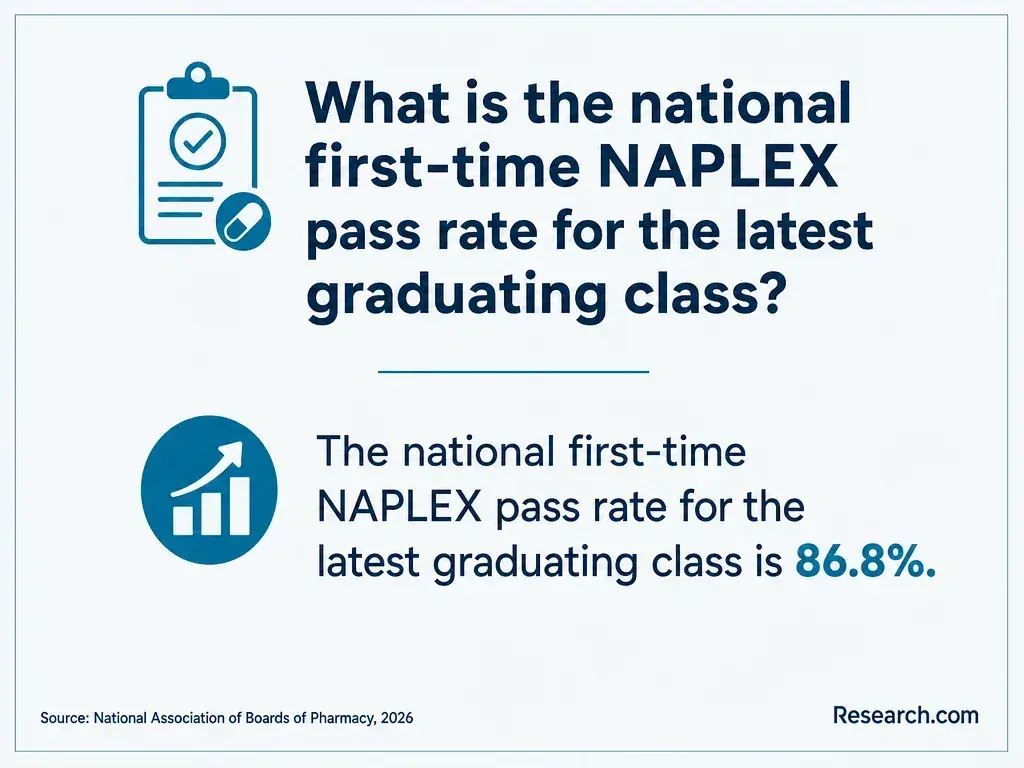
A Pharm.D. does not itself issue a pharmacist license. State boards set licensing requirements, including examinations and other conditions. The North American Pharmacist Licensure Examination (NAPLEX) is part of the process, while jurisprudence examination requirements vary by jurisdiction; do not assume every state uses the Multistate Pharmacy Jurisprudence Examination (MPJE). Ask prospective residencies when a license must be obtained and what happens if an exam or board approval is delayed. Likewise, online doctoral study duration says nothing by itself about ACPE status or residency eligibility.
How can PharmD students plan rotations for competitive career pathways?
Work backward from the kind of position you want. PGY1 generally develops broad practice capability; PGY2 typically provides more focused training and has additional entry requirements set by the program. A fellowship usually emphasizes a different training objective, often research or industry work, and is not interchangeable with a pharmacy residency. Board certification is a separate credential, not a pharmacist license or an automatic consequence of residency completion. Not every pharmacist role requires postgraduate training.
The Bureau of Labor Statistics reports median annual pay of $140,910 in May 2025 for pharmacists. That occupation-wide figure does not predict residency pay or prove that a particular rotation or specialty will increase earnings. Weigh the cost of placements and postgraduate training against the requirements of jobs you actually intend to pursue, including when considering cost-effective pharmacy degree options.
Use this sequence to make a rotation plan before preferences are due:
- Identify several target residency programs or jobs and record their stated experience, application, and licensure requirements.
- Rank available APPEs by supervised responsibility, relevant setting, preceptor access, timing, and travel cost.
- Place at least one useful experience early enough to support an application or letter, while leaving room to explore an alternative career interest.
- Confirm placements and onboarding with your school, then revisit the plan when schedules or career goals change.
Other Things You Should Know About PharmD
Yes, if the individual program accepts the applicant. Check its current eligibility criteria and be prepared to explain how employment supports the training goal.
Residencies commonly provide a stipend, but compensation and benefits vary by program. Compare the published offer with living costs and any relocation expenses before ranking positions.
Potentially. The Match has subsequent opportunities for eligible applicants and unfilled positions. Follow the current Match schedule and each remaining program's instructions; availability is not guaranteed.
Eligibility depends on the program and the relevant state's licensure rules. Ask about accepted educational credentials, foreign graduate requirements, work authorization, and the deadline for obtaining a pharmacist license before applying.
- Which PGY1 Pharmacy Residency Is Right for Me... - PMC https://pmc.ncbi.nlm.nih.gov/articles/PMC7243907/
- Advanced Pharmacy Practice Experiences (APPE) | Veterans Affairs https://www.va.gov/loma-linda-health-care/work-with-us/internships-and-fellowships/advanced-pharmacy-practice-experiences-appe/
- Evaluation of Residents | siumed.edu https://www.siumed.edu/gme/evaluation-residents
- Pharmacy Preceptor FAQs | Butler University https://www.butler.edu/health-professions/experiential/pharmacy-faqs/
- Evaluations (Resident, Fellow, Faculty and Program) | ucsf.edu https://fresno.ucsf.edu/document/compliantevaluationpolicypdf
- How to prepare for and apply to Pharmacy Residency Programs | Texas A&M University Irma Lerma Rangel College of Pharmacy https://pharmacy.tamu.edu/residency/residency-plan.html
- Experiential Education Site Selection Policy | ucsf.edu https://pharmd.ucsf.edu/policies/site-selection
- Advanced Pharmacy Practice Experiences (APPE) | Lake Erie College of Osteopathic Medicine https://lecom.edu/post-graduate-education/pharmacists/advanced-pharmacy-practice-experiences/
- Experiential Education | Washington State University https://pharmacy.wsu.edu/pharmd/experiential-services/
- PGY1 Pharmacy Residency - A Practical Guide for Clinical Pharmacy Professionals | American College of Clinical Pharmacy https://careers.accp.com/career-resources/on-the-job-3/pgy1-pharmacy-residency-a-practical-guide-for-clinical-pharmacy-professionals-148