2027 How to Become a Licensed Therapist (LPC) in Atlanta, GA: Counselor License Requirements

Co-Founder and Chief Data Scientist
If you want to become a Licensed Professional Counselor (LPC) in Atlanta, the main decision is not simply where to study. You need to understand Georgia’s licensure rules, choose a graduate program that supports those rules, complete supervised clinical experience, pass an approved national exam, and position yourself for work in a competitive but active mental health market.
This guide explains the LPC pathway in Atlanta for prospective graduate students, career changers, counseling interns, and pre-licensed professionals. You will learn what education is required, how supervision works, where students can train locally, what salaries are commonly reported, which employers hire LPCs, and how to avoid costly mistakes before committing to a program.
Quick answer: How do you become an LPC in Atlanta?
To become an LPC in Atlanta, you generally need a qualifying master’s degree in counseling or a closely related field, supervised clinical experience that meets Georgia requirements, a passing score on the National Counselor Examination (NCE) or National Clinical Mental Health Counseling Examination (NCMHCE), a completed application through the Georgia Secretary of State, and approval from the Georgia Composite Board of Professional Counselors, Social Workers, and Marriage & Family Therapists.
| Step | What you need to complete | Why it matters |
| Graduate education | A master’s degree in counseling or a closely related discipline from an accredited institution | Georgia requires advanced clinical preparation before candidates can pursue LPC licensure. |
| Clinical training during school | Practicum or internship experience, often around 600 hours depending on the program | This gives students supervised client-facing experience before post-master’s practice. |
| Post-master’s supervision | 3,000 hours of supervised clinical experience over at least two years | Supervised work helps candidates build competency before independent practice. |
| National exam | NCE or NCMHCE | Georgia accepts these exams as part of the licensure process. |
| State application | Application, transcripts, supervision documentation, background check, and fingerprints | The Board uses these documents to verify eligibility and public protection standards. |
What are the key benefits of becoming an LPC in Atlanta?
- Atlanta gives LPCs access to hospitals, community agencies, private practices, schools, nonprofit programs, and telehealth roles, making it easier to build experience across different populations and treatment settings.
- Commonly reported LPC pay in Atlanta appears in several ranges throughout available market sources, including $50,000 to $65,000 annually, with compensation affected by experience, setting, specialization, and whether the role is salaried, contract-based, or private practice.
- Major local employers and systems connected to behavioral health work include Emory Healthcare, Grady Health System, and the Georgia Department of Behavioral Health and Developmental Disabilities.
- Educational requirements for LPC licensure in Atlanta
- How to apply for counselor licensure in Atlanta
- Atlanta-area schools for future LPCs
- Practicum and internship opportunities in Atlanta
- LPC salary expectations in Atlanta
- Georgia supervision requirements for LPC candidates
- Whether Atlanta is a good market for LPCs
- Substance abuse counseling specialization and Atlanta work conditions
- Dual licensure options for LPCs in Atlanta
- Affordable ways to finance LPC education
- Renewal and continuing education expectations
- LPC job market competitiveness in Atlanta
- Professional counseling associations in Atlanta and Georgia
- Popular LPC employers and work settings
- Alternative certifications for LPC career growth and related credential planning
Is becoming an LPC in Atlanta worth it?
Becoming an LPC in Atlanta can be worth it if you are committed to graduate-level education, supervised clinical work, and long-term professional development. The city has a broad behavioral health ecosystem, but the pathway requires time, tuition planning, and careful attention to Georgia licensure rules.
| Choose the LPC path if... | Consider another path if... |
| You want to provide mental health counseling in clinical, community, healthcare, school-adjacent, or private practice settings. | You want a faster entry route into support roles that do not require a master’s degree or clinical licensure. |
| You are prepared for post-master’s supervised practice before full independent licensure. | You are not ready to complete graduate school, clinical internships, or supervised hours. |
| You want flexibility to specialize in areas such as trauma, substance use, family systems, grief, anxiety, or child and adolescent services. | You mainly want to conduct psychological testing or diagnose complex psychiatric conditions in roles that may require psychology, psychiatry, or social work credentials. |
| You can compare programs by accreditation, clinical placement support, cost, faculty fit, and licensure alignment. | You are choosing a school based only on convenience, advertising, or tuition without verifying licensure outcomes. |
What are the educational requirements to become an LPC in Atlanta?
Atlanta LPC candidates follow Georgia’s professional counseling requirements, so the educational foundation usually begins with a graduate degree that prepares students for clinical mental health practice. The safest approach is to select a program that clearly maps its curriculum, practicum, internship, and faculty supervision model to Georgia LPC expectations.
- Earn a master’s degree in counseling or a closely related field, such as clinical mental health counseling, psychology, or marriage and family therapy, from an accredited institution.
- Look for graduate coursework covering counseling theory, ethics, assessment, diagnosis, human development, multicultural counseling, group counseling, research, and professional practice.
- Prioritize programs that combine classroom learning with counseling skill development, case conceptualization, psychopathology, treatment planning, and supervised applied work.
- Plan for supervised practicum or internship experience during the degree; many programs require around 600 hours before graduation.
- Confirm that any Atlanta-area program you consider is designed around Georgia licensure standards. Programs associated with Georgia State University and Argosy University Atlanta have been referenced in relation to structured curricula and local internship opportunities, but applicants should verify current program status, accreditation, and Board alignment before enrolling.
- Do not limit your search to the city limits. Nearby institutions, including Mercer University in Macon, may also meet Georgia’s educational prerequisites for LPC licensure.
How to evaluate a counseling master’s program before enrolling
| Factor to verify | Question to ask the program | Why it affects licensure or ROI |
| Accreditation and licensure alignment | Does the curriculum meet Georgia LPC educational requirements? | A degree that does not align with state rules can delay or block licensure. |
| Clinical placement support | Does the school help students secure practicum and internship sites in Atlanta? | Placement delays can extend your timeline and affect graduation planning. |
| Faculty supervision experience | Are faculty members licensed counselors or experienced clinical supervisors? | Faculty expertise can improve clinical preparation and mentoring. |
| Format | Can the program be completed full time, part time, online, hybrid, or on campus? | Working adults may need flexibility, but online students still need approved clinical placements. |
| Total cost | What is the full cost including tuition, fees, books, clinical requirements, commuting, and exam preparation? | Sticker tuition alone does not show the real investment required. |
How do you apply for licensure as a counselor in Atlanta?
The LPC application process in Atlanta is handled at the state level through the Georgia Composite Board of Professional Counselors, Social Workers, and Marriage & Family Therapists. Candidates typically apply after completing the required education, supervised experience, and exam requirements specified by Georgia.
Applicants submit materials through the Georgia Secretary of State’s online system. The application generally includes identifying information, official transcripts, supervision records, exam documentation, and other materials required by the Board. Because rules and forms can change, applicants should always check the current Board instructions before submitting payment or requesting transcripts.
Georgia recognizes the National Counselor Examination (NCE) and the National Clinical Mental Health Counseling Examination (NCMHCE). Passing one of these exams demonstrates competency in core counseling knowledge and clinical decision-making areas. Candidates must also document at least 3,000 hours of supervised clinical experience completed over at least two years, including appropriate direct client contact and supervision by a qualified professional.
A criminal background check and fingerprint submission are also part of the process. After licensure, LPCs must follow Georgia’s ethical rules, renewal policies, and continuing education requirements to remain in good standing.
- File the LPC application through the Georgia Secretary of State portal.
- Submit documentation showing 3,000 hours of supervised clinical experience over at least two years.
- Pass either the NCE or the NCMHCE.
- Complete the required background check and fingerprinting process.
- Maintain compliance with Georgia’s ethical, professional, renewal, and continuing education standards.
If your long-term interests include addiction treatment, court-connected services, recovery programs, or community behavioral health, review related pathways in substance abuse and addiction counseling careers.
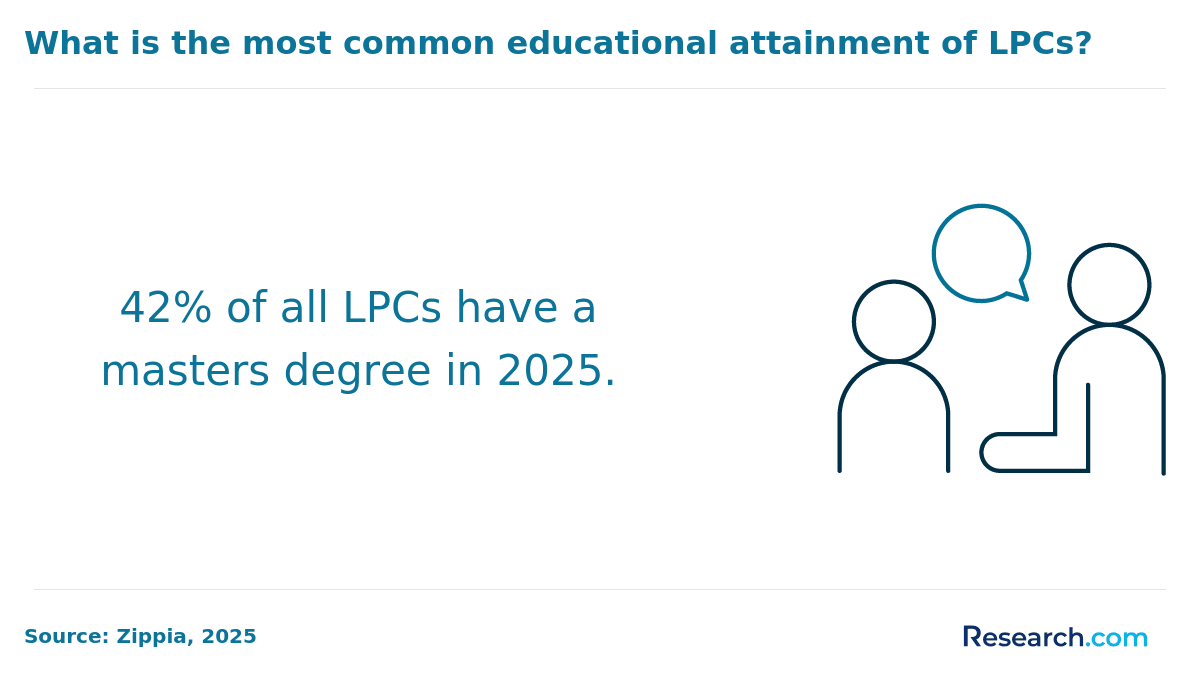
The visual below notes that a master’s degree is the most common educational level among licensed professional counselors, with 42% holding this credential in 2025. For Atlanta candidates, that reinforces why graduate education is central to the LPC pathway.
Which schools in Atlanta offer programs for aspiring LPCs?
Several Atlanta-area institutions offer graduate counseling programs that may prepare students for the LPC pathway in Georgia. Before applying, verify the program’s current accreditation, curriculum, clinical placement process, and licensure disclosures directly with the school and the Georgia Board.
| School | Program information stated | Best fit for students who... |
| Georgia State University (GSU) | Offers a CACREP-accredited Master of Science in Clinical Mental Health Counseling. | Want a public university setting with preparation for counseling roles across multiple environments. |
| Mercer University | Provides a CACREP-accredited Master of Science in Clinical Mental Health Counseling through its College of Professional Advancement. | Need flexible learning options while pursuing a Georgia-focused counseling pathway. |
| Clark Atlanta University (CAU) | Offers a 60-credit-hour Master of Arts in Clinical Mental Health Counseling. | Want training designed for professional counseling work in community settings. |
| Richmont Graduate University | Provides a CACREP-accredited Master of Arts in Clinical Mental Health Counseling with a Christian perspective. | Prefer a program that integrates clinical preparation with faith-informed education. |
Program names and accreditation status should never be assumed. Ask admissions staff whether the program meets Georgia LPC educational rules, how internship sites are approved, what exam preparation is offered, and whether graduates have encountered licensure delays.
If you are comparing counseling careers more broadly, Research.com’s guide to counseling psychology career options can help you understand how professional counseling differs from psychology-focused roles.
Are there internship or practicum opportunities for counseling students in Atlanta?
Yes. Atlanta has a range of practicum and internship sites for counseling students, but availability depends on school partnerships, site capacity, supervision requirements, schedule fit, and the student’s readiness for clinical work. Students should begin planning placements early because competitive sites may have application deadlines, interviews, background checks, and minimum time commitments.
Examples of Atlanta practicum and internship settings
- Skyland Trail: Offers a 9-month, 20-hour-per-week unpaid internship for graduate students in clinical counseling, social work, or marriage and family therapy. Interns may gain exposure to individual therapy, group work, Dialectical Behavior Therapy (DBT), and Cognitive Behavioral Therapy (CBT).
- Sigma Counseling Services: Provides practicum and internship options for students in counseling, psychology, or social work, including individual, group, and family counseling with supervision from licensed clinicians.
- Connect Counseling Center: Offers structured placements focused on clinical services, triage, individual and group counseling, and private practice operations. The program requires a commitment of at least two semesters.
- Agnes Scott College: Connects Clinical Mental Health Counseling students with placement sites such as Art It Out Therapy Center, Dekalb Community Service Board, and Skyland Trail.
- Georgia State University Counseling Center: Offers a doctoral internship program with supervision, case conferences, and seminars designed to build counseling competencies.
How to choose a strong clinical placement
| Placement feature | Why it matters | Question to ask |
| Qualified supervision | Your hours must be supervised appropriately for academic and licensure purposes. | Who will supervise me, and what license or credential does that person hold? |
| Client population | Your placement shapes early clinical identity and future job competitiveness. | Will I work with adults, children, families, groups, trauma cases, addiction, crisis, or severe mental illness? |
| Direct service hours | Programs often require specific client-contact experience. | How many direct client hours do interns usually complete each semester? |
| Training model | Some sites provide formal didactics; others expect more independent learning. | Are there case conferences, seminars, documentation training, or evidence-based practice workshops? |
| Schedule expectations | Students working full time may struggle with daytime clinical requirements. | Are evening, weekend, or telehealth hours available? |
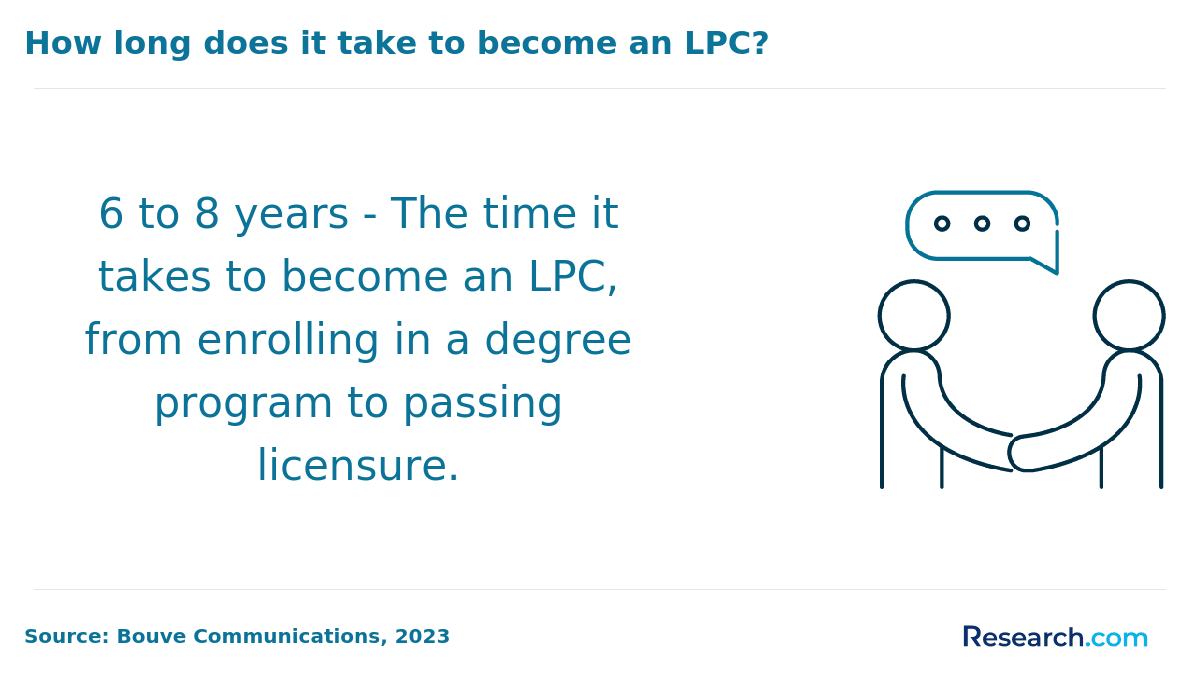
The image below summarizes a typical LPC timeline of about 6 to 8 years from initial formal education through licensure. That long runway is why Atlanta counseling students should treat practicum and internship planning as a core part of their career strategy, not as a last-semester task.
How much do LPCs make in Atlanta?
LPC earnings in Atlanta vary widely because counselors work in many settings, including hospitals, community agencies, school-linked services, private practices, pediatric systems, autism centers, group practices, and telehealth companies. Reported salary figures also differ by source and job title definition, so candidates should compare multiple sources before estimating return on investment.
| Salary figure stated | Context | How to interpret it |
| $45,000 to $65,000 annually | Commonly cited LPC average salary range in Atlanta. | Useful as a general planning range, especially for earlier-career or agency-based roles. |
| $50,000 to $65,000 annually | Another reported range for LPCs in Atlanta. | Shows that many estimates cluster in the mid-five-figure range. |
| Approximately $76,936 | Reported average annual salary in one Atlanta market summary. | May reflect a different source, sample, job mix, or experience profile. |
| $45,869 to $129,042 | Reported salary range tied to experience and specialization. | Highlights how much earnings can differ between entry roles, specialized practice, and higher-paying arrangements. |
| Approximately $64,903 | Another stated average annual salary for LPCs in Atlanta. | May be more conservative than higher estimates and should be compared with current job postings. |
| $57,472 to $69,660 | Typical range reported in the job market section. | Helpful for evaluating ordinary salaried offers. |
| $50,706 to $73,991 | Reported range from entry-level to experienced counselors. | Suggests experience and specialization can meaningfully affect pay. |
Employers and settings that may hire LPCs in Atlanta
- Emory Healthcare: A major healthcare system where counselors may work alongside interdisciplinary medical and behavioral health teams.
- The Marcus Autism Center: A specialized setting serving children and families affected by autism spectrum disorders.
- Center for Family Counseling: A community-based environment where counselors may encounter family therapy, substance use concerns, and accessible mental health services.
- Grady Health System: A large public hospital system with diverse client needs and high-acuity behavioral health demand.
- Children’s Healthcare of Atlanta: A pediatric-focused system where counseling work may involve children, adolescents, caregivers, and developmental concerns.
If you are exploring counseling-adjacent roles that do not follow the standard LPC route, review Research.com’s guide on becoming a grief counselor without a degree to understand the limits and possibilities of nontraditional support roles.
The chart below compares top-paying metropolitan areas for therapists. Atlanta is not shown among the highest-paying regions, but the comparison helps place local LPC compensation within a broader national context.
What are the supervision requirements for LPCs in Atlanta?
Georgia requires LPC candidates to complete supervised post-master’s professional counseling experience before independent licensure. Supervision is not just a paperwork requirement; it is where new counselors refine ethics, diagnosis, treatment planning, documentation, risk assessment, boundaries, and cultural responsiveness.
| Requirement | Georgia expectation stated | Practical planning tip |
| Total supervised experience | At least 3,000 hours of supervised post-master's directed experience in professional counseling. | Track hours from the beginning and keep copies of signed supervision records. |
| Minimum time | Experience must be completed over a period of not less than two years. | Do not assume working extra hours will shorten the minimum timeline. |
| Direct client contact | At least 1,000 hours must involve direct client contact. | Choose roles that provide enough client-facing work, not only administrative duties. |
| Total supervision | At least 100 hours of supervision are required. | Schedule supervision consistently so you are not short on hours near application time. |
| Individual supervision | At least 50 hours must be individual supervision. | Confirm how your supervisor distinguishes individual, group, and administrative consultation. |
Supervisors must also meet Georgia qualifications. They should be Licensed Professional Counselors in Georgia with at least three years of post-licensure experience and hold an approved supervision credential such as the Approved Clinical Supervisor (ACS) credential from the National Board for Certified Counselors (NBCC) or the Certified Professional Counselor Supervisor (CPCS) credential from the Licensed Professional Counselors Association of Georgia (LPCAGA).
Questions to ask before accepting a supervised counseling job
- Will this position count toward Georgia LPC supervised experience requirements?
- Who signs off on my hours, and what credentials does that person hold?
- How many direct client hours can I reasonably expect each week?
- Is supervision included in employment, or do I pay separately?
- Does the employer support exam preparation, continuing education, or professional association membership?
Is Atlanta a good place to work as an LPC?
Atlanta can be a strong LPC market for counselors who want access to large healthcare systems, community mental health programs, private practice networks, pediatric providers, university-adjacent services, and culturally diverse client populations. It is not a guaranteed easy market, however. New counselors still need strong supervision, clinical documentation skills, professional references, and a clear specialty or population focus.
One market summary reports an average annual salary of approximately $76,936 for LPCs in Atlanta, with a range from $45,869 to $129,042 depending on experience and specialization. Another section of available data reports over 200 LPC positions on platforms like Indeed, including jobs in private practices, hospitals, schools, and community health organizations.
Cost-of-living figures also vary by source. One stated estimate places Atlanta’s cost of living about 3% lower than the national average, with median rents around $1,411 per month and median home prices approximately $464,167. Another stated estimate places the city’s cost of living about 3.8% higher than the national average. Because these figures differ, use them as prompts for personal budgeting rather than fixed assumptions.
For many LPCs, Atlanta’s appeal is the mix of professional opportunity and community need. Counselors can work with clients across age groups, socioeconomic backgrounds, cultures, diagnoses, and treatment levels. That diversity can accelerate clinical growth, but it also requires humility, supervision, and continuing education.
How can I specialize in substance abuse counseling as an LPC in Atlanta?
Substance abuse counseling can be a valuable LPC specialization in Atlanta because addiction concerns often overlap with trauma, family stress, court involvement, housing instability, co-occurring mental health conditions, and medical care. LPCs who want to work in this area should seek addiction-focused coursework, supervised clinical experience, continuing education, and training in assessment, relapse prevention, motivational interviewing, group counseling, crisis planning, and ethical documentation.
Specialization should be intentional. If you want to work in detox, outpatient treatment, recovery programs, community behavioral health, or private practice with substance use concerns, choose internship and supervised roles that expose you to addiction treatment systems. For a more focused pathway, see Research.com’s guide on how to become a drug counselor in Atlanta.
Can pursuing dual licensure expand career prospects for LPCs in Atlanta?
Dual licensure can broaden an LPC’s employment options when the second credential genuinely supports the counselor’s clinical goals. For example, a professional who works heavily with couples, families, parenting concerns, or relational trauma may benefit from understanding how to become a marriage and family therapist in Atlanta.
The trade-off is cost and time. Additional licensure may require more coursework, supervision, exams, fees, and continuing education. It makes the most sense when it aligns with your target clients, employer requirements, and long-term practice model.
| Option | Potential advantage | Watch out for |
| LPC only | Focused preparation for professional counseling roles. | May be less specialized for family-systems or other niche roles. |
| LPC plus marriage and family therapy pathway | May strengthen work with couples, families, and relational systems. | Can add time, cost, and separate licensure obligations. |
| LPC plus addiction-focused credentialing or training | Can support work in recovery, outpatient programs, and co-occurring disorder treatment. | Requirements vary, so verify credential rules before paying for training. |
How can I finance your LPC education economically in Atlanta?
The most economical route to LPC preparation is usually the one that meets Georgia licensure requirements at the lowest total net cost, not necessarily the program with the lowest advertised tuition. Students should compare tuition, fees, commuting, books, internship-related expenses, exam preparation, supervision costs after graduation, and the income they may give up while studying.
- Ask each school about scholarships, assistantships, grants, payment plans, and employer tuition benefits.
- Compare public, private, online, hybrid, and part-time options based on total cost and licensure alignment.
- Choose programs with strong placement support so you do not lose time searching for practicum or internship sites.
- Ask whether graduate credits can transfer if you already completed relevant coursework.
- Budget for post-master’s supervision, exam fees, application fees, background checks, and professional liability insurance.
Although teaching credentials follow a different professional pathway, Research.com’s resource on the cheapest way to become a teacher in Atlanta may be useful if you are comparing how different licensed professions control education costs.
What are the licensure renewal and continuing education requirements for LPCs in Atlanta?
After licensure, Atlanta LPCs must maintain their Georgia license according to the rules of the Georgia Composite Board of Professional Counselors, Social Workers, and Marriage & Family Therapists. Renewal usually involves completing Board-approved continuing education, submitting renewal materials, and paying the required fee during the licensure cycle.
Continuing education should not be treated as a checkbox. Strong CE choices keep counselors current in ethics, diagnosis, telehealth, suicide risk, trauma-informed care, documentation, cultural competence, and emerging treatment practices. Counselors should save certificates and confirm that courses meet current Georgia requirements before relying on them for renewal.
For a broader explanation of counseling career preparation in the city, see how to become a mental health counselor in Atlanta.
Common mistakes to avoid on the Atlanta LPC pathway
| Mistake | Why it can hurt you | Better approach |
| Choosing a program without checking licensure alignment | You may graduate without the coursework or clinical preparation Georgia expects. | Ask for written licensure disclosures and compare them with Board requirements. |
| Looking only at tuition | Fees, commuting, lost wages, supervision, and exam costs can change the real price. | Calculate total net cost from enrollment through licensure. |
| Assuming online programs automatically meet Georgia requirements | Some online degrees may not match state-specific rules or placement expectations. | Confirm Georgia eligibility before enrolling. |
| Waiting too long to plan practicum or internship | Competitive sites may fill early or require multi-semester commitments. | Start researching placements during the first year of graduate study. |
| Failing to document supervision carefully | Missing signatures or unclear records can delay licensure review. | Track hours weekly and keep backup copies of forms. |
| Relying on salary averages as guarantees | Pay varies by employer, caseload, specialization, experience, and contract type. | Compare current job postings and ask about productivity requirements, benefits, and supervision. |
How competitive is the job market for LPCs in Atlanta?
The Atlanta LPC job market appears active but not effortless. As of May 2025, more than 200 LPC job openings were reported in the area, including roles in private practices, hospitals, schools, and community health organizations. That level of posting activity suggests demand, but candidates still compete on experience, specialization, licensure status, availability, and fit with the employer’s client population.
Reported pay varies. One estimate lists the average annual salary at approximately $64,903, with a typical range between $57,472 and $69,660. Entry-level positions may begin around $50,706, while experienced counselors may reach up to $73,991. These numbers should be weighed against role expectations, benefits, supervision support, productivity quotas, and cost of living.
Atlanta’s cost of living is described in one source as about 3.8% higher than the national average. Because salary and cost estimates vary, LPC candidates should build a personal budget before accepting a position, especially if they carry graduate student debt or pay for outside supervision.
Counselors who want a faith-integrated academic path may also compare options such as a Christian counseling masters, while confirming whether any program they choose supports their intended license and career setting.
Are there counseling associations in Atlanta?
Yes. Professional associations can help Atlanta LPCs and counseling students find continuing education, networking, advocacy updates, supervision resources, job leads, and specialty communities. They are especially useful for pre-licensed counselors who need guidance on supervision, ethics, and career planning.
- Licensed Professional Counselors Association of Georgia (LPCA of GA): A professional organization and state chapter of the American Mental Health Counselors Association that supports counseling practice and professional standards.
- ACA of Georgia: A branch of the American Counseling Association serving professional counselors and counseling students across specialties in the state.
- Atlanta Group Psychotherapy Society (AGPS): A multidisciplinary organization focused on education, professional development, and connection in group psychotherapy.
- Georgia Addiction Counselors Association (GACA): Provides credentialing, training, education, advocacy, and support for addiction-focused professionals across Georgia.
- Georgia School Counselor Association (GSCA): Supports school counselors through professional development and resources connected to student success.
If you are still deciding on graduate education, compare the structure and outcomes of a master's degree in counseling before choosing a program or specialization.
Which are the most popular employers of LPCs in Atlanta?
Atlanta LPCs commonly work for large healthcare systems, public hospitals, community agencies, private practices, universities, pediatric providers, telehealth companies, and nonprofit mental health organizations. Employers such as Emory Healthcare and Grady Health System are frequently associated with behavioral health opportunities. Community organizations, including Thresholds and Mental Health America of Georgia, may appeal to counselors interested in access, advocacy, and underserved populations.
Current trends affecting LPC employment in Atlanta
- High patient-to-provider ratios: Public and community systems may carry heavy caseloads, which can create meaningful experience but also increase burnout risk.
- Limited state funding: Budget pressure in mental health programs can affect staffing, pay, and the number of available roles.
- More competition in private practice: Counselors entering group or independent practice may need a defined niche, referral strategy, and strong clinical reputation.
- Regulatory updates: Georgia LPCs must stay alert to changes in licensure, continuing education, supervision, and telehealth rules.
- Telehealth growth: Remote counseling has expanded access, but LPCs need digital competence, privacy awareness, and skill in building rapport online.
To stand out, aspiring LPCs should build experience across more than one setting, become comfortable with telehealth documentation and platforms, pursue supervision from strong clinicians, and choose continuing education that supports a recognizable specialty.
The chart below shows major industries that employ therapists. Settings such as offices of other health practitioners and psychiatric hospitals help illustrate where LPC-related opportunities may appear in Atlanta and comparable markets.
How can alternative certifications enhance my LPC career in Atlanta?
Additional certifications can help an LPC deepen expertise, collaborate across disciplines, and serve specific client populations more effectively. The best credentials are those that match your caseload and employer needs, such as addiction counseling, trauma-informed care, play therapy, group therapy, telehealth, behavioral interventions, or family-focused practice.
Behavior analysis is one example of a related field that may complement counseling work, especially for professionals serving children, neurodiverse clients, families, or behavioral health programs. If that direction fits your goals, review BCBA certification requirements in Atlanta to understand how behavioral intervention training differs from LPC preparation.
| Career goal | Certification or training focus to consider | Decision rule |
| Work with substance use disorders | Addiction counseling, relapse prevention, motivational interviewing, co-occurring disorders | Choose this if your clinical placements or target employers serve recovery populations. |
| Work with children and families | Family systems, play therapy, parenting interventions, developmental mental health | Choose this if you want pediatric, school-linked, or family practice roles. |
| Expand telehealth services | Telebehavioral health ethics, online risk management, digital documentation | Choose this if you plan to work remotely or across hybrid care models. |
| Collaborate in behavioral programs | Behavior analysis concepts, autism-informed care, interdisciplinary treatment planning | Choose this if your setting includes autism services, behavioral health teams, or structured interventions. |
What LPCs in Atlanta Say About Their Careers
- My Atlanta LPC path helped me serve clients from many backgrounds while developing a stronger clinical identity. After completing my studies at Georgia State University, I found work with a nonprofit that focuses on mental health outreach in underserved communities. Seeing therapy improve daily life for clients keeps me committed to this profession. Maya
- Practicing near Midtown has shown me how varied counseling needs can be in a fast-growing city. I value the workshops, peer consultation, and professional networks available in Atlanta because they help me keep my skills current. The city’s mix of culture, neighborhoods, and green spaces also makes the work-life balance more manageable. James
- After two decades as an LPC, I still see Atlanta as a place where counselors can build stable and meaningful careers. I graduated from Emory University, now mentor newer therapists, and manage a caseload at a community health center in Decatur. The need for mental health services remains steady, but success requires good supervision, boundaries, and ongoing learning. Linda
Related Articles for Nearby Cities
- 2027 How to Become a Licensed Therpist (LPC) in Huntsville, AL: Counselor License Requirements
- 2027 How to Become a Licensed Therapist (LPC) in Nashville, TN
- 2027 How to Become a Licensed Therapist (LPC) in Charlotte, NC
- 2027 How to Become a Licensed Therapist (LPC) in Jacksonville, FL
- 2027 How to Become a Licensed Therapist (LPC) in Winston-Salem, NC
- 2027 How to Become a Licensed Therapist (LPC) in Lexington, KY
- 2027 How to Become a Licensed Therapist (LPC) in Greensboro, NC
- 2027 How to Become a Licensed Therapist (LPC) in Louisville, KY
- 2027 How to Become a Licensed Therapist (LPC) in Memphis, TN
- 2027 How to Become a Licensed Therapist (LPC) in Durham, NC: Counselor License Requirements
References:
- Agnes Scott College. Clinical Mental Health Counseling Practicum and Internship Sites.
- American Counseling Association. Internship Opportunities.
- Anxiety Specialists of Atlanta. Employment Opportunities.
- Counseling Center at Georgia State University. Internship Program - Georgia State Counseling Center.
- LPCA of Georgia. CE Requirements - Licensed Professional Counselors Association.
- Online Counseling Programs. How to Become a Licensed Counselor (LPC) in Georgia.
- Restoration Counseling of Atlanta. Employment Opportunities - Restoration Counseling of Atlanta.
- Skyland Trail. Counseling and Recreational Therapy Internships at Skyland Trail.
- The Comfy Place. Counseling Intern Program - The Comfy Place.
- The Well Woman. LCSW, LPC, LMFT Therapist Employment Atlanta, GA.
Key Insights
- Atlanta can be a strong LPC market because it includes hospitals, community programs, private practices, pediatric providers, nonprofit agencies, and telehealth roles, but candidates still need a clear specialization and strong supervised experience.
- The Georgia LPC pathway requires graduate education, clinical training, 3,000 hours of supervised experience over at least two years, an approved national exam, background checks, and Board approval.
- Salary estimates for Atlanta LPCs vary significantly, with reported figures ranging from $45,000 to $65,000 annually, $50,000 to $65,000 annually, approximately $64,903, and approximately $76,936 depending on the source and role mix.
- The best counseling master’s program is not automatically the cheapest or most convenient one. It should meet Georgia requirements, support practicum and internship placement, offer qualified faculty supervision, and fit your budget.
- Students should plan clinical placements early. Sites such as Skyland Trail, Sigma Counseling Services, Connect Counseling Center, Agnes Scott College partner sites, and Georgia State University Counseling Center illustrate the range of local training environments.
- Common mistakes include ignoring accreditation and licensure alignment, underestimating total cost, assuming online programs meet Georgia rules, delaying internship planning, and failing to document supervision hours carefully.
- Specializations in substance abuse counseling, family systems, telehealth, behavioral interventions, grief, trauma, or child and adolescent care can help Atlanta LPCs stand out when those credentials match real employer and client needs.
Other Things You Need to Know About Becoming an LPC in Atlanta
Georgia LPC candidates must pass the National Counselor Examination (NCE) for licensure. The Georgia Composite Board requires a passing score before issuing full LPC status, along with the required graduate degree and supervised experience. Exam registration is handled through the National Board for Certified Counselors.
To acquire the required supervision hours for LPC licensure in Atlanta, 2027, complete at least 3,000 supervised post-master's hours, with a minimum of 100 hours of direct supervision by a licensed supervisor, such as an LPC with the necessary credentials. Ensure experiences cover various competencies in counseling and therapy.