Financial Aid for Online PharmD Students

Co-Founder and Chief Data Scientist
An online Doctor of Pharmacy (Pharm.D.) program can reduce commuting without eliminating tuition, campus visits, or in-person clinical training costs. For prospective students, the harder question is whether grants, scholarships, employer support, and federal loans will cover the full cost without creating unmanageable debt.
This guide explains which aid may be available, how recent federal borrowing changes affect planning, and what to ask each school before enrolling. You'll leave with a way to compare aid offers against the actual cost of completing an accredited program.
Key Things You Should Know
- Online delivery does not, by itself, disqualify an eligible Pharm.D. student from federal aid; the school, program, enrollment, and student must meet applicable requirements.
- Federal borrowing rules changed for many new graduate and professional students beginning July 1, 2026. Get a written, year-by-year financing estimate rather than assuming Grad PLUS loans will cover any remaining cost.
- Compare aid with the full cost of attendance, including required campus visits and in-person rotations. An advertised tuition price is not the amount you will necessarily need to finance.
What financial aid is available for online PharmD students?
Eligible students may combine school scholarships, outside scholarships, employer tuition assistance, federal student loans, and personal funds. Some students may qualify for grants during undergraduate prerequisite coursework, but they should not assume those grants will continue after entering the professional Pharm.D. curriculum. Aid depends on the student's classification and the school's award policies - not whether lectures are viewed online.
Use the categories below to separate funding that reduces your cost from funding you must repay.
| Funding source | What to check |
| Scholarships and grants | Eligibility, renewal conditions, and whether awards apply to professional students |
| Employer assistance | Covered courses, payment timing, work commitments, and tax treatment |
| Federal student loans | Program eligibility, your borrower classification, applicable limits, and repayment obligations |
| Private loans | Interest rate, cosigner requirements, repayment protections, and total borrowing cost |
Private loans can fill a gap, but compare their terms carefully with federal loans before signing. When reviewing options for Doctor of Pharmacy study online, ask each school for an aid estimate covering every academic year, not just the first term.
Can online PharmD students receive federal financial aid?
Yes, potentially. Online instruction is not an automatic barrier to federal aid. Eligibility depends on factors including the institution's and program's participation in federal student aid, the student's eligibility, enrollment status, and satisfactory academic progress. Submit the Free Application for Federal Student Aid (FAFSA) for the applicable aid year and confirm the school's requirements with its financial aid office.
Classification matters: Undergraduate pre-pharmacy courses and the professional Pharm.D. curriculum are different stages of education. Grant eligibility and loan rules can change between them. Students entering Pharm.D. programs for students with a pre-pharmacy background should ask when the school will classify them as professional students.
For many students who begin graduate or professional study on or after July 1, 2026, new federal borrowing rules limit access to loans that previously helped cover costs beyond Direct Unsubsidized Loan limits. Transition provisions may apply to some existing borrowers. Because eligibility turns on individual circumstances and current implementation rules, ask the aid office which loan types and annual and aggregate limits apply to you for each remaining year. Do not treat a school's full cost of attendance as a promise that you can borrow that amount federally.
How much does an online PharmD program cost?
There is no dependable single price for an online Pharm.D. Tuition varies by school, credit load, residency status where applicable, and program length. More importantly, the bill from the school may exclude costs you must pay to complete the degree. Request the current tuition and fee schedule and the school's cost-of-attendance budget for your enrollment plan.
These cost categories show why two programs with similar tuition can require different amounts of cash or borrowing.
| Cost category | Potential expense |
| Academic charges | Tuition, mandatory fees, technology, books, and clinical-reference resources |
| Hands-on requirements | Campus immersions, lab supplies, travel, lodging, and missed work |
| Clinical training | Rotation travel or housing, background checks, immunizations, and required equipment |
| Before and after the degree | Unmet prerequisites, licensure applications, and examinations |
Compare the net amount you must fund: total expected costs minus aid you do not repay, with loans shown separately. A lower tuition rate may lose its advantage if required travel or extended enrollment raises the total. Lists of Doctor of Pharmacy programs with manageable tuition can help you identify candidates, but confirm every price and required visit directly with the school.
Start with the pharmacy school's admissions and financial aid offices. Schools may offer merit awards, need-based aid, or scholarships tied to service, background, or academic standing. Professional associations, community organizations, employers, and local pharmacy groups may also offer awards. An online student's eligibility is determined by each scholarship's terms; never assume either automatic inclusion or exclusion.
Focus applications on awards for which you meet the published criteria, then check whether they can be renewed. An award limited to the first year does much less to reduce total borrowing than one available throughout the professional curriculum. Ask whether outside scholarships reduce loans, other school aid, or both.
To judge the value of an award, compare its duration with your expected enrollment schedule. A guide to pharmacy program tuition and length may help frame that comparison, but use each school's current scholarship terms and full cost estimate for your decision.
Apply early enough to meet both the school's and outside organizations' deadlines. Admissions and financial aid are separate processes: an acceptance letter does not establish your aid eligibility or final award.
Follow this sequence to turn a preliminary offer into a workable financing plan:
- Confirm the Pharm.D. program's federal aid participation and ask how the school classifies students at each stage of the pathway.
- Submit the FAFSA for the appropriate aid year and complete any school-specific scholarship applications.
- Request a written, term-by-term cost estimate that includes required campus activities and clinical rotations.
- Review the offer for renewable gift aid, loan type, applicable borrowing limits, and costs still uncovered.
- Ask how a changed credit load, transfer evaluation, or delayed rotation would affect aid before committing.
If you expect prior coursework to shorten your path, remember that the receiving school decides which credits apply. Review pharmacy degree transfer credit policies, then obtain an individual evaluation; an assumed transfer can make both your timeline and aid budget inaccurate.
Some online or hybrid Pharm.D. pathways are offered through programs accredited by the Accreditation Council for Pharmacy Education (ACPE), but the delivery label alone proves nothing. Check the current professional-program listing and status in ACPE's directory before paying a deposit. Also confirm the institution's accreditation and whether it is authorized to enroll you in your state. These are distinct questions, and state authorization to study online does not establish eligibility for a particular clinical placement or pharmacist license.
Be especially careful with short online pharmacy credentials. Lists of online pharmacy programs under two years may include credentials other than a professional Pharm.D.; completing one does not substitute for the education required for pharmacist licensure. Even an online Pharm.D. includes supervised, in-person practice experiences, and a school must explain where and how yours can be completed.
Requirements vary by school. Applicants generally need specified undergraduate prerequisite coursework before starting the professional curriculum, but a completed bachelor's degree is not universally required. Schools set their own course, laboratory, grade, application, interview, and deadline rules. The Pharmacy College Admission Test (PCAT) was retired in 2024; do not plan around taking it.
For an applicant balancing work or returning to school, admission fit affects affordability: additional prerequisites cost money and may delay entry. Compare pharmacy programs for nontraditional applicants against each school's current published requirements, then request a review of your transcripts. Ask separately whether online science labs are accepted, whether coursework has an age limit, and whether you may finish outstanding prerequisites after applying. Meeting minimum requirements does not guarantee admission or a scholarship.
The professional Pharm.D. curriculum commonly takes about four academic years after prerequisites; some accelerated pathways use a shorter, more intensive schedule. Your total timeline can be longer if you still need undergraduate courses. Online coursework does not remove required hands-on learning, including introductory pharmacy practice experiences (IPPEs) and advanced pharmacy practice experiences (APPEs).
A shorter schedule may reduce time away from a pharmacist salary, but it can also compress coursework and rotations, limiting paid work. Compare fast-track Doctor of Pharmacy programs by total cost and actual calendar commitments - not advertised duration alone. Ask who secures or approves rotation sites, whether placements near home are possible, and when travel or full-time clinical hours may be required.
An eligible graduate who meets state licensing requirements may pursue pharmacist roles in community pharmacies, hospitals, ambulatory care, and other settings. Employers may prefer postgraduate training for some positions. A residency is supervised postgraduate practice; a fellowship usually emphasizes a focused professional or research area. Neither is the same as optional specialty board certification or a state pharmacist license.
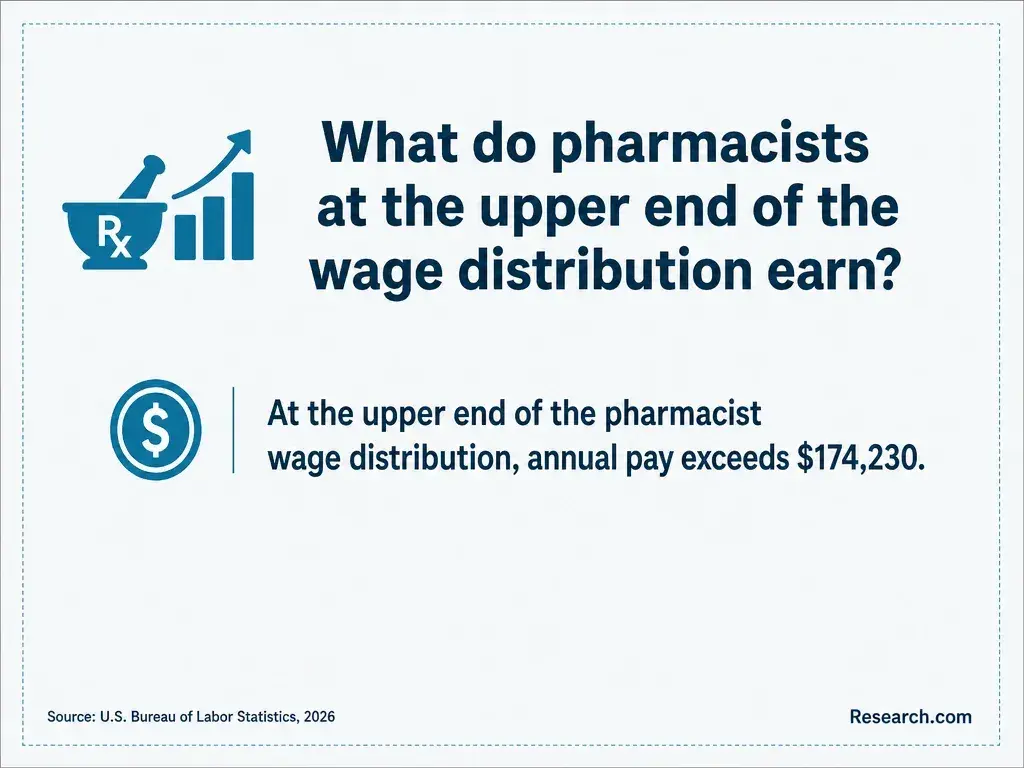
The Bureau of Labor Statistics reports median annual pay of $140,910 in May 2025 for pharmacists and projects 5% growth, 2025-2035. That occupation-wide median is not an entry-level salary or a return-on-investment guarantee. Assess it alongside likely debt, interest, time out of the workforce, and the jobs available in your intended location.
If your goal is a different pharmacy-related role, compare the credential it actually requires before financing a Pharm.D. Pharmacy technicians, for example, are a separate occupation that does not ordinarily require this degree. Broader doctoral degree length comparisons can clarify the time commitment of alternatives, but they cannot establish that another doctorate qualifies someone to practice as a pharmacist.
Do online PharmD graduates need a license to practice pharmacy?
Yes. Earning a Pharm.D. - online, hybrid, or campus-based - does not itself authorize someone to practice as a pharmacist. Graduates must satisfy the board of pharmacy requirements in the jurisdiction where they seek licensure. Requirements typically include education, the North American Pharmacist Licensure Examination (NAPLEX), and other jurisdiction-specific conditions, which may include an intern registration, supervised hours, background review, or a law examination. Do not assume every jurisdiction uses the Multistate Pharmacy Jurisprudence Examination (MPJE); some use other processes, including the Uniform MPJE (UMPJE).
Before enrolling, ask the school whether your planned state of residence permits its distance-education enrollment and required placements, then check licensure requirements with that state's board. If you may move, repeat the check for the destination state. Admission flexibility is not a waiver of professional education or licensing rules: descriptions of pharmacy programs with flexible entry requirements should be checked against the school's conditions for completing prerequisites and progressing to the Pharm.D.
Other Things You Should Know About PharmD
Possibly. Ask whether your employer covers professional pharmacy coursework, whether it pays the school directly or reimburses you later, and whether you must remain employed after receiving assistance.
An eligible student's school-approved cost of attendance may include allowable living expenses, but available aid may not cover the full amount. Ask the aid office how it budgets rotations that require travel or temporary housing.
Withdrawing can change earned aid and may leave a balance owed to the school or loan servicer. Request the school's withdrawal and refund calculations before making a decision.
No. A residency generally comes after the Pharm.D. and applicable licensing steps. Any pay associated with postgraduate training should not be counted on to cover tuition while you are enrolled.
- FAFSA® Application Deadlines | studentaid.gov https://studentaid.gov/apply-for-aid/fafsa/fafsa-deadlines
- School-Determined Requirements - FSA Partner Connect https://fsapartners.ed.gov/knowledge-center/fsa-handbook/2026-2027/vol1/ch1-school-determined-requirements
- Changes to 2026-2027 Federal Student Loans | columbia.edu https://sfs.columbia.edu/content/changes-2026-2027-federal-student-loans
- Distance Doctor of Pharmacy | University of Findlay https://pharmdonline.findlay.edu/programs/online-pharm-d
- Financial Aid - Pharm.D. Admissions " College of Pharmacy " https://admissions.pharmacy.ufl.edu/financial-aid/
- Scholarships & Financial Aid | University of Cincinnati | James L. Winkle College of Pharmacy https://www.pharmacy.uc.edu/admissions/scholarships-aid.html
- Online PharmD Program Accelerated | MCPHS https://www.mcphs.edu/academics/programs/pharmacy-online-pharmd-accelerated
- Tuition, Financial Aid, & Scholarships | CU School of Pharmacy https://pharmacy.cuanschutz.edu/degreesandprograms/pharmd/scholarship-tuition-financial-aid/apply
- Earn an Online Pharm.D. Degree at St. John Fisher University https://onlinepharmd.sjf.edu/
- PharmD Tuition & Scholarships | R. Ken Coit College of Pharmacy https://www.pharmacy.arizona.edu/academics/pharmd/tuition-scholarships