PharmD Tuition Planning for the 2027 Cohort

Co-Founder and Chief Data Scientist
A PharmD offer can be difficult to evaluate when the tuition quote leaves out prerequisite courses, clinical rotations, living expenses, and borrowing costs. For students considering a 2027 start, federal loan rules also deserve a fresh look rather than reliance on older pharmacy school budgets. This guide shows prospective Doctor of Pharmacy students how to compare complete costs, test whether an aid package is workable, and identify the questions to resolve before paying an enrollment deposit.
Key Things You Should Know
- Compare the full cost through graduation, not one year of tuition: include required fees, living costs, rotations, and any unfinished prerequisites.
- For a 2027 start, request an aid estimate under the federal borrowing rules that began changing on July 1, 2026; older descriptions of Grad PLUS access may not apply to new borrowers.
- Use a program-specific worksheet and compare the amount you must borrow, not just the advertised price. The pharmacist median annual pay was $140,910 in May 2025, but that figure cannot predict an individual graduate's earnings or repayment capacity.
What is PharmD tuition, and what costs should students expect?
PharmD tuition is the charge for instruction in the professional Doctor of Pharmacy program. It is not the same as the school's total cost of attendance, an aid-budget estimate that also accounts for eligible living and educational expenses. Undergraduate pre-pharmacy courses taken before admission may generate separate tuition bills.
Start with the amount a school will actually charge your entering cohort. Ask whether tuition is assessed by semester, academic year, or credit; whether summer enrollment is included; and whether rates can change before graduation. Then add mandatory fees and expenses you must pay to attend, even if the school does not bill you directly.
Keep the credential in view while comparing prices. General online doctoral degree options may have very different costs and timelines, but they are not substitutes for an appropriately accredited PharmD if your goal is U.S. pharmacist licensure.
How much does an accredited PharmD program cost?
There is no dependable nationwide tuition figure for the 2027 cohort: charges differ by school, residency classification, enrollment pattern, and year of study. Some schools may not yet have published every rate that will apply through graduation.
Rather than treating an older advertised figure as a quote, request each school's 2027 entering-cohort charges and its policy for later increases. Compare online Doctor of Pharmacy tuition on the same basis as campus tuition, with required in-person costs added.
This worksheet keeps two offers on comparable terms. Fill the blank cells from each school's published charges and financial aid budget; mark unpublished amounts as unknown rather than assuming they are zero.
| Comparison field | Program A | Program B |
| 2027 entering-cohort tuition basis and published amount | - | - |
| Expected tuition charges through graduation | - | - |
| Mandatory program and university fees | - | - |
| Required travel, campus visits, and rotations | - | - |
| Living-cost estimate for the full enrollment period | - | - |
| Confirmed grants and scholarships | - | - |
| Estimated amount still to finance | - | - |
Record whether a figure is a published charge, a personal estimate, or an aid-office projection. An Accreditation Council for Pharmacy Education (ACPE)-accredited professional program can still be expensive; accreditation establishes an educational standard, not a price ceiling or a guaranteed licensing outcome.
How can students budget and pay for PharmD tuition?
Work backward from the full enrollment period, including terms with clinical rotations. The financing decision is whether confirmed resources can cover that period without relying on loans or earnings you may not receive.
If a shorter credential would meet a different career goal, compare shorter online pharmacy education options before taking on professional-degree costs; those routes do not replace a PharmD for pharmacist licensure.
Use this sequence for each offer so a lower first-year bill does not hide a larger financing gap later:
- Map required terms from matriculation through graduation, including summers and rotations, and note when each charge is due.
- Add school-billed charges and realistic housing, food, transportation, insurance, and clinical-placement costs.
- Subtract only aid you have confirmed, checking renewal conditions and whether an award covers summer terms.
- Ask the financial aid office to show eligible federal borrowing under the rules applicable to your entry date and prior borrowing history; identify any remaining gap before considering private loans.
- Compare the resulting borrowing need with a repayment estimate, allowing for interest, possible income changes, and time away from paid work.
Treat an unfunded gap as a decision point. A private loan may have different rates, protections, and underwriting requirements from a federal loan; admission alone does not mean every student can borrow the full cost of attendance.
Required costs can appear outside the tuition page. Ask for an itemized schedule covering university and professional-program fees, textbooks and drug-information resources, technology, lab or compounding supplies, testing, background checks, immunizations, and health insurance when applicable. Add application and enrollment expenses separately: they may come due before aid is available.
Clinical education can change the budget substantially. Introductory pharmacy practice experiences (IPPEs) and advanced pharmacy practice experiences (APPEs) involve supervised practice, potentially across different sites and schedules.
Ask who arranges placements, whether travel or temporary housing may be necessary, and which site-specific requirements you pay for. Plan separately for postgraduation licensure application and examination charges.
Unfinished prerequisite courses also belong in the plan. Some schools offer pharmacy application requirement flexibility, but an offer that allows courses to remain in progress does not erase their tuition, deadline, or completion conditions. Confirm the school's policy before budgeting for a later start or an extra term.
Delivery format alone does not establish which program costs less. An online or hybrid pathway may reduce routine commuting or relocation costs, while adding travel for required campus sessions. Both formats require supervised experiential education, and an online label does not mean labs, assessments, IPPEs, or APPEs can all be completed remotely.
The relevant comparison is the cost of meeting each program's actual schedule. Before you choose an online Pharm.D. program, confirm live-class attendance, campus-immersion dates, placement responsibilities, and whether rotations can occur near home. Do not assume current employment can replace a required rotation or that a full-time job will remain feasible during clinical terms.
Also verify ACPE professional-program accreditation and, for distance enrollment, the school's authorization to serve students in your state. State authorization, ACPE accreditation, and eligibility for pharmacist licensure are separate questions; ask the program and the state board where you intend to practice about any location-specific restrictions.
Potential sources include institutional scholarships, outside scholarships, employer support, and federal aid for eligible students. Amounts and eligibility depend on the student, program, enrollment status, and aid year.
Complete the Free Application for Federal Student Aid (FAFSA) as required, then request a written, term-by-term award estimate rather than assuming that admission includes sufficient funding.
Pay particular attention to federal borrowing rules for a 2027 start. Changes beginning July 1, 2026, affect many new graduate and professional borrowers, including access to Grad PLUS; transitional provisions may depend on earlier enrollment and borrowing.
Have each school's aid office identify your applicable Direct Unsubsidized Loan limits, any other federal loan eligibility, and the amount its budget leaves uncovered. Do not use a pre-2026 borrowing example as your plan.
Previously earned coursework can affect costs but does not automatically reduce the professional curriculum. If you are considering pharmacy school prior learning credits, get the receiving school's written evaluation of which prerequisites - or, where permitted, professional courses - will count. Then ask the aid office how the resulting enrollment pattern affects eligibility and the school's cost-of-attendance budget.
Applicants generally complete specified undergraduate pre-professional coursework before beginning the professional curriculum, but a bachelor's degree is not universally required. Schools set their own course, laboratory, grade, GPA, and application policies; some require PharmCAS, while others use a different process or additional materials.
The Pharmacy College Admission Test (PCAT) was retired in January 2024 and should not be treated as a current routine requirement.
Check the 2027 entry requirements for each program, including how it evaluates community-college, Advanced Placement, online-lab, repeated, and older coursework. Published admission pathways for pharmacy students can help you identify possibilities, but only the receiving school can confirm whether your credits satisfy its requirements. A stated minimum is not a promise of admission.
For tuition planning, request a prerequisite evaluation before comparing offers. If one program requires additional courses, add their cost and the possibility of a later matriculation date to that program's side of the worksheet.
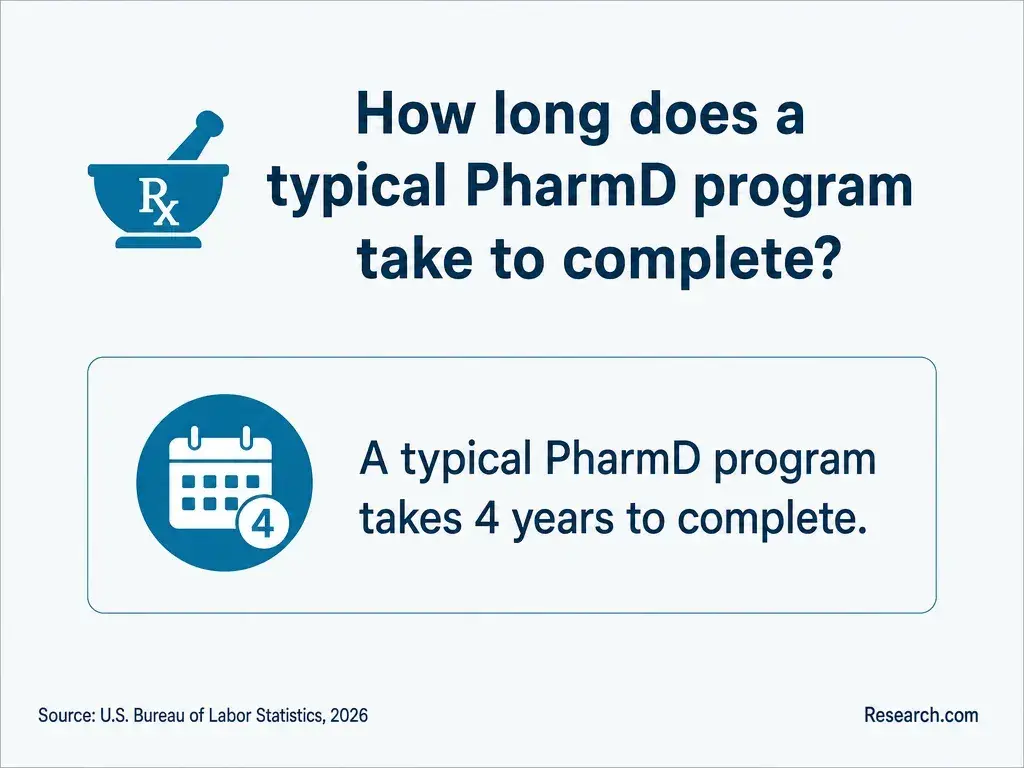
Many professional PharmD curricula are designed around four academic years after prerequisites; some offer accelerated calendars. The time from your current starting point also depends on unfinished prerequisite courses, admission timing, required summers, and whether you can maintain the prescribed course sequence. A faster calendar may reduce time away from full-time earnings without reducing total tuition or rotation costs.
Compare Pharm.D. programs for a faster path using the published calendar, not the label alone. Ask when tuition installments are due, whether summer housing or travel is necessary, and what happens financially if a course must be repeated. An accelerated schedule can leave less room for paid work.
Before committing financially, confirm the professional program's current status in ACPE's program records. ACPE accreditation is distinct from a university's institutional accreditation and from authorization to enroll a student online in a particular state.
A short course or another pharmacy-related credential - even one among fast online pharmacy program choices - should not be mistaken for the professional PharmD pathway to pharmacist licensure.
Graduation does not itself issue a license. U.S.-educated applicants must meet their licensing jurisdiction's requirements, which commonly include the North American Pharmacist Licensure Examination (NAPLEX), required practical experience, and any applicable law examination.
Jurisdictions differ: do not assume every state requires the Multistate Pharmacy Jurisprudence Examination (MPJE), particularly as some jurisdictions began moving to the Uniform Multistate Pharmacy Jurisprudence Examination (UMPJE) in 2026. Check the relevant state board and the National Association of Boards of Pharmacy for current requirements and fees.
These steps matter to the budget because applications, exams, travel, and the time between graduation and licensure can require funds after school-based aid ends.
What pharmacist careers and salaries can PharmD graduates expect?
Licensed pharmacists work in settings such as community, hospital, ambulatory care, and specialty pharmacy, with responsibilities and hiring preferences that vary by role. The Bureau of Labor Statistics reports $140,910 in May 2025 as the median annual pay for pharmacists. That occupation-wide figure is a useful repayment benchmark, not an entry-level offer or a forecast for a particular graduate.
The same BLS outlook projects 5% growth, 2025-2035, with about 12,500 openings per year. Openings across the occupation do not establish demand in a preferred location or specialty. Consider local job requirements when weighing tuition against a possible career path.
A PharmD graduate may enter employment directly or pursue postgraduate training. A residency is structured practice training; a fellowship typically emphasizes a focused professional or research area; and specialty board certification is a separate credential, not a pharmacist license.
None is universally required for pharmacist jobs. For a student arriving with biology or chemistry coursework, pharmacy programs for students with science credits may clarify the education route, but those credits still need a school-specific evaluation.
Choose a program only after its full financing gap, completion schedule, accreditation status, and intended state's licensing requirements are clear. If the amount to borrow depends on uncertain aid or an unworkable clinical schedule, resolve that uncertainty before paying a deposit.
Other Things You Should Know About PharmD
Policies vary. Read the offer's deposit and withdrawal terms before paying, and ask for written clarification if a scholarship or prerequisite decision is still pending.
Not necessarily. Deferral permission and scholarship renewal are separate school policies. Confirm both in writing, along with which cohort's tuition rate would apply.
Possibly. Check whether your employer offers tuition assistance, which courses qualify, and whether continued employment or repayment conditions apply. Do not count the benefit until eligibility is confirmed.
The school's refund schedule determines whether billed tuition is reduced; financial aid may also be recalculated. Ask the bursar and aid office for the consequences of your specific withdrawal date before acting.
- One Big Beautiful Bill Act - Important Definitions https://studentaid.gov/announcements-events/big-updates/definitions
- Cost of Attendance (Budget) | 2026-2027 Federal Student Aid Handbook https://fsapartners.ed.gov/knowledge-center/fsa-handbook/2026-2027/vol3/ch2-cost-attendance-budget
- PharmD Sources of Financial Aid - USF Health https://health.usf.edu/financial-aid/pharmd-program/sources-of-financial-aid
- How Much Do Pharmacists Make? Salary, Pay and Career Outlook | PCOM https://www.pcom.edu/pharmacy/news/how-much-do-pharmacists-make.html
- Cost of Attendance " Pharm.D. Admissions " | ufl.edu https://admissions.pharmacy.ufl.edu/financial-aid/anticipated-expenses/
- Payment Due Dates - PAY MY BILL Home https://paymybill.uillinois.edu/payments/paymentduedates
- Cost of Attendance - Financial Aid and Scholarships | The University of Utah https://financialaid.utah.edu/tuition-and-fees/cost-of-attendance.php