Transfer From a Pre-Pharmacy Program to a PharmD Pathway

Co-Founder and Chief Data Scientist
Finishing a pre-pharmacy program does not automatically place you in a Doctor of Pharmacy (Pharm.D.) program. The receiving school decides which courses satisfy its admission requirements, whether you need a bachelor's degree, and when you can enter its professional curriculum. That makes an early credit review more valuable than simply accumulating courses.
This guide helps prospective and current pre-pharmacy students identify viable pathways, avoid credits that do not count, and compare the time, cost, and licensing implications before applying.
Key Things You Should Know
- Pre-pharmacy credits usually satisfy admission prerequisites; they do not automatically shorten the professional Pharm.D. curriculum, which commonly takes four academic years.
- Ask each receiving school for a course-by-course prerequisite review, including labs, grades, course-age limits, and courses still in progress.
- Before committing, confirm the program's ACPE accreditation status and full cost; earning a Pharm.D. does not itself grant a pharmacist license.
How do you transfer from a pre-pharmacy program into a PharmD pathway?
In most cases, you apply for admission to a Pharm.D. program rather than transfer into it automatically. A pre-pharmacy program is undergraduate preparation; the Pharm.D. is a separate professional degree. Even an affiliated college's early-assurance or direct-entry pathway may require you to meet progression conditions.
Work backward from the receiving school's current admissions rules. These steps help you distinguish a realistic entry date from an assumed one:
- Identify Pharm.D. programs you would attend and check each school's current prerequisites, deadlines, and application route; not every school uses the Pharmacy College Application Service (PharmCAS).
- Send unofficial course descriptions and transcripts to admissions for an initial prerequisite review, then ask what official evaluation is required.
- Map missing courses and labs against their prerequisite sequences, and confirm whether unfinished courses may be completed before enrollment.
- Complete the required application, transcripts, recommendations, supplemental materials, and interview, if applicable; confirm any deposit and final-transcript deadlines.
If you are short of requirements, pharmacy program admission planning can help you frame questions about conditional admission. An allowance to apply with courses in progress is not permission to begin the Pharm.D. without completing them.
What prerequisites are required for admission to a PharmD program?
Schools commonly require undergraduate science and general education coursework, but there is no nationwide prerequisite checklist or credit total. Biology, general and organic chemistry, mathematics or statistics, and writing frequently appear; laboratory requirements and acceptable substitutions differ. Some schools also specify minimum course grades, a prerequisite or overall grade-point average, and how recently science courses must have been completed.
Use each school's current admissions page and, where applicable, its PharmCAS directory entry to check exact course equivalents. Ask specifically about community-college classes, Advanced Placement or International Baccalaureate credit, online labs, repeated courses, and prerequisites in progress. A published minimum makes you eligible for consideration, not guaranteed admission. The Pharmacy College Admission Test (PCAT) was retired in 2024 and is not a current exam to schedule.
When comparing pharmacy degree entry options, prioritize schools where your completed courses actually meet the stated requirements rather than treating a lower minimum as an admission prediction.
Do pre-pharmacy credits transfer directly into PharmD programs?
Usually, pre-pharmacy courses are evaluated against admission prerequisites, not substituted for professional Pharm.D. courses. The receiving school makes both decisions. Accreditation of your previous institution alone does not establish that a particular class meets its content, lab, grade, or recency rules.
The distinction below shows why "credit accepted" is too vague a question to ask admissions.
| Credit decision | What it means for your pathway |
| Accepted as a prerequisite | The course helps satisfy an entry requirement but may not reduce Pharm.D. coursework. |
| Accepted as undergraduate elective credit | The course may count toward a separate undergraduate credential without meeting a Pharm.D. prerequisite. |
| Accepted toward the professional Pharm.D. | The school permits a course to replace part of its professional curriculum; this requires a separate, often restrictive evaluation. |
Keep syllabi, lab descriptions, and official transcripts. If you previously attended another Pharm.D. program, ask about professional transfer admission separately; available seats, curricular alignment, and experiential requirements may limit it. Guidance on pharmacy school prior learning credits is a starting point, but obtain the receiving school's decision in writing before changing schools or dropping a course.
Not universally. Some Pharm.D. programs admit applicants after specified undergraduate prerequisites without a completed bachelor's degree; others require one or offer different admission routes. Check each school's degree requirement separately from its course and credit requirements.
Completing a bachelor's degree can make sense if it meets your backup career goals or fills substantial missing prerequisites. It can also add tuition and delay entry if your target Pharm.D. schools do not require it. Students who already studied biology, chemistry, or pre-pharmacy should compare an online Pharm.D. for students with prior science study against campus options using actual prerequisite matches - not the assumption that a science degree replaces professional pharmacy coursework.
The Accreditation Council for Pharmacy Education (ACPE) accredits professional pharmacy education programs. Check the specific Pharm.D. program and its current status in ACPE's program directory; institutional accreditation and permission to enroll online students in a state answer different questions. If you are considering Doctor of Pharmacy programs with online coursework, verify all three issues separately.
Graduating from a Pharm.D. program is not the same as becoming licensed. State boards set pharmacist licensure requirements, which generally include education, the North American Pharmacist Licensure Examination (NAPLEX), and other jurisdiction-specific conditions. A board may require a jurisprudence exam, but do not assume every jurisdiction uses the Multistate Pharmacy Jurisprudence Examination (MPJE); some began transitioning to the Uniform Multistate Pharmacy Jurisprudence Examination (UMPJE) in 2026. Check the board where you intend to practice, including any intern-registration requirements while enrolled.
Some schools accept online undergraduate prerequisites, while others restrict particular courses or labs. A Pharm.D. with online instruction still involves supervised, in-person pharmacy practice and may require scheduled live classes, campus visits, hands-on assessments, and travel. "Online" does not mean self-paced or compatible with uninterrupted full-time work.
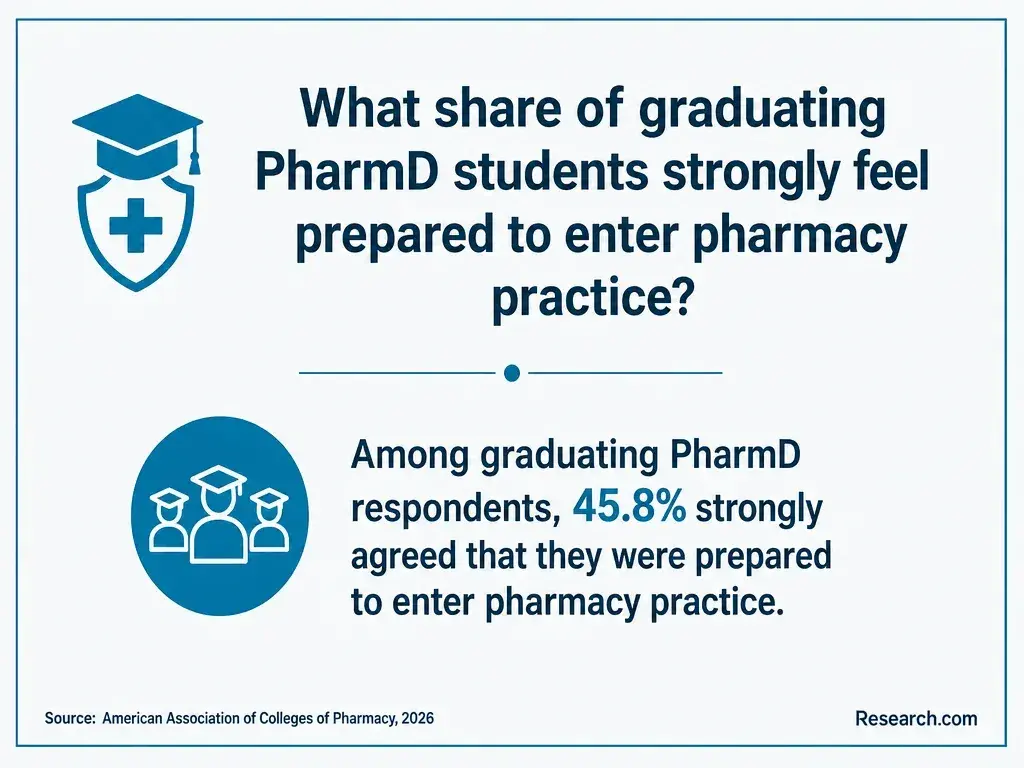
Ask who arranges or approves introductory pharmacy practice experiences (IPPEs) and advanced pharmacy practice experiences (APPEs), whether placements can be near you, and what happens if a local site is unavailable. Sites may require intern registration, immunizations, background checks, and schedule flexibility. Comparisons of fast-track online pharmacy education need particular care: a short pharmacy-related credential is not a substitute for a professional Pharm.D. or pharmacist licensure.
Pre-pharmacy coursework builds the science, quantitative, and communication foundation needed for admission. The professional Pharm.D. curriculum applies those foundations to medications and patient care through subjects such as pharmacology, pharmacotherapy, medicinal chemistry, pharmaceutics, medication safety, and professional practice. Skills labs and supervised experiences develop abilities such as assessing medication use, communicating with patients and clinicians, and working within legal and ethical requirements.
Course titles and sequencing vary by school. IPPEs introduce supervised practice during the program; APPEs provide more advanced supervised experiences, often toward its end. If you hope to complete a Pharm.D. on an accelerated schedule, compare the published course calendar and experiential blocks - not just the advertised completion time. A tighter schedule may leave less room for paid work, repeat courses, or unexpected travel.
The total time depends on how many prerequisites you have finished and how the receiving school schedules its professional curriculum. A traditional Pharm.D. curriculum commonly spans four academic years after prerequisites; some schools use accelerated calendars. Previous undergraduate credit can shorten your preparation without shortening the Pharm.D. itself.
Compare a school's full estimated cost of attendance, not tuition alone. Include remaining prerequisites, mandatory fees, books and technology, campus visits, rotation travel or housing, and licensing-related expenses. For an online Doctor of Pharmacy price range, ask what the published figure excludes and whether travel makes a seemingly cheaper option more expensive for you.
Confirm aid eligibility and borrowing options with each financial aid office for your enrollment year. Federal loan rules changed for many new graduate and professional borrowers beginning July 1, 2026, so older descriptions of Grad PLUS access or borrowing limits may not apply. The financially better route is the one you can complete with manageable total borrowing and a workable schedule, not necessarily the one with the lowest advertised tuition.
Licensed pharmacists work in settings including community pharmacies, hospitals, ambulatory care, and other medication-focused roles. The U.S. Bureau of Labor Statistics reports pharmacist median annual pay of $140,910 in May 2025 and projects 5% growth from 2025-2035, with about 12,500 openings per year. Those occupation-wide figures are useful for weighing the investment, but they do not predict a new graduate's pay, location, or ability to obtain a particular role.
A postgraduate residency or fellowship may support certain career goals; neither is universally required to work as a pharmacist. Specialty board certification is a separate credential, not a state license. If your goal is a pharmacy technician role rather than pharmacist practice, a Pharm.D. is ordinarily unnecessary. This distinction matters when comparing pharmacy degree programs with shorter timelines: first identify the job and credential it actually requires.
How do you choose a reputable pre-pharmacy or PharmD program?
Start with the receiving Pharm.D. school, then judge a pre-pharmacy program by how well its courses satisfy that school's requirements. Check ACPE's current directory for the professional program, review published licensing-exam outcomes with attention to their reporting year, and confirm where experiential placements may take you. For online delivery, separately verify state authorization and the licensing rules of the state where you plan to practice.
Request a written prerequisite evaluation and compare your remaining courses, earliest feasible entry date, total cost, and required travel across programs. Published online doctoral program duration comparisons cannot establish how quickly you can finish a Pharm.D.; prerequisite gaps, fixed course sequences, and rotations determine that. Be cautious if a school cannot clearly explain credit decisions, accreditation status, clinical placement responsibilities, or the costs beyond tuition.
Other Things You Should Know About PharmD
Usually not. It may strengthen an application and clarify your career goals, but the Pharm.D. school decides whether you have met its academic prerequisites.
Requirements vary. Check each school's current instructions for the number of letters, who may write them, and whether they must be submitted through PharmCAS or another system.
Check the school's repeat-course and minimum-grade policies. If the application offers space for an explanation, briefly describe what changed and point to later evidence of academic readiness.
Possibly, but acceptance and transcript-evaluation rules vary by school. Ask about required credential evaluations and course equivalencies before relying on those credits for an application.
- Are Prerequisite Courses Barriers to Pharmacy Admission or the Keys to Student Success? - PMC https://pmc.ncbi.nlm.nih.gov/articles/PMC10159397/
- U.S. Graduate Pharmacy References | EducationUSA https://educationusa.state.gov/your-5-steps-us-study/research-your-options/graduate/graduate-student/what-graduate-programs-a-4
- Admission Requirements | ufl.edu https://admissions.pharmacy.ufl.edu/steps-to-apply/application-requirements/
- Admissions - Doctor of Pharmacy (PharmD) https://pharmsci.uci.edu/degrees-programs/doctoral-programs/pharmd/admissions/
- PharmD Roadmap | Admissions | Taneja College of Pharmacy | USF Health https://health.usf.edu/pharmacy/admissions/roadmap
- PharmD Application Process | pitt.edu https://www.pharmacy.pitt.edu/academics/doctor-pharmacy/apply-pharmd-program/pharmd-application-process
- How Many Years Is a PharmD Degree? | MCPHS https://www.mcphs.edu/admission-and-aid/blog/how-many-years-is-a-pharmd-degree
- PharmD Early Assurance - Doctor of Pharmacy https://pharmacy.wisc.edu/pharmd/early-assurance/
- FAQ | OSU College of Pharmacy - Oregon State University https://pharmacy.oregonstate.edu/programs-admissions/pharm-d/faq
- Accreditation | School of Pharmacy https://pharmacy.llu.edu/about-us/accreditation