PharmD Transfer Credit Limits and Exclusions

Co-Founder and Chief Data Scientist
Changing pharmacy schools can mean repeating courses, delaying clinical rotations, or paying for more terms than expected. A Doctor of Pharmacy (Pharm.D.) transfer decision depends on more than the number of credits on a transcript: the receiving school must decide which courses fit its professional curriculum and sequence.
This guide is for applicants with prerequisite coursework and students already enrolled in a Pharm.D. program. It explains common limits and exclusions, the documents schools need, and how to compare written evaluations before committing to a transfer.
Key Things You Should Know
- There is no nationwide Pharm.D. transfer-credit cap. The receiving school sets its own limit and decides where an accepted course fits.
- Undergraduate prerequisites and professional Pharm.D. courses are evaluated separately; accepted credits may satisfy a requirement without shortening the degree.
- Request a written, course-by-course evaluation and an updated graduation timeline before paying a deposit or leaving your current program.
How much PharmD transfer credit can students apply toward the degree?
No single credit-hour maximum applies across U.S. Pharm.D. programs. A school may cap professional transfer credit, require a minimum amount of its own coursework, admit transfers only into certain years, or decline professional transfers altogether. Published policy is a starting point; the receiving school makes the final course-by-course decision.
Ask what the school means by "accepted." A course might count as an elective, replace a required course, or satisfy a prerequisite for a later class. Those outcomes have different effects on your graduation date. A student with substantial accepted credit may still need to join an earlier cohort if required courses are offered only in sequence.
Use a school's published policy to screen your options, then request an individual evaluation. A broader overview of pharmacy degree transfer credit policies can help you identify questions to bring to the receiving program.
Which PharmD courses and credits typically cannot transfer?
Schools are most likely to exclude work they cannot match to their required content, assessments, or supervised experiences. An accepted transcript entry does not automatically replace a course in the professional curriculum.
The following categories warrant an explicit decision from the receiving school because exclusion or partial credit can change your placement:
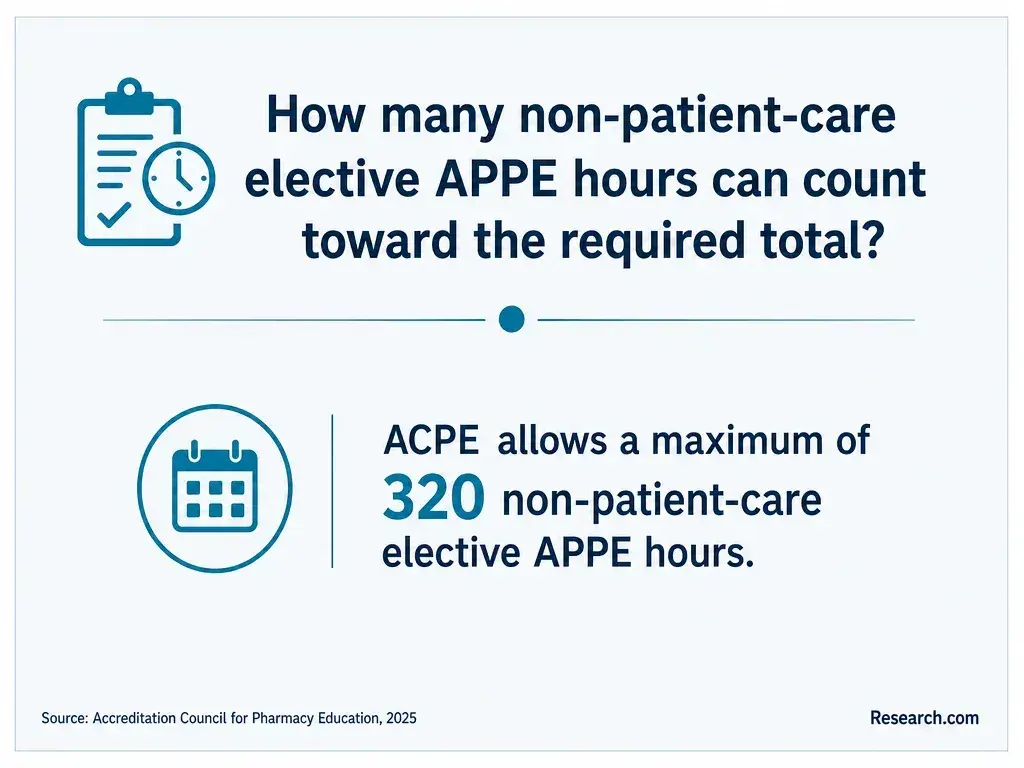
- Clinical experiences: Introductory pharmacy practice experiences (IPPEs) and advanced pharmacy practice experiences (APPEs) may need separate review of hours, settings, preceptors, and documented competencies.
- Integrated or school-specific courses: A therapeutics, skills, simulation, or capstone sequence may not align with another school's course boundaries.
- Uncompleted or noncredit work: Courses in progress, audits, continuing education, workplace training, and certificates generally do not become professional degree credit merely because they cover related material.
- Courses below the required grade or taken too long ago: A school may require a repeat even when the subject appears equivalent.
Shorter online pharmacy study options can serve different educational goals, but their courses should not be assumed to replace professional Pharm.D. coursework.
Do PharmD schools accept transfer credit from other pharmacy programs?
Some do, but admission and credit acceptance are separate decisions. A school may consider a student from another Pharm.D. program only when a seat is available in the appropriate cohort. It may also require the applicant to be in good standing and review why they are leaving. Even closely named courses can cover different material or occur at different points in the curriculum.
Transfer from another professional pharmacy program is different from entering pharmacy school after an undergraduate major. Biology, chemistry, and pre-pharmacy courses usually undergo prerequisite review, not professional-course substitution. If that is your starting point, guidance on pharmacy school after biology or chemistry is more relevant than a professional transfer policy.
The Accreditation Council for Pharmacy Education (ACPE) accredits professional pharmacy education programs, not individual courses or pharmacists. A receiving school must be able to document that its graduates meet its program requirements, including experiential education requirements. That responsibility helps explain why a school may re-evaluate coursework from another pharmacy program rather than accepting it automatically.
Verify the receiving program's current ACPE status through ACPE's official program records, and ask how it treats courses from your sending program. Institutional accreditation is a separate matter; neither type of accreditation guarantees a particular transfer award. If you are considering pharmacy schools offering online Pharm.D. study, also check in-person labs, clinical placements, and applicable state authorization separately from ACPE status. Degree completion alone does not grant a pharmacist license; state boards set licensure requirements.
Requirements vary, but a transcript alone rarely shows enough detail to determine professional course equivalence. Ask the transfer coordinator which materials are needed for an initial estimate and which are required for a final decision.
Prepare the following records so reviewers can assess both credit and placement:
- Official transcripts from every institution attended, plus any unofficial copies permitted for an initial review.
- Catalog descriptions and syllabi from the term each course was taken, including learning outcomes, credit hours, lab work, and assessment methods.
- For IPPEs or APPEs, records of completed hours, practice settings, preceptor evaluations, and competencies, if applicable.
- Documentation of academic standing or a letter from the current pharmacy program if the receiving school requests it.
Keep admissions and credit-review instructions separate. A school may use PharmCAS for the application while requesting additional materials directly for transfer evaluation; do not assume every school uses PharmCAS. Review its pharmacy admissions criteria alongside its transfer-document requirements.
Often, yes - but satisfying an admissions prerequisite is not the same as transferring credit into the professional Pharm.D. curriculum. The receiving school decides whether an undergraduate course meets its subject, laboratory, grade, credit, and recency rules. A completed bachelor's degree does not necessarily waive specified prerequisites, and a bachelor's degree is not a universal admission requirement.
Check each prerequisite against the current admissions requirements, especially laboratory format and courses still in progress. Some schools permit outstanding prerequisites when you apply but require completion before enrollment. If you are exploring pharmacy application requirement flexibility, confirm the receiving school's actual completion deadline in writing.
A passing grade at the sending school may fall below the receiving school's minimum. Credit-hour totals can also conceal differences in content: a combined course may not cover everything taught in two separate required courses. Some schools review the age of science coursework or distinguish lecture from laboratory credit.
Ask for a decision on each course, not simply an overall credit total. The most useful evaluation states the receiving course it replaces, any remaining requirement, and whether the grade is included in the receiving school's GPA calculation. Accelerated Pharm.D. degree options may have especially tight sequencing; an accepted course does not necessarily create room to skip a term.
They may, particularly for prerequisites, but policies differ by school and course. Check whether the receiving program accepts community college coursework for the specific requirement and whether an online science laboratory meets its rules. Delivery format alone does not establish - or rule out - equivalence.
Professional Pharm.D. credit requires its own review regardless of where a course was taught. Likewise, a doctorate advertised as online may follow a different curriculum or lead to a different credential. When comparing doctoral degree timeline options, confirm that the credential is an ACPE-accredited Pharm.D. if your goal is a U.S. pharmacist licensure pathway. Online instruction also does not eliminate required in-person training or clinical rotations.
The financial value of transferred credit depends on when it lets you enter the curriculum, not just how much appears on an evaluation. If a required course is offered only once in a cohort sequence, a small gap can delay later courses or rotations. Conversely, credit that replaces a required course and advances placement may avoid tuition for that course and reduce time away from work.
Request a term-by-term plan and a program-specific cost estimate. Compare tuition and mandatory fees for the terms you would actually attend, then account for possible repeat courses, moving costs, clinical-rotation travel, and lost earnings. Pharm.D. tuition planning is most useful when based on your assessed credit rather than advertised tuition alone. If you expect to borrow, ask the financial aid office which current federal loan rules apply to your enrollment and borrowing history; rules changed for many new graduate and professional borrowers beginning July 1, 2026.
How should students compare PharmD programs' transfer-credit policies?
Compare the same outcomes at every school: professional credit awarded, placement in the course sequence, remaining clinical requirements, expected completion date, and total cost. The table distinguishes a promising offer from one that needs closer scrutiny; neither column replaces a written individual evaluation.
| Decision factor | More favorable evidence | Potential concern |
| Credit application | Named required courses are replaced | Credit counts only as electives |
| Program placement | A confirmed cohort and term-by-term schedule | Placement depends on future seat or course availability |
| Experiential education | Written decision on prior IPPEs or APPEs | Clinical work must be repeated or remains under review |
| Cost estimate | Charges reflect the remaining terms and requirements | Estimate assumes all requested credits will be accepted |
Before withdrawing from your current school, obtain written confirmation of admission, credit application, cohort placement, and outstanding requirements. Ask who approves clinical placements and whether a transfer changes expected travel or intern-registration obligations. A comparison of pharmacy programs balancing cost and time can narrow your search, but your individual evaluation should determine the final choice. Prefer the offer with the clearer feasible path to graduation - not simply the largest headline credit award.
Other Things You Should Know About PharmD
Usually, you can inquire or apply before leaving, subject to the receiving school's rules. Stay enrolled until you understand its admission decision, credit award, and start date.
Not necessarily. An initial review may depend on official transcripts, final grades, syllabi, or faculty approval. Ask when the evaluation becomes final and whether it can change.
That depends on the school's policy. If an appeal is available, provide the syllabus and specific evidence that the course covered the missing outcomes; ask for the deadline and decision-maker.
No. Intern registration and recognition of training hours are governed by applicable state board rules, which may differ from academic credit decisions. Check with the relevant board and the receiving school before relying on prior registration or hours.
- Program Integrity Questions and Answers - Retaking Coursework | U.S. Department of Education http://www.ed.gov/laws-and-policy/higher-education-laws-and-policy/program-integrity-information-questions-and-2
- Prospective Students | Ernest Mario School of Pharmacy https://pharmacy.rutgers.edu/info-for/prospective-students/
- Accreditation - Texas A&M College of Pharmacy https://pharmacy.tamu.edu/about/acpe-self-study.html
- College News | College of Pharmacy | University of Houston https://uh.edu/pharmacy/news-and-events/news-releases-2025/february/acpe-reaccredits-uhcop-pharmd/
- Introductory Pharmacy Practice Experience Overview | Southwestern Oklahoma State University https://swosu.edu/pharmacy/current-students/experiential-program/introduction/overview-pharmacy-practice.php
- Admissions Pathways - Pharmacy | Long Island University https://liu.edu/pharmacy/Admissions/PharmD/Admissions-Pathways
- Transfer Pharm.D. Applicants - Pharmacy Advising Center https://advising.pharmacy.uconn.edu/faq/transfer-pharmd-applicants/
- Experiential Learning Manual - School of Pharmacy https://www.pharmacy.pitt.edu/experiential-learning-manual
- Eshelman School of Pharmacy: Course Section Guidelines | University of North Carolina at Chapel Hill https://policies.unc.edu/TDClient/2833/Portal/KB/Article/161545/Eshelman-School-of-Pharmacy-Course-Section-Guidelines
- Introductory Pharmacy Practice Experiences Curriculum (IPPE) | wvu.edu https://pharmacy.hsc.wvu.edu/explearning/introductory-pharmacy-practice-experiences-curriculum-ippe/