
PharmD school comparison questions for an information session

Co-Founder and Chief Data Scientist
A Pharm.D. information session can make every school sound appealing while leaving the differences that affect your decision unanswered. If you are comparing Doctor of Pharmacy programs, ask about more than coursework and campus life: accreditation, admissions rules, clinical placements, total cost, and licensure preparation can change your path substantially. This guide gives you questions to ask, a side-by-side comparison tool, and ways to interpret the answers so you can identify which program is workable for your goals, location, and budget.
Key Things You Should Know
- Ask each school for its current ACPE professional-program status, required in-person experiences, and state-specific licensure eligibility; a Pharm.D. alone is not a pharmacist license.
- Compare the full cost of attendance and clinical-rotation logistics, not tuition alone. Federal borrowing rules changed for many new graduate and professional borrowers beginning July 1, 2026.
- Request recent, clearly labeled licensure-exam outcomes and support details. The pharmacist occupation's median annual pay was $140,910 in May 2025, but that national figure cannot predict an individual graduate's earnings.
What should you compare when choosing between PharmD schools?
Compare schools against the same questions, then record answers from their current catalogs, disclosures, and information sessions. Start with factors that could make attendance impossible or unaffordable: eligibility, location, schedule, clinical placements, and financing. A list of pharmacy programs with varied admission routes can help you find options, but an accessible route is not a substitute for checking program quality and cost.
Use this worksheet during each session. Enter a specific answer, document, or follow-up contact rather than a general impression.
| Comparison field | School A | School B |
| ACPE status and next review | ________ | ________ |
| Remaining prerequisites | ________ | ________ |
| Required campus attendance | ________ | ________ |
| Rotation placement and travel | ________ | ________ |
| Total estimated attendance cost | ________ | ________ |
| Recent NAPLEX results and cohort size | ________ | ________ |
| Unanswered question or red flag | ________ | ________ |
A school may be the stronger choice for one applicant because it accepts their completed prerequisites; another may offer a more workable rotation network or lower travel costs. Treat unanswered questions as items to resolve before paying a deposit.
Why does ACPE accreditation matter when comparing PharmD programs?
The Accreditation Council for Pharmacy Education (ACPE) accredits professional pharmacy education programs. Ask: "What is this Pharm.D. program's current ACPE status, and where can I confirm it in ACPE's program records?" Check the specific program and campus or pathway, including any published conditions or upcoming reviews. Accreditation status can matter for licensure eligibility; institutional accreditation and permission to enroll distance-education students are separate questions.
If you are considering online pharmacy school programs, ask the school to identify the accredited professional pathway you would enter, its authorization to enroll you in your state, and whether your proposed clinical placements are permitted there. None of those answers, by itself, establishes that a state board will license you. Confirm intended-state eligibility with that board before committing.
What are the admission requirements for different PharmD programs?
Ask admissions staff to evaluate your record against the current entering class's requirements: "Which prerequisite courses, labs, minimum grades, and credit totals would I still need? May any be in progress when I apply, and when must they be complete?" Pre-pharmacy prerequisites are undergraduate work taken before entry; they are not the professional Pharm.D. curriculum. Some schools admit students without a completed bachelor's degree, while course-age rules and acceptance of community-college, online-lab, AP, or international credit vary.
For pharmacy admission pathways for nontraditional students, also ask whether the school uses PharmCAS, requires a supplemental application or interview, and evaluates repeated coursework differently. Request a written prerequisite review if your history is complicated. The Pharmacy College Admission Test (PCAT) was retired in January 2024; do not plan around taking it. Meeting a published minimum does not guarantee admission.
Ask both types of program for a term-by-term schedule. For an online or hybrid pathway, the useful questions are: "Which classes meet live? How often must I travel for labs, assessments, or campus immersions? Where must I complete introductory and advanced clinical experiences?" Online instruction does not make hands-on training remote, self-paced, or compatible with unrestricted full-time work.
Campus-based programs can also require travel when clinical sites are far from campus. Ask who finds and approves placements, whether a nearby site is possible rather than guaranteed, and what happens if a placement changes. Guides to how long online doctoral programs take may describe other doctoral credentials; compare the actual Pharm.D. calendar and in-person obligations instead of assuming that "online" means faster.
Pharm.D. coursework commonly develops knowledge in pharmacology, therapeutics, medication safety, calculations, and patient communication. Ask for the curriculum map rather than a course-name list: "When do students practice counseling and clinical decision-making, how are those skills assessed, and which courses must be passed before rotations?" Requirements and sequencing differ by school.
Introductory pharmacy practice experiences (IPPEs) introduce supervised practice during the program; advanced pharmacy practice experiences (APPEs) provide more intensive supervised rotations later. Ask which settings are required, who secures preceptors and sites, and which intern-registration, background-check, immunization, travel, or scheduling duties fall to students. If you have prior college work, explore transfer-friendly pharmacy education options, then ask the receiving school precisely whether those credits satisfy prerequisites or apply to professional coursework. One does not automatically follow from the other.
Ask for the time from your starting point to graduation: remaining prerequisites, professional terms, required summers, and rotation blocks. Many professional Pharm.D. curricula run roughly three to four years after prerequisites, but accelerated calendars can reduce breaks rather than reduce the work required.
Request a current, year-by-year cost-of-attendance estimate that separates tuition from mandatory fees and living costs. Ask specifically about books and clinical references, equipment, campus travel, rotation housing, background checks, and licensure-related expenses. For pharmacy doctorate financial planning, compare the amount you would need to finance - not just the advertised tuition - and ask the financial aid office to apply current rules to your enrollment and borrowing history. Federal loan rules changed for many new graduate and professional borrowers beginning July 1, 2026; do not assume an older borrowing limit or automatic Grad PLUS access applies to you.
A Pharm.D. graduate must satisfy the requirements of the jurisdiction where they seek a pharmacist license. Ask: "How does your program help students prepare for the North American Pharmacist Licensure Examination (NAPLEX), document required practical experience, and understand state board applications?" The NAPLEX is an examination used in licensure, not a license itself. Jurisprudence requirements vary: a jurisdiction may use the MPJE, the newer UMPJE, or another approach. Confirm current exams, intern requirements, and application steps with the intended state board.
Be particularly careful when browsing pharmacy degree programs with accelerated schedules: a shorter pharmacy-related credential is not necessarily a professional Pharm.D. that supports pharmacist licensure eligibility. Ask the school to name the exact credential and explain its graduates' licensing route.
Licensed pharmacists may work in community, hospital, ambulatory care, specialty pharmacy, and other settings; responsibilities and hiring expectations differ. At an information session, ask which practice settings students actually experience, which employers recruit graduates, and whether career advising serves students who seek immediate employment as well as postgraduate training.
A pharmacy residency provides structured postgraduate practice training; a fellowship typically focuses on a defined area such as research or industry. Board certification is a separate specialty credential, not state licensure, and none of these steps is universally required for pharmacist employment. If your goal is a pharmacy-adjacent role rather than pharmacist practice, compare shorter pharmacy programs with career potential before taking on Pharm.D. costs. Pharmacy technician work, for example, is a distinct occupation that does not ordinarily require a Pharm.D.
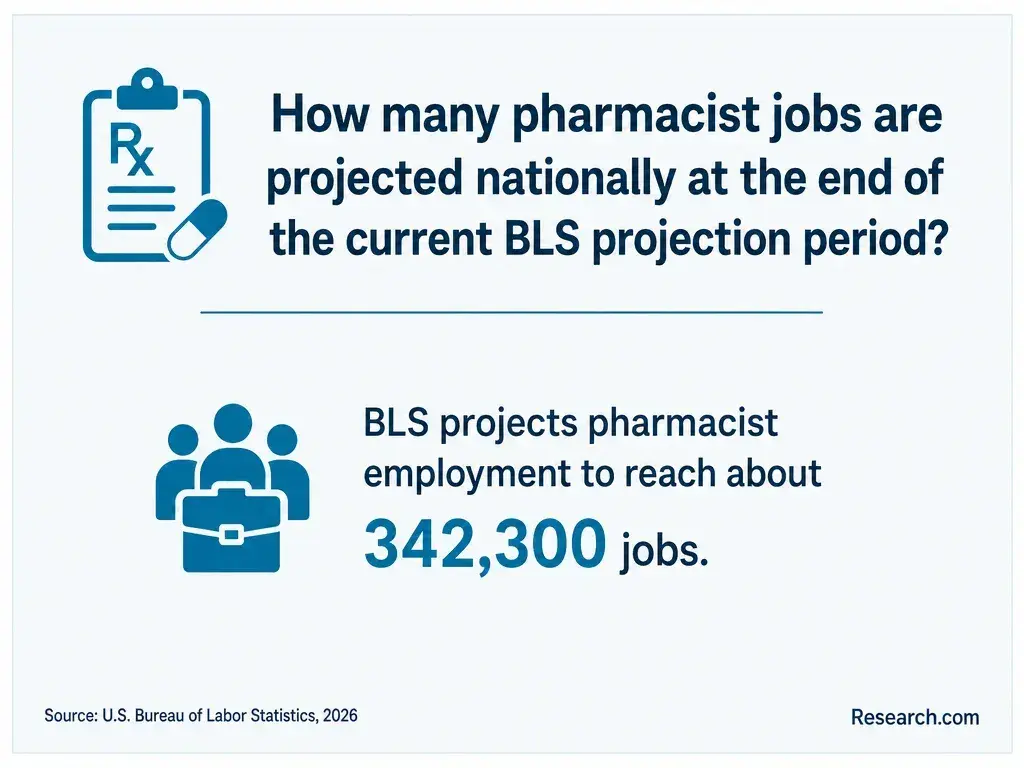
The Bureau of Labor Statistics reports median annual pay of $140,910 in May 2025 for pharmacists and projects 5% employment growth from 2025 to 2035, with about 12,500 openings per year. These are national occupational figures, not starting-salary offers or placement results for a particular school. Region, employer, hours, and experience can change an individual outcome.
Ask schools for graduate employment results that identify the cohort, reporting date, and share of graduates whose status is known. When weighing the earnings potential against pharmacy doctorate program length, account for prerequisites, time away from paid work, borrowing costs, and the possibility that a faster calendar leaves less room for employment during school.
How can you evaluate PharmD program outcomes and student support?
Ask for recent NAPLEX results alongside the number of first-time examinees, the years covered, and any explanation of how the school supports students who struggle. A single pass-rate figure cannot establish teaching quality or predict your result. Also ask for on-time completion, attrition, and placement information with clear definitions and cohort sizes; be cautious if a representative can provide only testimonials.
Support should be specific enough to use: "Who helps resolve a failed course, a lost clinical placement, or an unexpected licensing issue in my intended state? When can students meet advisers, and what does tutoring cost?" Students entering through Doctor of Pharmacy pathways after pre-pharmacy study should ask how the program bridges prior science coursework to patient-care training. Before choosing, obtain the most consequential answers - especially cost, credit decisions, and placement obligations - in writing.
Other Things You Should Know About PharmD
It is useful but usually not necessary unless a school says otherwise. A session can help you identify questions that published materials do not answer; confirm application requirements directly with admissions.
Yes, but ask in advance whether staff can review it there. An informal conversation may not count as an official prerequisite or credit evaluation.
Yes. Ask for students with circumstances similar to yours, such as commuters or career changers, and compare their experiences with the school's written policies.
Ask who owns the policy, where it is published, and when you can expect a written response. Avoid making a nonrefundable commitment while a decision-critical answer remains unresolved.
- Association Between Accreditation Era, North American... - PMC https://pmc.ncbi.nlm.nih.gov/articles/PMC10159541/
- Pharmacy Schools Costs | Presbyterian College https://www.presby.edu/graduate-programs/pharmacy/admissions/tuition-aid/
- Advanced Pharmacy Practice Experience (APPE) | Pacific University https://www.pacificu.edu/directory/division-graduate-professional-studies/college-health-rehabilitation-sciences/school-pharmacy/experiential-education/students/advanced-pharmacy-practice-experience
- Tuition and Fees for Doctor of Pharmacy (PharmD) Year 1 | UNT Health Fort Worth https://www.unthealth.edu/tuition-and-fees/cop-tuition-and-fees/pharmd-year-1.html
- Experiential Education | Washington State University https://pharmacy.wsu.edu/pharmd/experiential-services/
- Doctor of Pharmacy, PharmD | University of the Pacific https://www.pacific.edu/pharmacy/academics/doctor-pharmacy
- Advanced Pharmacy Practice Experience (APPE) | OSU College of Pharmacy https://pharmacy.oregonstate.edu/programs-admissions/pharm-d/experiential-education/advanced-pharmacy-practice
- Professional Schools: College of Pharmacy | The University of Utah https://financialaid.utah.edu/tuition-and-fees/cost-of-attendance-professional-schools-college-of-pharmacy.php
- Current PharmD Students Rx for Success | CU School of Pharmacy https://pharmacy.cuanschutz.edu/current-students/on-campus-pharmd-students/rx-for-success
- Academic Success - Pharmacy Current Students | University of Illinois Chicago https://students.pharmacy.uic.edu/student-life/tutoring/


