
2027 Comparing Online BS in Business Administration Options for Workers Whose Jobs Require a Degree for Promotion
Audited and Verified:
Our Editorial and Data Verification Process
Research.com uses government datasets, official education statistics and primary institutional information to support its career and degree guides. Our review process checks factual accuracy, occupational definitions, source dates and the requirements associated with the credentials discussed.
How This Article Was Fact-Checked
Our editorial team verifies salary estimates, employment projections, education requirements and program information against original data providers and official organizations. Salary figures are checked against the relevant occupational definitions and reporting periods. Information about licensure, accreditation and required in-person training is reviewed separately.
Fact-checked and verified on:

Co-Founder and Chief Data Scientist
Your employer may value your experience but still require a bachelor's degree before you can apply for promotion. An online BS in Business Administration could clear that requirement without forcing you to leave your job - but programs differ in how they apply prior credits, schedule classes, and charge tuition. This guide shows working adults how to compare those differences against a specific promotion policy, so they can choose a realistic path to graduation rather than simply the program with the fastest-sounding advertisement.
Key Things You Should Know
- Start with the promotion rule: Confirm whether your employer requires any accredited bachelor's degree, a business degree, or additional experience before choosing a program.
- Compare the credits left to complete, not just credits accepted: An official degree audit, course schedule, and full cost estimate matter more than an advertised completion time.
- Keep salary expectations separate from promotion eligibility: The U.S. Bureau of Labor Statistics reports a May 2025 median wage of $75,940 for human resources specialists, but that occupation-wide figure is not a raise forecast for degree completers.
What is an online BS in Business Administration?
An online Bachelor of Science in Business Administration is an undergraduate degree that combines general education with business subjects such as accounting, management, finance, marketing, and operations. "Online" describes delivery, not a separate academic level. Some schools offer the same degree requirements online and on campus; others use different calendars or course structures.
For a worker facing a promotion requirement, the degree's exact title matters less than the employer's written rule. If the rule accepts any bachelor's degree, an existing degree or a completion program in another field may be sufficient. If it specifies business administration, confirm whether a BBA, BA in Business, or BS in Management also qualifies before assuming similar names are interchangeable.
Programs marketed as undergraduate programs with faster pacing may shorten the calendar through shorter terms or year-round enrollment. They do not necessarily reduce required coursework or make each week easier to manage alongside full-time work.
Is an online business administration degree accredited and recognized?
An online degree can satisfy a bachelor's requirement when the institution holds recognized institutional accreditation and the completed credential meets the employer's policy. Verify the institution and its current accreditation status through the accreditor or the U.S. Department of Education's accreditation database. Then ask human resources whether the specific degree and its expected conferral date meet the promotion rule; accreditation alone cannot answer an employer-specific question.
Institutional accreditation differs from business-school or programmatic accreditation. AACSB, ACBSP, and IACBE review business education within their respective scopes, but a school's affiliation does not establish that every named program is covered. Check the accreditor's listing and the program's own description if business-specific accreditation matters to your employer.
Application fees are a separate consideration. If you compare colleges that waive online application costs, apply the same accreditation and employer-recognition checks rather than treating a fee waiver as a quality signal.
How can an online business degree help workers qualify for promotion?
A BS in Business Administration can remove a formal degree barrier and help an experienced employee demonstrate broader financial, operational, and leadership knowledge. It cannot replace every other qualification for a supervisory job. Employers may also require a record of managing projects, budgets, staff, or customer relationships - and may fill openings competitively even after an employee becomes eligible.
Before enrolling, request the target position's current posting or classification description. Compare its education requirement with your existing credentials, then ask HR when the degree must be conferred: at application, interview, or appointment. Ask your manager which responsibilities you could take on now to build evidence for the remaining criteria.
Keep a record of your actual responsibilities and approved accomplishments while studying. A course project may help you practice analyzing a workplace problem, but using employer data or claiming a business result requires the appropriate permission. For examples of how people study business administration without leaving your job, compare those approaches against your employer's schedule and promotion policy.
The decisive difference for many workers is not location but control over attendance. This comparison shows why a program described as online may still conflict with a rotating shift or peak work season.
| Format | Potential advantage | Constraint to check |
| Asynchronous online | Lectures and materials can often be accessed outside work hours. | Weekly deadlines, group meetings, timed exams, and fixed course sequences may still apply. |
| Live online | Scheduled interaction can make discussion and instructor access more predictable. | Required meeting times may conflict with shifts or travel. |
| Campus-based or hybrid | In-person classes and services may suit workers with a stable local schedule. | Commutes, campus attendance, and limited section times reduce flexibility. |
Ask each program for sample course calendars, exam and proctoring policies, group-project expectations, required campus visits, and the frequency of required classes. Business degree options with shorter sessions can be useful when you need to focus on fewer subjects at once, but condensed courses may demand more work each week.
Most programs combine a business core with general education and electives. The core commonly introduces financial and managerial accounting, economics, finance, marketing, management, operations, business law, and quantitative decision-making. Requirements vary: one school may emphasize statistics and analytics, while another offers more room for management or supply chain electives.
Choose courses against the work named in the promotion posting. For a move into operations, compare process improvement, purchasing, project planning, and spreadsheet-based analysis. For a people-management role, examine organizational behavior, communication, budgeting, and HR-related coursework. An elective is not necessarily an official concentration, and introductory coursework is not proof of supervisory experience.
A specialized route may be preferable if the next position calls for substantial logistics expertise rather than general management preparation. Compare the required courses and transfer rules of an online supply chain bachelor's fast-track guide with those of a general business degree - but first confirm that the specialized degree satisfies your employer's education requirement.
Schools commonly request prior academic transcripts, and requirements differ for first-time, transfer, returning, and second-degree applicants. Admission to the institution is not the same as admission to a business major. A school may also require particular math, statistics, accounting, or introductory business courses before upper-level work.
Working adults should send transcripts from every prior college for evaluation, including coursework completed long ago. Ask for a degree audit showing which credits fulfill general education, business core, electives, and any residency requirement. Credits accepted as electives may not shorten the sequence that controls graduation. The institution - not an informal transfer calculator - has final authority over how coursework applies.
Use a program's published rules and an adviser's evaluation to identify missing preparation; this business administration admissions coursework and credit requirements guide can help you frame questions before applying. Ask when any prerequisite must be finished and whether it is offered online in the term you need it.
Your remaining requirements, course availability, and sustainable enrollment pace determine completion time. A school may accept substantial prior credit yet require a sequence of upper-level business courses that cannot all be taken together. Request a term-by-term plan based on your evaluated transcripts, including what happens if a required course fills or is offered infrequently.
For an accurate cost comparison, obtain each school's charges for the courses you still need. Include mandatory fees, books or software, proctoring, any campus travel, and likely borrowing costs - not just the advertised tuition rate. Compare schools on the same part-time or full-time assumption. A lower per-credit price may lose its advantage if more coursework must be repeated or completed there.
If your employer offers education assistance, confirm eligible schools and grades, annual limits, reimbursement timing, and any repayment obligation if you leave. Reimbursement may lower your eventual cost while still requiring you to pay upfront. A business degree tuition comparison guide is a starting point; your personalized degree audits and aid offers should control the final comparison.
For workers seeking an internal promotion, the most relevant outcome is often a specific position at their current employer - not a new graduate job title. Depending on prior experience, a degree completer might pursue operations coordination, project coordination, procurement, HR, sales operations, or an administrative supervisory role. Each has distinct tasks and hiring standards.
Map the posting to evidence you can provide. An operations applicant might show experience tracking workflow and explaining a process change; an HR applicant might need familiarity with hiring procedures and confidential records. A business degree can support that evidence but does not, by itself, establish specialist expertise or qualify someone to manage staff.
If your target job is specifically project-focused, compare its required experience and coursework with project management bachelor's routes for associate degree graduates. The better choice is the one your employer accepts that lets you develop the relevant skills without unnecessary repeated courses.
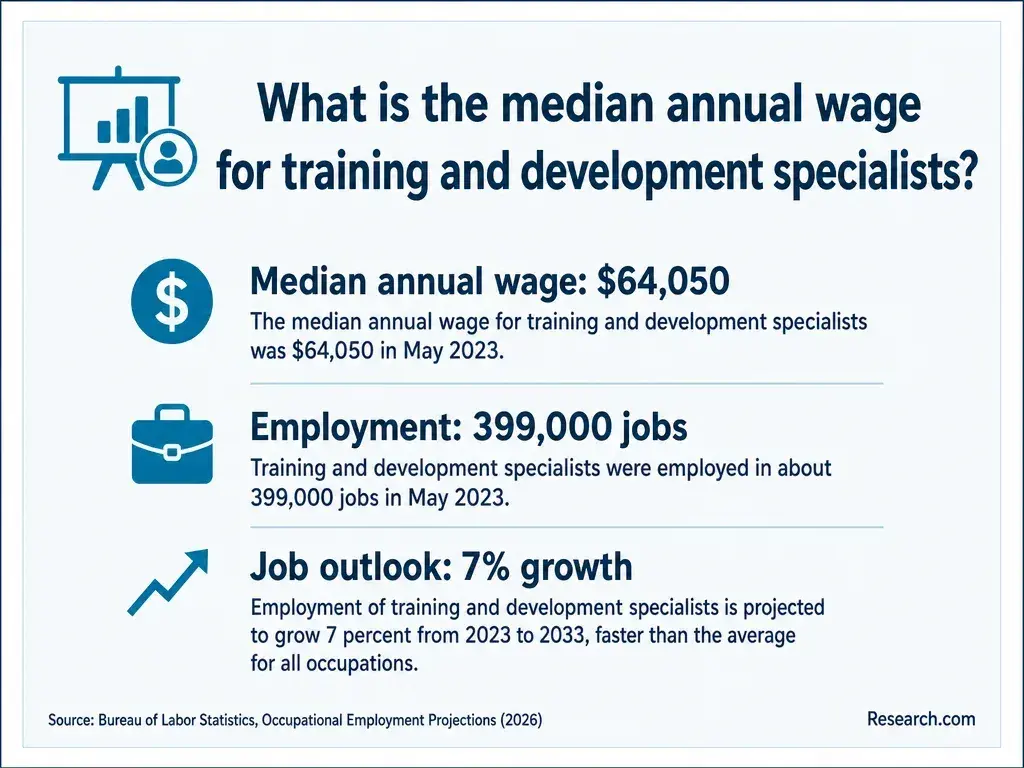
There is no single salary or growth rate for graduates of a BS in Business Administration. Pay depends on the occupation, employer, location, and the responsibilities an employee already holds. For one relevant occupation, the U.S. Bureau of Labor Statistics reports a May 2025 median annual wage of $75,940 for human resources specialists and projects 6% employment growth from 2025 to 2035. Those are occupation-wide figures, not starting pay or a predicted raise for a worker who finishes a degree.
For an internal move, the employer's posted pay range, classification rules, and promotion process are more useful than a national median. Compare the likely change in compensation with your remaining education costs, time commitment, and the possibility that a qualifying degree makes you eligible to compete rather than certain to advance. When reviewing budget-friendly colleges for business administration online, do not let low advertised tuition stand in for a complete cost or promotion estimate.
Which certifications or professional standards complement a business degree?
A certification is worth considering when the target posting names a particular function or credential. Project management, HR, and supply chain organizations offer separate professional credentials, but their eligibility rules may include experience, exams, continuing education, or specific coursework. A business administration degree does not automatically award any of them. For accounting or financial services roles, check applicable licensing rules separately rather than assuming a general business degree meets them.
Ask whether your employer wants a bachelor's degree, a credential, or both. If the degree is the binding promotion requirement, prioritize a recognized program you can finish; add a certification only when it addresses a documented skill gap. If the employer accepts any bachelor's degree and you already have one, targeted training may be the more direct next step.
Financing matters if you consider both paths. Compare out-of-pocket education costs and aid eligibility before committing; a guide to business administration tuition and FAFSA eligibility can help you identify questions for each school's financial-aid office. Eligibility for federal aid, employer reimbursement, or certification funding must be confirmed separately.
Other Things You Should Know About Business Administration
Yes, if the application permits it, list the school, degree, and accurate expected completion date as in progress. Do not describe it as awarded. Ask HR whether candidates may apply before conferral.
Request the revised policy in writing and ask whether existing employees or applicants receive a transition period. Keep copies of earlier guidance, but do not assume it guarantees eligibility under a later policy.
Only with the permissions required by your employer and school. If approval is unavailable, use public or appropriately fictionalized information and avoid identifying employees, customers, or proprietary results.
It might. Review your benefit agreement for reimbursement timing and repayment conditions before resigning. Ask the benefits office for clarification about charges already incurred and courses still underway.
- DAPIP | Homepage - Office of Postsecondary Education (OPE) https://ope.ed.gov/dapip/
- Chapter 5 - Advanced Degree or Exceptional Ability https://www.uscis.gov/policy-manual/volume-6-part-f-chapter-5
- Measuring Student Success In IPEDS: Graduation Rates (GR), Graduation Rates 200% (GR200), And Outcome Measures (OM) https://nces.ed.gov/ipeds/use-the-data/measuring-student-success-in-ipeds
- Student Outcomes | THECB Data https://databridge.highered.texas.gov/outcomes/
- How Many Hours a Week Does Online College Really Take? | Grace Christian University https://gracechristian.edu/blog/how-many-hours-a-week-does-online-college-really-take/
- 1-N.O.W. Online Programs | Houston City College https://www.hccs.edu/programs--courses/flexible-learning-online-hybrid--weekend/1-now-online-programs/
- Properly Write Your Degree | marquette.edu https://www.marquette.edu/career-center/resources/properly-write-degree.php
- Is an Online Business Degree Worth It? | American College of Education https://ace.edu/blog/what-employers-think-about-online-business-degrees/
- Transferring Credit | Undergraduate Admissions | University of Houston https://www.uh.edu/undergraduate-admissions/apply/transfer/transferring-credit/
- Online Bachelor's Degree in Business Administration | Purdue Global https://www.purdueglobal.edu/degree-programs/business/bachelor-business-administration/


